
Germany
Germany Drink Driving Limits: The 0.5, 1.1 and 0.0 Promille Rules
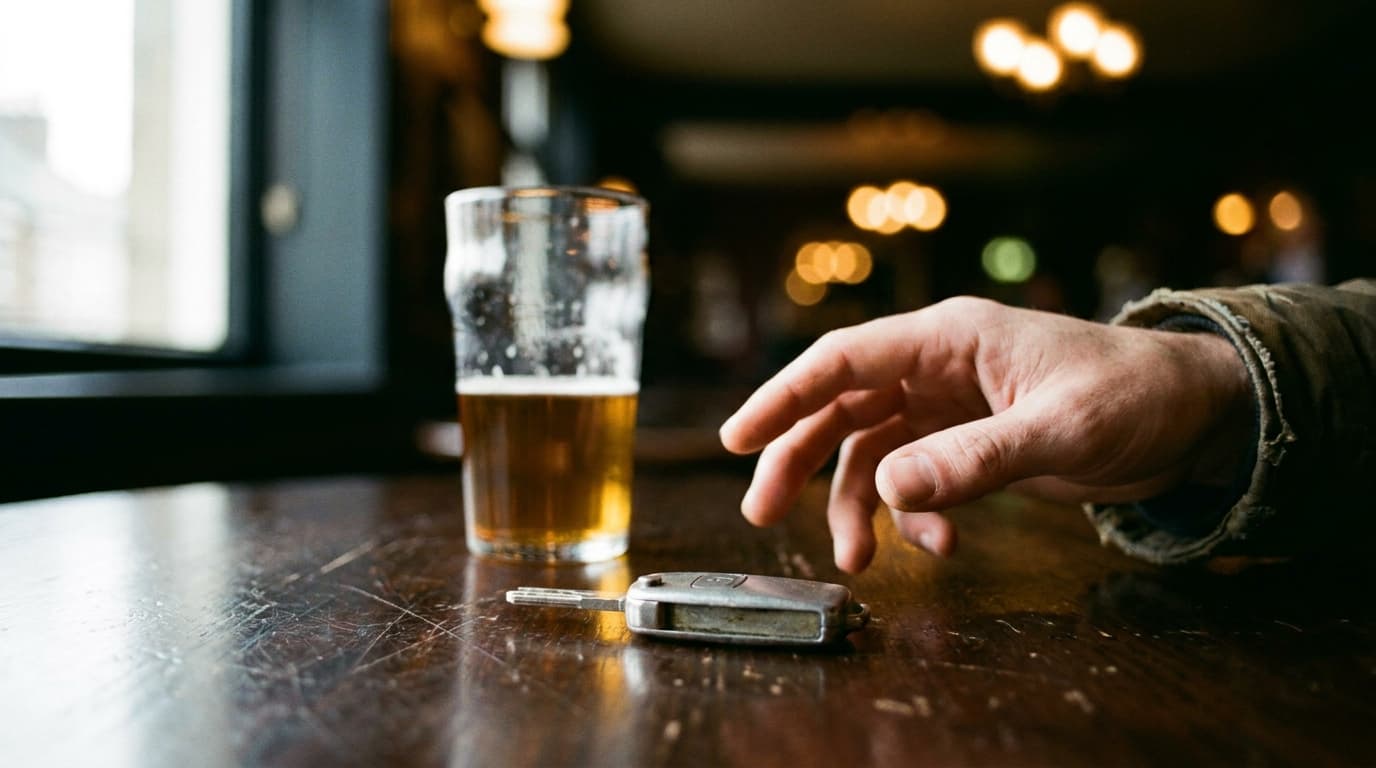
Germany does not have one blood alcohol limit for driving. It has three separate thresholds that trigger three different kinds of legal consequence, and only two of them are actually written into a statute as a number.
This page works through where each figure comes from, what happens at each level, and a part of the picture most search results get wrong: the criminal drink driving statute contains no promille number at all, and the widely quoted 1.1 promille line was never written by the Bundestag. It was set by the Bundesgerichtshof (BGH), Germany's federal court for criminal matters. For the wider context of how German statutes and courts fit together, see German law explained.
Information last verified on 19 July 2026. This page provides general legal information and does not constitute legal advice in an individual case.
Three numbers, but only two are in the statute books
A lot of German driving content lines up 0.5, 1.1 and 0.0 promille as though a single lawmaker drew all three lines side by side. That is not what happened.
Only two of those figures are literal statutory text: 0.5 promille in § 24a Abs. 1 StVG, and 0.0 in the sense that § 24c StVG bans any measurable alcohol at all for new and young drivers. The 1.1 promille figure that everyone associates with drink driving in Germany does not appear in any statute. It is judge-made law, and the difference matters for how each case is actually handled.
§ 24a StVG: the 0.5 promille administrative limit
§ 24a Abs. 1 StVG makes it an Ordnungswidrigkeit to drive a motor vehicle with 0.25 mg/l or more alcohol in the breath, or 0.5 promille or more in the blood. It applies whether the driver acted intentionally or merely negligently, so not realizing how much had been consumed is not a defense.
This is a regulatory offense, not a criminal one, and it does not itself require any sign that the driver was actually impaired. Crossing the number is enough. The same structure covers drugs: § 24a Abs. 1a StVG sets 3.5 ng/ml of THC in blood serum as the equivalent line, and Abs. 2 covers a list of other intoxicating substances.
The standard fines escalate sharply if the driver already has an earlier entry in the Fahreignungsregister (the federal driver record) for § 24a StVG, § 316 StGB or § 315c Abs. 1 Nr. 1 Buchstabe a StGB. A prior criminal drink driving conviction counts toward that escalation too, not just a prior administrative one.
| Violation | First offense | One prior entry | Multiple prior entries |
|---|---|---|---|
| 0.5 promille / 0.25 mg/l breath (§ 24a Abs. 1) | EUR 500, 1 month ban, 2 points | EUR 1,000, 3 month ban, 2 points | EUR 1,500, 3 month ban, 2 points |
| 3.5 ng/ml THC (§ 24a Abs. 1a) | EUR 500, 1 month ban, 2 points | EUR 1,000, 3 month ban, 2 points | EUR 1,500, 3 month ban, 2 points |
| Alcohol combined with 3.5 ng/ml THC (§ 24a Abs. 2a) | EUR 1,000, 1 month ban, 2 points | EUR 1,500, 3 month ban, 2 points | EUR 2,000, 3 month ban, 2 points |
These figures come from the Anlage to the Bußgeldkatalog-Verordnung (BKatV) and represent the standard rate, not a hard ceiling. § 24a Abs. 3 StVG allows a Geldbuße of up to EUR 3,000 for Abs. 1, 1a or 2, and up to EUR 5,000 for the combined alcohol and THC case in Abs. 2a, in an aggravated individual case. See the fine catalogue for how these figures compare with the wider BKatV, and points in Flensburg for how the 2 point entries above actually accumulate toward losing a licence under the separate § 4 StVG points system.
§ 316 StGB: the criminal offense that names no number
§ 316 Abs. 1 StGB is Germany's core criminal drink driving offense, and its wording is worth reading closely, because it is not built around a promille figure at all. It punishes someone who drives a vehicle in traffic while, as a result of alcohol or another intoxicant, they are not in a position to drive the vehicle safely, provided the act is not already covered by § 315a or § 315c StGB.
Abs. 2 makes clear that a negligent version of the same conduct is punished too, not only an intentional one. The maximum penalty is imprisonment of up to one year or a Geldstrafe (a criminal fine).
A German criminal fine is not a flat amount. Under § 40 StGB it is set in Tagessätze, day fine units, of which a court can impose between five and 360. Each unit is priced individually based on the defendant's net daily income, from a minimum of EUR 1 up to EUR 30,000. To illustrate the arithmetic only: a defendant with a net income of roughly EUR 2,400 a month has a daily rate close to EUR 80, so 30 day fine units for that person would total around EUR 2,400. The number of units actually set in any case depends on the seriousness of the conduct, and is decided separately from the daily rate.
Because § 316 StGB itself contains no number, courts and prosecutors need a separate way to decide when a driver was actually not in a position to drive safely. That separate standard is where 1.1 promille comes from.
Where the 1.1 promille figure actually comes from
The Bundesgerichtshof addressed this question directly in a decision of 28 June 1990, file number 4 StR 297/90, reported at BGHSt 37, 89. The court held that once blood alcohol reaches 1.1 promille, a driver of a motor vehicle is conclusively presumed unable to drive safely, a concept known as absolute Fahruntüchtigkeit.
Conclusively presumed is the key phrase. Above 1.1 promille, the prosecution does not have to show that the driver was actually swerving, slow to react or otherwise visibly impaired. The number alone satisfies the safe driving element of § 316 StGB, and a court cannot accept evidence that a particular driver was somehow unaffected at that level.
That threshold has never been written into § 316 StGB itself. It exists only because the Bundesgerichtshof set it, based on the scientific evidence available to it, and later case law has continued to apply it. Anything describing 1.1 promille as a line drawn in the StGB is describing it incorrectly.
The gap below 1.1: relative Fahruntüchtigkeit
The 1.1 promille line does not mean nothing happens below it. Case law recognizes a second, older concept called relative Fahruntüchtigkeit, established well before the 1990 absolute threshold decision and still applied alongside it.
Under this doctrine, a driver below 1.1 promille, roughly from around 0.3 promille upward, can still be convicted under § 316 StGB if there is additional evidence that the driver was actually impaired: an accident, weaving between lanes, unusually slow reactions, or a failed field sobriety indicator observed by police. The lower figure is not a bright statutory line the way 0.5 or 1.1 are, so a specific case citation for the 0.3 mark is not given here, only that it is an established feature of German drink driving case law.
This means the space between roughly 0.3 and 1.1 promille is not automatically safe from criminal exposure just because it sits below the administrative 0.5 line or the absolute 1.1 line. A driver at 0.6 promille who causes an accident is not simply looking at the § 24a StVG fine table above. The accident itself can be the additional fact that turns the same reading into a § 316 StGB prosecution.
§ 315c StGB: when it becomes endangering road traffic
§ 315c StGB, Gefährdung des Straßenverkehrs, is a more serious offense than § 316 StGB and requires more to prove. Impaired driving under § 315c Abs. 1 Nr. 1 Buchstabe a StGB is judged by the same safe driving standard as § 316 StGB, so the same 1.1 promille absolute threshold and the same relative Fahruntüchtigkeit doctrine both apply here too.
What separates § 315c StGB from § 316 StGB is a concrete result: the driving has to actually endanger the life or body of another person, or property of significant value. § 316 StGB does not require that anyone actually be put at risk. § 315c StGB does, which is also why it is one of the offenses that can turn an impaired driving stop into a case involving another road user's injuries or a damaged vehicle.
The penalty reflects that added harm. § 315c Abs. 1 StGB carries up to five years imprisonment or a fine, and an attempt is separately punishable under Abs. 2. Where the danger was brought about negligently, or the underlying conduct itself was negligent, Abs. 3 StGB reduces the range to up to two years imprisonment or a fine.
Losing the licence: Fahrverbot versus Entziehung
The administrative and criminal tracks do not just carry different fines. They do fundamentally different things to a driving licence.
On the administrative track, an offense under § 24a StVG carries a Fahrverbot, a temporary driving ban of one to three months on the ladder above. The licence itself stays valid the whole time. It is handed in and returned once the ban ends, with no reapplication needed. See driving ban for how the Fahrverbot works more generally, including outside drink driving cases.
A conviction under § 316 or § 315c StGB is different in kind. § 69 Abs. 1 StGB requires the court to revoke the licence outright, called Entziehung, if the offense shows the driver is unfit to drive. § 69 Abs. 2 StGB lists specific offenses, including § 315c and § 316 StGB, for which unfitness is presumed from the conviction itself, which is why an ordinary drink driving conviction almost always costs the licence outright rather than producing a short suspension.
Once revoked, the licence is gone, not paused. § 69a Abs. 1 StGB requires the court to set a Sperrfrist, a waiting period of six months to five years before a new licence can even be applied for. § 69a Abs. 3 StGB raises the minimum to one year if an earlier Sperrfrist was imposed against the same person within the preceding three years, and the ban can be made permanent where the court sees an ongoing danger that no fixed period would address.
| Track | Effect on the licence | Range |
|---|---|---|
| § 24a StVG (Ordnungswidrigkeit) | Fahrverbot: temporary ban, licence stays valid | 1 to 3 months |
| § 316 or § 315c StGB (Straftat) | Entziehung: licence extinguished under § 69 StGB | New licence must be separately applied for |
| § 69a StGB Sperrfrist | Waiting period before a new licence can be applied for | 6 months to 5 years, minimum 1 year on repetition within 3 years, or permanent in serious cases |
The MPU trigger at 1.6 promille
A separate question from whether the licence is revoked is whether getting a new one requires passing an MPU, the medizinisch-psychologische Untersuchung sometimes called the Idiotentest. That question is governed by § 13 FeV, not by the StGB.
§ 13 Satz 1 Nr. 2 Buchstabe c FeV requires the driving licence authority to order an MPU where a vehicle was driven at 1.6 promille blood alcohol or more, or 0.8 mg/l breath alcohol or more. This fires on a single occasion. It does not require a pattern of prior violations, and it applies independent of whatever criminal or administrative penalty the same incident also produces.
The same provision separately requires an MPU where there have been repeated alcohol related traffic violations (Buchstabe b, excluding violations charged only under § 24c StVG), where a medical report has already found signs of alcohol abuse (Buchstabe a), or where the licence was previously revoked for one of those same underlying reasons (Buchstabe d). A single conviction below 1.6 promille, without any of those other indicators, does not automatically fall into one of these categories, though the licensing authority still separately assesses fitness to drive case by case before reissuing anything.
See MPU assessment for how the process itself works, what it tests, and how long preparation typically takes.
Cannabis has its own limit, not a fraction of this one
Alcohol and THC are related in this cluster of law but are not measured on the same scale. Since 22 August 2024, § 24a Abs. 1a StVG has set its own statutory THC limit of 3.5 ng/ml in blood serum. That date is worth getting right, because it is routinely confused with a different one. The Konsumcannabisgesetz, which legalised limited adult possession and cultivation, took effect on 1 April 2024. The driving limit came separately, through the Sechstes Gesetz zur Änderung des Straßenverkehrsgesetzes, published in the Bundesgesetzblatt on 21 August 2024 and in force the following day. Sources that date the driving limit to April 2024 have merged the two laws.
For anyone in the Probezeit or under 21, § 24c StVG names Tetrahydrocannabinol expressly, alongside alcohol, so the novice threshold for THC is zero, not a scaled down version of the 3.5 ng/ml adult figure. See cannabis and driving for the full THC framework, including how it interacts with alcohol under § 24a Abs. 2a StVG.
Cycling under the influence
The 0.5 promille limit in § 24a StVG applies only to a Kraftfahrzeug, a motor vehicle. Its text does not reach a bicycle, and neither does § 24c StVG's zero tolerance rule or the BKatV fine ladder built on both provisions. There is, in other words, no administrative drink cycling offense in Germany in the way there is for cars.
That does not mean cycling under the influence is unregulated. § 316 StGB and § 315c StGB both refer to a Fahrzeug, a vehicle, in general terms, not a Kraftfahrzeug specifically, and case law treats a bicycle as covered. The catch is that the absolute Fahruntüchtigkeit threshold for a cyclist sits at a different number than for a driver: 1.6 promille rather than 1.1, based on a 1986 Bundesgerichtshof decision that set the figure from a base value of 1.5 promille plus a 0.1 safety margin, reflecting that the physical and reaction demands of riding a bicycle differ from driving a car.
Below 1.6 promille, the same relative Fahruntüchtigkeit doctrine that applies to drivers can still apply to a cyclist given other signs of impairment, such as an accident or an inability to ride in a straight line. A cyclist convicted under § 316 or § 315c StGB faces the same criminal fine or imprisonment exposure as a driver would.
One consequence surprises people: § 69 StGB speaks of revoking the Fahrerlaubnis, the licence to drive a motor vehicle, and it applies to that licence regardless of what kind of vehicle the underlying offense involved. A serious enough drink cycling conviction can cost, or delay, a car or motorcycle driving licence even though no car was involved in the offense itself.
What it costs beyond the fine: insurance
A drink driving conviction reaches the driver's insurance too, on two separate tracks. The Kfz-Haftpflichtversicherung, the compulsory third party liability cover, still pays the injured third party in full. That is the entire point of compulsory insurance, and it applies regardless of how the accident happened.
What changes is whether the insurer can then claim some of that money back from the driver personally, a process called Regress. § 5 Abs. 3 KfzPflVV caps that recourse at EUR 5,000 per person where the breach, such as driving under the influence, happened before the insured event occurred. § 6 KfzPflVV separately caps recourse for a breach committed after the event, for example refusing a blood test or fleeing the scene, generally at EUR 2,500, rising to EUR 5,000 only for a particularly serious intentional breach.
The driver's own Kaskoversicherung, the comprehensive cover for their own vehicle, works differently and less predictably. Rather than a fixed cap, the insurer can reduce the payout on a sliding scale tied to how seriously at fault the driver was, and can refuse to pay anything at all where the breach was intentional rather than merely careless. A drink driving conviction is exactly the kind of fact an insurer will point to when reducing or denying a Kasko claim on the driver's own vehicle.
Why this page will not publish a drinks to promille table
Many sites publish a table suggesting that a given number of drinks, for a given body weight, produces a given promille level. This page will not do that, and the reason is not caution for its own sake.
Alcohol elimination rates vary meaningfully between individuals based on body composition, sex, food intake, medication, tolerance and general metabolism, and even the same person's rate can differ from one occasion to the next. Blood alcohol also keeps rising for a period after drinking stops, so a reading taken shortly after the last drink can be materially lower than the true peak that follows. A table built on population averages cannot account for any of that for one specific person on one specific night.
The only figure that has any legal weight is a breath or blood reading actually taken by police at the time. Anything estimated in advance is, at best, a rough guide to how a body might behave on average, and cannot be relied on to keep a specific evening's driving under a specific legal line.
Worked example: three drivers, three outcomes
A driver stopped with a reading of 0.6 promille, driving normally, with no accident and no signs of impairment, sits in the § 24a StVG administrative track. On a first offense that is a EUR 500 fine, a one month Fahrverbot, and two points, with the licence itself untouched and returned once the month ends.
A driver stopped at 1.3 promille is automatically over the 1.1 promille absolute Fahruntüchtigkeit line, regardless of how well they otherwise appeared to be driving. That is a § 316 StGB criminal conviction, not an Ordnungswidrigkeit, which brings § 69 StGB Entziehung and a § 69a StGB Sperrfrist. Exactly how far into the six month to five year Sperrfrist range a court goes depends on the individual case and any aggravating history, but the outcome is a lost licence and a genuine criminal record, not a fine and a short ban.
A driver stopped at 1.7 promille faces the same § 316 StGB exposure as the 1.3 promille driver, plus one more consequence: crossing 1.6 promille separately triggers the mandatory MPU under § 13 FeV. Getting a new licence after the Sperrfrist ends is not simply a matter of waiting it out. It requires passing the medical psychological assessment first, which is a materially longer and more demanding process than the 1.3 promille case above.
Frequently Asked Questions
What is the legal blood alcohol limit for driving in Germany?
For a full licence holder over 21, the administrative limit is 0.5 promille or 0.25 mg/l of breath alcohol under § 24a StVG. A separate criminal offense can apply well before or after that figure depending on the circumstances, so 0.5 promille is not the only number that matters.
Is 1.1 promille written into German law?
No. § 316 StGB, the criminal drink driving offense, contains no promille figure at all. The 1.1 promille absolute Fahruntüchtigkeit threshold was set by the Bundesgerichtshof in a 1990 decision, not by the legislature, and it is applied by courts rather than stated in any statute.
Can I be charged with a crime below 1.1 promille?
Yes. Under the relative Fahruntüchtigkeit doctrine, a driver below 1.1 promille, roughly from around 0.3 promille upward, can still be prosecuted under § 316 StGB if there is other evidence of impairment, such as an accident, erratic driving, or a failed field sobriety indicator.
What happens on a first offense between 0.5 and just under 1.1 promille with no accident?
This is usually treated as an Ordnungswidrigkeit under § 24a StVG rather than a crime: a EUR 500 fine, a one month driving ban and two points on a first offense, escalating sharply on any repeat entry in the Fahreignungsregister.
Is there really zero tolerance for new drivers in Germany?
Yes. Under § 24c StVG, anyone in their first two years after passing their test, the Probezeit defined in § 2a StVG, or under 21, faces an alcohol and THC ban with no numeric buffer at all, enforced as an Ordnungswidrigkeit.
Does a drink driving conviction cost me my licence permanently?
A conviction under § 316 or § 315c StGB usually leads to Entziehung, the licence being extinguished outright under § 69 StGB, followed by a Sperrfrist of six months to five years under § 69a StGB before a new one can even be applied for. A permanent ban is possible but reserved for cases where a court sees an ongoing danger that no fixed period addresses.
At what level do I automatically need an MPU?
Reaching 1.6 promille while driving triggers a mandatory medical psychological assessment under § 13 FeV on that single occasion, separate from whatever criminal or administrative penalty the same incident also produces.
Is the drink driving limit different for cycling?
Yes. The 0.5 promille administrative limit under § 24a StVG applies only to motor vehicles, so it does not reach a bicycle at all. A cyclist instead faces the criminal thresholds directly, with absolute Fahruntüchtigkeit set at 1.6 promille rather than 1.1, under the same case law approach used for motor vehicle drivers.
Sources and References
- § 24a StVG, 0,5 Promille-Grenze, Tetrahydrocannabinol-Grenzwert(gesetze-im-internet.de).gov
- § 24c StVG, Alkohol- und Cannabisverbot für Fahranfänger und Fahranfängerinnen(gesetze-im-internet.de).gov
- § 2a StVG, Fahrerlaubnis auf Probe(gesetze-im-internet.de).gov
- Anlage zur Bußgeldkatalog-Verordnung (BKatV), Regelsätze für §§ 24a und 24c StVG(gesetze-im-internet.de).gov
- Anlage 13 FeV, Punktsystem im Fahreignungsregister(gesetze-im-internet.de).gov
- § 316 StGB, Trunkenheit im Verkehr(gesetze-im-internet.de).gov
- § 315c StGB, Gefährdung des Straßenverkehrs(gesetze-im-internet.de).gov
- § 40 StGB, Verhängung der Geldstrafe in Tagessätzen(gesetze-im-internet.de).gov
- § 69 StGB, Entziehung der Fahrerlaubnis(gesetze-im-internet.de).gov
- § 69a StGB, Sperre für die Erteilung einer Fahrerlaubnis(gesetze-im-internet.de).gov
- § 13 FeV, Klärung von Eignungszweifeln bei Alkoholproblematik(gesetze-im-internet.de).gov
- § 14 FeV, Klärung von Eignungszweifeln im Hinblick auf Betäubungsmittel und Arzneimittel(gesetze-im-internet.de).gov
- § 5 KfzPflVV, Obliegenheiten vor Eintritt des Versicherungsfalls und Regresshöchstbetrag(gesetze-im-internet.de).gov
- § 6 KfzPflVV, Obliegenheiten nach Eintritt des Versicherungsfalls(gesetze-im-internet.de).gov
- Sechstes Gesetz zur Änderung des Straßenverkehrsgesetzes, BGBl. 2024 I Nr. 266(recht.bund.de).gov