
Germany
Speed Cameras in Germany (Blitzer): What Happens After You Are Flashed
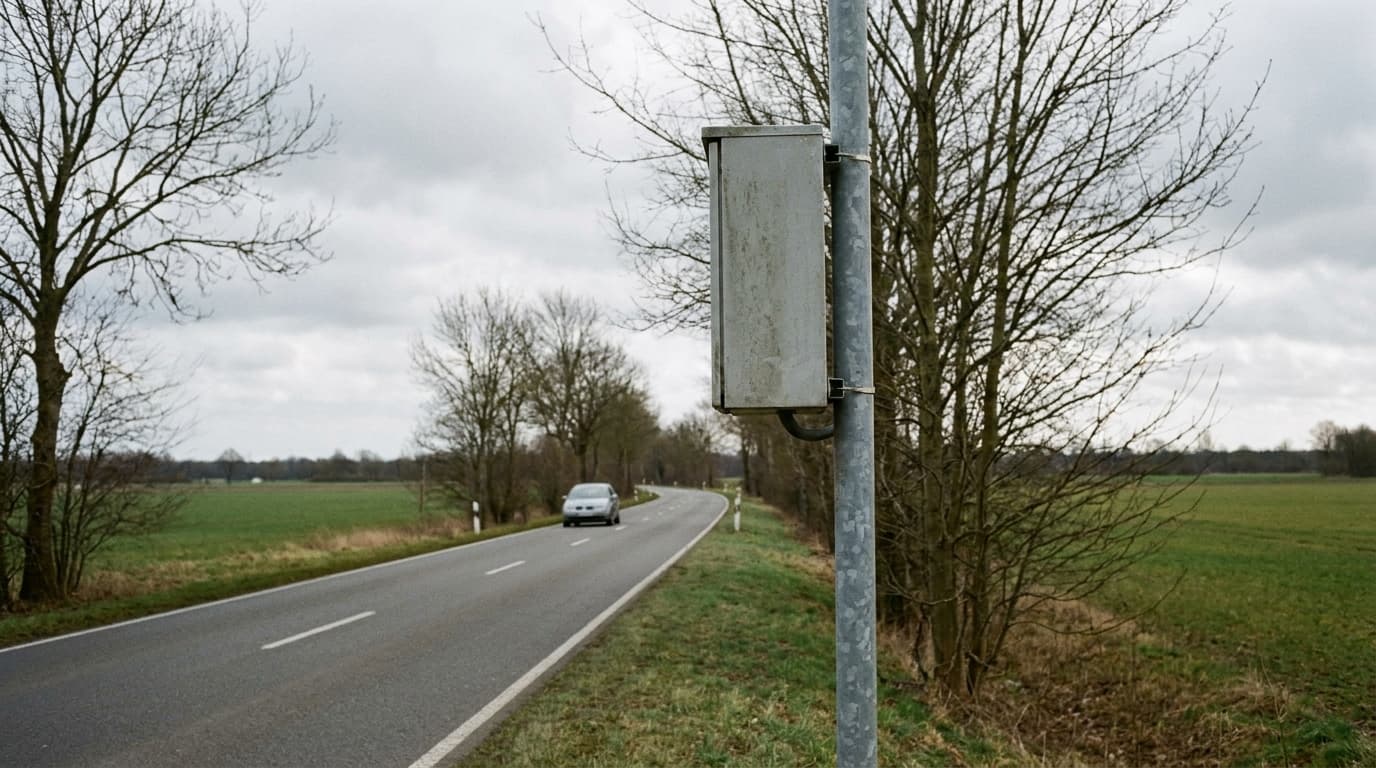
Being flashed by a Blitzer usually means a letter arrives weeks later asking who was driving. Most people searching for what that letter means have already been photographed and want to know what happens next, not a general overview of enforcement policy.
This page walks through the actual sequence: the Anhörungsbogen, the Bußgeldbescheid, the deduction that applies to the recorded speed, the two week deadline to object, and the real consequence of simply staying silent, which is not what most people assume it is.
Information last verified on 19 July 2026. This page provides general legal information and does not constitute legal advice in an individual case.
What arrives in the post, and in what order
A fixed or mobile speed camera does not issue a fine on the spot. The device photographs the vehicle and, on many mobile units, the driver, and the record goes to the local Bußgeldstelle for processing.
The keeper on file with the vehicle registration authority is then sent an Anhörungsbogen (hearing notice) or, less often, a Zeugenfragebogen (witness questionnaire) if the case already points to someone other than the keeper. This document is not the fine itself. It asks the recipient to confirm whether they were driving and, if not, who was.
If the driver is identified, or the keeper is treated as the driver, a Bußgeldbescheid follows: the formal notice stating the fine, any points, and any driving ban. That document, not the earlier Anhörungsbogen, is what starts the two week clock described below.
A photograph that clearly shows someone other than the registered keeper changes the process. The authority will pursue the person in the photo directly where identification succeeds, and the keeper's own exposure narrows to the questions of cooperation covered further down this page, not to paying a fine for someone else's driving.
The Toleranzabzug: real, but not statutory
Ask most drivers how a German speed reading is corrected and they will say 3 km/h is deducted up to 100 km/h, and 3 percent above that. The number is right. Where it comes from is usually described wrong.
Neither the StVO nor the Bußgeldkatalog-Verordnung contains this figure. It comes from a long line of Oberlandesgericht decisions applying the measurement error tolerances that the Physikalisch-Technische Bundesanstalt (PTB) builds into its approval of each device type. Courts adopted the PTB's own margin as the safety deduction, and that practice is now settled enough to be applied routinely, but it remains case law layered on top of a technical standard, not a rule a statute states in numbers.
That distinction matters for one practical reason: the deduction only applies to a measurement taken by an approved, standardised device operated within its approval conditions. A driver whose speed was established a different way is not automatically entitled to assume the same 3 km/h or 3 percent figure applies to them.
Worked example. A fixed camera clocks a car at 62 km/h in a 50 km/h zone inside a town. Applying the flat 3 km/h deduction gives a corrected speed of 59 km/h, an overage of 9 km/h. Under the current Bußgeldkatalog that falls in the lowest innerorts tier, a fine of 30 euros with no points and no ban, The raw reading of 62 km/h would have been an overage of 12 km/h, which sits in the 11 to 15 km/h band at 50 euros. The deduction moves the case down one band rather than several.
A second example shows the percentage version. A device on a road outside a built up area, where the limit is 100 km/h, records 119 km/h. Above 100 km/h the deduction is 3 percent, so 119 km/h becomes roughly 115 km/h after rounding down, an overage of 15 km/h rather than 19. That lands in the 11 to 15 km/h außerorts tier at 40 euros. The unadjusted overage of 19 km/h would have sat in the 16 to 20 km/h tier at 60 euros, so again the deduction is worth one band, not a dramatic reclassification.
A larger, different deduction for non standardised measurement
Not every speed comes from a camera. Where an officer follows a vehicle and estimates its speed from their own patrol car's speedometer (Nachfahren), rather than from a laser or radar device with its own independent approval, courts require a much larger safety margin, generally around 20 percent, to account for following distance and speedometer inaccuracy that the fixed device tolerance was never designed to cover.
This is a genuinely different regime from the one above, and a reader who was followed rather than flashed by a stationary or handheld device is often looking at a different outcome once the correction is applied.
Worked example. A patrol car follows a vehicle and its officer reads an indicated 130 km/h on a stretch limited to 100 km/h. Applying a 20 percent deduction for the non standardised method brings the usable figure to roughly 104 km/h, an overage of only 4 km/h, likely resulting in the lowest fine tier or, depending on the exact facts, no fine at all once the margin is properly applied. The same raw number from a calibrated fixed camera, corrected by only 3 percent, would have produced a materially higher overage and a higher fine.
The practical lesson is not that a Nachfahren reading is worthless. It is that the correction owed to it is larger, and a Bußgeldbescheid that applies the ordinary 3 km/h or 3 percent figure to a following car measurement has applied the wrong deduction.
The Anhörungsbogen: what you have to say, and what you do not
The Anhörungsbogen exists under § 55 OWiG, which applies § 163a StPO with one adjustment: it is enough that the person is given an opportunity to comment on the accusation. Nothing in that provision forces a response about who was driving.
Two different positions follow from that, and confusing them is the most common mistake.
If the recipient is themselves the suspected driver, they are the Betroffener, and the right against self incrimination applies in full. German law does not require anyone to accuse themselves, a principle the Bundesverfassungsgericht has repeatedly confirmed applies in Ordnungswidrigkeiten proceedings through § 46 OWiG's incorporation of ordinary criminal procedure rights. A keeper in this position can decline to say anything at all about the driving, including declining to confirm or deny it.
If the recipient is the registered keeper but was not driving, a different rule applies to their own details: giving a false name, address, or other personal particular to the authority is itself an offense under § 111 OWiG, so the keeper must answer truthfully about themselves if asked. What they are not required to do, absent a specific separate legal basis that applies to some commercial fleet contexts, is identify a third party as the driver. Where the third party is a close relative, a keeper questioned as a witness rather than as the accused can also rely on § 52 StPO to refuse to testify about that relative at all.
Staying silent is lawful. It is not free of consequences, and the next section covers the one that actually bites.
The Fahrtenbuchauflage: the real cost of an unresolved case
The consequence most people are never told about is not a fine for not answering. It is § 31a StVZO. Where a traffic violation cannot be pinned on an individual driver because identification failed, the licensing authority can order the vehicle's keeper to keep a Fahrtenbuch, a logbook, for a period it sets.
The keeper then has to record, before every trip, the driver's name and address, the vehicle's plate, and the date and time the trip started, then complete the entry with the date, time, and a signature immediately after the trip ends. The book has to be produced to the authority on request and kept for six months after the ordered period ends.
This order does not require the keeper to have done anything wrong. It follows from the simple fact that a violation happened and nobody could be identified as responsible for it, regardless of whether the keeper's own silence was entirely lawful. A keeper who repeatedly declines to identify drivers of a shared or family vehicle is a realistic candidate for this order, and it is considerably more burdensome, over months, than most single fines.
Standardised measurement and your right to see the file
Courts do not re examine the technical workings of every radar or laser device in every case. Since a 1993 Bundesgerichtshof decision on what counts as a standardised measurement procedure, a device that is approved and used within its approved conditions is treated as reliable without the court redoing the underlying physics, unless the defense raises a concrete, evidence backed doubt about that specific measurement rather than a general objection to the method.
That rule of thumb has a real limit, confirmed by the Bundesverfassungsgericht in a 2020 decision: a person facing a Bußgeldbescheid has a fair trial right to inspect not just the case file but relevant measurement material the authority holds outside it, including the device's raw data, so that a defense can actually look for the kind of concrete error the standardised procedure doctrine asks for. The court was careful to bound that right to material that is factually and time connected to the alleged violation and actually relevant to a defense, not an open ended request for everything the device has ever recorded.
In practice this means Akteneinsicht is worth requesting through counsel where a driver intends to contest a reading, but it is a tool for finding a specific, documented problem with that measurement, not a general audit of the device or a way to relitigate whether standardised measurement should be trusted at all.
Verjährung: how long the case can run
§ 26 Abs. 3 StVG sets the ordinary limitation period (Verfolgungsverjährung) for a § 24 Abs. 1 StVG traffic offense, which covers most speeding cases, at six months from the date of the offense. If nothing happens within that window, the case is time barred and no Bußgeldbescheid can validly follow.
That clock does not run untouched. § 33 OWiG lists specific steps that interrupt it and restart it from zero, including the first formal questioning of the person concerned and, critically, the issuing of the Bußgeldbescheid itself. So a keeper who receives an Anhörungsbogen promptly, followed later by a Bußgeldbescheid, is looking at a case where each of those steps has already reset the clock, not a single unbroken six month window from the offense to a final decision.
There is an outer limit even so. § 33 Abs. 3 OWiG caps the total run, however many times it is interrupted, at roughly double the base period measured from the date of the offense, with an absolute floor of two years. In practice, for an ordinary speeding matter, this means the authority cannot let the case drift indefinitely simply by taking one procedural step every few months.
Radar apps and warning devices: what is actually banned
§ 23 Abs. 1c StVO prohibits a driver from operating or carrying, ready for use, a technical device designed to indicate or interfere with traffic monitoring measures, naming radar warning and laser jamming devices specifically. Where a device serves other purposes too, only the monitoring related function is banned, not the whole device.
The provision is written around the person who is driving the vehicle, not around anyone else in it. A phone app that warns of camera locations, running on the driver's own device and consulted or heard by the driver while driving, falls squarely inside the ban. A passenger using their own phone for their own information, without the driver operating or relying on it, sits in a genuinely different position, though a driver who acts on a warning a passenger relays to them while driving has not avoided the substance of what the rule targets.
This is one of the more commonly misunderstood rules on this topic, largely because commercial map and navigation apps often market a speed camera alert feature as a separate, optional layer, without making clear that switching it on while driving the vehicle yourself is the conduct the statute addresses directly.
New drivers: the Probezeit layer
A driver in their first two years of holding a license, the Probezeit under § 2a StVG, faces consequences layered on top of the ordinary fine, points, and any ban a speeding offense already carries. A serious violation, or two less serious ones, during this period triggers a mandatory remedial course and extends the Probezeit itself, independent of whatever the underlying fine amounted to.
A new driver who is flashed should expect the Anhörungsbogen and Bußgeldbescheid process described above to run exactly the same way as for any other driver. The Probezeit consequence is a separate track that follows from the same violation once it is established, not an alternative process.
Is it worth challenging a reading
There is no honest answer that applies to every case, and any page that promises one is overselling. A reading from a properly approved, calibrated device operated correctly, with the ordinary deduction already applied, is difficult to dislodge on the strength of a general objection, because the standardised procedure doctrine exists precisely to make that kind of general challenge unproductive.
What tends to be worth pursuing is a concrete, documentable problem: a Nachfahren measurement corrected by the wrong, smaller deduction, a device used outside its approved conditions, a photograph that does not actually show the keeper or a clearly identifiable driver, or a Bußgeldbescheid issued after the Verjährung window described above had already closed. None of that is a guarantee of a particular outcome in any individual case, and an Einspruch filed after the two week deadline in § 67 OWiG is generally too late regardless of the underlying merits.
See the fine catalogue for how a given overage translates into euros, points, and any ban, and challenging a fine for the Einspruch process itself in more depth. Where points or a driving ban are already in play, points in Flensburg and driving bans cover those consequences directly, and the wider German law explained hub links the rest of this cluster.
Frequently Asked Questions
Is the 3 km/h speed camera tolerance a law in Germany?
No. It is settled Oberlandesgericht case law based on the Physikalisch-Technische Bundesanstalt's device approval error limits, not a figure written into the StVO or the Bußgeldkatalog-Verordnung. Courts apply it consistently, but it is a judicial practice layered on a technical standard, not a statute.
How long do I have to challenge a speeding ticket in Germany?
Two weeks from service of the Bußgeldbescheid, under § 67 OWiG. The Einspruch has to reach the authority that issued the notice within that window, in writing or on the record, or it is generally too late regardless of the underlying facts.
Do I have to tell the police who was driving my car?
If you were the driver yourself, no. Nobody can be forced to accuse themselves under German law. If you were not driving, you have to answer honestly about your own details, since a false statement about yourself is its own offense, but no statute generally compels you to name someone else as the driver.
What happens if I never say who was driving?
There is usually no separate fine simply for staying silent. The realistic consequence is § 31a StVZO: the authority can order the keeper to keep a logbook (Fahrtenbuch) recording every driver and trip for a set period, which is often more burdensome over time than the original fine would have been.
Is it legal to use a radar warning app in Germany?
Not while driving. § 23 Abs. 1c StVO bans a driver from operating or carrying ready for use a device meant to indicate or interfere with traffic monitoring, which covers radar warning apps run on the driver's own phone. A passenger using their own device for their own information sits in a different position.
What is a non standardised speed measurement and does a different tolerance apply?
It usually means the speed was estimated by an officer following the vehicle (Nachfahren) rather than measured by a calibrated fixed or handheld device. Courts require a much larger safety deduction there, generally around 20 percent, rather than the ordinary 3 km/h or 3 percent figure used for standardised device readings.
Can I see the raw measurement data behind my speeding fine?
Often yes, through a formal request. The Bundesverfassungsgericht has confirmed a fair trial right to inspect relevant measurement material connected to the specific alleged violation, including a device's raw data, though the right is limited to material actually relevant to mounting a defense, not an open ended request.
Does the fine for the same speeding offense differ between German states?
No. The Bußgeldkatalog-Verordnung is a federal regulation, so the euro amount, points, and any driving ban attached to a given overage are the same nationwide. Only local enforcement intensity, not the tariff itself, varies by area.
Sources and References
- § 67 OWiG, Form und Frist (Einspruch gegen den Bußgeldbescheid)(gesetze-im-internet.de).gov
- § 55 OWiG, Anhörung des Betroffenen(gesetze-im-internet.de).gov
- § 46 OWiG, Anwendung der Vorschriften über das Strafverfahren(gesetze-im-internet.de).gov
- § 111 OWiG, Falsche Namensangabe(gesetze-im-internet.de).gov
- § 31 OWiG, Verfolgungsverjährung(gesetze-im-internet.de).gov
- § 33 OWiG, Unterbrechung der Verfolgungsverjährung(gesetze-im-internet.de).gov
- § 26 StVG, Verjährung(gesetze-im-internet.de).gov
- § 31a StVZO, Fahrtenbuch(gesetze-im-internet.de).gov
- § 23 StVO, Sonstige Pflichten von Fahrzeugführenden (Abs. 1c: Verkehrsüberwachungsgeräte)(gesetze-im-internet.de).gov
- § 2a StVG, Fahrerlaubnis auf Probe(gesetze-im-internet.de).gov
- Anhang BKatV, Tabelle 1: Regelsätze für Geschwindigkeitsüberschreitungen(gesetze-im-internet.de).gov
- Bundesverfassungsgericht, Beschluss vom 12. November 2020, 2 BvR 1616/18 (Akteneinsicht in Messunterlagen)(bundesverfassungsgericht.de).gov