Windshield Mounting Restrictions by State (2026 Guide)
Independently fact-checked against primary sources (last audited August 17, 2026). · Reviewed by the RecordingLaw editorial team. · Law checked current as of August 7, 2026. · 2 primary sources cited on this page. How we verify our legal content
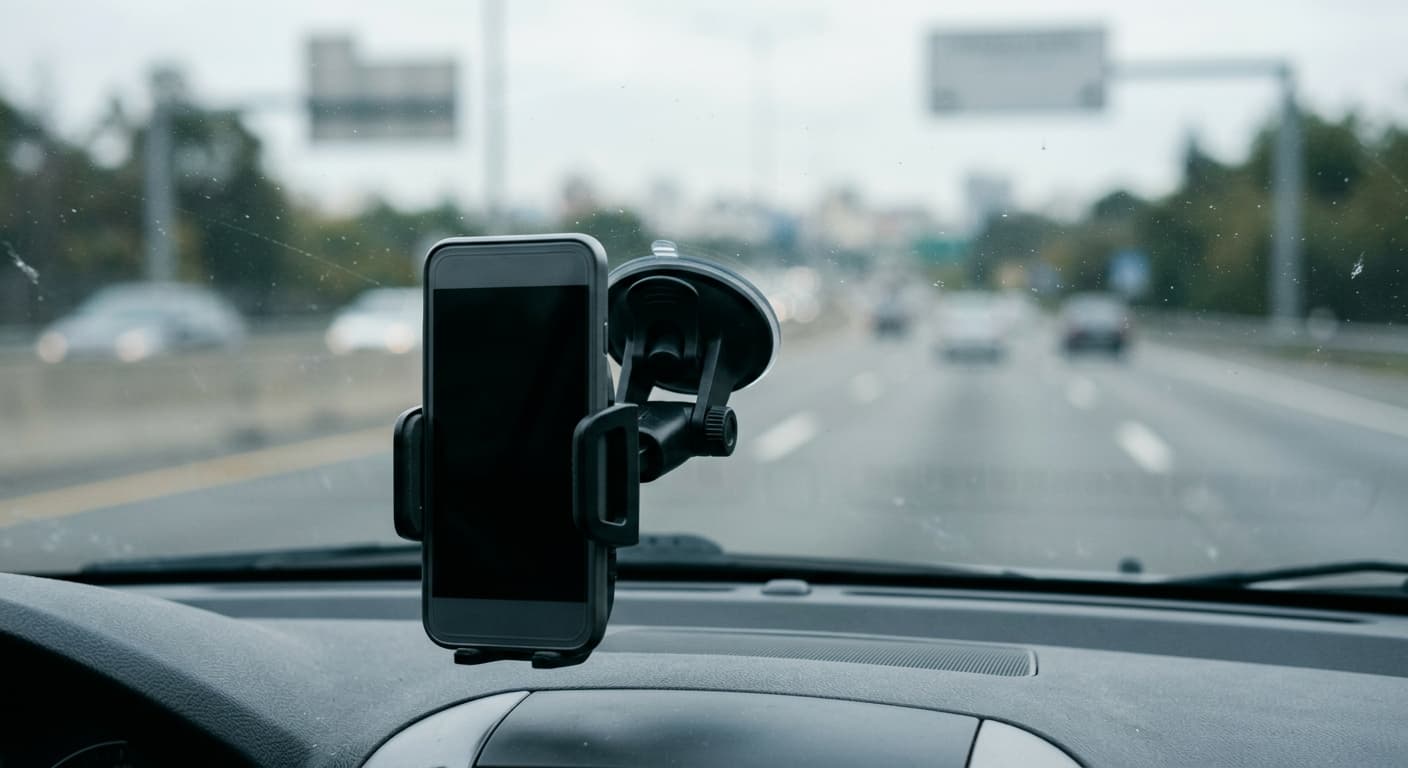
Windshield mounting rules vary by state across the United States. Many states prohibit any device that obstructs the driver's clear view, while others allow small GPS or navigation devices only in specific corner zones or behind the rearview mirror. Dashboard and vent-clip mounts are the safest legal option in every state.
Windshield mounting laws determine what devices, stickers, and materials you can legally attach to your vehicle's windshield. Every state has regulations, but they vary dramatically in what they allow, where devices can be placed, and how strictly the rules are enforced.
This guide links to detailed state-by-state pages covering the specific statutes, placement zones, penalties, exemptions, and how each state's hands-free driving law interacts with windshield mounting restrictions.
Windshield Mounting Laws by State
Select your state for a complete guide to windshield mounting rules, GPS and phone mount legality, dashcam placement, tinting restrictions, and penalties.
Northeast states
The table below covers 3 states in the Northeast.
Midwest states
The table below covers 7 states in the Midwest.
| State | State |
|---|---|
| Illinois | Rhode Island |
| Indiana | South Carolina |
| Iowa | South Dakota |
| Kansas | Tennessee |
| Michigan | West Virginia |
| Minnesota | Wisconsin |
| Missouri |
Southern states
The table below covers 9 states in the South, plus the District of Columbia.
| State | State |
|---|---|
| Alabama | Montana |
| Arkansas | New Hampshire |
| Delaware | North Carolina |
| D.C. | North Dakota |
| Florida | Ohio |
| Georgia | Oklahoma |
| Kentucky | Texas |
| Louisiana | Utah |
| Maryland | Virginia |
| Mississippi | Wyoming |
Western states
The table below covers 6 states in the West.
| State | State |
|---|---|
| Alaska | Nebraska |
| Arizona | Nevada |
| California | New Jersey |
| Colorado | New Mexico |
| Hawaii | Oregon |
| Idaho | Pennsylvania |
Frequently Asked Questions
Can I mount my phone on my windshield?
It depends on the state. California allows GPS devices and dashcams in designated 5-inch or 7-inch corner zones (CVC 26708(b)(12)-(13)). Arizona has similarly sized 5-inch and 7-inch corner zones, but ARS 28-959.01(A)(5) reserves them for signs and stickers, not electronic devices. A GPS, phone, or dashcam placed there instead falls under the safety-monitoring-equipment exemption near the rearview mirror, or is safest on the dashboard. D.C. effectively prohibits all windshield mounts. Pennsylvania lists no device exemption, but 75 Pa.C.S. 4524 reaches only material that materially obstructs, obscures or impairs the driver's clear view, so placement is what decides it. Dashboard and vent mounts are the safest legal option in every state.
Are dashcams legal on windshields?
Dashcams are legal in all 50 states, but where you can mount them varies. Most states allow dashcams behind the rearview mirror or in the lower corners if they do not obstruct the driver's view. A few states, Pennsylvania among them, name no device exemption at all, so a dashcam there is judged only by whether it materially obstructs the driver's view.
What is the safest place to mount a GPS or phone?
A dashboard mount or vent-clip mount is the safest legal option in every state. These comply with both windshield obstruction laws and hands-free driving requirements without attaching anything to the windshield glass.
Which states are the most restrictive?
D.C., New Jersey, Rhode Island, and North Dakota are among the most restrictive. D.C. has a blanket ban on all windshield-mounted objects. Rhode Island and New Jersey require 70% light transmittance with no device exemptions. Pennsylvania names only inspection certificates and other officially required stickers as exempt, but 75 Pa.C.S. 4524 prohibits only material that materially obstructs, obscures or impairs the driver's view, so a small non-obstructing mount is not banned outright.
Which states are the most permissive?
Ohio explicitly allows GPS devices and electronic equipment on windshields. California has the most detailed framework with specific 5-inch and 7-inch mounting zones. Georgia's law explicitly permits device mounts. Florida exempts GPS devices and toll transponders by name.
Updates
Corrected the Pennsylvania summary: 75 Pa.C.S. 4524 bans windshield material only where it materially obstructs the driver view, so the page no longer describes Pennsylvania as banning all windshield mounts, and the California citation now points to the mounting statute rather than the safety-glazing one.
Corrected the FAQ's claim that Arizona allows phone and GPS mounts in its 5-inch/7-inch windshield corner zones (those zones are reserved for signs and stickers under Arizona law) and fixed the penalty-range figure, which had misattributed a $1,000 business-installer fine in Texas to ordinary drivers and understated Delaware's actual fine.
Independently fact-checked against the cited primary sources
Governing law re-checked for recent changes
Reviewed and approved by an editor
State-by-state comparison
Each state guide below is paired with the governing statute our editors adjudicated for it, held in our own legal record and verified against the official source.
Each statute shown is the same adjudicated anchor its state guide renders, independently verified against primary sources. A dash means not yet adjudicated in our record — never that no law exists.
The Law Behind This Article
This article rests on the statutory provisions below, held in our own legal record and retrieved from the official source. Tap a section to read the operative text.
California Vehicle Code
§ 26708In forcecited in 7 of our articles
(a) (1) A person shall not drive any motor vehicle with any object or material placed, displayed, installed, affixed, or applied upon the windshield or side or rear windows. (2) A person shall not drive any motor vehicle with any object or material placed, displayed, installed, affixed, or applied in or upon the vehicle that obstructs or reduces the driver’s clear view through the windshield or side windows. (3) This subdivision applies to a person driving a motor vehicle with the driver’s clear vision through the windshield, or side or rear windows, obstructed by snow or ice. (b) This section does not apply to any of the following: (1) Rearview mirrors. (2) Adjustable nontransparent sunvisors that are mounted forward of the side windows and are not attached to the glass.
Official text (excerpt) · last checked 2026-09-07 · Read the full text in our law library · Verify at leginfo.legislature.ca.gov
Cited in 56 court opinions in our collectionLatest citing opinion in our collection: 2026
In the courts (editorial summary, independently checked):California courts read section 26708(a)(2) to require an objective basis that an object actually obstructed the driver's view. People v. White (2003) held an air freshener on a mirror did not justify a stop where the officer never said it blocked his view; People v. Colbert (2007) found such a basis on fuller testimony.
Opinions citing this section in our collection:
- People v. White (California Court of Appeal 2003, 132 Cal. Rptr. 2d 371)✓An officer stopped a car for a tree-shaped air freshener on the mirror; the court held section 26708(a)(1) does not reach an object not affixed on the windshield, and that with no testimony the view was obstructed there was no reasonable basis under subdivision (a)(2).
- People v. Colbert (California Court of Appeal 2007, 68 Cal. Rptr. 3d 912)✓An officer stopped a car for a 4.75-inch tree air freshener on the mirror and testified from his own experience how an object that size hides cars and pedestrians; the court held that testimony gave an objectively reasonable basis under section 26708(a)(2).
- Klarfeld v. State of California (California Court of Appeal 1983, 142 Cal. App. 3d 541)✓A tint installer and car owners challenged sections 26708 and 26708.5 as vague; the court held the terms are not unconstitutionally vague and declared applied tint may not go on the windshield or front side windows, but may go behind the driver if the car has required mirrors.
Identified automatically from the court opinions citing this section — not a ranking of which case controls.
Also relied on in: California Dashcam Laws: Mounting Rules, Audio Recording, and Evidence (2026), Window Tint Laws by State (2026): Legal VLT Limits, California Window Tint Laws (2026): Legal VLT Limits
§ 26701In force
(a) No person shall sell, offer for sale, or operate any motor vehicle, except a motorcycle, manufactured after January 1, 1936, unless it is equipped with safety glazing material wherever glazing materials are used in interior partitions, doors, windows, windshields, auxiliary wind deflectors or openings in the roof. (b) No person shall sell or offer for sale any camper manufactured after January 1, 1968, nor shall any person operate a motor vehicle registered in this state which is equipped with that camper, unless the camper is equipped with safety glazing materials wherever glazing materials are used in outside windows and doors, interior partitions, and openings in the roof. (c) No person shall operate a motorcycle manufactured after January 1, 1969, equipped with a windshield containing glazing material unless it is safety glazing material. (d) No person shall sell, offer for sale, or operate any motor vehicle equipped with red, blue, or amber translucent aftermarket material in any partitions, windows, windshields, or wind deflectors.
Official text (excerpt) · last checked 2026-07-28 · Read the full text in our law library · Verify at leginfo.legislature.ca.gov
Arizona Revised Statutes, Title 28 (Transportation), Chapter 3 (TRAFFIC AND VEHICLE REGULATION), Article 16 (Equipment)
§ 28-959.01Materials on windows or windshield; exceptions; requirements; violation; definitionsIn forcecited in 5 of our articles
A. This section does not apply to: 1. Front side wing vents and windows that have a substance or material in conjunction with glazing material that has a light transmission of thirty-three percent plus or minus three percent and a luminous reflectance of thirty-five percent plus or minus three percent. 2. Front side wing vents and windows that have a substance or material not attached in conjunction with glazing material that is used by a vehicle operator on a moving vehicle during daylight hours as provided in section 28-922. 3. Rearview mirrors. 4. Adjustable nontransparent sun visors that are mounted forward of the side windows and that are not attached to the glass. 5. Signs, stickers or other materials that are either: (a) Displayed in a seven inch square in the lower corner of the windshield farthest removed from the driver. (b) Displayed in a five inch square in the lower corner of the windshield nearest the driver. 6. Side windows that are to the rear of the driver and rear windows that have a substance or material in conjunction with glazing material that has a luminous reflectance of thirty-five percent plus or minus three percent or less. 7.
Official text (excerpt) · last checked 2026-09-07 · Read the full text in our law library · Verify at azleg.gov
Cited in 2 court opinions in our collectionLatest citing opinion in our collection: 2016
Opinions citing this section in our collection:
- State of Arizona v. Jesus Ramiro Moreno (Court of Appeals of Arizona 2014, 236 Ariz. 347)“…vehicle based on mistaken view of the law). 4Under A.R.S. § 28-959.01(A)(1), window tint on the front-side wi…”
- State v. Meza-Contreras (Court of Appeals of Arizona 2016)“…er that obstructs or restricts the driver’s clear view. See A.R.S. § 28-959.01.B; see also A.R.S. § 28- 1594 (An offic…”
Identified automatically from the court opinions citing this section — not a ranking of which case controls.
Also relied on in: Arizona Dashcam Laws: Rules for Dashboard Cameras in Vehicles, Arizona Windshield Mounting Laws (2026 Guide), Arizona Window Tint Laws (2026): Legal VLT Limits
Wisconsin Statutes, Chapter 346: Rules Of The Road
§ 346.88Obstruction of operator’s view or driving mechanism.In forcecited in 4 of our articles
(1) No person shall drive a vehicle when it is so loaded or when there are in the front seat such number of persons, or any persons so situated, as to obstruct the view of the operator to the front or to the sides or as to interfere with the operator having free use of both hands and feet to the operating mechanisms or controls of the vehicle. (2) No passenger in a vehicle shall ride in such a position as to interfere with the operator’s view ahead or to the sides or to interfere with the operator’s control of the operating mechanism of the vehicle. (3) (a) No person shall drive any motor vehicle with any sign, poster or other nontransparent material upon the front windshield, front side wings, side windows in the driver’s compartment or rear window of such vehicle other than a certificate or other sticker issued by order of a governmental agency. Such permitted sticker shall not cover more than 15 square inches of glass surface and shall be placed in the lower left-hand corner of the windshield; the left corner being on the driver’s left when seated behind the wheel.
Official text (excerpt) · last checked 2026-09-08 · Read the full text in our law library · Verify at docs.legis.wisconsin.gov
Cited in 1 court opinions in our collectionLatest citing opinion in our collection: 2015
Opinions citing this section in our collection:
- State v. Richard E. Houghton, Jr. (Wisconsin Supreme Court 2015, 364 Wis. 2d 234)“…pull Houghton over for a violation of Wis. Stat. § 346.88(3)(b) (2011-12),3 "Obstruction of opera…”
Identified automatically from the court opinions citing this section — not a ranking of which case controls.
Also relied on in: Wisconsin Dashcam Laws: Mounting Rules, Audio Recording, and Evidence (2026), Dashboard Camera Legality and Privacy Laws: Is It Illegal to Use Dashcams in North America?, Wisconsin Windshield Mounting Laws
Pennsylvania Consolidated Statutes Title 75 (Vehicles)
§ 4524Windshield obstructions and wipersIn forcecited in 7 of our articles
(a) Obstruction on front windshield.--No person shall drive any motor vehicle with any sign, poster or other nontransparent material upon the front windshield which materially obstructs, obscures or impairs the driver's clear view of the highway or any intersecting highway except an inspection certificate, sticker identification sign on a mass transit vehicle or other officially required sticker and no person shall drive any motor vehicle with any ice or snow on the front windshield which materially obstructs, obscures or impairs the driver's clear view of the highway or any intersecting highway. (b) Obstruction on side and rear windows.--No person shall drive a motor vehicle with any sign, poster or other nontransparent material, including ice or snow, upon the side wings or side or rear windows of the vehicle which materially obstructs, obscures or impairs the driver's clear view of the highway or any intersecting highway. The placement of a registration permit upon the side or rear window of a vehicle shall not be considered a material obstruction.
Official text (excerpt) · last checked 2026-09-08 · Read the full text in our law library · Verify at palegis.us
Cited in 70 court opinions in our collectionLatest citing opinion in our collection: 2026
In the courts (editorial summary, independently checked):Pennsylvania courts read section 4524 subsection by subsection. Commonwealth v. Brubaker (2010) held a tint conviction under section 4524(e)(1) fails where the officer could see into the vehicle, whatever a meter showed. Commonwealth v. Holmes (2011) held a stop under section 4524(c) illegal where the officer never described the object.
Opinions citing this section in our collection:
- Commonwealth v. Holmes (Supreme Court of Pennsylvania 2011, 609 Pa. 1)✓An officer stopped a car after testifying only that objects hung from the rearview mirror obstructing the driver's view; the court held that with no description of the objects or how they impaired vision there was no reasonable suspicion of a section 4524(c) violation.
- Commonwealth v. Rodriguez (Superior Court of Pennsylvania 2013, 2013 Pa. Super. 302)✓A Pennsylvania constable cited for driving his own black-tinted BMW argued the car was an exempt government vehicle; the court held constables are not government employees and affirmed the conviction, finding no exemption under section 4524(e)(2)(i).
- Commonwealth v. Santiago, A., Aplt. (Supreme Court of Pennsylvania 2019, 209 A.3d 912)“…es a dissenting opinion in which Justice Donohue joins. 75 Pa.C.S. § 4524(e)(1). The Commonwealth concedes…”
Identified automatically from the court opinions citing this section — not a ranking of which case controls.
Also relied on in: Pennsylvania Dashcam Laws: Mounting Rules, Audio Recording, and Evidence (2026), Pennsylvania Window Tint Laws (2026): Legal VLT Limits, Pennsylvania Windshield Mounting Laws (2026 Guide)
Search our full record of US law — 2.1 million sections, every state + federal →
Sources and References
- Wisconsin Statute § 346.88: obstructions to the operator's view(docs.legis.wisconsin.gov).gov
- California Vehicle Code § 26701: safety glazing requirements for windshields(leginfo.legislature.ca.gov).gov
- California Vehicle Code § 26708(b)(12)-(13): portable GPS and video event recorder windshield mounting zones(leginfo.legislature.ca.gov)
- Arizona Revised Statutes § 28-959.01: materials on windows or windshield, exceptions and requirements(azleg.gov)
- 75 Pa.C.S. § 4524: windshield obstructions and wipers(palegis.us)