Surveillance Camera Laws by State (2026 Guide)
Independently fact-checked against primary sources (last audited September 12, 2026). · Reviewed by the RecordingLaw editorial team. · Law checked current as of August 7, 2026. · 8 primary sources cited on this page. How we verify our legal content
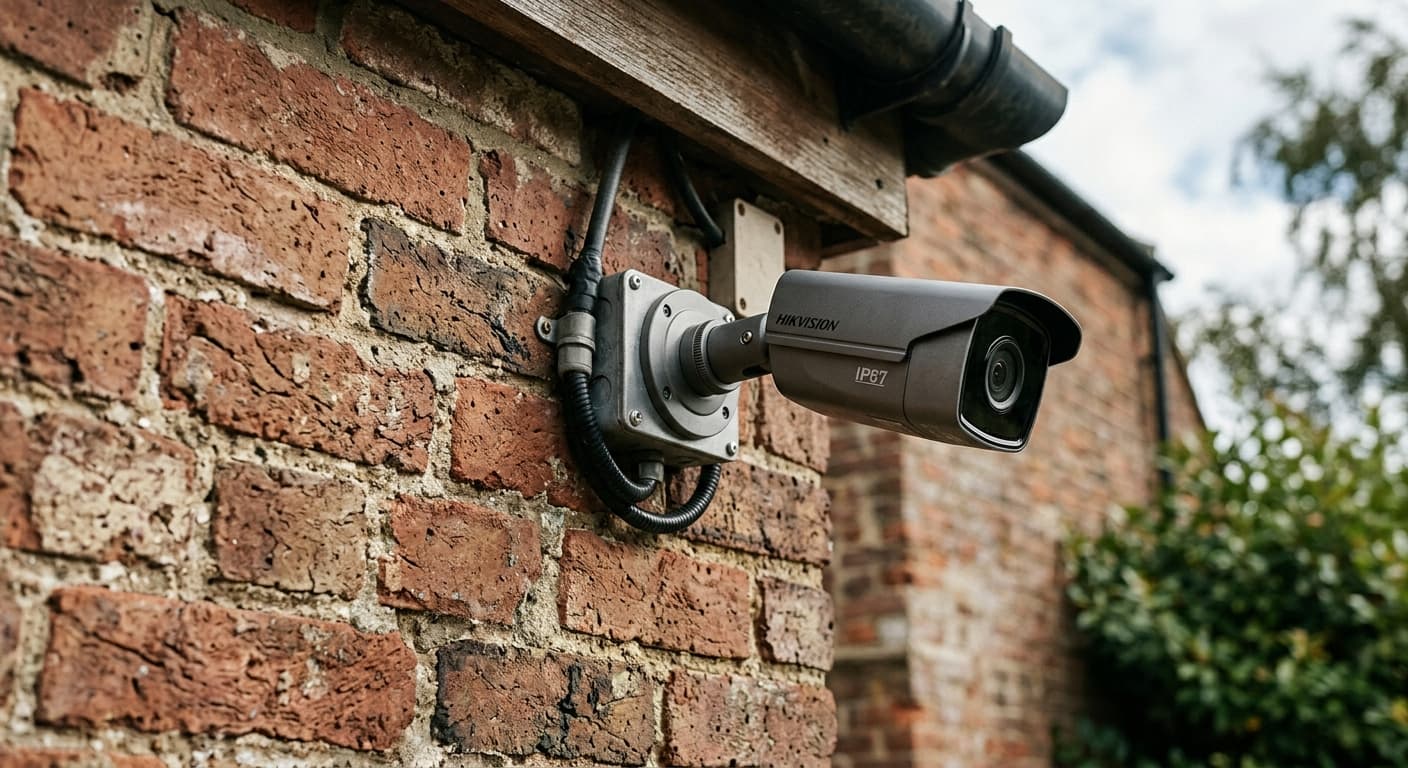
Camera rules change with what a device captures, where it is aimed, why it is being used, and which jurisdiction applies. A silent video feed, a microphone that acquires a conversation, and a camera pointed into a private changing area can raise different legal questions. Start with those facts, then use the state or situation guide that matches the recording.
For a comparison of notice requirements and links to every state guide, see security camera sign laws by state.
Jurisdiction scope: This guide explains federal audio rules and uses California workplace law as a specific example. Use the linked state and situation guides to identify the law that applies to your recording.
Surveillance Camera Laws by State
Compare all 50 states and D.C.. The chart separates state-specific video and private-area issues from workplace notice and audio resources. A navigation-only cell means the chart does not assert a statewide rule; it does not mean no law applies.
State-by-state comparison
Use this directory to compare verified camera and workplace-monitoring points, then open the linked state guides for scope and exceptions.
Navigation-only cells point to further state research. They do not mean that no law applies. Verified through 2026-09-12.
What Changes the Legal Analysis: Video, Audio, and Private Areas
Audio and video do not share one legal test. Before drawing a conclusion, identify exactly what the device records and the physical setting in which it operates.
Federal interception law illustrates why a microphone deserves separate attention. Under 18 U.S.C. § 2510, an “oral communication” covered by the statute involves a speaker who exhibits an expectation that the communication is not subject to interception, in circumstances that justify that expectation. The same section defines “intercept” as acquiring the contents of a communication through an electronic, mechanical, or other device.
18 U.S.C. § 2511 generally prohibits intentional interception. It also contains a private-party exception when the person is a party to the communication or a party has given prior consent, unless the interception is undertaken to commit a criminal or tortious act. That framework does not mean every locally recorded video is an intercepted electronic communication, and it does not resolve whether a particular camera microphone captured a protected conversation. State law may impose additional requirements.
| Fact to identify | Why it changes the analysis | Next place to look |
|---|---|---|
| Video only or video plus audio | A microphone may implicate interception and consent rules that silent images do not | The recording-consent law for the relevant state |
| Exact field of view | A porch, shared hallway, workstation, bedroom, and restroom involve different facts | The state guide and the matching situation guide |
| Who installed and uses it | Homeowners, employers, landlords, tenants, HOAs, and caregivers may face different rules | The guide for that relationship |
| Purpose and notice | Purpose and notice may matter under a particular statute, but neither supplies a universal answer | The text of the controlling law |
Private-area restrictions can also be highly specific. California Labor Code § 435 bars an employer from causing audio or video recording of an employee in a restroom, locker room, or room the employer designates for changing clothes, unless a court order authorizes it. The statute also bars use of a recording made in violation. This is a California employer rule, not a national rule for every camera or a rule about every homeowner installation.
The practical lesson is to separate the issues. Ask whether the device records sound, whether a conversation qualifies for legal protection, where the lens and microphone reach, who controls the camera, and what state law governs. A broad statement that “security cameras are legal” or “hidden cameras are illegal” skips facts that may decide the result.
How to Use the State Guides
Begin with the device. Check its settings, not only its product name. A camera sold as a video doorbell or security camera may include a microphone, two-way talk, cloud clips, motion-triggered recording, and controls that can disable some features. The legal analysis should reflect what was enabled and acquired during the event.
Next, describe the location precisely. “At home” could mean a camera facing a public approach, a shared hallway, a guest room, or a bathroom. “At work” could mean a public sales floor, a private office, or an employer-designated changing room. Those details matter more than the general label.
Then identify the people and jurisdiction. Note who installed the camera, who controlled the account, who appeared or spoke in the recording, and where the capture occurred. For audio, the federal definitions and prohibition in 18 U.S.C. §§ 2510 and 2511 provide part of the framework, but the relevant state guide is needed to evaluate state consent and privacy rules.
Finally, separate legal requirements from privacy precautions. Adjusting a field of view, disabling unnecessary audio, limiting access to clips, or posting notice may reduce conflict. Those steps do not prove that a specific statute requires them or that the recording becomes lawful. Use the official authority cited in the state or situation guide for the legal rule.
A short fact sheet can make the next review more productive. It can identify the camera model, enabled features, dates and times, mounting point, field of view, audio setting, retention period, account access, notices, and the states connected to the event. Keep the original clip and device information if a dispute may turn on what was actually captured. This is an information-gathering step, not a conclusion that a recording is admissible or that keeping it is legally required.
Also distinguish live viewing from recording and storage. A device may display a live feed, save event clips, continuously record, or allow two-way speech. Each function creates a different factual record. The federal provisions cited here concern acquisition of communication contents through a device; they do not support treating every camera feature as legally identical.
Does Notice or a Sign Change the Answer?
Notice can be relevant, but a sign does not settle every camera issue. A sign may tell people that an area is monitored, while a separate law may focus on audio interception, a protected location, the installer’s role, or another required fact.
Consent also requires careful reading. The private-party exception in 18 U.S.C. § 2511(2)(d) refers to a person who is a party to the communication or to prior consent from one of the parties, subject to the exception’s stated limitation. A general camera sign is not automatically the same thing as proving every statutory element of consent for every captured conversation.
Treat signage as one fact in the record. Preserve the wording and placement of a sign, determine whether audio was enabled, and consult the state-specific authority.
Camera Laws by Situation
The relationship between the installer, the people recorded, and the property often determines which body of law needs attention. Use the route that best matches the dispute.
- HOA Security Camera Rules covers when a homeowners association can restrict your camera or video doorbell.
- Neighbor Security Camera Laws explains what to do when a neighbor's camera records your property.
- Nanny Cam Laws covers recording a caregiver at home and the audio and private-area limits.
- Workplace Surveillance Camera Laws explains when your employer can record you at work.
- Landlord Security Camera Laws covers what cameras a landlord may install in a rental.
- Ring Doorbell Laws focuses on video doorbells, including their field of view and audio features.
These pages organize the facts around a recurring setting. They still require the correct jurisdiction and device details. For example, the California workplace restriction in Labor Code § 435 addresses an employer’s recording of an employee in specified private rooms; it should not be generalized into a rule for a neighbor’s exterior camera.
Choose the most specific route first. A tenant concerned about a landlord-installed hallway camera will usually get more useful orientation from the landlord page than from a general home-camera discussion. A homeowner disputing a neighbor’s field of view should begin with the neighbor page, while an HOA restriction on the homeowner’s own device belongs in the HOA guide. If the device is a doorbell with an active microphone, the doorbell page and the applicable state recording guide may both be relevant.
Some disputes overlap. A nanny camera may raise an in-home placement question and a separate audio question. A workplace camera may involve a private location as well as microphone capture. Keep those issues separate as you follow the links, because one rule may address who records, another may address where, and another may address what the device acquired.
This national guide explains a framework and routes readers to jurisdiction-specific material. It does not establish that a camera is lawful or unlawful in a particular state or setting and is general legal information, not legal advice. Consult an attorney for advice specific to your situation.
Statutes cited reflect their in-force version as of 2026-09-11.
Last updated: 2026-09-11.
Frequently Asked Questions
Does a security camera recording audio follow the same rules as video?
Not necessarily. Federal law defines and regulates the interception of qualifying oral communications in 18 U.S.C. §§ 2510 and 2511, while state law may add consent requirements. Check whether the microphone was enabled and use the guide for the state where the capture occurred.
Does posting a camera sign make every recording lawful?
No universal rule in the sources reviewed makes every recording lawful because a sign is posted. Notice is one fact; audio, location, purpose, the people involved, and the governing statute may still change the analysis.
Which state camera law should I check?
Start with the law of the state where the recording occurred, then identify any other jurisdiction connected to the conduct. Use the state directory above and the situation guide that matches the workplace, home, rental, HOA, neighbor, caregiver, or doorbell setting.
Are workplace cameras governed by one national rule?
No single rule in this guide decides every workplace camera. California Labor Code § 435 is one state-specific example covering employer recording in specified private rooms, while audio can require a separate federal and state analysis.
Updates
Added a comparison linking camera, workplace and audio guides for all 50 states and D.C.; reconciled the legal-source connections.
Independently fact-checked against the cited primary sources
Rebuilt the guide around video, audio, location, and purpose; preserved the state and situation directories; and removed unsupported nationwide conclusions.
Corrected the FAQ's all-party-consent state count and list (it said 11 states, contradicting the article's own count of 12) to match the intro and add the necessary hedges for Connecticut, Nevada, and Michigan.
Independently fact-checked against the cited primary sources
Governing law re-checked for recent changes
Reviewed and approved by an editor
The Law Behind This Article
This article rests on the statutory provisions below, held in our own legal record and retrieved from the official source. Tap a section to read the operative text.
California Labor Code
§ 435In forcecited in 7 of our articles
(a) No employer may cause an audio or video recording to be made of an employee in a restroom, locker room, or room designated by an employer for changing clothes, unless authorized by court order. (b) No recording made in violation of this section may be used by an employer for any purpose. This section applies to a private or public employer, except the federal government. (c) A violation of this section constitutes an infraction.
Official text (excerpt) · last checked 2026-07-28 · Read the full text in our law library · Verify at leginfo.legislature.ca.gov
Cited in 1 court opinions in our collectionLatest citing opinion in our collection: 2006
Opinions citing this section in our collection:
- Trujillo v. City of Ontario (District Court, C.D. California 2006, 428 F. Supp. 2d 1094)“…See, e.g., Cal.Penal Code §§ 647(k), 653(n); Cal. Labor Code 435. While the laws concerning video survei…”
Identified automatically from the court opinions citing this section — not a ranking of which case controls.
Also relied on in: California Employee Monitoring Laws: Employer Rules (2026), Workplace Surveillance Camera Laws: Employee Guide
Connecticut General Statutes, Title 31 (Labor), Chapter 557
§ 31-48dEmployers engaged in electronic monitoring required to give prior notice to employees. Exceptions. Civil penalty.In forcecited in 22 of our articles
(a) As used in this section: (1) “Employer” means any person, firm or corporation, including the state and any political subdivision of the state which has employees; (2) “Employee” means any person who performs services for an employer in a business of the employer, if the employer has the right to control and direct the person as to (A) the result to be accomplished by the services, and (B) the details and means by which such result is accomplished; and (3) “Electronic monitoring” means the collection of information on an employer's premises concerning employees' activities or communications by any means other than direct observation, including the use of a computer, telephone, wire, radio, camera, electromagnetic, photoelectronic or photo-optical systems, but not including the collection of information (A) for security purposes in common areas of the employer's premises which are held out for use by the public, or (B) which is prohibited under state or federal law.
Official text (excerpt) · last checked 2026-08-31 · Read the full text in our law library · Verify at cga.ct.gov
Cited in 4 court opinions in our collectionLatest citing opinion in our collection: 2021
In the courts (editorial summary, independently checked):Gerardi v. City of Bridgeport (2010) held that section 31-48d creates no private right of action, reading subsection (c) to delegate all enforcement of the electronic monitoring notice duty to the labor commissioner. J.P. Alexandre, LLC v. Egbuna (2012) cited that reading when rejecting an implied right of action under a tax statute.
Opinions citing this section in our collection:
- Gerardi v. City of Bridgeport (Supreme Court of Connecticut 2010, 294 Conn. 461)✓Bridgeport put GPS units in fire inspectors' city vehicles without telling them, then disciplined them; the Connecticut Supreme Court held section 31-48d creates no private right of action because subsection (c) leaves enforcement to the labor commissioner.
- Borelli v. Renaldi (Supreme Court of Connecticut 2020, 336 Conn. 1)“…(2010) (comparing electronic monitoring statute, General Statutes § 31-48d, to other employment statutes…”
- J.P. Alexandre, LLC v. Egbuna (Connecticut Appellate Court 2012, 137 Conn. App. 340)“…idgeport, supra, 294 Conn. 472 (rejecting claim that General Statutes § 31-48d [c] provided private right of action wh…”
Identified automatically from the court opinions citing this section — not a ranking of which case controls.
Also relied on in: Employer Guide to Wearable Recording Device Policies (2026), Connecticut Audio Recording Laws: Mixed Consent Rules and Penalties (2026), Connecticut Dashcam Laws: Mounting Rules, Audio Recording, and Evidence (2026)
Delaware Code, Title 19 (Labor), Chapter 007 (EMPLOYMENT PRACTICES)
§ 705Notice of monitoring of telephone transmissions, electronic mail and Internet usage.In forcecited in 10 of our articles
(a) As used in this section, “employer” includes any individual, corporation, partnership, firm or association with a place of business in Delaware and the State of Delaware or any agency or political subdivision thereof. (b) No employer, nor any agent or any representative of any employer, shall monitor or otherwise intercept any telephone conversation or transmission, electronic mail or transmission, or Internet access or usage of or by a Delaware employee unless the employer either: (1) Provides an electronic notice of such monitoring or intercepting policies or activities to the employee at least once during each day the employee accesses the employer-provided e-mail or Internet access services; or (2) Has first given a 1-time notice to the employee of such monitoring or intercepting activity or policies. The notice required by this paragraph shall be in writing, in an electronic record, or in another electronic form and acknowledged by the employee either in writing or electronically. The notice required by this subsection shall not apply to activities of any law-enforcement officer acting under the order of a court issued pursuant to Chapter 24 of Title 11.
Official text (excerpt) · last checked 2026-08-31 · Read the full text in our law library · Verify at delcode.delaware.gov
Cited in 1 court opinions in our collectionLatest citing opinion in our collection: 2013
Opinions citing this section in our collection:
- In re Information Management Services, Inc. Derivative Litigation (Court of Chancery of Delaware 2013, 81 A.3d 278)“…r (ii) obtain written consent from the monitored employees. 19 Del. C. § 705(b). Although the court need not reach t…”
Identified automatically from the court opinions citing this section — not a ranking of which case controls.
Also relied on in: Delaware Recording Laws (2026): Two-Statute Consent Conflict, Delaware AI Meeting Recording Laws (2026), Delaware GPS Tracking Laws: Is It Legal to Put a Tracker on a Car? (2026)
United States Code Title 18
§ 2510DefinitionsIn forcecited in 126 of our articles
As used in this chapter— “wire communication” means any aural transfer made in whole or in part through the use of facilities for the transmission of communications by the aid of wire, cable, or other like connection between the point of origin and the point of reception (including the use of such connection in a switching station) furnished or operated by any person engaged in providing or operating such facilities for the transmission of interstate or foreign communications or communications affecting interstate or foreign commerce; “oral communication” means any oral communication uttered by a person exhibiting an expectation that such communication is not subject to interception under circumstances justifying such expectation, but such term does not include any electronic communication; “State” means any State of the United States, the District of Columbia, the Commonwealth of Puerto Rico, and any territory or possession of the United States; “intercept” means the aural or other acquisition of the contents of any wire, electronic, or oral communication through the use of any electronic, mechanical, or other device.1 So in original. The period probably should be a semicolon.
Official text (excerpt) · last checked 2026-07-28 · Read the full text in our law library · Verify at uscode.house.gov
Cited in 2,382 court opinions in our collectionLatest citing opinion in our collection: 2026
In the courts (editorial summary, independently checked):United States v. New York Telephone Co. (1977) held that pen registers fall outside Title III because they do not acquire the contents of a communication as Section 2510(4) and (8) define interception. Forsyth v. Barr (1994) applied the same definitions, treating the defendant officers as law enforcement officers under Section 2510(7).
Opinions citing this section in our collection:
- Forsyth v. Barr (Court of Appeals for the Fifth Circuit 1994, 19 F.3d 1527)✓Neighbors tapped an informant's home line and the overheard charges reached Dallas internal affairs; the Fifth Circuit saw no evidence the police defendants intercepted anything and held they were 2510(7) law enforcement officers, so 2517(1) and (2) allowed their use of it.
- Nixon v. Administrator of General Services (Supreme Court of the United States 1977, 433 U.S. 425)“…of the Omnibus Crime Control and Safe Streets Act of 1968, 18 U. S. C. §§ 2510 et seq. 408 F. Supp., at 363 . We…”
- Gannett Co. v. DePasquale (Supreme Court of the United States 1979, 443 U.S. 368)“…of the Omnibus Crime Control and Safe Streets Act of 1968, 18 U. S. C. § 2510 et seq., be preserved prior to the d…”
Identified automatically from the court opinions citing this section — not a ranking of which case controls.
Also relied on in: US Recording Laws by State (2026): All 50 States Explained, Georgia Recording Laws (2026): One-Party Audio, All-Party Video, District of Columbia Recording Laws (2026): One-Party Consent Rules
§ 2511Interception and disclosure of wire, oral, or electronic communications prohibitedIn forcecited in 422 of our articles
Except as otherwise specifically provided in this chapter any person who— intentionally intercepts, endeavors to intercept, or procures any other person to intercept or endeavor to intercept, any wire, oral, or electronic communication; intentionally uses, endeavors to use, or procures any other person to use or endeavor to use any electronic, mechanical, or other device to intercept any oral communication when— such device is affixed to, or otherwise transmits a signal through, a wire, cable, or other like connection used in wire communication; or such device transmits communications by radio, or interferes with the transmission of such communication; or such person knows, or has reason to know, that such device or any component thereof has been sent through the mail or transported in interstate or foreign commerce; or such use or endeavor to use (A) takes place on the premises of any business or other commercial establishment the operations of which affect interstate or foreign commerce; or (B) obtains or is for the purpose of obtaining information relating to the operations of any business or other commercial establishment the operations of which affect interstate or foreign…
Official text (excerpt) · last checked 2026-08-28 · Read the full text in our law library · Verify at uscode.house.gov
Cited in 2,045 court opinions in our collectionLatest citing opinion in our collection: 2026
In the courts (editorial summary, independently checked):Griggs-Ryan v. Smith (1990) applied the Section 2511(2)(d) prior-consent exception, treating a tenant repeatedly told that all incoming calls were taped as having impliedly consented. United States v. United States District Court (1972) read the then-current Section 2511(3) as conferring no presidential surveillance power.
Opinions citing this section in our collection:
- Mitchell v. Forsyth (Supreme Court of the United States 1985, 472 U.S. 511)✓The Attorney General authorized a warrantless 1970 national security wiretap that caught the plaintiff's calls; the Court held the since-repealed Section 2511(3) disclaimer left the tap lawful under Title III, and that Mitchell had qualified immunity.
- United States v. United States District Court for the Eastern District of Michigan (Supreme Court of the United States 1972, 407 U.S. 297)✓The Attorney General approved warrantless wiretaps on members of a domestic group accused of bombing a CIA office; the Court read Section 2511(3) as a congressional disclaimer conferring no surveillance power, then held the Fourth Amendment required prior judicial approval.
- Forsyth v. Barr (Court of Appeals for the Fifth Circuit 1994, 19 F.3d 1527)✓Dallas police used, in an internal affairs probe of an officer, calls private parties allegedly intercepted illegally; assuming that was unlawful, the Fifth Circuit held Section 2517(1) and (2) allowed the disclosure and use, defeating the Section 2511(1)(c) and (d) claims.
Identified automatically from the court opinions citing this section — not a ranking of which case controls.
Also relied on in: Connecticut Recording Laws (2026): Hybrid Consent Rules Explained, Oregon Recording Laws (2026): Hybrid One-Party and All-Party Rules, Hawaii Recording Laws (2026): Hybrid Consent State Rules
West Virginia Code
§ 21-3-20Use of video and other electronic surveillance devices by employers prohibited.In forcecited in 17 of our articles
(a) It is unlawful for any employer or the agent or representative of an employer, whether public or private, to operate any electronic surveillance device or system, including, but not limited to, the use of a closed circuit television system, a video-recording device, or any combination of those or other electronic devices for the purpose of recording or monitoring the activities of the employees in areas designed for the health or personal comfort of the employees or for safeguarding of their possessions, such as rest rooms, shower rooms, locker rooms, dressing rooms and employee lounges. (b) Any employer or agent thereof who violates any provision of this section is guilty of a misdemeanor and, if convicted, shall be fined $500 for the first offense. An employer or agent thereof convicted a second time under this provision shall be fined $1,000. For the third and any subsequent offense, the penalty shall be $2,000.
Official text (excerpt) · last checked 2026-08-31 · Read the full text in our law library · Verify at code.wvlegislature.gov
Cited in 1 court opinions in our collectionLatest citing opinion in our collection: 2019
Opinions citing this section in our collection:
- Blackwood v. Berry Dunn, LLC (District Court, S.D. West Virginia 2019)“…out being in an area protected from monitoring by W. Va. Code § 21-3-20, it cannot be said that taking a…”
Identified automatically from the court opinions citing this section — not a ranking of which case controls.
Also relied on in: West Virginia Employee Monitoring Laws: Workplace Surveillance and Social Media (2026)
New York Civil Rights Law
§ 52-c*2Employers engaged in electronic monitoring; prior notice requiredIn forcecited in 4 of our articles
* § 52-c. Employers engaged in electronic monitoring; prior notice required. 1. For purposes of this section, employer means any individual, corporation, partnership, firm, or association with a place of business in the state. It shall not include the state or any political subdivision of the state. 2. (a) Any employer who monitors or otherwise intercepts telephone conversations or transmissions, electronic mail or transmissions, or internet access or usage of or by an employee by any electronic device or system, including but not limited to the use of a computer, telephone, wire, radio, or electromagnetic, photoelectronic or photo-optical systems, shall give prior written notice upon hiring to all employees who are subject to electronic monitoring. The notice required by this subdivision
Official text (excerpt) · last checked 2026-09-12 · Read the full text in our law library · Verify at nysenate.gov
Search our full record of US law — 2.1 million sections, every state + federal →
Sources and References
- 18 U.S.C. § 2510 - Definitions(uscode.house.gov).gov
- 18 U.S.C. § 2511 - Interception and disclosure prohibited(uscode.house.gov).gov
- California Labor Code § 435 - Employee recording in private areas(leginfo.legislature.ca.gov).gov
- W. Va. Code § 21-3-20, electronic surveillance of employees(code.wvlegislature.gov).gov
- Conn. Gen. Stat. § 31-48d, current electronic-monitoring law(prdext2.cga.ct.gov).gov
- 2026 Conn. Pub. Acts 26-73, changes effective October 1, 2026(cga.ct.gov).gov
- N.Y. Civ. Rights Law § 52-c*2, notice of enumerated electronic monitoring(nysenate.gov).gov
- 19 Del. C. § 705, notice of telephone, email, and internet monitoring(delcode.delaware.gov).gov