HOA Security Camera Rules: Can They Make You Remove It?
Independently fact-checked against primary sources (last audited August 16, 2026). · Reviewed by the RecordingLaw editorial team. · Law checked current as of August 9, 2026. · 10 primary sources cited on this page. How we verify our legal content

Most HOAs cannot flatly ban a homeowner's security camera or video doorbell on property the owner controls. An association can regulate a camera's size, placement, and appearance through its CC&Rs and architectural rules, and several states protect a resident's right to install one by statute.
Jurisdiction scope: This page explains the national framework for how a homeowners association can and cannot regulate security cameras, plus notable state statutes. It is general legal information, not legal advice. For the criminal recording rules in your state, see your state surveillance camera laws page.
Can an HOA Make You Remove a Security Camera?
Usually not, if the camera sits on property you control and your governing documents do not clearly prohibit it. An HOA is a creature of contract. Its power flows from the recorded covenants, conditions, and restrictions (CC&Rs), the bylaws, and any architectural standards adopted under them. It has no authority beyond what those documents and your state common-interest statute grant. That means the first question is never what the board prefers. It is what the documents actually say.
When the documents address cameras, courts generally read restrictions narrowly and require that they be reasonable and applied evenly to every owner. A rule that limits how many cameras you mount, how large they are, how they attach to the building, or where they point is the kind of restriction associations routinely enforce. A rule that bans all security cameras outright is far weaker, especially where a state statute protects the right to install one.
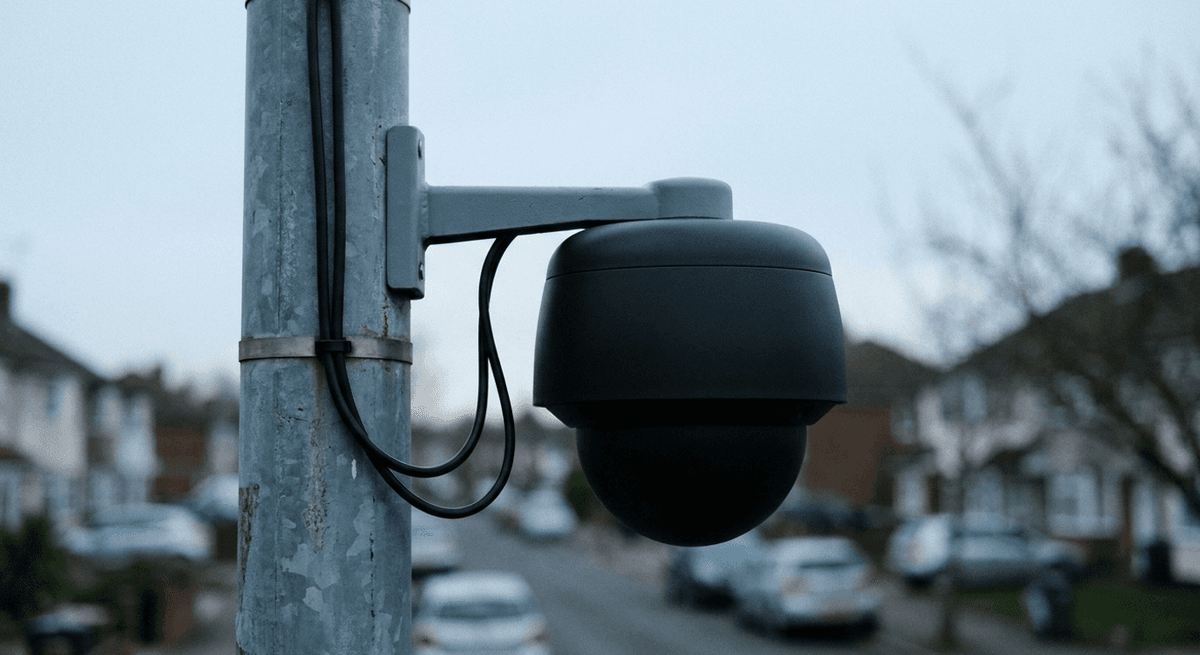
States That Protect a Homeowner's Cameras
A small number of states have stepped in to limit what an association can do. Texas bars a property owners association from adopting or enforcing a restrictive covenant that prevents an owner from building or installing security measures, including a security camera, motion detector, or perimeter fence, though the statute does not apply to condominiums or master mixed-use property owners' associations.
Read the exceptions in that statute closely, because only the first of them concerns cameras: the association may still prohibit the installation of a security camera in a place other than the owner's private property. Every other exception is about fencing, covering the type of fence, placement that obstructs a license area, a public sidewalk, or a drainage easement, driveway gate setbacks, and fencing in front of the front-most building line. Texas law does not itself grant the association authority over a camera's appearance or its placement on the owner's own property. Any rule of that kind has to come from the governing documents and still has to be reasonable and evenly applied.
Utah is the other state with an express camera statute, and it reaches further than Texas in one respect that matters. Utah Code 57-8a-218, which sets limits on the rules a community association may adopt, provides that a rule may not prohibit a lot owner from installing a personal security camera immediately adjacent to the entryway, window, or other outside entry point of the owner's dwelling unit. Utah Code 57-8-8.1 carries the same protection into the Condominium Ownership Act for a condominium unit, while allowing a rule to prohibit a camera in a common area not physically connected to the owner's unit. That is precisely the gap Texas leaves open, since Texas Property Code 202.023 expressly excludes condominiums.
Be careful about what those two Utah sections reach. Both limit association rules, not a recorded declaration. Utah addresses the declaration separately: 57-8-10 governs what a condominium declaration may contain and 57-8a-212 does the same for a community association declaration, and each lists a prohibition on a personal security camera at the owner's entry points among the things a declaration may not do. So a Utah owner facing a camera restriction should first identify whether the restriction lives in a board-adopted rule or in the recorded declaration, because the governing section is different.
Hawaii has no comparable camera-specific statute. HRS 514B-140, Hawaii's general condominium additions and alterations law, is the section a Hawaii condo owner's camera runs through, and the burden depends on whether the work counts as material. A nonmaterial addition or alteration requires approval by the board, which may not unreasonably withhold it, plus whatever percentage or group of unit owners the declaration or bylaws require. A material addition or alteration requires considerably more: the written consent of sixty-seven per cent of the unit owners, the consent of all unit owners whose units or appurtenant limited common elements are directly affected, and the approval of the board. The solar energy device carve-out sits inside the nonmaterial subsection rather than applying to the whole section, and the section also carries a separate regime of its own for the installation of telecommunications equipment.
Most states have no camera-specific statute. In California, Arizona, Nevada, Illinois, and Virginia, the analysis falls back on the reasonableness standard and the association's architectural authority. California has no statute naming cameras, but its rules requiring that HOA operating rules be reasonable and within the board's authority make a categorical ban difficult to sustain, and the legislature has repeatedly limited HOA control over items like flags and solar panels. Arizona's planned-community statute protects flags and several kinds of signs but says nothing about cameras, so authority there turns entirely on the CC&Rs.
Florida is worth stating carefully, because its statute is easy to read backwards. Florida has no camera-specific protection, but Fla. Stat. 720.3045 is a real limit on association authority rather than the absence of one. Regardless of any covenants, restrictions, bylaws, rules, or requirements of an association, and unless prohibited by general law or local ordinance, an association may not restrict parcel owners or their tenants from installing, displaying, or storing items on a parcel that are not visible from the parcel's frontage, an adjacent parcel, an adjacent common area, or a community golf course. The statute's list of examples is expressly not exhaustive, so a camera mounted where none of those vantage points can see it falls inside the protection. The catch is practical rather than legal: most contested devices, doorbell cameras and eave-mounted units above all, are plainly visible from the frontage, so the section rarely reaches the typical dispute.
| State | What the law does | Authority |
|---|---|---|
| Texas | HOA may not prevent a security camera on the owner's own property; the only camera exception covers cameras placed off that property (condominiums excluded) | Property Code 202.023 |
| Utah | Association rules may not prohibit a personal security camera at the owner's entryway, window, or other outside entry point, condominiums included; declarations limited separately | Utah Code 57-8a-218, 57-8-8.1, 57-8-10, 57-8a-212 |
| Hawaii | No camera-specific statute; a condo camera needs board approval, and supermajority owner consent if it counts as a material alteration | HRS 514B-140 |
| California | No camera statute; rules must be reasonable and within board authority | Civ. Code 4350, 4360 |
| Arizona | Statute protects flags and signs only, not cameras | ARS 33-1808 |
| Nevada | Statute protects flags, signs, solar, not cameras | NRS Chapter 116 |
| Florida | No camera-specific protection; 720.3045 bars restrictions only on items not visible from the frontage, an adjacent parcel, adjacent common area, or golf course | Fla. Stat. 720.3045, 718.113 |
What an HOA Can Still Control
Even where a homeowner has a protected right to install a camera, the association keeps real power over the details. It can require architectural review of the mounting method and the appearance of the device. It can require you to re-aim or shield a camera that points into a neighbor's window or fenced yard. It can regulate or prohibit cameras placed on common areas, shared walls, and the limited common elements of a condominium, because you do not solely control that space.
Approval requirements are generally enforceable. What an HOA cannot do is use an approval process as a backdoor to deny cameras entirely in a state or situation where the owner has a protected right to install one on property they control. If your board passes a brand new rule banning all visible cameras and tries to apply it to a device you installed years earlier, look closely at whether the rule can reach you at all.
A license plate reader camera at a neighborhood entrance raises a different set of questions from a homeowner's own camera. For those systems, see Are Flock Cameras Legal?, which covers cameras installed by HOAs, apartment complexes, and businesses.
Audio Recording Changes the Analysis
Video and audio follow different rules, and audio is the larger legal risk. Pointing a camera at a common area or the street is generally lawful because no one has a reasonable expectation of privacy there. Most HOA camera fights are contract disputes about placement, not crimes. The moment a device records the sound of private conversations, state wiretap and eavesdropping law applies on top of the HOA rules.
In all-party-consent states such as California, Florida, Pennsylvania, Massachusetts, Illinois, Maryland, and Washington, recording a confidential conversation without the consent of every participant can be a crime regardless of who approved the device or who owns the spot it is mounted on. For that reason, many associations disable the microphones on common-area cameras, and homeowners often turn off audio on doorbell cameras aimed where neighbors gather and talk.
Fair Housing and Disability Accommodations
Federal law can override an HOA rule entirely. Under the Fair Housing Act, an association must grant a reasonable accommodation or modification when a resident needs a camera because of a disability, unless doing so would be an undue financial burden or a fundamental alteration. A documented safety concern tied to a disability can require the board to permit a camera the CC&Rs would otherwise forbid. The federal guidance on this duty applies to homeowner and condominium associations alike.
Watch out: A fine is only valid for an actual violation of an enforceable, reasonable, evenly applied rule. If your camera sits on your own property in a state that protects it, a fine may be unenforceable. Confirm the rule predates your install and that the board followed the notice and hearing steps in your documents.
Frequently Asked Questions
Can an HOA make you remove a security camera?
Usually only if your CC&Rs or rules restrict it and the camera sits on space you do not solely control. Many states and the general reasonableness standard prevent a flat ban on cameras on your own property, though the HOA can often require you to re-aim, relocate, or change the appearance of the device.
Can an HOA ban Ring video doorbells?
It depends on your governing documents and your state. In Texas an HOA cannot ban a camera on your private property under Property Code 202.023, unless the property is a condominium, which the statute excludes. In Utah, an association rule may not prohibit a personal security camera immediately adjacent to the entryway or other outside entry point of the owner's unit, which is exactly where a video doorbell sits, and that protection reaches condominium units as well. In some Florida condos, an arbitrator has treated a doorbell on a shared element as a material alteration that needs approval. A reasonable placement rule is generally allowed, but a total ban is vulnerable where the device is on space you control. See your state Ring doorbell laws page for local detail.
Do my CC&Rs override state law on cameras?
No. CC&Rs are a private contract and cannot override a state statute that protects cameras, such as Texas Property Code 202.023, your state recording law, or the federal Fair Housing Act. Where the documents are silent, any restriction still has to be reasonable.
Can an HOA install cameras in common areas?
Generally yes, in places with no reasonable expectation of privacy such as lobbies, pools, and parking lots. It cannot aim cameras into restrooms, locker rooms, or inside units, and recording audio can trigger wiretap law. A written surveillance policy and notice are best practice and are sometimes required by the governing documents.
Can my HOA require approval before I install a camera?
Often yes. Architectural review of the mounting method and appearance is generally enforceable. Approval cannot be used to deny cameras outright in states or situations where the owner has a protected right to install one on property they control.
Do disabled residents have extra rights to install cameras?
Possibly. Under the federal Fair Housing Act, an HOA must grant a reasonable accommodation or modification when a camera is necessary because of a disability, unless it would be an undue burden or a fundamental alteration.
Which states protect a homeowner's right to install a camera against the HOA?
Texas and Utah are the two states with an express HOA camera statute. Texas Property Code 202.023 bars a covenant that prevents an owner from installing a security camera on the owner's own property, but it does not apply to condominiums or master mixed-use associations. Utah Code 57-8a-218 and 57-8-8.1 provide that an association rule may not prohibit a personal security camera immediately adjacent to the entryway, window, or other outside entry point of the owner's dwelling or condominium unit, so Utah covers the condominium owners Texas leaves out; those two sections limit association rules, and Utah restricts what a recorded declaration may contain separately in 57-8-10 and 57-8a-212. Hawaii has no comparable camera-specific statute, and a Hawaii condo owner's camera runs through the HRS 514B-140 alteration process, which requires supermajority owner consent when the work counts as a material alteration. Most other states rely on the reasonableness standard plus analogies to flag and solar statutes, with the HOA keeping placement and appearance control.
Updates
Corrected what Texas Property Code 202.023 reserves to an HOA regarding cameras, added Utah’s express security-camera protections (including for condominium owners), corrected the Florida entry that cited a homeowner-protection statute as the authority for having none, and restated the Hawaii condominium alteration consents.
Removed a fabricated claim that Hawaii law (HRS 514B-140) lets a condo owner install a security camera without board approval; that statute is Hawaii's general condo-alterations law, which requires board approval for camera installs like any other alteration. Also added the actual California statute (Civil Code 4350) behind the page's 'rules must be reasonable' claim to the citations list.
Independently fact-checked against the cited primary sources
Governing law re-checked for recent changes
Qualified every restatement of Texas's HOA camera protection (KeyTakeaways, overview paragraph, comparison table, and an FAQ answer) to note Property Code 202.023 excludes condominiums, matching the statute text and the article's own final FAQ answer, which already had it right.
Governing law re-checked for recent changes
Reviewed and approved by an editor
The Law Behind This Article
This article rests on the statutory provisions below, held in our own legal record and retrieved from the official source. Tap a section to read the operative text.
Texas Property Code
§ 202.023SECURITY MEASURESIn forcecited in 4 of our articles
(a) This section does not apply to: (1) a condominium as defined by Section 81.002 or 82.003; or (2) a master mixed-use property owners' association subject to Chapter 215. (b) Except as provided by Subsection (c), a property owners' association may not adopt or enforce a restrictive covenant that prevents a property owner from building or installing security measures, including but not limited to a security camera, motion detector, or perimeter fence. (c) This section does not prohibit a property owners' association from: (1) prohibiting the installation of a security camera by a property owner in a place other than the property owner's private property; (2) regulating the type of fencing that a property owner may install; (3) prohibiting the placement of fencing that obstructs: (A) a license area, as defined by a written license agreement or plat; (B) a sidewalk in the public right-of-way or otherwise installed for public or community use; or (C) a drainage easement or drainage area; (4) requiring a driveway gate to be set back at least 10 feet from the right-of-way if the driveway intersects with a laned roadway, as defined by Section 541.302, Transportation Code;…
Official text (excerpt) · last checked 2026-07-28 · Read the full text in our law library · Verify at statutes.capitol.texas.gov
Cited in 2 court opinions in our collectionLatest citing opinion in our collection: 2025
Opinions citing this section in our collection:
- Benjamin J. Corbin and Cindy Nicole Kroth v. the Commons of Lake Houston Property Owners Association, Inc. (Texas Court of Appeals, 14th District (Houston) 2024)“…2) interpreting and applying Property Code section 202.023. Tex. Prop. Code Ann. § 202.023. We affirm the trial court’s order.…”
- WCH Master Community, Inc. v. Thomas Wolf and Eileen Wolf (Texas Court of Appeals, 15th District 2025)“…area, and without the approval of the Association. Texas Property Code §202.023 provides in relevant part, “(b)…”
Identified automatically from the court opinions citing this section — not a ranking of which case controls.
Also relied on in: Texas Security Camera Laws: Residential, Commercial, and Privacy Rules, Texas Surveillance Camera Laws (2026 Guide), Texas Ring Doorbell Laws: What You Need to Know in 2026
California Civil Code
§ 4350In forcecited in 3 of our articles
An operating rule is valid and enforceable only if all of the following requirements are satisfied: (a) The rule is in writing. (b) The rule is within the authority of the board conferred by law or by the declaration, articles of incorporation or association, or bylaws of the association. (c) The rule is not in conflict with governing law and the declaration, articles of incorporation or association, or bylaws of the association. (d) The rule is adopted, amended, or repealed in good faith and in substantial compliance with the requirements of this article. (e) The rule is reasonable.
Official text (excerpt) · last checked 2026-07-28 · Read the full text in our law library · Verify at leginfo.legislature.ca.gov
Cited in 13 court opinions in our collectionLatest citing opinion in our collection: 2022
Opinions citing this section in our collection:
- Estate of Hafner (California Court of Appeal 1986, 184 Cal. App. 3d 1371)“…and applies to Charles' estate in the case at bench. [9] Civil Code section 4350 provides: "Marriage is dissolved only b…”
- McLellan v. McLellan (California Court of Appeal 1972, 23 Cal. App. 3d 343)“…244 Cal.App.2d 746, 751 [ 53 Cal.Rptr. 365 ]; and see Civ. Code, § 4350.) The effect thereof was to require the…”
- Curiale v. Reagan (California Court of Appeal 1990, 222 Cal. App. 3d 1597)“…the court in which custody is at issue such as dissolution (Civ. Code, § 4350 et seq.), guardianship (Prob. Code, § 1…”
Identified automatically from the court opinions citing this section — not a ranking of which case controls.
Also relied on in: Are Flock Cameras Legal? State Rules and Court Limits
§ 4360In forcecited in 3 of our articles
(a) The board shall provide general notice pursuant to Section 4045 of a proposed rule change at least 28 days before making the rule change. The notice shall include the text of the proposed rule change and a description of the purpose and effect of the proposed rule change. Notice is not required under this subdivision if the board determines that an immediate rule change is necessary to address an imminent threat to public health or safety or imminent risk of substantial economic loss to the association. (b) A decision on a proposed rule change shall be made at a board meeting, after consideration of any comments made by association members. (c) As soon as possible after making a rule change, but not more than 15 days after making the rule change, the board shall deliver general notice pursuant to Section 4045 of the rule change. If the rule change was an emergency rule change made under subdivision (d), the notice shall include the text of the rule change, a description of the purpose and effect of the rule change, and the date that the rule change expires.
Official text (excerpt) · last checked 2026-07-28 · Read the full text in our law library · Verify at leginfo.legislature.ca.gov
Cited in 2 court opinions in our collectionLatest citing opinion in our collection: 1999
Opinions citing this section in our collection:
- Sundquist v. Lechowick (California Court of Appeal 1998, 65 Cal. App. 4th 1406)“…ptr. 654 ].) Section 214’s immediate predecessor was Civil Code section 4360; before that, it was Civil Code section…”
- NBC Subsidiary (KNBC-TV), Inc. v. Superior Court (California Supreme Court 1999, 86 Cal. Rptr. 2d 778)“…69 as former Civil Code section 4519, and in 1970 as former Civil Code section 4360. Operative in 1994, Family Code section…”
Identified automatically from the court opinions citing this section — not a ranking of which case controls.
§ 4710In force
(a) The governing documents may not prohibit posting or displaying of noncommercial signs, posters, flags, or banners on or in a member’s separate interest, except as required for the protection of public health or safety or if the posting or display would violate a local, state, or federal law. (b) For purposes of this section, a noncommercial sign, poster, flag, or banner may be made of paper, cardboard, cloth, plastic, or fabric, and may be posted or displayed from the yard, window, door, balcony, or outside wall of the separate interest, but may not be made of lights, roofing, siding, paving materials, flora, or balloons, or any other similar building, landscaping, or decorative component, or include the painting of architectural surfaces. (c) An association may prohibit noncommercial signs and posters that are more than nine square feet in size and noncommercial flags or banners that are more than 15 square feet in size.
Official text (excerpt) · last checked 2026-07-28 · Read the full text in our law library · Verify at leginfo.legislature.ca.gov
Hawaii Revised Statutes, Chapter 514B: CONDOMINIUMS
§ 514B-140Additions to and alterations of condominiumIn forcecited in 2 of our articles
(a) No unit owner shall do any work that may jeopardize the soundness or safety of the property, reduce the value thereof, or impair any easement, as reasonably determined by the board. (b) Subject to the provisions of the declaration, no unit owner may make or allow any material addition or alteration, or excavate an additional basement or cellar, without first obtaining the written consent of sixty-seven per cent of the unit owners, the consent of all unit owners whose units or appurtenant limited common elements are directly affected, and the approval of the board, which shall not unreasonably withhold such approval. The declaration may limit the board's ability to approve or condition a proposed addition or alteration; provided that the board shall always have the right to disapprove a proposed addition or alteration that the board reasonably determines could jeopardize the soundness or safety of the property, impair any easement, or interfere with or deprive any nonconsenting owner of the use or enjoyment of any part of the property.
Official text (excerpt) · last checked 2026-07-30 · Read the full text in our law library · Verify at capitol.hawaii.gov
Cited in 1 court opinions in our collectionLatest citing opinion in our collection: 2026
Opinions citing this section in our collection:
- Jabre v. Association of Apartment Owners of Ka'iulani of Princeville (Hawaii Intermediate Court of Appeals 2026)“…shall not unreasonably withhold such approval. HRS § 514B-140(b). It appears that the ci…”
Identified automatically from the court opinions citing this section — not a ranking of which case controls.
Also relied on in: Hawaii Ring Doorbell Laws: What You Need to Know in 2026
United States Code Title 42
§ 3604Discrimination in the sale or rental of housing and other prohibited practicesIn forcecited in 4 of our articles
As made applicable by section 3603 of this title and except as exempted by sections 3603(b) and 3607 of this title, it shall be unlawful— To refuse to sell or rent after the making of a bona fide offer, or to refuse to negotiate for the sale or rental of, or otherwise make unavailable or deny, a dwelling to any person because of race, color, religion, sex, familial status, or national origin. To discriminate against any person in the terms, conditions, or privileges of sale or rental of a dwelling, or in the provision of services or facilities in connection therewith, because of race, color, religion, sex, familial status, or national origin. To make, print, or publish, or cause to be made, printed, or published any notice, statement, or advertisement, with respect to the sale or rental of a dwelling that indicates any preference, limitation, or discrimination based on race, color, religion, sex, handicap, familial status, or national origin, or an intention to make any such preference, limitation, or discrimination.
Official text (excerpt) · last checked 2026-07-28 · Read the full text in our law library · Verify at uscode.house.gov
Cited in 3,075 court opinions in our collectionLatest citing opinion in our collection: 2026
Opinions citing this section in our collection:
- Warth v. Seldin (Supreme Court of the United States 1975, 422 U.S. 490)“…n of § 804 of the Civil Rights Act of 1968, 82 Stat. 83 , 42 U. S. C. § 3604 . They claimed that, as a result of suc…”
- Havens Realty Corp. v. Coleman (Supreme Court of the United States 1982, 455 U.S. 363)“…le, or rental when such dwelling is in fact so available,” 42 U. S. C. § 3604 (d) (emphasis added), a prohibition mad…”
- Gladstone, Realtors v. Village of Bellwood (Supreme Court of the United States 1979, 441 U.S. 91)“…nois, alleging that they had violated § 804 of Title VIII, 42 U. S. C. § 3604 . 2 Simultaneously, respondents filed…”
Identified automatically from the court opinions citing this section — not a ranking of which case controls.
Also relied on in: Renting Without a Social Security Number in the U.S. (2026), Roommate Rights: Co-Tenants, Subtenants and Occupants, California Ring Doorbell Laws: What You Need to Know in 2026
California Penal Code
§ 632In forcecited in 55 of our articles
(a) A person who, intentionally and without the consent of all parties to a confidential communication, uses an electronic amplifying or recording device to eavesdrop upon or record the confidential communication, whether the communication is carried on among the parties in the presence of one another or by means of a telegraph, telephone, or other device, except a radio, shall be punished by a fine not exceeding two thousand five hundred dollars ($2,500) per violation, or imprisonment in a county jail not exceeding one year, or in the state prison, or by both that fine and imprisonment. If the person has previously been convicted of a violation of this section or Section 631, 632.5, 632.6, 632.7, or 636, the person shall be punished by a fine not exceeding ten thousand dollars ($10,000) per violation, by imprisonment in a county jail not exceeding one year, or in the state prison, or by both that fine and imprisonment.
Official text (excerpt) · last checked 2026-09-23 · Read the full text in our law library · Verify at leginfo.legislature.ca.gov
Cited in 267 court opinions in our collectionLatest citing opinion in our collection: 2026
In the courts (editorial summary, independently checked):Kimmel v. Goland (1990) held the section 47(2) litigation privilege does not bar a damages claim under Section 632 for recording confidential conversations without consent. Lieberman v. KCOP Television, Inc. (2003) held a Section 632 violation is complete the moment the recording is made, whether or not it is disclosed.
Opinions citing this section in our collection:
- Rubin v. Green (California Supreme Court 1993, 4 Cal. 4th 1187)“…f telephone conversations with defendants, an offense under Penal Code section 632. We noted that defendants alleged that…”
- Kimmel v. Goland (California Supreme Court 1990, 51 Cal. 3d 202)✓Mobilehome owners secretly taped phone calls with park management in anticipation of suing; the court held the section 47(2) litigation privilege did not bar the cross-complaint for damages under Penal Code section 632, since the injury came from recording, not publication.
- Shulman v. Group W Productions, Inc. (California Supreme Court 1998, 74 Cal. Rptr. 2d 843)✓A TV producer put a wireless microphone on the flight nurse treating a crash victim. No section 632 claim was before the court, but it called section 632 and the intrusion tort laws of general applicability and said the press may not eavesdrop in violation of section 632.
Identified automatically from the court opinions citing this section — not a ranking of which case controls.
Also relied on in: California Recording Laws (2026): All-Party Consent Rules, US Recording Laws by State (2026): All 50 States Explained, Can an Employer Record Conversations Without Consent? (2026)
Florida Statutes
§ 718.113Maintenance; limitation upon improvement; display of flag; hurricane protection; display of religious decorations.In forcecited in 3 of our articles
(1) Maintenance of the common elements is the responsibility of the association, except for any maintenance responsibility for limited common elements assigned to the unit owner by the declaration. The association shall provide for the maintenance, repair, and replacement of the condominium property for which it bears responsibility pursuant to the declaration of condominium. After turnover of control of the association to the unit owners, the association must perform any required maintenance identified by the developer pursuant to s. 718.301(4)(p) and (q) until the association obtains new maintenance protocols from a licensed professional engineer or architect or a person certified as a reserve specialist or professional reserve analyst by the Community Associations Institute or the Association of Professional Reserve Analysts. The declaration may provide that certain limited common elements shall be maintained by those entitled to use the limited common elements or that the association shall provide the maintenance, either as a common expense or with the cost shared only by those entitled to use the limited common elements.
Official text (excerpt) · last checked 2026-07-28 · Read the full text in our law library · Verify at leg.state.fl.us
Cited in 2 court opinions in our collectionLatest citing opinion in our collection: 2016
Opinions citing this section in our collection:
- Escadote I Corp. v. Ocean Three Limited Partnership (District Court of Appeal of Florida 2016, 211 So. 3d 1059)“…ciation’s duty to maintain and repair common elements under section 718.113, Florida Statutes (2007).…”
- Colony Beach & Tennis Club, Ltd. v. Colony Beach & Tennis Club Ass'n (District Court, M.D. Florida 2011, 456 B.R. 545)“…ransactions, § 190.20[2][c] (2010); see Fla. Stat. § 718.113 (1). Under the Condominium Act, an asso…”
Identified automatically from the court opinions citing this section — not a ranking of which case controls.
Also relied on in: Florida Ring Doorbell Laws: What You Need to Know in 2026, Ring Doorbell Laws by State: Complete 2026 Legal Guide
§ 720.3045Installation, display, and storage of items.In force
Regardless of any covenants, restrictions, bylaws, rules, or requirements of an association, and unless prohibited by general law or local ordinance, an association may not restrict parcel owners or their tenants from installing, displaying, or storing any items on a parcel which are not visible from the parcel’s frontage or an adjacent parcel, an adjacent common area, or a community golf course, including, but not limited to, artificial turf, boats, flags, vegetable gardens, clotheslines, and recreational vehicles.
Official text (excerpt) · last checked 2026-07-28 · Read the full text in our law library · Verify at leg.state.fl.us
Utah Code, Title 57: Real Estate
§ 57-8-10Contents of declaration -- Limitations on declaration.In force
(1) (a) Before the conveyance of a unit in a condominium project, a declaration shall be recorded that contains the covenants, conditions, and restrictions relating to the project that shall be enforceable equitable servitudes, where reasonable, and which shall run with the land. (b) Unless otherwise provided, a unit owner or a unit owner's successor in interest may enforce a servitude described in Subsection (1)(a). (2) (a) For every condominium project, the declaration shall: (i) include a description of the land or interests in real property included within the project; (ii) contain a description of any buildings that states the number of storeys and basements, the number of units, the principal materials of which the building is or is to be constructed, and a description of all other significant improvements contained or to be contained in the project; (iii) contain the unit number of each unit, the square footage of each unit, and any other description or information necessary to properly identify each unit; (iv) describe the common areas and facilities of the project; (v) describe any limited common areas and facilities and state to which units the use of the common…
Official text (excerpt) · last checked 2026-07-29 · Read the full text in our law library · Verify at le.utah.gov
Cited in 4 court opinions in our collectionLatest citing opinion in our collection: 2006
Opinions citing this section in our collection:
- Kimball Condominiums Owners Ass'n v. County Board of Equalization of Salt Lake County (Utah Supreme Court 1997, 323 Utah Adv. Rep. 11)“…e added subsection (4) to section 57-8-27, it also amended Utah Code Ann. § 57-8-10 (7) to add the following words: “The de…”
- Dover Elevator Co. v. Hill Mangum Investments (Court of Appeals of Utah 1988, 97 Utah Adv. Rep. 39)“…n by Hill-Man-gum of a condominium declaration pursuant to Utah Code Ann. § 57-8-10 (1986). The declaration was recorded D…”
- Park West Condominium Ass'n v. Deppe (Court of Appeals of Utah 2006, 567 Utah Adv. Rep. 55)“…e Association adopted pursuant to the Condominium Act. See Utah Code Ann. §§ 57-8-10 ,-84(1) (2000). The Association urges u…”
Identified automatically from the court opinions citing this section — not a ranking of which case controls.
§ 57-8-8.1Equal treatment by rules required -- Limits on rules.In forcecited in 3 of our articles
(1) (a) Except as provided in Subsection (1)(b), a rule shall treat similarly situated unit owners similarly. (b) A rule may: (i) vary according to the level and type of service that the association of unit owners provides to unit owners; (ii) differ between residential and nonresidential uses; or (iii) for a unit that a unit owner leases for a term of less than 30 days, impose a reasonable limit on the number of individuals that may use the common areas and facilities as the rental unit tenant's guest or as the unit owner's guest. (2) (a) Except as provided in Subsection (2)(b), if a unit owner owns a rental unit and is in compliance with the association of unit owners' governing documents and any rule that the association of unit owners adopts under Subsection (4), a rule may not treat the unit owner differently because the unit owner owns a rental unit.
Official text (excerpt) · last checked 2026-07-29 · Read the full text in our law library · Verify at le.utah.gov
Also relied on in: Utah Ring Doorbell Laws: What You Need to Know in 2026, Utah Surveillance Camera Laws (2026 Guide)
§ 57-8a-212Content of a declaration.In force
(1) An initial declaration shall contain: (a) the name of the project; (b) the name of the association; (c) a statement that the project is not a cooperative; (d) a statement indicating any portions of the project that contain condominiums governed by Chapter 8, Condominium Ownership Act; (e) a statement that the project is governed by this chapter; (f) if the declarant desires to reserve the option to expand the project, a statement reserving the option to expand the project; (g) the name of each county in which any part of the project is located; (h) a legally sufficient description of the real estate included in the project; (i) a description of any limited common areas and any real estate that is or is required to become common areas; (j) any restriction on the alienation of a lot, including a restriction on leasing; and (k) (i) an appointment of a trustee who qualifies under Subsection 57-1-21(1)(a)(i) or (iv); and (ii) the following statement: "The declarant hereby conveys and warrants pursuant to U.C.A.
Official text (excerpt) · last checked 2026-07-29 · Read the full text in our law library · Verify at le.utah.gov
§ 57-8a-218Equal treatment by rules required -- Limits on association rules and design criteria.In force
(1) (a) Except as provided in Subsection (1)(b), a rule shall treat similarly situated lot owners similarly. (b) A rule may: (i) vary according to the level and type of service that the association provides to lot owners; (ii) differ between residential and nonresidential uses; and (iii) for a lot that an owner leases for a term of less than 30 days, impose a reasonable limit on the number of individuals who may use the common areas and facilities as guests of the lot tenant or lot owner. (2) (a) Except as provided in Subsection (2)(b), if a lot owner owns a rental lot and is in compliance with the association's governing documents and any rule that the association adopts under Subsection (4), a rule may not treat the lot owner differently because the lot owner owns a rental lot.
Official text (excerpt) · last checked 2026-07-29 · Read the full text in our law library · Verify at le.utah.gov
Arizona Revised Statutes, Title 33 (Property), Chapter 16 (PLANNED COMMUNITIES), Article 1 (General Provisions)
§ 33-1808Flag display; political signs; caution signs; for sale, rent or lease signs; political and community activities; definitionsIn forcecited in 2 of our articles
A. Notwithstanding any provision in the community documents, an association shall not prohibit the outdoor front yard or backyard display of any of the following: 1. The American flag or an official or replica of a flag of the uniformed services of the United States by an association member on that member's property if the American flag or a uniformed services flag is displayed in a manner consistent with the federal flag code (P.L. 94-344; 90 Stat. 810; 4 United States Code sections 4 through 10). 2. The POW/MIA flag. 3. The Arizona state flag. 4. An Arizona Indian nations flag. 5. The Gadsden flag. 6. A first responder flag. A first responder flag may incorporate the design of one or two other first responder flags to form a combined flag. 7. A blue star service flag or a gold star service flag. 8. Any historic version of the American flag, including the Betsy Ross flag, without regard to how the stars and stripes are arranged on the flag. B. The association shall adopt reasonable rules and regulations regarding the placement and manner of display of the flags prescribed by subsection A of this section. The association rules: 1.
Official text (excerpt) · last checked 2026-08-04 · Read the full text in our law library · Verify at azleg.gov
Cited in 1 court opinions in our collectionLatest citing opinion in our collection: 2013
Opinions citing this section in our collection:
- Hawk v. PC Village Ass'n (Court of Appeals of Arizona 2013, 233 Ariz. 94)“…s argued that Section 12.3 of the CC & Rs was superseded by AR.S. §§ 33-1808(F) and 33-441, and the Association argu…”
Identified automatically from the court opinions citing this section — not a ranking of which case controls.
Also relied on in: Arizona Security Camera Laws: Rules for Homes and Businesses
Search our full record of US law — 2.1 million sections, every state + federal →
Sources and References
- Texas Property Code 202.023 - Security Measures(statutes.capitol.texas.gov).gov
- Hawaii Revised Statutes 514B-140 - Condominium additions and alterations (general board-approval process for material and nonmaterial changes; no camera-specific provision)(capitol.hawaii.gov).gov
- California Civil Code 4350 - Operating Rule Validity (must be written, within board authority, and reasonable)(leginfo.legislature.ca.gov).gov
- California Penal Code 632 - Eavesdropping(leginfo.legislature.ca.gov).gov
- Florida Statutes 720.3045 - HOA Restrictions(flsenate.gov).gov
- Florida Statutes 718.113 - Condominium Material Alterations(flsenate.gov).gov
- Arizona Revised Statutes 33-1808 - Planned Community Flags and Signs(azleg.gov).gov
- Nevada Revised Statutes Chapter 116 - Common-Interest Ownership(leg.state.nv.us).gov
- Virginia Property Owners Association Act 55.1-1800(law.lis.virginia.gov).gov
- HUD and DOJ Joint Statement on Reasonable Accommodations (FHA, 42 U.S.C. 3604(f))(justice.gov).gov
- Utah Code 57-8a-218 - Equal treatment by rules required; limits on association rules and design criteria (a rule may not prohibit a personal security camera at the owner’s entryway, window, or other outside entry point)(le.utah.gov)
- Utah Code 57-8-8.1 - Equal treatment by rules required; limits on rules (Condominium Ownership Act; same personal security camera protection, with a common-area exception)(le.utah.gov)
- Utah Code 57-8-10 - Contents of declaration; limitations on declaration (condominium declaration may not prohibit a personal security camera at the unit’s entry points)(le.utah.gov)
- Utah Code 57-8a-212 - Content of a declaration (community association declaration may not prohibit a personal security camera at the owner’s entry points)(le.utah.gov)
- Texas SB 711 (89th Legislature, enrolled) - amends Property Code 202.023; the only camera exception covers cameras installed off the owner’s private property, the remaining exceptions concern fencing(capitol.texas.gov)