Illinois Law Bars Police From Stopping Drivers Solely for Windshield Obstructions Like Air Fresheners
Illinois drivers can no longer be pulled over just because something is hanging from the rearview mirror or stuck to the glass. A state law that took effect on January 1, 2024 amended the Illinois Vehicle Code so that no vehicle, driver, or passenger may be stopped or searched by police solely because of an object placed or suspended between the driver and the front windshield. The change targets a category of minor equipment stops, often built around an air freshener, a rosary, or a disability placard, that civil rights groups have long called a pretext for broader investigatory stops.
Information last verified on June 20, 2026.
What the Illinois Law Actually Changed
The measure is House Bill 2389 of the 103rd General Assembly, signed into law and designated Public Act 103-0032. It amended Section 12-503 of the Illinois Vehicle Code, codified at 625 ILCS 5/12-503, the provision requiring that windshields be kept unobstructed. The amendment took effect on January 1, 2024.
The substantive prohibition is unchanged. A driver still may not operate a vehicle with any object placed or suspended between the driver and the front windshield that materially obstructs the driver's view. The word that does the work is materially. A small, low-mounted item that does not actually block the line of sight does not meet that standard.
The new language is an enforcement restriction layered on top of that rule. Under the amended statute, no motor vehicle, and no driver or passenger of a motor vehicle, may be stopped or searched by a law enforcement officer solely on the basis of a violation or suspected violation of that windshield-obstruction subsection. In plain terms, the dangling object can no longer be the lone reason for the stop.
Why Air Fresheners Became a Legal Flashpoint
For years, an air freshener swinging from the mirror was a routine entry point for traffic enforcement. Many state codes, including Illinois before this amendment, treated almost anything hanging in the windshield zone as a potential violation, which gave officers a low-friction reason to initiate a stop.
Illinois Secretary of State Alexi Giannoulias, who championed the bill, was blunt about the rationale. In announcing the legislation he said, "Pulling someone over for merely having an air freshener attached to the rearview mirror is not only archaic, it's ridiculous." Supporters argued that such stops too often escalated and that the underlying offense was frequently a pretext for unrelated investigation.
Sponsors pointed to items that millions of drivers display without a second thought: air fresheners, rosaries, graduation tassels, and disability parking placards. Under the prior reading of the law, each could in theory justify a stop. The 2024 change says that if one of those objects is the only thing the officer has, it is no longer enough.
The Fourth Amendment Backdrop
It is important to be precise about what this law is and is not. It is a state statutory limit on Illinois police authority. It is not a court decision interpreting the Fourth Amendment, and it does not overrule the controlling federal case law on pretextual stops.
That case law is Whren v. United States, decided by the U.S. Supreme Court in 1996. In Whren, the Court held that a traffic stop is reasonable under the Fourth Amendment so long as the officer has probable cause to believe a traffic violation occurred, regardless of the officer's actual subjective motive for the stop. That ruling is why a minor equipment violation can lawfully open the door to a much broader encounter.
The national debate over hanging-object stops sharpened after the 2021 traffic stop of Daunte Wright in Minnesota, where an air freshener was among the cited issues, and the stop ended in his death. Reform-minded legislatures, including Illinois, responded not by trying to overturn Whren, which they cannot do by statute, but by removing the predicate. If state law says the windshield object alone cannot justify the stop, then under Whren there is no qualifying violation to anchor it. As of 2024, that is the structure Illinois adopted.
How This Connects to Windshield Mounting Rules
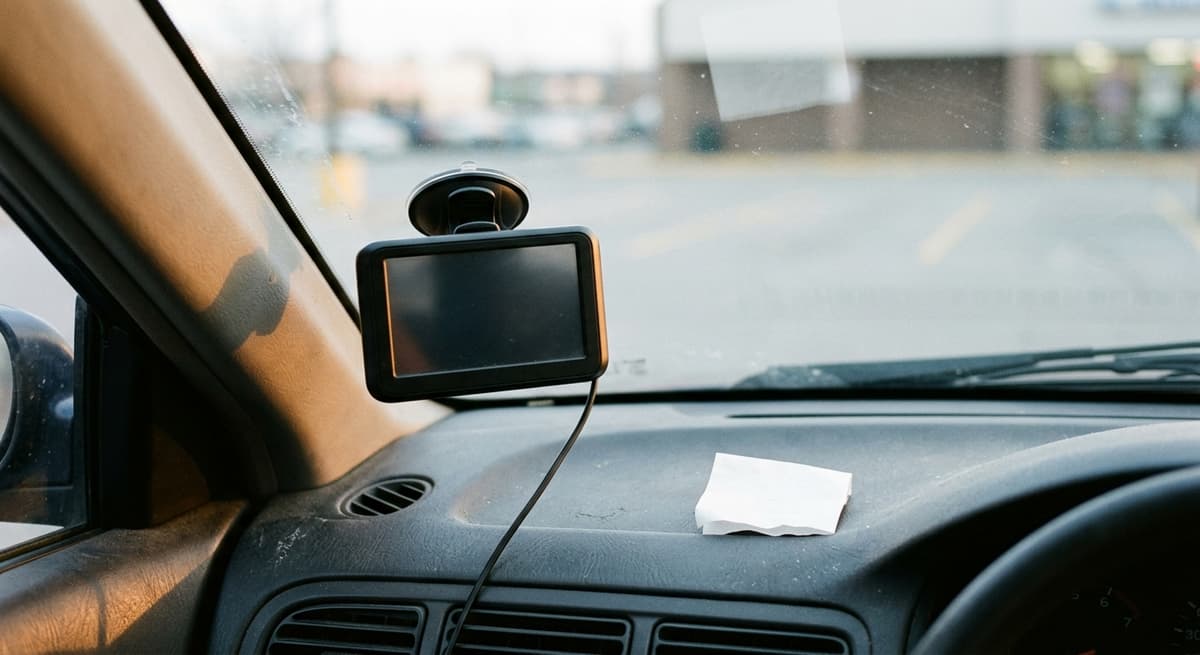
The Illinois change does not give drivers a free pass to clutter the glass. The materially-obstructs standard still governs, which means the placement of a phone mount, a navigation unit, or a dashcam remains a live legal question. A device positioned where it blocks the sweep of the windshield can still be a genuine violation, and in Illinois it can still be part of a stop when combined with other observed conduct.

That is why mounting rules differ so sharply across the country, and why the specifics matter before you stick anything to the glass. Our overview of windshield mounting restrictions lays out the recurring categories: total bans on windshield attachment, designated low-corner zones, and size limits measured in inches.
The contrast between neighboring approaches is instructive. Ohio is among the strictest jurisdictions, and our guide to Ohio windshield mounting laws explains why drivers there generally move phones and GPS units to the dashboard rather than the glass. Utah, by contrast, expressly allows certain windshield-mounted devices within defined size and position limits, as detailed in our breakdown of Utah windshield mounting laws. The Illinois reform addresses when police may stop you, but these state placement rules still decide whether your setup is legal in the first place.
Analysis: Why This Matters
The following analysis reflects the views of the Recording Law Editorial Team.

The Illinois statute is a clean example of how legislatures are working around, rather than against, the Whren framework. Because states cannot rewrite the Fourth Amendment, they are instead narrowing the menu of violations that can serve as a stop's sole justification. Removing the non-obstructing windshield object from that menu is a targeted move, and it is one other states have mirrored in different forms.
We think the most underappreciated detail is that the obstruction offense itself survived. Lawmakers did not legalize blocking your own view. They kept the safety rule and stripped out the enforcement hook that was being used for purposes unrelated to visibility. That distinction is exactly why the law reads as a civil-liberties measure rather than a deregulation of car safety, and it is why a dashcam or phone mount that truly blocks the glass is still a problem.
For drivers, the practical takeaways are limited but real. In Illinois, a single hanging air freshener should not, by itself, produce a lawful stop as of 2024. Everywhere, including Illinois, a device that materially obstructs the windshield is still a violation and still a risk. None of this is legal advice, and anyone who believes they were stopped or searched in violation of the statute should consult a licensed Illinois attorney rather than rely on a general summary. The larger lesson is that the legality of what sits on your windshield now lives in two separate places: the placement rules of your state, and the increasingly contested law of when that placement can justify police contact.
Frequently Asked Questions
What did Illinois HB 2389 change about windshield obstruction stops?
HB 2389, enacted as Public Act 103-0032, amended 625 ILCS 5/12-503 effective January 1, 2024 so that no vehicle, driver, or passenger may be stopped or searched by police solely on the basis of an object placed or suspended between the driver and the front windshield. The underlying ban on objects that materially obstruct the driver's view remains in force.
Is it now legal to hang an air freshener from my mirror in Illinois?
You may display small items like an air freshener, but the law still prohibits any object that materially obstructs your view of the road. The 2024 change means a non-obstructing item cannot be the sole reason for a traffic stop or search, not that view-blocking objects are permitted.
Did this law overturn the Whren pretextual-stop rule?
No. Whren v. United States, decided by the U.S. Supreme Court in 1996, holds that a stop based on an actual traffic violation is valid regardless of an officer's motive, and a state statute cannot overrule it. Illinois instead removed the windshield object as a qualifying sole basis, so under Whren there is no underlying violation to anchor a stop in that narrow situation.
Does the Illinois law affect phone mounts, GPS units, or dashcams?
Indirectly. A device that materially obstructs the windshield is still a violation in Illinois, so placement still matters. The law limits when a windshield object alone can justify a stop, but it does not change the rule that a view-blocking mount or camera is illegal.
Who sponsored the Illinois windshield obstruction reform?
The measure was advanced by Illinois Secretary of State Alexi Giannoulias and sponsored in the General Assembly by Rep. La Shawn Ford and Sen. Christopher Belt. Giannoulias publicly described stops over a hanging air freshener as archaic and called for ending them.
Do windshield mounting rules vary by state?
Yes, significantly. Some states bar windshield attachment outright, others allow it only in a small lower corner, and others set size limits measured in inches. Ohio is strict on windshield-mounted devices while Utah expressly permits certain mounts within defined limits, so check your specific state's placement rules.
The Law Behind This Article
This article rests on the statutory provisions below, held in our own legal record and retrieved from the official source. Tap a section to read the operative text.
Ohio Revised Code
§ 4513.241Using tinted glass and other vision obscuring materialsIn forcecited in 3 of our articles
(A) The director of public safety, in accordance with Chapter 119. of the Revised Code, shall adopt rules governing the use of tinted glass, and the use of transparent, nontransparent, translucent, and reflectorized materials in or on motor vehicle windshields, side windows, sidewings, and rear…
Official text (excerpt) · last checked 2026-07-31 · Read the full text in our law library · Verify at codes.ohio.gov
Cited in 37 court opinions in our collectionLatest citing opinion in our collection: 2026
In the courts (editorial summary, independently checked):Ohio courts separate the proof needed to stop from the proof needed to convict. State v. Scott (2022) held a conviction under R.C. 4513.241 requires proof the windows broke the light-transmittance limits in Adm.Code 4501-41-03; State v. Fleckinger (2024) held observed very dark tint supported a stop.
Opinions citing this section in our collection:
- State v. Scott (Ohio Court of Appeals 2022, 195 N.E.3d 244)✓Officers cited a driver for excessive tint on their testimony that they could not see into her Hyundai, never using a tint meter; the court reversed the conviction, holding that section 4513.241 requires proof the windows failed the administrative light-transmittance standards.
- State v. Fleckinger (Ohio Court of Appeals 2024, 2024 Ohio 5659)✓An agent stopped a car on I-75 because tint on the windshield and front windows was dark enough that he could not tell the driver's sex; the court held that observation gave reasonable suspicion of a section 4513.241 violation, though the tint was measured only afterward.
- State v. Johnson (Ohio Court of Appeals 2020, 154 N.E.3d 387)“…stigation of the tint violation. The State points out that R.C. 4513.241(C) prohibits operation of a vehicle tha…”
Identified automatically from the court opinions citing this section — not a ranking of which case controls.
Also relied on in: Ohio Windshield Mounting Laws (2026 Guide), Ohio Window Tint Laws (2026): Legal VLT Limits
Utah Code, Title 41: Motor Vehicles
§ 41-6a-1635Windshields and windows -- Tinting -- Obstructions reducing visibility -- Wipers -- Prohibitions.In forcecited in 4 of our articles
(1) Except as provided in Subsections (2), (3), and (4) a person may not operate a motor vehicle with: (a) a windshield that allows less than 70% light transmittance; (b) a front side window that allows less than 35% light transmittance, with no more than a 5% variance observed by a peace officer metering the light transmittance; (c) any windshield or window that is composed of, covered by, or treated with any material or component that presents a metallic or mirrored appearance; (d) any sign, poster, or other nontransparent material on the windshield or side windows of the motor vehicle except: (i) a certificate or other paper required to be so displayed by law; or (ii) the vehicle's identification number displayed or etched in accordance with rules made by the department under Section 41-6a-1601; or (e) any debris, frost, or other substance that materially obstructs the operator's view. (2) (a) A person may not operate a motor vehicle with an object or device hanging or mounted in a manner that materially obstructs the operator's view.
Official text (excerpt) · last checked 2026-09-08 · Read the full text in our law library · Verify at le.utah.gov
Cited in 3 court opinions in our collectionLatest citing opinion in our collection: 2023
Opinions citing this section in our collection:
- Harvey v. Butcher (District Court, D. Utah 2023)“…de windows that “allow less than 43% light transmittance.” Utah Code § 41-6a-1635(1)(b) (2015). Officer Simpson measured…”
- Linin v. Neff (District Court, D. Utah 2021)“…ff saw that Linin had a cracked windshield in violation of Utah Code § 41-6A-1635. Neff informed Linin of the reasons for…”
Identified automatically from the court opinions citing this section — not a ranking of which case controls.
Also relied on in: Utah Dashcam Laws, Utah Window Tint Laws (2026): Legal VLT Limits, Utah Windshield Mounting Laws (2026 Guide)
Search our full record of US law — 2.1 million sections, every state + federal →
Sources and References
- 625 ILCS 5/12-503, Illinois Vehicle Code, Windshields must be unobstructed and equipped with wipers (as amended by Public Act 103-0032; bars stopping or searching a vehicle solely for an object between the driver and front windshield)(ilga.gov).gov
- Illinois General Assembly, Bill Status for HB 2389 (103rd General Assembly), enacted as Public Act 103-0032, effective January 1, 2024(ilga.gov).gov
- Illinois Public Act 103-0032, amending Section 12-503 of the Illinois Vehicle Code (windshield obstruction enforcement limit)(ilga.gov).gov
- Illinois Secretary of State press release on HB 2389 (Giannoulias: pulling someone over for merely having an air freshener attached to the rearview mirror is archaic; air fresheners, rosaries, and disability placards)(ilsos.gov).gov
- Whren v. United States, 517 U.S. 806 (1996) (decided June 10, 1996), U.S. Supreme Court holding that a traffic stop supported by probable cause of a violation is reasonable regardless of the officer's subjective motive(law.cornell.edu)
- Ohio Revised Code Section 4513.241, using tinted glass and other vision-obscuring materials on windshields and windows(codes.ohio.gov).gov
- Utah Code Section 41-6a-1635, windshields and windows: tinting, obstructions reducing visibility, wipers, and prohibitions (including lower-corner windshield placement allowance)(le.utah.gov).gov