
Germany
Germany's Bußgeldkatalog: How Traffic Fines, Points and Driving Bans Work
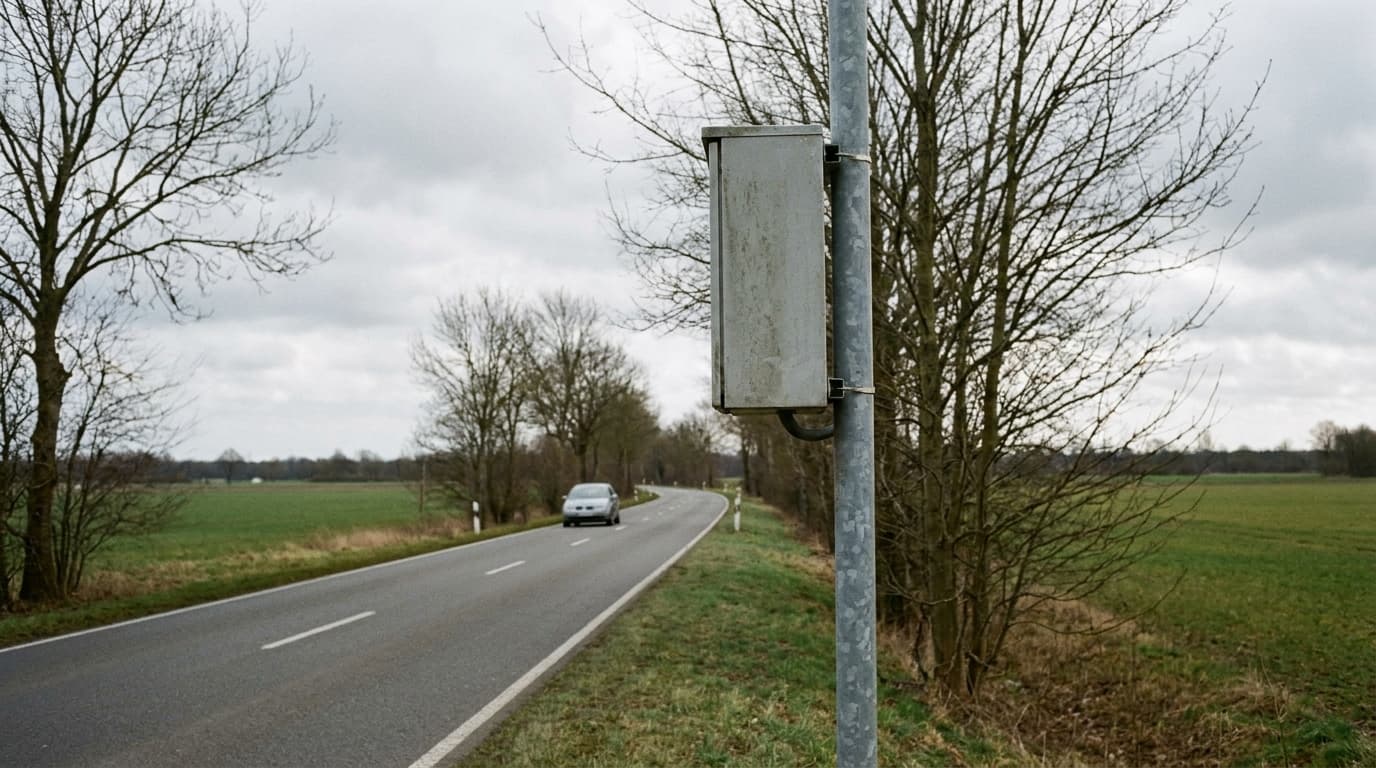
Germany runs one nationwide price list for traffic fines. Whether a car is clocked doing 62 km/h in a 50 zone in Munich, Hamburg or a small town in Saxony, the fine, the points and any driving ban all come from the same regulation. That single fact is what makes a fine calculator possible in the first place, and it is the opposite of the position in the United States, where every state sets its own speeding schedule.
This page works through that regulation, the Bußgeldkatalog-Verordnung (BKatV): its legal basis and structure, the full passenger car speeding tables, the separate rule that actually produces points, the tolerance deduction that is widely described as law but is not, and the two week window to challenge a notice once it arrives.
Information last verified on 19 July 2026. This page provides general legal information and does not constitute legal advice in an individual case.
One nationwide price list
Germany's 16 Bundesländer each run their own police force and their own Bußgeldstelle, the local office that processes speeding notices and issues fine decisions. What they do not do is set their own fine amounts.
The Bußgeldkatalog-Verordnung is a Bundes-Rechtsverordnung, a federal regulation, issued under the authorisation in § 26a StVG. It fixes warning amounts, standard fine amounts (Regelsätze) and driving ban rules for the whole country, and a Land government cannot raise or lower any of them.
That structural fact is why a lookup tool for German speeding fines is workable at all. A comparable US tool would need fifty separate tables, one per state. A German one needs exactly one. For the wider split of responsibility between the federal government and the Länder, see German law explained.
Verwarnungsgeld or Bußgeld
German traffic law runs on two separate tracks depending on how serious the violation is, and the distinction matters because only one of them can ever put points on a driver's record.
§ 56 OWiG lets an authority resolve a minor regulatory offense with a Verwarnung, a formal warning, and collect a Verwarnungsgeld of between 5 and 55 euro, in practice always one of the fixed steps set by § 2 BKatV: 5, 10, 15, 20, 25, 30, 35, 40, 45, 50 or 55 euro. A Verwarnung only takes effect if the driver agrees to it and pays within roughly a week. If they do not agree, the matter proceeds instead as a formal Bußgeldverfahren.
Once a violation is serious enough to carry a Regelsatz of 60 euro or more under § 1 BKatV, it is handled as a Bußgeld through a formal Bußgeldbescheid rather than a roadside Verwarnung. That same 60 euro line is also, separately, the threshold that decides whether the violation is entered on the Fahreignungsregister at all, covered further below.
How the BKatV itself is structured
The regulation itself is short. § 1 sets out the Bußgeldkatalog as the Anlage, the appendix to the regulation, and states that fines follow the amounts listed there. § 2 covers the Verwarnung mechanics above. § 3 sets the rules for adjusting a Regelsatz up or down. § 4 defines the Regelfahrverbot, the driving ban that attaches automatically to certain catalog entries. § 5 is the commencement and repeal clause.
The real content sits in the Anlage itself, the Bußgeldkatalog, and in its own Anhang of numbered tables. Table 1 covers the speed offenses referenced at item 11 of the catalog, Table 2 covers distance offenses, Table 3 covers a set of parking and stopping items, and Table 4 covers the vehicle categories addressed separately in § 3 Abs. 3.
§ 3 also shows that a Regelsatz is not fixed in stone. Under § 3 Abs. 4a, a violation committed intentionally rather than negligently generally doubles the standard rate. Under § 3 Abs. 5, an authority can reasonably increase the rate where several violations concur. Under § 3 Abs. 6, pedestrians and cyclists get reduced rates rather than the motor vehicle figures. That flexibility is the mechanism behind a rule worth keeping in mind throughout this page: the number printed in the table assumes an ordinary, negligent, first time violation under normal circumstances, not every possible fact pattern.
Passenger car speeding fines: how the tables work
The Anhang's Table 1, at Buchstabe c, covering ordinary motor vehicles other than trucks, buses and certain other classes, sets the standard speeding fine and any attached driving ban from two variables: whether the violation happened inside a built up area (innerorts) or outside one (außerorts), and how many km/h over the limit the driver was measured.
The bands are not linear. A small excess inside a town costs far more, in both euro and eventual points, than the same excess on the open road, because German traffic law treats speeding around pedestrians and cyclists as a materially different risk from speeding on a rural through road.
A worked example: a car is measured doing 65 km/h in a 30 km/h zone inside a town. Applying the standard 3 km/h tolerance deduction, covered fully below, brings the counted speed to 62 km/h, which is 32 km/h over the limit. That lands in the 31 to 40 km/h band for an innerorts violation: a 260 euro fine, a one month Fahrverbot, and an entry on the Fahreignungsregister because the fine clears 60 euro.
The calculator below runs that same lookup for any limit, measured speed and area, including the tolerance step.
Speeding fine calculator (Bußgeldkatalog)
The Bußgeldkatalog is federal, so the same figures apply in all 16 Bundesländer. Based on the passenger car table in the BKatV.
Where did it happen?
This calculator gives general information based on the federal Bußgeldkatalog and is not legal advice in an individual case. The result is not a binding calculation and does not replace the official Bußgeldbescheid.
The full speeding tables
Both tables below are the Regelsatz for an ordinary passenger car under normal, first offense circumstances, as set out in Anhang Tabelle 1 Buchstabe c of the BKatV, taken from Anhang Tabelle 1 to the Bußgeldkatalog, whose own Fundstelle is BGBl. I 2021, 4701 to 4703. The BKatV as a whole was last amended on 30 January 2026 (BGBl. 2026 I Nr. 32, in force 1 April 2026), but that amendment is not the source of the figures below.
Innerorts (inside a built up area)
| km/h over the limit | Fine | Fahrverbot |
|---|---|---|
| Up to 10 | 30 euro | None |
| 11 to 15 | 50 euro | None |
| 16 to 20 | 70 euro | None |
| 21 to 25 | 115 euro | None |
| 26 to 30 | 180 euro | None |
| 31 to 40 | 260 euro | 1 month |
| 41 to 50 | 400 euro | 1 month |
| 51 to 60 | 560 euro | 2 months |
| 61 to 70 | 700 euro | 3 months |
| Over 70 | 800 euro | 3 months |
Außerorts (outside a built up area)
| km/h over the limit | Fine | Fahrverbot |
|---|---|---|
| Up to 10 | 20 euro | None |
| 11 to 15 | 40 euro | None |
| 16 to 20 | 60 euro | None |
| 21 to 25 | 100 euro | None |
| 26 to 30 | 150 euro | None |
| 31 to 40 | 200 euro | None |
| 41 to 50 | 320 euro | 1 month |
| 51 to 60 | 480 euro | 1 month |
| 61 to 70 | 600 euro | 2 months |
| Over 70 | 700 euro | 3 months |
Separate, generally higher tariffs apply to vehicles covered by § 3 Abs. 3 Nr. 2 StVO and to placarded hazmat and bus vehicles. Those tables are not reproduced here.
Where points actually come from
None of the numbers above are the point figure. Points are a separate legal question, governed by § 40 FeV together with Anlage 13 to that regulation, while the 60 euro entry threshold itself comes from § 28 Abs. 3 StVG, and they are administered by the Kraftfahrt-Bundesamt through the Fahreignungsregister, the successor to the old Verkehrszentralregister.
The practical rule most drivers encounter is the 60 euro line: a traffic Ordnungswidrigkeit listed in Anlage 13 is entered on the register, and scored, only once the fine reaches 60 euro or more. Below that, a Verwarnungsgeld under § 2 BKatV leaves no trace on the register at all.
Where an entry is made, Anlage 13 assigns either one or two points, with two points reserved for violations the regulation marks as particularly affecting road safety. We have not independently pulled the exact km/h boundary within the speeding table where that marking starts, so this page states the 60 euro trigger, which is solid, rather than a precise per band point count.
For the wider point system, the eight point licence loss threshold and how points reduce over time, see points in Flensburg.
The tolerance deduction is not a law
Almost every German driver has heard of a fixed deduction applied before a speeding fine is calculated: 3 km/h off a measured speed up to 100 km/h, or 3 percent off above that. It is real, it is applied in practice, and it is not, on its own, written into the StVO or the BKatV.
The deduction comes from settled Oberlandesgericht case law, built around the approved error margin the Physikalisch-Technische Bundesanstalt sets when it certifies a given measuring device for use. It functions as a built in safety margin against instrument error, not as a right created by the fine schedule itself. Content that describes it as a statutory entitlement is overstating what it actually is.
A separate and larger deduction applies where the measurement was not taken by a standardised, approved method, for example a following vehicle's speedometer that was not itself calibrated for the purpose. Courts typically require a considerably larger safety margin there, commonly cited at around 20 percent off the measured differential, precisely because that method carries more room for error than a calibrated fixed device.
For the enforcement side of this, including how speed cameras (Blitzer) work and what to check on a notice, see speed cameras.
Challenging a fine: the two week window
§ 67 OWiG gives a driver two weeks from delivery of a Bußgeldbescheid to file a written Einspruch, an objection, with the issuing authority. There is no requirement to state reasons in that initial filing. The deadline itself is what matters.
Miss the two week window and the notice generally becomes final, including the fine amount, any points and any Fahrverbot it carries. A late objection can occasionally still be accepted through a separate Wiedereinsetzung procedure, but that is the exception rather than something to plan around.
See challenging a fine for the fuller procedure, including what an Akteneinsicht request, a file inspection, can show about how the measurement was actually taken.
Driving bans: the basics
§ 25 StVG sets the outer frame for a Fahrverbot: one to three months, covering motor vehicles of any type or a specific type named in the order. The BKatV's § 4 Regelfahrverbot rule is what actually triggers a ban at set thresholds in the catalog, including the speeding bands shown above.
A ban does not start the moment a Bußgeldbescheid is issued. It generally takes effect once the licence is physically surrendered or noted, and no later than one month after the decision becomes final. A driver who has not had a Fahrverbot in the preceding two years can generally have that window extended to up to four months, to arrange time off work or similar.
Driving bans, and how they differ from a full Fahrerlaubnisentzug, a full licence revocation, are covered in full at driving bans.
What this page covers, and what it does not
Everything above concerns an ordinary passenger car under the Regelsatz in Anhang Tabelle 1 Buchstabe c. Separate, generally higher tariffs apply to vehicles under § 3 Abs. 3 Nr. 2 StVO and to placarded hazmat and bus vehicles, and this page does not attempt to reproduce those.
Alcohol and drug related driving offenses sit under different statutes entirely, § 24a and § 24c StVG and § 316 StGB, with their own fine and licence consequences. See drink driving limits for that separate framework.
Frequently Asked Questions
Is the German speeding fine catalogue the same in every state?
Yes. The Bußgeldkatalog-Verordnung is a federal regulation made under § 26a StVG, so the fine, point and Fahrverbot amounts are identical in all 16 Bundesländer. Only the local Bußgeldstelle handling the paperwork differs.
What is the difference between a Verwarnungsgeld and a Bußgeld?
A Verwarnungsgeld is a fixed 5 to 55 euro warning fine under § 56 OWiG and § 2 BKatV that only takes effect if the driver agrees to it. A Bußgeld of 60 euro or more is a formal Bußgeldbescheid, and it is that formal notice, not the warning, that can be entered on the Fahreignungsregister.
Is the 3 km/h tolerance for speed cameras written into German law?
No. It comes from settled court practice tied to a measuring device's approved error margin, not from the StVO or the BKatV directly. A separate, larger deduction of around 20 percent applies where the measurement was not taken by a standardised method.
How many points do I get for speeding?
Points are set under § 40 FeV and Anlage 13, not by the BKatV fine table. The main practical trigger is that a fine of 60 euro or more brings an entry on the Fahreignungsregister, generally scored at one or two points depending on how the specific violation is classified.
How long is there to challenge a speeding fine?
Two weeks from delivery of the Bußgeldbescheid, under § 67 OWiG. The Einspruch, the objection, must be in writing or filed for the record with the issuing authority within that window.
How long is a Fahrverbot for speeding?
Between one and three months, set by § 25 StVG, with the exact length in a given case coming from the Regelfahrverbot bands in the BKatV shown on this page. It does not start immediately. It generally begins once the licence is surrendered, no later than one month after the decision becomes final, or up to four months in some first time cases.
Does the same fine table apply to trucks and buses?
No. Vehicles covered by § 3 Abs. 3 Nr. 2 StVO, along with placarded hazmat and bus vehicles, are fined under a separate, generally higher tariff. This page covers ordinary passenger cars only.
Sources and References
- § 26a StVG, Ermächtigung zum Erlass der Bußgeldkatalog-Verordnung(gesetze-im-internet.de).gov
- § 24 StVG, Bußgeldvorschriften(gesetze-im-internet.de).gov
- § 1 BKatV, Bußgeldkatalog(gesetze-im-internet.de).gov
- § 2 BKatV, Verwarnung(gesetze-im-internet.de).gov
- § 3 BKatV, Bußgeldregelsätze(gesetze-im-internet.de).gov
- § 4 BKatV, Regelfahrverbot(gesetze-im-internet.de).gov
- Anlage zu § 1 Absatz 1 BKatV, Bußgeldkatalog (BKat) mit Anhang Tabelle 1(gesetze-im-internet.de).gov
- § 40 FeV, Fahreignungs-Bewertungssystem(gesetze-im-internet.de).gov
- Anlage 13 FeV, Zuwiderhandlungen nach dem Fahreignungs-Bewertungssystem(gesetze-im-internet.de).gov
- § 56 OWiG, Verwarnung durch die Verwaltungsbehörde(gesetze-im-internet.de).gov
- § 67 OWiG, Einspruch gegen den Bußgeldbescheid(gesetze-im-internet.de).gov
- § 25 StVG, Fahrverbot(gesetze-im-internet.de).gov
- Kraftfahrt-Bundesamt, Fahreignungs-Bewertungssystem(kba.de).gov
- Anhang Tabelle 1 zum Bußgeldkatalog, Geschwindigkeitsüberschreitungen(gesetze-im-internet.de).gov
- § 28 StVG, Fahreignungsregister und die 60-Euro-Eintragungsschwelle(gesetze-im-internet.de).gov