Nunavut
Nunavut Slip and Fall Laws: Common-Law Negligence
Independently fact-checked against primary sources (last audited June 18, 2026). · 4 primary sources cited on this page. How we verify our legal content
Slip and fall claims in Nunavut are governed entirely by the common law of negligence. Unlike most Canadian provinces, Nunavut has never enacted an Occupiers' Liability Act. That means there is no single statute replacing the traditional duty-of-care categories. Instead, courts assess an occupier's conduct against the ordinary negligence standard derived from the common law: did the occupier take reasonable care in the circumstances to prevent foreseeable harm?
Understanding that framework matters if you are injured on someone else's property in Nunavut. You must prove the same elements as any negligence claim, the deadline to sue is set by territorial legislation, and falls on publicly owned land involve an added layer of government-liability considerations. This page explains how all of those pieces fit together.
The legal framework: why Nunavut uses common-law negligence
When Nunavut became a territory on April 1, 1999, it inherited the statute book that had applied in the Northwest Territories and then set its own legislative path. Nunavut's Legislature has enacted legislation covering many areas of civil life, but it has never passed an Occupiers' Liability Act. The Government of Nunavut's consolidated statute registry confirms this: there is no Occupiers' Liability Act in force in the territory.
That absence is significant. Six Canadian provinces (Ontario, British Columbia, Alberta, Manitoba, Nova Scotia, and Prince Edward Island) replaced the old common-law categories of visitors with a single statutory duty requiring occupiers to take "such care as in all the circumstances is reasonable to see that persons entering on the premises are reasonably safe." Nunavut, like the Northwest Territories, Yukon, New Brunswick, Saskatchewan, and Newfoundland and Labrador, instead relies on the pre-existing common law.
Under the common law, the duty an occupier owes historically depended on the legal category of the visitor: an invitee (a business customer, for example) was owed the highest duty; a licensee (a social guest) a somewhat lower duty; and a trespasser merely a duty not to deliberately or recklessly harm them. While modern Canadian courts have broadly applied the negligence principles from Anns v. Merton London Borough Council and Cooper v. Hobart to move toward a unified reasonable-care approach, the absence of statutory language means you cannot simply point to a section number. Your case is built on the elements of negligence as articulated through the case law.
Practically, the result is similar to what an OLA province produces. A court will ask whether the occupier knew or ought to have known of the hazardous condition, what a reasonable occupier would have done about it, and whether the failure to act caused your injury. The difference is that there is no statute to cite as your starting point, and the burden of proof sits entirely on you as the claimant to establish each element.
The four elements you must prove
Every slip and fall claim in Nunavut requires you to establish four things.
Duty of care. The occupier must have owed you a legal obligation to take care for your safety. Occupiers of premises (owners, tenants, or anyone in control of land or a building) owe a duty of care to persons who enter with their permission. A customer walking into a Iqaluit store, a visitor entering a community hall, or a resident using a common-area stairwell in an apartment building is owed that duty. The precise scope of the duty can depend on the relationship between the parties and the nature of the premises.
Breach. The occupier failed to meet the standard of a reasonable occupier in the circumstances. This is where most disputed slip and fall cases are won or lost. You must show the occupier either created the dangerous condition, had actual notice of it (an employee knew about the icy entrance mat, for example), or had constructive notice (the hazard had been present long enough that a reasonable inspection program would have caught it). Evidence like incident reports, photographs, witness accounts, and maintenance logs all bear on this question.
Causation. The breach caused your fall and your injuries. You must trace the connection between the specific hazard and your specific harm. A wet floor sign placed after you fell is evidence of prior notice; a maintenance log showing no inspections for three days before an icy walkway is evidence of constructive notice and causation.
Damages. You suffered a compensable loss. Medical records, treatment receipts, wage records, and expert evidence all support the quantum of your claim.
Common hazards in Nunavut and the duty of care
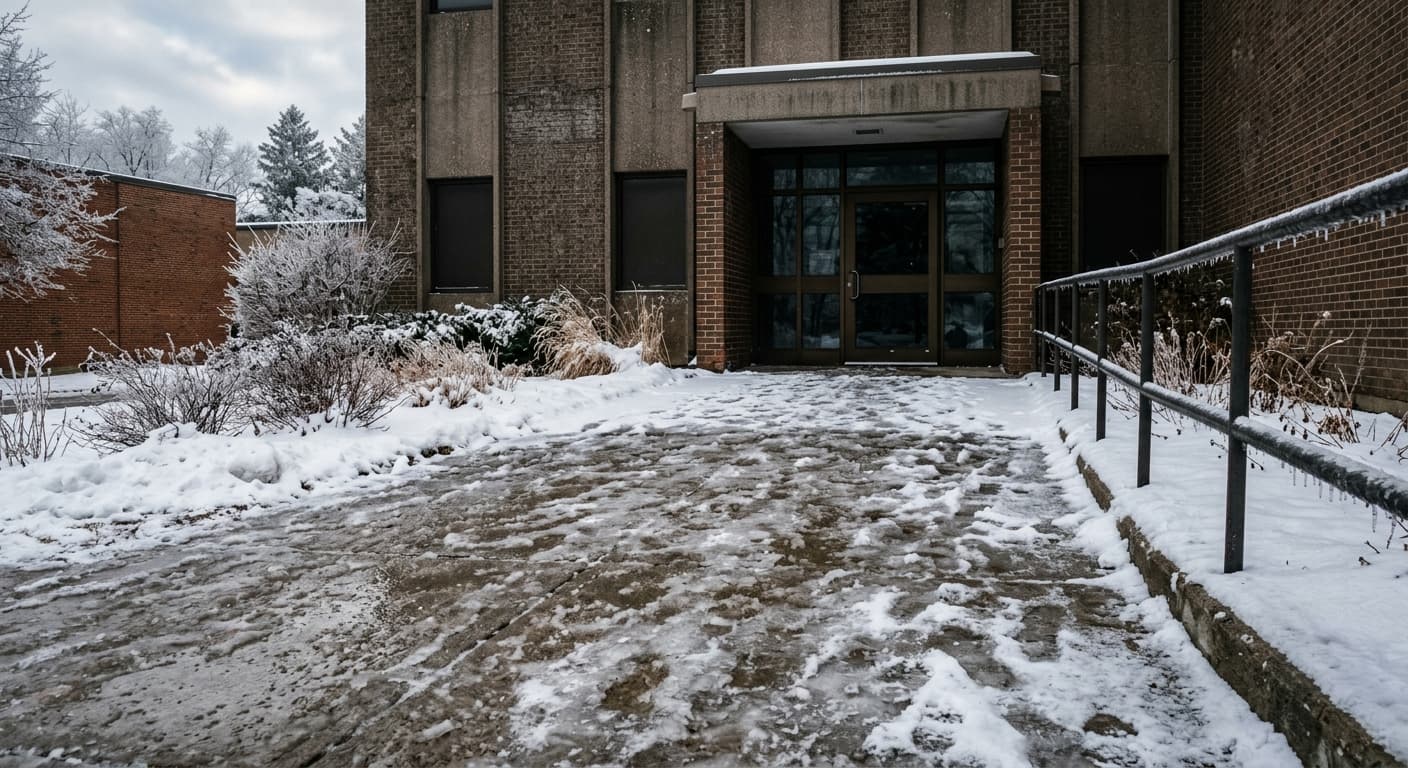
Nunavut's climate creates particular premises hazards. Ice and snow accumulation on walkways, building entrances, and parking areas is a reality for much of the year. Under the common-law negligence standard, an occupier in Nunavut cannot simply say that ice formed naturally and therefore is not their problem. The relevant question is whether the occupier took reasonable steps given the foreseeable risk. In a territory where sub-zero temperatures and blowing snow are the norm for six months or more, courts applying a reasonable-care standard would be expected to find that regular inspection, salting, sanding, and shovelling are part of what a reasonable occupier does.
Other common hazards include wet floors in commercial premises, uneven or damaged flooring in residential buildings, inadequate lighting in stairwells and hallways, and poorly maintained exterior walkways. The notice element is critical for all of these. If a spill occurred moments before your fall and no employee had an opportunity to observe and address it, the occupier may not be liable. If the spill had been present for an hour during business hours, the argument for constructive notice is strong.
The condition of the premises at the time of the fall is the central factual question. Document everything you can: take photographs of the hazard before it is cleaned up, get the names of any witnesses, request a copy of the incident report, and see a doctor promptly so your injuries are documented close in time to the event.
The trespasser question under common law
Because Nunavut applies common-law negligence rather than a statute, the old categories of visitor still have some analytical relevance even if courts tend to look at the overall reasonableness of the occupier's conduct. A trespasser who enters premises without permission stands in a weaker position than an invited visitor. At common law, the duty owed to a trespasser has historically been limited to not deliberately or recklessly injuring them. Courts may ask whether the occupier knew children or others were likely to trespass and whether the dangerous condition was a concealed trap or attraction.
In practice, most legitimate slip and fall claims arise where the claimant had permission to be on the property. The trespasser issue arises most often in cases involving fenced-off worksites, locked facilities entered through broken barriers, or residential properties entered without consent.
How fault is shared: Nunavut's Contributory Negligence Act
Nunavut has a Contributory Negligence Act, confirmed in the territory's consolidated legislation registry. The Act replaces the harsh common-law rule that any fault on the part of a claimant completely barred their recovery. Under the Act, damages are apportioned in proportion to each party's degree of fault. If you are found 30% responsible for your own fall (because you were distracted or wearing inappropriate footwear for the conditions), your award is reduced by 30%. You are not barred from recovering the remaining 70%.
This is consistent with the approach taken across Canada. All provinces and the other territories have abolished the all-or-nothing contributory negligence bar in favour of proportionate apportionment. Defendants in slip and fall cases routinely argue contributory negligence, pointing to footwear choices, failure to observe visible warnings, awareness of the hazard before proceeding, or rushing on a known icy surface. These arguments go to reducing the award, not to eliminating it entirely.
When a court cannot determine the precise degree of fault of each party, liability is typically shared equally. As a practical matter, the contributory negligence argument reinforces the importance of documenting your own conduct at the time of the fall: witnesses who can say you were walking carefully and at a normal pace, or photographs showing no warning signs were present, help answer the contributory-negligence argument at trial.
Limitation period: 2 years from when the cause of action arises
The deadline for commencing a slip and fall claim in Nunavut is set by the Limitation of Actions Act, RSNWT(Nu) 1988 c L-8. Under s.2(1)(d), actions for trespass to the person, assault, battery, wounding or other injury to the person, whether arising from an unlawful act or from negligence, must be commenced within 2 years after the cause of action arose. A slip and fall is injury to the person arising from negligence, so the 2-year period applies. The 6-year period that appears in this Act is the residual limitation period for other classes of action, not for personal injury. The clock begins when the cause of action arises, which for most slip and fall injuries is the date of the fall itself.
Unlike the modern limitations statutes in several provinces, the RSNWT(Nu) 1988 Act is not a discovery-based regime across the board. The 2-year period runs from when the cause of action arose, not from when the claimant learned of their rights. One exception is where the existence of a cause of action has been concealed by fraud: in that case the period runs from when the fraud was first known or discovered. Minors and persons under a legal disability typically benefit from tolling provisions that pause the period during their incapacity.
Two years is a relatively short window, and missing the deadline is fatal to your claim absent very narrow exceptions. If you believe you have a slip and fall claim, consulting a lawyer promptly after the injury is still strongly advisable. Evidence degrades quickly: witnesses' memories fade, photographs of the hazard become unavailable, and maintenance records may be purged. An early consultation preserves options and ensures you take no steps that inadvertently prejudice your position.
Claims against government in Nunavut
Falls on government-owned or government-controlled property raise additional considerations. Nunavut does not have a standalone Proceedings Against the Crown Act. Claims against the Government of Nunavut are governed by the territorial Financial Administration Act, RSNWT(Nu) 1988 c F-4, which regulates the financial obligations of the territorial government and provides the framework under which judgments against the Crown in right of Nunavut are satisfied. Hamlets (local governments in Nunavut) and other public bodies may also be named as defendants when the fall occurs on municipal land, a public building, or a publicly maintained road or path, with recourse under the Cities, Towns and Villages Act and the Hamlets Act.
Government defendants often raise arguments about the reasonableness of the steps they took to maintain public infrastructure given the territory's budget constraints, the severity of the climate, and the geographic challenges of maintaining facilities in remote Arctic communities. These arguments do not eliminate the duty of care owed to users of public spaces, but they are part of the factual assessment of whether the standard of reasonable care was met.
One practical consideration is that government bodies often have internal notice or reporting procedures. While Nunavut does not have a short-notice-of-claim provision comparable to Ontario's 10-day municipal notice rule under the Municipal Act, 2001, it is advisable to notify the relevant government entity in writing as soon as possible after a fall on public property. Prompt notice preserves evidence, triggers any internal investigation, and puts the respondent on notice before memories fade and physical conditions change. A lawyer experienced in territorial government liability can advise on whether any specific procedural requirements apply to your claim.
What damages are available
If your claim succeeds, you may recover two broad categories of damages.
Economic (pecuniary) damages compensate for actual out-of-pocket losses and future financial consequences. These include medical expenses (hospital fees, specialist treatment, physiotherapy, medication, medical equipment), lost income during your recovery, reduced earning capacity if the injury affects your long-term ability to work, and future care costs if your injuries require ongoing treatment. Economic damages are calculated based on evidence: bills, pay stubs, employer records, and expert actuarial or medical opinion for future losses. There is no cap on economic damages in Canadian personal injury law.
Non-economic (non-pecuniary) damages compensate for pain and suffering, loss of enjoyment of life, and loss of amenities. The Supreme Court of Canada established an informal cap on non-pecuniary general damages in Andrews v. Grand & Toy Alberta Ltd, 1978 CanLII 1 (SCC). Indexed for inflation, that cap sits at approximately CAD $430,000 to $450,000 in 2025 dollars. This cap is not statutory, and courts may depart from it in exceptional circumstances, but it represents the practical ceiling on pain-and-suffering awards for even the most severe injuries in Canada. For many slip and fall injuries, the non-pecuniary award will be a fraction of that figure, calibrated to the severity and permanence of the harm.
Both categories of damages are subject to reduction by your percentage of contributory fault. If the total award would be $200,000 and you are found 25% at fault, your recovery is $150,000.
Aggravated and punitive damages are available in principle but rarely awarded in slip and fall cases absent egregious or deliberate conduct by the occupier.
What to do after a fall in Nunavut
The steps you take in the hours and days after a fall shape the strength of any subsequent claim.
Report the incident immediately to the property owner, manager, or occupier, and ask for a written incident report. If one is created, request a copy. If you can safely do so, photograph the hazard and the surrounding area, including any (or any absence of) warning signs. Note the time, date, weather conditions, lighting, and the specific surface condition. Gather the names and contact details of any witnesses.
Seek medical attention promptly. Delayed treatment creates room for an argument that your injuries were not serious or were caused by something other than the fall. A contemporaneous medical record tying your injuries to the incident is a critical piece of evidence.
Preserve everything. Keep the footwear you were wearing; do not wash or discard clothing from the day of the fall. Hold on to any receipts for medical expenses. Document your recovery in a journal if your injuries significantly affect your daily life.
Finally, consult a lawyer. Nunavut's small but experienced legal community includes practitioners who handle civil litigation, and many lawyers in the territory and elsewhere in Canada will advise on the merits of a claim. The 2-year limitation period for personal injury runs quickly, and that window closes fast, so early legal advice ensures you do not take any steps that inadvertently prejudice your position.
This article is general legal information, not legal advice. Premises liability law can change, and how it applies to a specific incident depends on the particular facts. For advice about a fall that occurred in Nunavut, consult a lawyer licensed to practise in the territory or in another Canadian jurisdiction.
Related: Canada Slip and Fall Laws (hub) | Northwest Territories Slip and Fall Laws | Yukon Slip and Fall Laws
Related Canadian Guides
- Canadian law by province and topic
- Slip and Fall laws in Canada
- Nunavut Recording laws
- Nunavut Hit and Run laws
- Nunavut Child Support laws
Frequently Asked Questions
Does Nunavut have an Occupiers' Liability Act?
No. Nunavut has never enacted an Occupiers' Liability Act. Slip and fall claims in the territory are governed by the common law of negligence. You must prove the occupier owed you a duty of care, breached it by failing to maintain reasonably safe premises, and that the breach caused your injury and damages.
How long do I have to sue after a slip and fall in Nunavut?
The limitation period for personal injury is 2 years from the date the cause of action arises, under s.2(1)(d) of the Limitation of Actions Act, RSNWT(Nu) 1988 c L-8 (injury to the person from negligence). For most falls, the clock starts on the date of the incident. This is the same as the 2-year period in most provinces, and missing the deadline will bar your claim. Consult a lawyer promptly to preserve evidence and assess your options.
What must I prove in a Nunavut slip and fall case?
You must establish four elements: (1) the occupier owed you a duty of care, (2) they breached it by failing to keep the premises reasonably safe, (3) that breach caused your fall, and (4) you suffered compensable damages. There is no statutory shortcut in Nunavut; each element must be proven through evidence.
Can I still recover if I was partly at fault for my fall?
Yes. Nunavut's Contributory Negligence Act replaces the old all-or-nothing common-law rule with proportionate apportionment. Your damages are reduced by your percentage of fault, but you are not barred from recovering. If you are found 25% at fault and your damages total $100,000, you recover $75,000.
What if I slipped on ice outside a building in Nunavut?
Occupiers in Nunavut owe a duty of reasonable care to persons entering their premises. Given Nunavut's extreme climate, regular maintenance of walkways, entrances, and parking areas against ice and snow accumulation is part of what reasonable care requires. The key question is whether the occupier knew or ought to have known of the icy condition and failed to take reasonable steps to address it.
Can I sue a Hamlet or the Government of Nunavut for a fall on public property?
Yes. The territorial government is subject to civil claims governed by the Financial Administration Act, RSNWT(Nu) 1988 c F-4. Hamlets and other local governments can also be named as defendants under applicable territorial municipal legislation. Government defendants may raise arguments about the reasonableness of maintenance given resource and climate constraints, but those are factual matters for the court. Notify the relevant public body in writing as soon as possible after a fall on public property, and consult a lawyer about any applicable procedural requirements.
Is there a cap on pain and suffering damages in Nunavut?
There is no statutory cap, but the Supreme Court of Canada's informal ceiling on non-pecuniary general damages from Andrews v. Grand & Toy Alberta Ltd (1978 SCC) applies across Canada. Indexed for inflation, it sits at approximately CAD $430,000 to $450,000 in 2025 dollars. Economic damages (medical bills, lost income, future care) are uncapped.
Do the visitor categories (invitee, licensee, trespasser) still matter in Nunavut?
They can be relevant because Nunavut applies the common law rather than a statutory single-duty framework. Courts focus on the overall reasonableness of the occupier's conduct, but the traditional categories can inform the analysis. An invited customer is owed the highest duty of care. A trespasser is owed only a duty not to be deliberately or recklessly harmed.
Updates
Independently fact-checked against the cited primary sources
Sources and References
- Nunavut Legislation Registry, consolidated statute index (letter O): no Occupiers' Liability Act in force in Nunavut(nunavutlegislation.ca).gov
- Limitation of Actions Act, RSNWT(Nu) 1988 c L-8: 6-year general limitation period for personal injury claims, running from when the cause of action arises(nunavutlegislation.ca).gov
- Contributory Negligence Act (Nunavut, Official Consolidation): proportionate apportionment of damages replaces all-or-nothing contributory negligence bar(nunavutlegislation.ca).gov
- Andrews v. Grand & Toy Alberta Ltd, 1978 CanLII 1 (SCC): SCC informal cap on non-pecuniary general damages, indexed to approx. CAD $430,000 to $450,000 (2025)(canlii.org)
- Stacey v. Anglican Churches of Canada, 1999 CanLII 18933 (NLCA): common-law negligence standard for occupiers confirmed in a jurisdiction with no OLA(canlii.org)
- Financial Administration Act, RSNWT(Nu) 1988 c F-4: territorial framework governing financial obligations of the Government of Nunavut, including satisfaction of civil judgments against the Crown in right of Nunavut(nunavutlegislation.ca).gov