
Northwest Territories
Northwest Territories Slip and Fall Laws (2026)
Independently fact-checked against primary sources (last audited June 18, 2026). · 3 primary sources cited on this page. How we verify our legal content
Northwest Territories Slip and Fall Law: The Common-Law Framework
The Northwest Territories is one of three Canadian territories (alongside Yukon and Nunavut) that has never enacted an Occupiers' Liability Act. Across most of Canada, a dedicated statute replaced the old common-law categories of invitee, licensee, and trespasser with a single statutory duty of care. In the Northwest Territories, those older common-law principles and the modern law of negligence continue to govern what happens when a person is injured by a hazardous condition on someone else's property.
That distinction matters in practice. In a territory with an Occupiers' Liability Act, a court starts by asking whether the occupier met the statutory standard, a relatively streamlined analysis. In the NWT, a court applies general negligence principles: the plaintiff must prove that the defendant owed a duty of care, that the defendant breached that duty by failing to act reasonably, and that the breach caused the plaintiff's injury and resulting loss. There is no shortcut statutory presumption. The analytical framework is the same common-law negligence test that governs all of Canada, shaped by foundational Supreme Court of Canada decisions including the neighbour principle from Donoghue v. Stevenson and the proximity-and-policy framework from Anns v. Merton London Borough Council as adopted and refined in Canadian law.
Because NWT applies common law, courts in the territory draw on the full body of Canadian negligence jurisprudence, including decisions from other common-law provinces and territories and from the Supreme Court of Canada. A British Columbia or Alberta occupiers' liability decision interpreting what "reasonable care" means in a given context can be persuasive authority in an NWT court, even though the NWT has no equivalent statute.
No Occupiers' Liability Act: What That Means for Your Claim
When an Occupiers' Liability Act applies, it abolishes the old visitor-category distinctions and imposes a single duty: an occupier must take such care as is reasonable in all the circumstances to see that persons entering the premises will be reasonably safe. That duty runs equally to invitees and licensees.
The Northwest Territories has not enacted that reform. NWT courts therefore apply the traditional common-law framework, adjusted through modern negligence principles. Under that framework, the duty owed to a visitor depends partly on the relationship between the visitor and the occupier.
An invitee (someone invited to enter for a purpose connected to the occupier's business or activity) is owed the highest common-law duty. The occupier must use reasonable care to prevent damage from unusual danger of which the occupier knows or ought to know and which the visitor does not know. A licensee (someone permitted to enter but without a specific business invitation) is owed a duty to warn of any known concealed dangers. A trespasser (someone who enters without permission) is owed only a duty not to set traps or create dangers with the deliberate intention of causing harm.
In practice, Canadian courts applying common-law negligence have largely converged on a standard very close to the OLA provinces' statutory formulation: an occupier must act reasonably to ensure the safety of lawful visitors. The Supreme Court of Canada's modern negligence framework asks whether there is a relationship of proximity giving rise to a prima facie duty, whether the defendant's conduct fell below the standard of a reasonable person in that position, and whether the harm was a foreseeable consequence of the breach. In a slip and fall context, the court asks: did the occupier know or ought to have known about the hazard, and did the occupier take reasonable steps to address it in time?
Duty of Care Under Common-Law Negligence
Because the NWT applies common-law negligence, every element of the tort must be established by the plaintiff on a balance of probabilities.
Duty. In a slip and fall claim, the occupier owes a duty of care to any person whose presence on the premises is reasonably foreseeable. A customer entering a retail store, a tenant using a building's common areas, a visitor at a friend's home, or a pedestrian crossing a privately maintained walkway are all owed a duty by the occupier. That duty arises from the proximity of the relationship and is established by decades of Canadian case law.
Breach. The occupier must act as a reasonable person would in the circumstances. What is reasonable depends on the nature of the premises, the likely class of visitors, the foreseeability of the hazard, and the practicality of taking precautions. A commercial grocery store is expected to inspect its aisles frequently and respond quickly to spills. A private homeowner hosting guests is expected to keep common paths safe but is not held to the same operational standards as a commercial operator. A landlord maintaining a residential building owes tenants in common areas a duty to conduct reasonable inspections and to repair known hazards within a reasonable time.
Courts examining slip and fall cases ask questions such as: How long had the hazard existed before the fall? Did the occupier know or ought to have known about it? Were reasonable inspection procedures in place and followed? Were warnings posted where appropriate? Was maintenance carried out regularly? The longer a hazard has been present and the more foreseeable the risk of injury, the harder it is for an occupier to show that its conduct was reasonable.
Causation. The plaintiff must prove that the occupier's breach was a cause of the injury. In most slip and fall cases this is straightforward: the plaintiff fell on a hazardous surface that the occupier failed to address, and the fall caused the injuries claimed. Where the causal chain is more complex, for example where pre-existing conditions are relevant, medical evidence becomes important.
Damages. The plaintiff must have suffered actual harm: physical injury, psychological injury, economic loss, or some combination. Without proved damages, there is no actionable claim.
Types of Hazardous Conditions
The most common slip and fall scenarios in the Northwest Territories involve conditions that arise from the territory's climate and the nature of its premises:
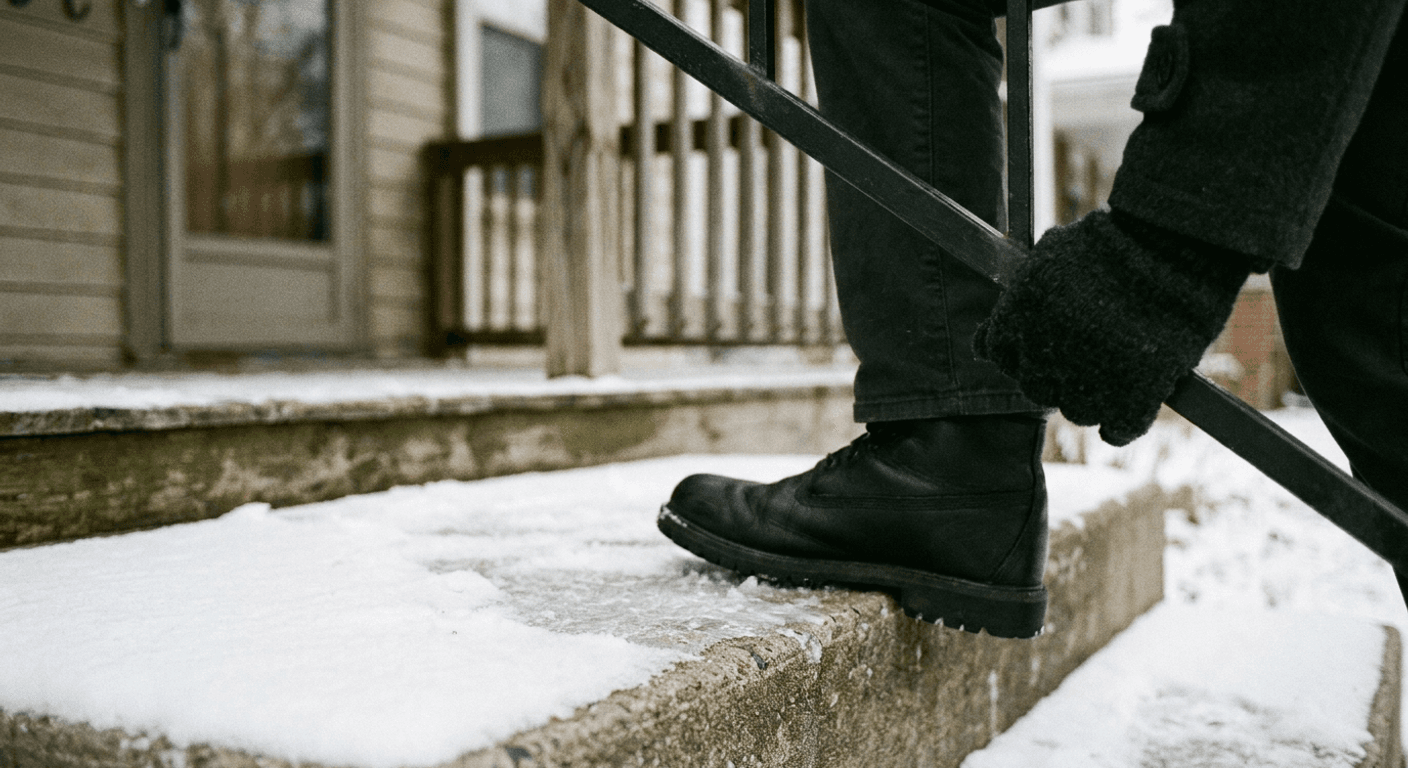
Ice and snow accumulation. The NWT experiences extreme winter conditions. Ice and compacted snow on walkways, parking areas, building entrances, and outdoor stairs are among the most frequent causes of slip and fall injuries. An occupier who allows ice to accumulate at a building entrance without salting, sanding, or posting warnings may be found negligent if a visitor falls as a result. Courts consider whether the occupier had a reasonable snow and ice maintenance programme and how quickly conditions deteriorated after treatment.
Wet or slippery floors. Water tracked in from outside, spills on hard-surface floors, and recently mopped surfaces that are not dried or marked are classic slip hazards inside commercial and residential premises. The occupier must have systems to detect and address these conditions within a reasonable time.
Uneven surfaces and defects. Cracked pavement, broken stairs, damaged flooring, unmarked changes in level, and loose mats can all cause trips and falls. A landlord who knows of a broken step in a common staircase and fails to repair it within a reasonable time will have difficulty explaining why the delay was consistent with the standard of a reasonable occupier.
Inadequate lighting. Poor lighting in stairwells, parking areas, and building entrances makes existing hazards more dangerous. Failure to maintain adequate lighting in a foreseeably used area can independently support a finding of negligence.
Trespassers and Persons Who Assume Risk
Under common law, the reduced duty owed to a trespasser is not abolished in the NWT simply because there is no statute; it remains part of the common-law framework. An occupier does not owe a trespasser the full duty of reasonable care. The duty is limited to refraining from deliberate or recklessly dangerous conduct intended to cause harm to the trespasser.
Persons who knowingly and voluntarily assume a known risk may also find their recovery limited by the doctrine of volenti non fit injuria. If a person enters premises aware of a specific hazard and chooses to proceed regardless, the occupier may argue that the person consented to the risk. This defence is available in common-law negligence even without a statutory provision, though courts apply it cautiously and require clear evidence of informed voluntary assumption of the specific risk that materialised.
Contributory Negligence and Apportionment
The Northwest Territories has enacted the Contributory Negligence Act, which abolished the harsh common-law rule that any contributory fault by the plaintiff entirely bars recovery. Instead, where both the plaintiff and the defendant contributed to the accident, damages are apportioned in proportion to each party's degree of fault.
In a slip and fall claim, occupiers frequently raise contributory negligence. Common arguments include: the plaintiff was wearing footwear inappropriate for icy or wet conditions; the plaintiff was not watching where they were walking; the plaintiff ignored a clearly posted warning sign; the plaintiff was distracted by a phone or other device at the time of the fall.
If the court finds that the plaintiff bears a share of the responsibility, the damages award is reduced by the corresponding percentage. For example, if the occupier is found 70% at fault and the plaintiff 30% at fault, the plaintiff receives 70% of the assessed damages. Contributory negligence does not extinguish the claim; it reduces it.
Appropriate footwear for conditions, attentiveness to one's surroundings, and taking notice of warning signs are therefore relevant to both liability and damages in any NWT slip and fall claim.
Limitation Period
The NWT Limitation of Actions Act (RSNWT 1988, c L-8) sets out the periods within which legal proceedings must be commenced. For personal injury claims arising from negligence, including slip and fall injuries, the limitation period under NWT law is two years from the date the cause of action arose (s. 2(1)(d)). The NWT Act is an older-style statute that has not yet been comprehensively reformed, but its 2-year period for injury to the person is consistent with the basic period in most other provinces. The separate 6-year period in s. 2(1)(e) applies only to trespass or injury to real property or chattels, not to personal injury.
The cause of action typically arises on the date of the fall and resulting injury. In most cases, the plaintiff knows immediately that they have been injured and can identify the premises and the person responsible. The two-year clock therefore usually begins to run from the date of the accident.
Where the full extent of an injury is not immediately apparent, for example where a delayed diagnosis reveals a serious condition related to the fall, there may be an argument that the cause of action did not arise until the plaintiff knew or reasonably ought to have known the material facts. Canadian courts have applied discoverability principles to the NWT Act in appropriate cases. These principles apply in the NWT under common-law negligence.
Although two years can pass quickly after a serious injury, it does not make delay advisable. Evidence deteriorates, witnesses become unavailable, and government notice requirements (discussed below) impose much shorter deadlines. Anyone injured in a slip and fall in the NWT should consult a lawyer promptly.
Claims Against Government and Municipal Bodies
Falls that occur on territorial or municipal government property raise additional considerations.
Notice requirements. Many Canadian jurisdictions require a person intending to sue a government body to give written notice of the claim within a specified period, which is often much shorter than the general limitation period. Under the NWT Cities, Towns and Villages Act, a person injured on a municipal road or sidewalk due to snow or ice must give the municipality written notice within 30 days of the incident in order to pursue a claim based on gross negligence. This 30-day window is far shorter than the two-year general limitation period. The Territorial government and other public bodies may have their own notice requirements under separate legislation.
Standard of care. Government bodies exercising discretionary policy decisions may attract different negligence analysis than private occupiers. Courts distinguish between policy decisions (which attract greater deference) and operational decisions (which are assessed against the reasonable person standard). A government decision about the frequency of sidewalk inspections may be a policy matter; the actual implementation of an inspection programme is operational.
Anyone who suffers a slip and fall on a public sidewalk, road, park, government building, or other public space in the NWT should seek legal advice promptly. Missing the 30-day municipal notice deadline for snow and ice claims can be fatal to a claim even where the two-year general limitation period has not yet expired.
Damages Available in NWT Slip and Fall Claims
A successful plaintiff in an NWT slip and fall claim may recover:
Non-pecuniary general damages. These are damages for pain and suffering, loss of enjoyment of life, and loss of amenities. The Supreme Court of Canada established an informal cap on non-pecuniary general damages in Andrews v. Grand & Toy Alberta Ltd (1978 CanLII 1 (SCC)), which has been indexed for inflation and currently sits at approximately CAD $430,000 to $450,000 in 2025 dollars. This cap applies in every Canadian common-law jurisdiction, including the Northwest Territories.
Special damages (pecuniary losses). These include past medical expenses, rehabilitation costs, prescription costs, transportation to medical appointments, and past lost income. Special damages must be proved with supporting documentation.
Future costs of care. Where the injury has caused lasting disability or will require ongoing treatment, a plaintiff may recover the cost of future care. Expert medical evidence is essential to establish the need for and cost of future care.
Future lost income. A plaintiff whose injuries reduce their earning capacity may recover the present value of the future income loss. This is often the largest head of damages in serious slip and fall cases involving working-age plaintiffs with significant injuries.
Aggravated and punitive damages. These are rarely awarded in slip and fall cases. Aggravated damages may be available where the defendant's conduct has worsened the plaintiff's injury (for example, by failing to warn of a hazard after learning of prior falls). Punitive damages require conduct that is independently reprehensible and deserving of condemnation beyond mere negligence.
Key Differences From OLA Provinces
It is worth understanding how NWT's common-law approach differs from the framework in provinces with an Occupiers' Liability Act, since many Canadians who visit or relocate to the territory will be more familiar with OLA-based systems.
Under an OLA, the statute sets the duty: an occupier must ensure visitors are reasonably safe. The plaintiff points to the statute. In NWT, the plaintiff must establish all elements of the common-law negligence tort, including the duty of care, standard, breach, causation, and damages, without the benefit of a statutory framing.
The traditional visitor categories (invitee, licensee, trespasser) retain more relevance in the NWT than in OLA provinces, where they have been replaced by a single statutory duty. While modern common-law negligence has largely converged on a reasonable-care standard regardless of visitor category for lawful entrants, the categories still inform the analysis of what is owed and what the occupier knew about the likelihood of entry.
There is no provision in NWT law equivalent to Ontario's 60-day written notice rule for snow and ice claims under the OLA. Ontario enacted that rule in 2021 specifically to require early notice where a slip on winter conditions is alleged against a private or public occupier. The NWT equivalent for municipal claims is the 30-day notice requirement under the Cities, Towns and Villages Act for snow and ice injuries on municipal roads and sidewalks. The general two-year limitation period and any applicable government notice requirements continue to apply.
Practical Steps After a Slip and Fall in the NWT
Taking the right steps immediately after an accident can significantly strengthen a potential claim:
Report the incident. Notify the property owner, occupier, business manager, or landlord of the accident as soon as possible. Request a written incident report and keep a copy.
Document the scene. Photograph the hazardous condition (the ice patch, the wet floor, the broken step, the poor lighting) before it is cleaned up, repaired, or otherwise changed. Take wide shots and close-up shots. Note the time, date, and precise location.
Gather witness information. Collect the names and contact details of anyone who witnessed the fall or saw the hazardous condition before or after the accident.
Seek medical attention promptly. Even if the injury seems minor, see a doctor or visit a medical clinic as soon as possible. Delayed presentation can complicate both the medical picture and the legal claim. Keep records of every medical appointment, prescription, and treatment.
Preserve the footwear. The footwear worn at the time of the fall may be relevant if the occupier raises a contributory negligence argument about inappropriate footwear. Do not discard it.
Consult a lawyer early. The two-year general limitation period is not the only deadline. If a municipal body is involved and the fall was caused by snow or ice, the 30-day written notice requirement under the Cities, Towns and Villages Act applies. A lawyer familiar with NWT personal injury law can identify all applicable deadlines and advise on the strength of the claim.
Related Canadian Guides
- Canadian law by province and topic
- Slip and Fall laws in Canada
- Northwest Territories Recording laws
- Northwest Territories Hit and Run laws
- Northwest Territories Child Support laws
Frequently Asked Questions
Does the Northwest Territories have an Occupiers' Liability Act?
No. The Northwest Territories has never enacted an Occupiers' Liability Act. Slip and fall claims in the NWT are governed by common-law negligence principles. The plaintiff must prove duty of care, breach, causation, and damages under the general law of negligence, without the benefit of a statutory duty framework.
What is the limitation period for a slip and fall claim in the NWT?
The NWT Limitation of Actions Act (RSNWT 1988, c L-8, s. 2(1)(d)) sets a 2-year limitation period for personal injury claims, including injury to the person arising from negligence, running from when the cause of action arose. The separate six-year period in section 2(1)(e) applies only to property damage, not to injury to the person. However, if a municipal body is involved and the fall was caused by snow or ice, a separate 30-day written notice requirement under the Cities, Towns and Villages Act may apply. Seek legal advice promptly after any fall on public property.
What must I prove to win a slip and fall case in the Northwest Territories?
You must prove all elements of the common-law negligence tort on a balance of probabilities: (1) the defendant (occupier) owed you a duty of care; (2) the occupier breached that duty by failing to act as a reasonable person would; (3) the breach caused your injury; and (4) you suffered actual damages as a result. There is no statute that shifts the burden to the occupier.
How does the NWT common-law approach differ from Ontario's Occupiers' Liability Act?
Ontario's Occupiers' Liability Act (RSO 1990 c O.2) imposes a single statutory duty to ensure visitors are reasonably safe, and eliminates the traditional visitor categories. NWT applies common-law negligence, which retains more relevance for the invitee/licensee/trespasser distinction and requires the plaintiff to establish the full negligence test. Ontario also has a 60-day written notice rule for snow and ice claims (s.6.1, in force since January 2021); the NWT has no equivalent rule.
Does contributory negligence bar a slip and fall claim in the NWT?
No. The NWT Contributory Negligence Act replaced the old common-law rule that any fault by the plaintiff completely bars recovery. Courts now apportion damages in proportion to each party's degree of fault. If you were 25% at fault and the occupier 75% at fault, you recover 75% of your assessed damages.
What duty does a property owner owe a trespasser in the Northwest Territories?
Under common law, an occupier owes a trespasser only a duty not to deliberately injure them or to act with reckless disregard for their safety. The full reasonable-care duty that applies to lawful visitors does not extend to trespassers.
Is there a cap on pain and suffering damages in NWT slip and fall cases?
There is no statutory cap, but the Supreme Court of Canada established an informal ceiling on non-pecuniary (pain and suffering) general damages in Andrews v. Grand & Toy Alberta Ltd (1978 CanLII 1 (SCC)). Indexed for inflation, that cap is approximately CAD $430,000 to $450,000 in 2025 dollars. Economic damages such as lost income and future care costs are uncapped.
What if I fell on a public sidewalk or government building in the NWT?
Falls on property owned or maintained by the territorial government, a municipality, or another public body may be subject to statutory notice requirements that are much shorter than the 2-year general limitation period. For snow and ice injuries on municipal roads or sidewalks, the Cities, Towns and Villages Act requires written notice to the municipality within 30 days of the incident. Missing a notice deadline can bar a claim entirely. Consult a lawyer as quickly as possible after any fall on public property.
Does the NWT have a snow and ice notice rule like Ontario?
Not exactly. Ontario enacted a 60-day written notice requirement for slip and fall claims involving snow or ice in 2021 (OLA s.6.1), which applies against all occupiers. The NWT equivalent is narrower: under the Cities, Towns and Villages Act, a 30-day written notice is required for snow and ice injury claims against a municipality. There is no Ontario-style blanket snow-and-ice notice rule covering private occupiers in the NWT. The general 2-year limitation period under the NWT Limitation of Actions Act applies, subject to any applicable government-entity notice requirements.
Can I still claim if I was wearing inappropriate footwear when I fell?
Possibly, but your damages may be reduced. Footwear is a common contributory negligence argument raised by occupiers in NWT slip and fall cases. If the court finds that your choice of footwear contributed to the fall, your damages will be reduced by your percentage of fault. You are not barred from recovering the remainder.
Updates
Independently fact-checked against the cited primary sources
Sources and References
- Northwest Territories Limitation of Actions Act, RSNWT 1988, c L-8: 6-year limitation period for personal injury tort claims (s. 2(e))(justice.gov.nt.ca).gov
- Northwest Territories Contributory Negligence Act, RSNWT 1988: proportionate apportionment of fault(justice.gov.nt.ca).gov
- Northwest Territories Cities, Towns and Villages Act, SNWT 2003, c 22: 30-day written notice for snow and ice municipal injury claims(justice.gov.nt.ca).gov
- Andrews v. Grand & Toy Alberta Ltd, 1978 CanLII 1 (SCC): SCC informal cap on non-pecuniary general damages (approximately CAD $430,000-$450,000 in 2025 dollars)(canlii.org)
- Stacey v. Anglican Churches of Canada, 1999 CanLII 18933 (NLCA): common-law negligence standard for occupiers in a jurisdiction without an OLA(canlii.org)
- Canada Slip and Fall Laws hub: RecordingLaw.com overview of slip and fall law across all Canadian provinces and territories(recordinglaw.com)