
Canada
Property Lines and Fence Laws in Canada
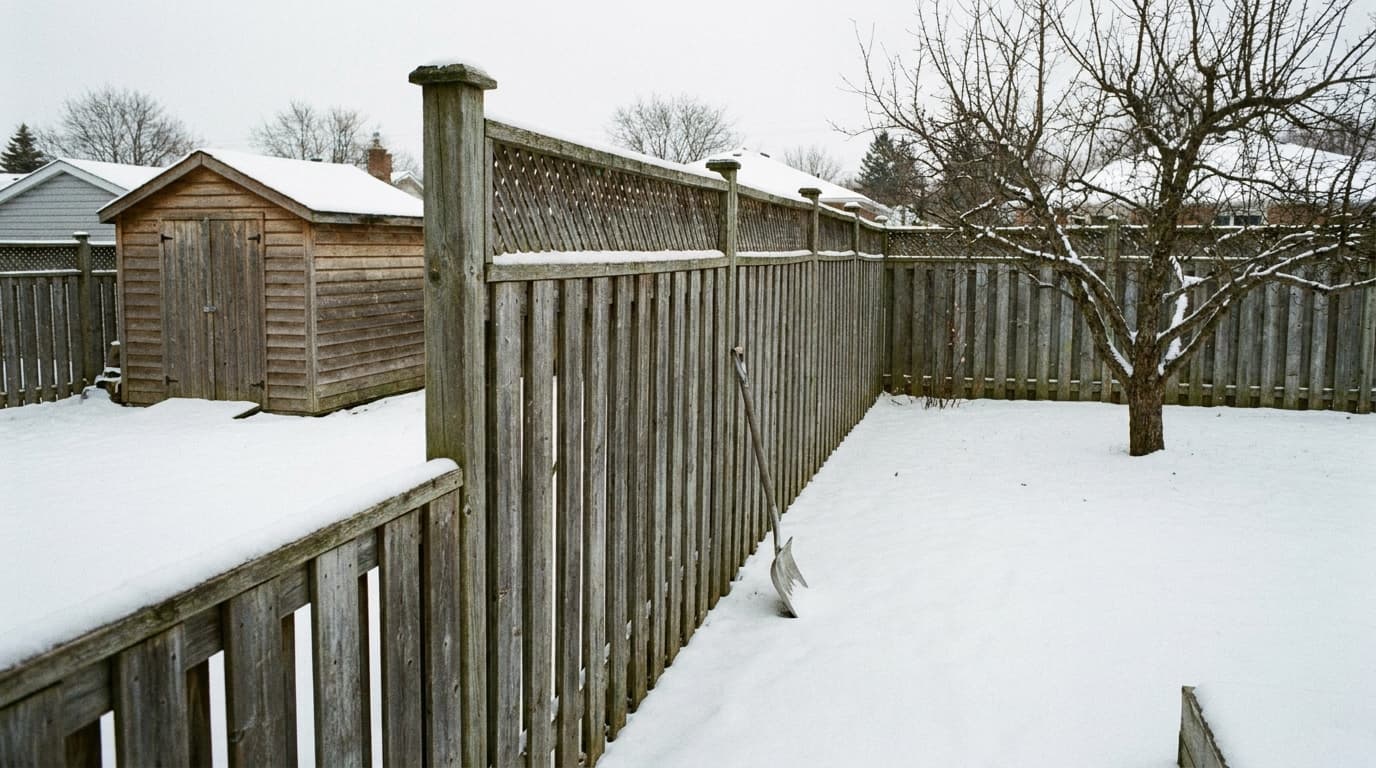
In Canada, a property boundary is set by a registered survey, not by where a fence, hedge or old post happens to sit, and a fence built in the wrong place does not move the line.
How a Property Boundary Is Actually Determined
A legal property boundary is a set of measurements and monuments described in a registered plan of survey, established on the ground by a licensed land surveyor. It is not determined by where a fence has stood for years, where a hedge grew up, or what a previous owner told the current one.
This matters because fences drift over time. They get rebuilt a foot or two off the original line, routed around a tree or a slope, or placed by eye rather than by measurement. None of that changes the underlying legal boundary. Only a survey, or in rare cases a successful court finding, can establish or move where a boundary actually runs.
If you want to know exactly where your line is, whether before building a fence, before a dispute, or before buying a property, the reliable step is to hire a licensed land surveyor to locate or re-establish the boundary. An old fence, a satellite map, or a municipal tax map is not accurate enough for any of these purposes.
The Surveyor's Real Property Report
In Ontario, the standard document a licensed surveyor prepares is a Surveyor's Real Property Report, often shortened to RPR or SRPR. It shows the measured boundaries of the property, the location of the house and other structures, and the position of fences, hedges and other features relative to those boundaries, along with any visible easements. Other provinces use similar documents under different names, including a certificate of location in Quebec.
An RPR is a private document. It is prepared for the client who ordered it and, unlike a deed or a plan of subdivision, it is not filed with the provincial land registry system. That means every owner should keep their own copy, and a buyer should ask for the seller's most recent one, since ordering a new survey from scratch typically costs more than updating an existing one.
A survey does more than settle disputes. It also confirms whether an existing fence, shed, deck or driveway actually sits inside the legal boundary or crosses it, which is the first fact anyone needs before deciding whether a neighbour has actually encroached.
A Fence Is Not a Boundary
None of this means a fence is meaningless. It usually marks where neighbours have agreed to divide use of their land, and moving a long-standing fence can itself cause a dispute. But legally, the fence is not the boundary. If a survey shows the fence sits a metre inside the true line, the true line still governs unless a court says otherwise.
This is also where adverse possession comes in, and it should not be read as a route to gaining land through a misplaced fence. In Ontario, adverse possession cannot be claimed against land registered in the Land Titles system, which is now nearly all Ontario land, and most provinces that have converted to land titles have effectively closed off the doctrine as well. See our companion article on adverse possession and squatters in Canada for how narrow this route actually is.
If you discover your fence, or your neighbour's, is not on the true line, the answer is not to occupy the disputed strip and hope. The realistic paths are agreement, an easement, a boundary adjustment through survey and registration, or one of the formal processes described below.
Ontario's Line Fences Act: A Little-Known Tool
Ontario has a statute specifically for boundary fence disputes: the Line Fences Act. Under the Act, the council of every local municipality appoints, by bylaw, a number of fence-viewers to carry out the Act's provisions and sets their pay. Fence-viewers are usually municipal staff or council appointees, not lawyers, and the process is designed to be used without one.
The process applies in two situations: where no fence currently exists on the boundary and one owner wants one built, or where a line fence already exists and one owner believes it needs to be rebuilt or repaired, and the two owners cannot agree. Either owner applies to the municipal clerk, who must send notice of the viewing to both owners and to the fence-viewers at least a week before the scheduled date.
At the viewing, the fence-viewers decide what kind of fence is needed and issue a written award apportioning the cost of construction or repair between the two owners. If an owner disagrees with the award, they have 15 days from receiving a certified copy to appeal to a referee appointed under the Act's regulations, and the referee can affirm, alter, set aside or correct the award. A further appeal is possible only to the Divisional Court, on a question of law, which is a significant escalation most disputes never need.
The Line Fences Act is genuinely useful because it gives neighbours a low-cost, non-court way to force a resolution when talking has failed. But it is not universal even within Ontario: some municipalities, including the City of Toronto, have chosen not to use the Act and instead direct residents toward mediation or the civil courts for fence disputes. Always check with your own municipal clerk before assuming the process is available where you live.
Other Provinces: Bylaws, Common Law and Quebec's Civil Code
No other Canadian province has legislation quite like Ontario's Line Fences Act. That does not mean boundary fences are unregulated elsewhere. It means the rules come from different sources: municipal bylaws that set height, material and permit requirements, the ordinary common law of nuisance and trespass, and, in Quebec, the Civil Code.
Quebec's Civil Code addresses shared fences directly. Any owner may fence their own land at their own expense, and an owner can also require a neighbour to share, in equal portions, the cost of building a dividing fence suited to the location and its use, once proper notice has been given. A fence that already sits on the boundary between two properties is generally presumed to be shared, meaning both owners share responsibility for its upkeep, unless one owner proves otherwise. An owner cannot simply build a fence unilaterally and then demand reimbursement after the fact.
In British Columbia, Alberta, Saskatchewan, Manitoba, Nova Scotia, New Brunswick, Prince Edward Island and Newfoundland and Labrador, there is no province-wide fence-viewer regime. Disputes over whether a fence is needed, who should pay, or where it should sit are generally resolved by agreement between neighbours, by whatever the local municipal bylaw provides, or, failing that, by small claims court.
How Boundary Fence Rules Compare Across Canada
| Province or territory | Boundary fence framework | Cost-sharing default |
|---|---|---|
| Ontario | Line Fences Act, municipally appointed fence-viewers (some municipalities opt out) | Apportioned by the fence-viewers' award |
| Quebec | Civil Code of Quebec provisions on shared fences | Presumed shared once proper notice is given |
| BC, Alberta, Saskatchewan, Manitoba | Municipal bylaw and common law | No set formula; negotiate or small claims court |
| Nova Scotia, New Brunswick, PEI, Newfoundland and Labrador | Municipal bylaw and common law | No set formula; negotiate or small claims court |
Cost-Sharing for a Shared Boundary Fence
Outside Ontario's fence-viewer process and Quebec's Civil Code presumption, there is generally no automatic legal obligation for a neighbour to pay half the cost of a fence you decide to build. If you build a fence entirely on your own initiative, you may simply own that fence, even if it sits on the boundary.
The safest approach anywhere in Canada is to put the arrangement in writing before construction starts: which neighbour is paying for what, who will maintain it, and what happens if one side wants it replaced later. A short written agreement, even an exchange of emails, avoids most of the disputes that end up in front of fence-viewers or small claims court.
Fence Height, Type and Pool-Enclosure Rules
Fence height, materials and setback from the property line are set by municipal bylaw, and the numbers genuinely differ from one city or township to the next. Toronto's fence bylaw, for example, generally limits front-yard fences to 1.2 metres if solid, or 2.0 metres if at least half open, such as wrought iron or spaced pickets, and limits side- and rear-yard fences to 2.0 metres, while banning barbed wire and sharp materials. A neighbouring municipality can set entirely different numbers, so always check the local bylaw before building.
Pool enclosures are typically governed by a separate, stricter bylaw than the general fence rule, because the safety purpose is different: keeping small children out of the water rather than marking a boundary or providing privacy. Pool-enclosure bylaws commonly require a fully enclosed yard, a minimum fence height, and a self-closing, self-latching gate that a young child cannot easily open, with no unsupervised direct access from the house. Do not assume a fence that satisfies your municipality's general fence bylaw automatically satisfies its pool-enclosure bylaw. Check both separately, and confirm whether a permit is required before installing either.
Trees on or Near the Boundary Line
Ontario has a specific rule for trees that grow on a property line, and it surprises a lot of people. Under the Forestry Act, a tree whose trunk grows on the boundary between two adjoining properties is the common property of both owners. Ontario courts have interpreted the trunk broadly, meaning that if any part of the trunk, even a small portion, crosses onto the neighbouring property, the tree is jointly owned.
The practical effect is that neither owner can remove, top or otherwise injure a boundary tree without the other owner's consent. Doing so without consent can be an offence under the Act, separate from any civil claim the other owner might bring for the value of the tree. If you and a neighbour disagree about a boundary tree, get the disagreement, and any agreement to remove it, in writing before anyone touches it.
Outside Ontario, similar shared-ownership thinking about boundary trees can arise under general common law or civil law principles even without an identical statute, so do not assume a tree is automatically yours to remove just because most of it happens to be on your side. When in doubt, get independent advice, ideally from a local arborist and, if there is real disagreement, a lawyer, before cutting anything down.
Overhanging Branches and Encroaching Roots
A neighbour's branches or roots that cross onto your land are a more common irritant than a full boundary-tree dispute, and the general rule across Canada is more forgiving. An owner can typically trim back branches and roots that cross the boundary line, at their own expense, up to the line itself, without the neighbour's permission, as long as they do not enter the neighbour's property to do the cutting and do not kill or seriously damage the tree.
That last condition matters. If a tree is a boundary tree under Ontario's Forestry Act, cutting roots or branches in a way that kills or seriously injures it can still require the other owner's consent, because the tree itself remains common property even though the encroaching parts crossed the line. For a valuable or mature tree, or any real disagreement about how much can safely be removed, it is worth paying an arborist for an opinion before reaching for a saw.
When a Neighbour Builds Over the Line
Start with a survey. Before assuming a neighbour's fence, shed, deck or driveway has crossed onto your land, confirm it with an up-to-date Surveyor's Real Property Report or equivalent. Many disputes turn out to be about an old, informal boundary understanding rather than an actual encroachment, and a current survey settles the question either way. For other common disagreements with neighbours beyond boundaries, see our guide to neighbour disputes in Canada.
If the survey confirms an encroachment, raise it with your neighbour directly and in writing, and propose a practical fix, whether that is moving the structure, granting a small easement, or agreeing to a boundary adjustment. Most encroachment disputes resolve at this stage once both sides can see the same survey.
If informal talks fail, the formal routes depend on what is actually in dispute. A disagreement specifically about a boundary fence in Ontario can go to fence-viewers under the Line Fences Act. A dispute over cost, damages, or a smaller encroachment can go to small claims court, which handles claims up to that province's monetary limit without needing a lawyer. A serious or permanent encroachment, such as a garage built partly on the wrong lot, generally needs a court application for a declaration of the boundary or an order to remove the structure. Try the cheapest step first: survey, then conversation, then the formal process that actually fits the dispute.
For more on Canadian property law generally, visit our property law hub.
Disclaimer: This article is for general information only and is not legal advice. Property boundary and fence rules vary by province, territory and municipality and change over time. Confirm current requirements with your municipality, a licensed land surveyor, or a lawyer before relying on them.
Frequently Asked Questions
Does a fence mark the legal property line in Canada?
No. A fence is only as accurate as whoever built it. The legal boundary is set by the property's registered plan of survey and confirmed on the ground by a licensed land surveyor. Fences, hedges and even long-standing verbal agreements between past owners do not change where the line actually runs.
What is a Surveyor's Real Property Report and do I need one?
A Surveyor's Real Property Report, sometimes called an RPR or SRPR, is a document prepared by a licensed land surveyor showing a property's boundaries and the location of fences, structures and easements relative to those boundaries. It is worth ordering before a boundary dispute, before building near the line, or before buying a property where the existing survey is old or missing.
Who pays for a shared boundary fence in Canada?
It depends on the province and municipality. There is no national rule. In Ontario, if neighbours cannot agree, either one can ask the municipality to appoint fence-viewers under the Line Fences Act, and their award apportions the cost. In Quebec, the Civil Code lets an owner require a neighbour to share the cost of a dividing fence once proper notice is given. In most other provinces, cost-sharing is a matter of agreement, the municipal bylaw, or, failing that, small claims court.
Can I cut down a tree that grows on my property line?
In Ontario, generally no, not without your neighbour's consent. The Forestry Act treats a tree whose trunk grows on the boundary as the common property of both owners, and removing or injuring it without consent can be an offence under the Act as well as a civil matter. Similar shared-ownership thinking applies in other provinces even without an identical statute, so get the neighbour's consent in writing, or legal advice, before removing a boundary tree anywhere in Canada.
What should I do if my neighbour built a fence or shed over the property line?
Start with an up-to-date survey to confirm exactly where the true boundary sits before assuming there is an encroachment at all. If the survey confirms it, raise it with your neighbour in writing and propose a fix. If that fails, Ontario residents can use the Line Fences Act process for a boundary-fence dispute, and anyone can pursue small claims court or a court application for a more serious or permanent encroachment.
Does Ontario's Line Fences Act apply anywhere else in Canada?
No. The Line Fences Act is Ontario legislation, and some Ontario municipalities, including the City of Toronto, have chosen not to use it, relying on mediation or the civil courts instead. Other provinces have their own municipal bylaws, common law rules, or, in Quebec, Civil Code provisions on shared fences. Always check the rule in your specific municipality and province rather than assuming Ontario's process applies.
Sources and References
- Line Fences Act, RSO 1990, c L.17(ontario.ca).gov
- Forestry Act, RSO 1990, c F.26(ontario.ca).gov
- Line Fences Act, RSO 1990, c L.17, consolidated text(canlii.org)
- City of Toronto Municipal Code, Chapter 447, Fences(toronto.ca).gov
- City of Toronto, Fences bylaw enforcement(toronto.ca).gov
- Association of Ontario Land Surveyors, The Surveyor's Real Property Report(aols.org)
- Civil Code of Quebec, CCQ-1991, provisions on fences(legisquebec.gouv.qc.ca).gov
- Gouvernement du Quebec, Fences and common walls(quebec.ca).gov