
Switzerland
Switzerland Recording Law: Audio Recording, Video Surveillance and Criminal Liability
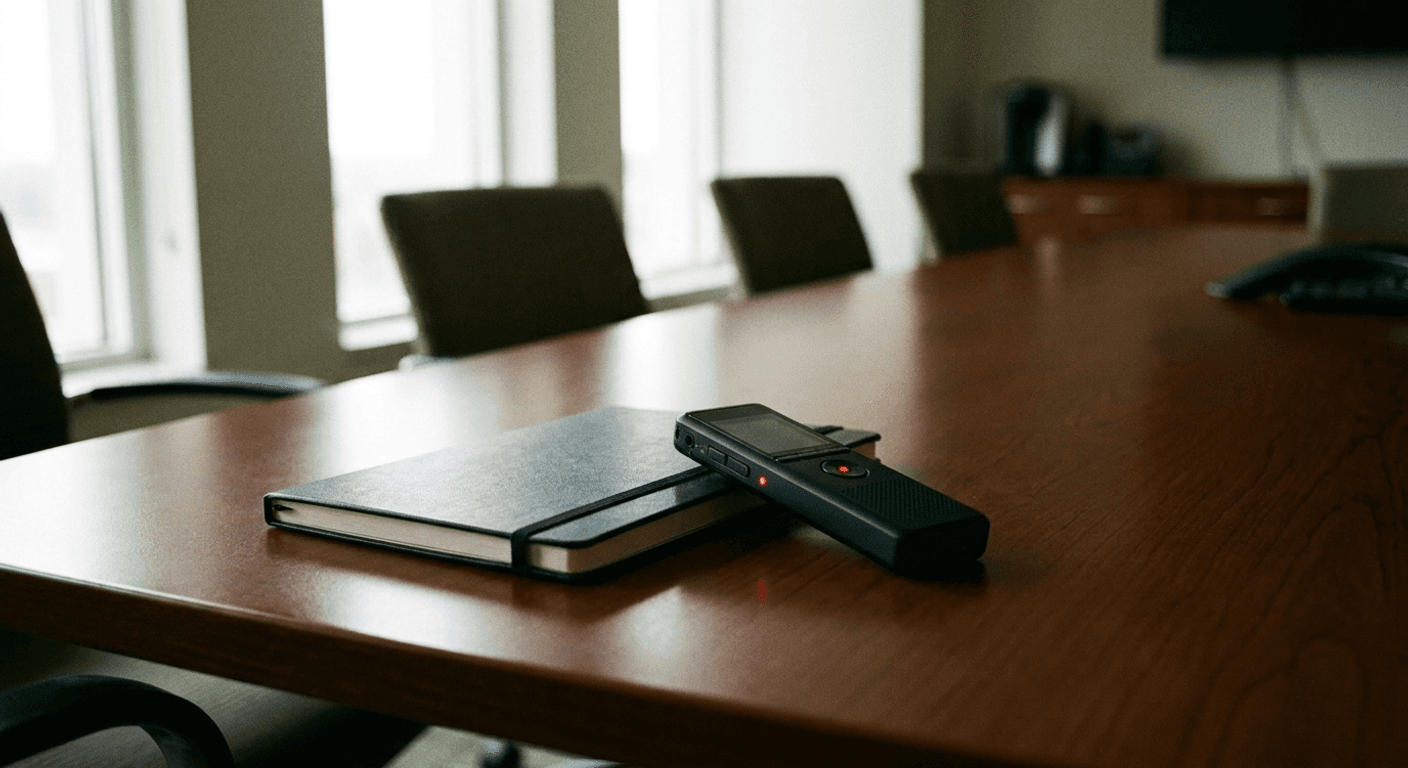
Most readers arriving at this page come from a country where one participant's consent is enough. In Switzerland, that assumption is backwards. Secretly recording a private conversation is a criminal offence under the Strafgesetzbuch, the Swiss Criminal Code, even when the person doing the recording is one of the people speaking.
Two rules run alongside each other. One governs audio, the sound of a conversation itself. The other governs image and video, what a camera or a recording device observes. This hub orients across both, then hands off to the two pages that cover each in full depth.
Information last verified on 21 July 2026. This page provides general legal information about Swiss law and does not constitute legal advice in an individual case.
Four provisions, one underlying rule
Swiss law does not deal with recording under a single article. It splits the question by who is recording and what they are capturing, and each split carries its own penalty.
Art. 179ter StGB covers a participant in a conversation who records it on a sound carrier without the consent of the other people speaking, punishable by up to one year in custody or a monetary penalty. Art. 179bis StGB covers the opposite actor, someone who is not part of the conversation at all, eavesdropping on or recording it with a listening device, carrying a higher ceiling of up to three years.
Art. 179quater StGB leaves audio behind and covers image and video: observing or recording, without consent, a fact from someone's secret domain or a private fact not otherwise freely accessible to everyone, also carrying up to three years. Art. 179quinquies StGB then carves out two narrow situations where none of this applies. Our recording conversations page and video surveillance page each work through their provision's wording, penalties and worked examples in full.
Why consenting to talk is not consenting to be recorded
The Federal Supreme Court's 2020 decision in BGE 146 IV 126 is the case that defines what makes a conversation non-public in the first place, and it is worth understanding before either spoke page's detail, since it applies to the audio offences generally.
The test the court set out turns on audience scope: a conversation is non-public when its participants speak in the legitimate expectation that what they say will not be understandable or accessible to just anyone. That is a question about who could reasonably hear or follow the conversation, not about whether a recording device happened to be present or whether the speakers thought about being recorded at all.
This matters because it cuts against a common but wrong assumption, that a conversation only counts as protected if the speaker was actively worried about being recorded. A conversation can be non-public, and therefore protected, even where recording never crossed anyone's mind, as long as it was directed at a limited audience rather than the world at large. Our recording conversations page applies this test to specific everyday situations.
Two deadlines that are easy to confuse
Every offence in this cluster is what Swiss law calls an Antragsdelikt: prosecution depends on the person affected actively filing a complaint, rather than happening automatically. Art. 31 StGB sets that complaint deadline at three months, running from the day the complainant learns who the offender actually is, not from the day of the recording itself.
That three-month window is not the same thing as how long the underlying offence can still be prosecuted once a valid complaint has been filed. Under Art. 97 StGB, the general prosecution limitation period tracks the maximum penalty for the offence: an offence with a three-year maximum, which covers both Art. 179bis and Art. 179quater, carries a ten-year limitation period, while an offence with a lower maximum, which covers Art. 179ter, carries seven years.
Keeping these two figures distinct matters more than it might first appear. The three-month clock is about acting quickly once you know who did it. The seven to ten year figure is about how long the state's ability to prosecute lasts once a complaint has actually been made. Each spoke page addresses this distinction for its own provision.
Two narrow exceptions, and where they run out
Art. 179quinquies StGB spares two specific kinds of telecommunications call from the audio offences entirely: a call to an aid, rescue or security service, and a routine business call limited to orders, reservations or similar transactions. Both exist so a caller or a business can keep a usable record of what was actually said, for evidentiary purposes only.
Both exceptions have a real limit worth flagging here rather than leaving a reader to assume otherwise. The text names only Art. 179bis and Art. 179ter, the two audio provisions. It does not name Art. 179quater, so a business recording video, rather than just sound, of an otherwise exception-eligible call gets no statutory shelter for the image portion of that recording. Our video surveillance page explains what that gap means in practice.
Cameras sit under a different provision, with a data protection layer on top
A microphone and a camera are governed by different articles of the same code, and readers researching one often need the other. Image and video capture of someone's private facts falls to Art. 179quater StGB rather than the audio provisions, and it interacts with a second, separate statute: the nDSG, Switzerland's data protection law.
The nDSG generally does not apply to personal data a person processes exclusively for personal use, which can take a homeowner's camera pointed strictly at their own property outside its scope. That exemption is about data protection duties, though, and it does not touch the separate criminal question under Art. 179quater, which can still apply to a camera that captures a neighbour's private domain regardless of the nDSG's own-use exemption. The federal privacy regulator also publishes practical guidance on private cameras, which our video surveillance page sets out alongside the criminal test itself.
Which page matches your situation
A reader wondering whether they can record a phone call, a meeting, or a conversation they are personally part of should start with recording conversations, which covers Art. 179ter and Art. 179bis in depth, including the business-call exception and what counts as non-public.
A reader dealing with a camera, whether installing one, being filmed by a neighbour's, or facing a workplace surveillance question, should start with video surveillance, which covers Art. 179quater, the nDSG overlay, and the employment-specific rules that apply to a camera at work.
Both pages sit inside our broader guide to Swiss law, which covers the codes, courts and institutions behind this cluster and the rest of our Swiss coverage.
Frequently Asked Questions
Does the same rule cover a phone call and an in-person conversation in Switzerland?
Yes. Art. 179ter and Art. 179bis apply to a non-public conversation generally, whether it happens in person or over the phone, since neither article is limited by medium. Art. 179quinquies's two exceptions, by contrast, are drafted specifically for telecommunications calls and do not extend to an in-person conversation.
Is recording a video call covered by the same rule as recording an audio call in Switzerland?
No. The audio track of a call falls under Art. 179ter or Art. 179bis, while any video or image captured falls under the separate Art. 179quater. This matters most for the Art. 179quinquies exceptions, which name only the audio provisions and give no equivalent shelter to video.
Who do I file a complaint with if I believe I was recorded illegally in Switzerland?
A criminal complaint, a Strafantrag, goes to the police or the cantonal prosecutor's office, within three months of learning who the offender is. Our recording conversations and video surveillance pages each set out the specific complaint route for their own provision.
Which of the Swiss recording provisions applies to my situation?
It depends on what was captured, not on who was in the room. Audio of a conversation you took part in falls under Art. 179ter, audio of a conversation you were not part of under Art. 179bis, and images or video under Art. 179quater. Our recording conversations page covers the audio provisions and our video surveillance page covers cameras.
How is Swiss recording law different from German or EU rules on recording and cameras?
Switzerland is not a member of the EU, so the GDPR is not the applicable law here. Swiss data protection runs under the nDSG, and Swiss criminal liability for recording runs under Art. 179bis through Art. 179quinquies StGB, a distinct statute from Germany's criminal code.
Does the three-month complaint deadline apply the same way to audio recording and video surveillance cases?
Yes. Art. 31 StGB's three-month deadline, running from when the complainant learns the offender's identity, applies equally to a complaint under Art. 179ter, Art. 179bis or Art. 179quater. What differs between provisions is the maximum penalty and the resulting prosecution limitation period, not the complaint deadline itself.
If I am unsure whether my situation involves recording a conversation or video surveillance, which page should I read first?
If the concern is centred on sound, a phone call, a meeting, something someone said, start with the recording conversations page. If a camera or any image capture is involved at all, start with the video surveillance page, since it covers the separate provision and the data protection layer that applies specifically to cameras.
Sources and References
- Art. 179bis StGB, Abhören und Aufnehmen fremder Gespräche(fedlex.admin.ch).gov
- Art. 179ter StGB, Unbefugtes Aufnehmen von Gesprächen(fedlex.admin.ch).gov
- Art. 179quater StGB, Verletzung des Geheim- oder Privatbereichs durch Aufnahmegeräte(fedlex.admin.ch).gov
- Art. 179quinquies StGB, Nicht strafbares Aufnehmen(fedlex.admin.ch).gov
- Art. 31 StGB, Antragsfrist(fedlex.admin.ch).gov
- Art. 97 StGB, Verjährungsfristen(fedlex.admin.ch).gov
- Art. 2 nDSG, Persönlicher und sachlicher Geltungsbereich(fedlex.admin.ch).gov
- BGE 146 IV 126, Auslegung des Begriffs nichtöffentlich(bger.ch).gov
- EDÖB, Videoüberwachung durch Private(edoeb.admin.ch).gov