
District of Columbia
D.C. Smart Glasses Recording Laws: One-Party Consent Guide
Independently fact-checked against primary sources (last audited August 24, 2026). · Reviewed by the RecordingLaw editorial team. · Law checked current as of August 24, 2026. How we verify our legal content
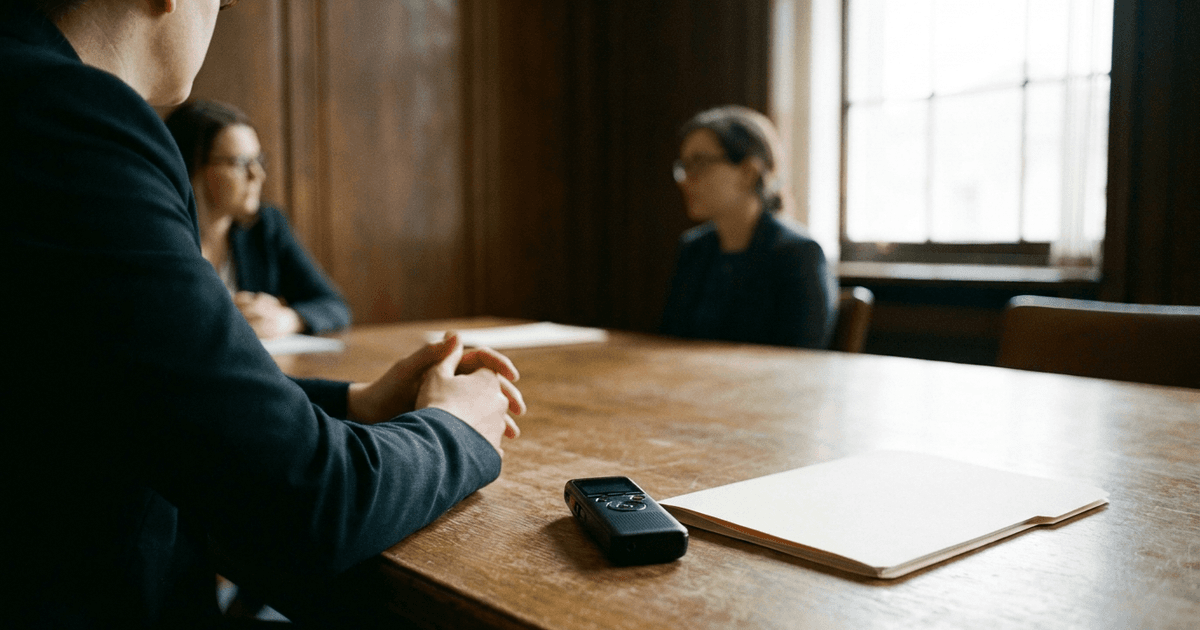
Yes, smart glasses are legal to own and wear in Washington, D.C., but whether you can legally record with them depends on a critical distinction between audio and video. Video in public is generally lawful. Audio of private conversations is governed by D.C.'s one-party consent wiretap statute, D.C. Code § 23-542, which means a participant in the conversation can record it without notifying the other party.
Are Smart Glasses Legal to Own and Wear in Washington, D.C.?
Yes. No D.C. statute restricts purchasing, owning, or wearing smart glasses such as Meta Ray-Ban AI glasses. The device is sold freely in the District and its possession raises no legal issue under D.C. or federal law.
The legal analysis begins only when the glasses are used to capture audio or video, and it turns on three variables: what was recorded, where, and whether you were a participant in any conversation captured.
Recording Video in Public vs. Private Spaces
Public spaces
Recording video in a public space in Washington, D.C. (a street, sidewalk, the National Mall, a Metro station concourse, or any other location generally open to the public) is lawful under both D.C. and federal law. Persons in public have a diminished reasonable expectation of privacy from being seen or filmed. The federal Wiretap Act (18 U.S.C. § 2510) limits the definition of an "oral communication" to one uttered under circumstances justifying a reasonable expectation against interception; silent video of people in public does not trigger it. D.C. law follows the same principle.
A smart glasses wearer walking through Georgetown, recording a street scene on the Capitol steps, or capturing footage of a public event does not create legal exposure from video capture alone.
Semi-public and private spaces
The analysis changes in semi-public or private spaces. A private residence, hotel room, medical office, or closed conference room carries a strong expectation of privacy. Even spaces that are technically accessible to others, such as a restaurant table during a one-on-one conversation, a workplace break room, or a quiet corner of a library, can give rise to a reasonable expectation of privacy in the content of spoken words exchanged there.
In a concurring opinion in Katz v. United States, 389 U.S. 347 (1967), Justice Harlan described a twofold requirement: that a person have exhibited an actual (subjective) expectation of privacy, and that the expectation be one society is prepared to recognize as reasonable. D.C. courts apply this framework when evaluating whether a location or conversation is "private" within the meaning of the wiretap statute.
Federal Property: A D.C.-Specific Consideration
Washington, D.C. contains an unusually high concentration of federal government property: the Capitol grounds, federal office buildings, national monuments, parks administered by the National Park Service, and the Smithsonian Institution. Recording video on federal property in public-access areas is generally permitted under the same First Amendment principles that apply on public streets. However, some federal buildings and secured facilities restrict photography and recording by posted policy or regulation. The general lawfulness of public video recording does not override access restrictions set by specific federal agencies on their premises.
Recording Audio and D.C.'s One-Party Consent Rule
The statute
D.C. Code § 23-542 is the District's wiretap and surveillance law. It mirrors the structure of the federal Wiretap Act and prohibits any person from willfully intercepting, endeavoring to intercept, or procuring another to intercept any wire or oral communication.
The critical provision for smart glasses users is § 23-542(b)(3), which carves out a consent exception for non-law-enforcement persons:
It is not unlawful for a person not acting under color of law to intercept a wire or oral communication "where such person is a party to the communication, or where one of the parties to the communication has given prior consent" to the interception, provided the interception is not made for the purpose of committing a criminal or tortious act, or for the purpose of committing any other injurious act.
This is the one-party consent rule. If you are wearing smart glasses and you are a participant in the conversation being recorded (meaning you are actively exchanging words with the other person), you are a party to the communication and may record it without notifying or obtaining consent from other participants. One party's consent (your own) is sufficient.
What the one-party rule does NOT cover
The one-party exception is specific: it protects participants. It does not cover:
- Capturing the private conversation of two or more other people nearby who are not speaking to you.
- Secretly recording inside a room where a meeting is taking place and you have no speaking role.
- Using the glasses to intercept wire communications, such as phone calls, where you are not a participant.
Recording the "oral communication" of others (in which you are not a party) without at least one of those parties consenting is a violation of § 23-542. Oral communication is defined in D.C. Code § 23-541 as "any oral communication uttered by a person exhibiting an expectation that the communication is not subject to interception under circumstances justifying the expectation." The private words of two colleagues in a break room qualify. A loud street argument between strangers may not, if no reasonable expectation against interception exists.
Practical application for smart glasses
For a smart glasses wearer in Washington, D.C., the one-party consent rule means:
- Recording a conversation you are having (at a business meeting, a social gathering, or a street encounter) is lawful. You are a party. No disclosure is required under D.C. law.
- Recording your own video content in a public space without engaging in any private conversation raises no wiretap issue at all.
- Recording a conversation between two other people that you are not part of is not protected by the participant exception. At least one of those parties must consent.
For more on D.C.'s consent framework, see the District of Columbia Recording Laws page.
Where You Cannot Record: Voyeurism and Unlawful Surveillance
Separately from the wiretap consent rules, D.C. law prohibits recording people, without their express and informed consent, in locations where they have a reasonable expectation of privacy from visual observation of their body or intimate conduct.
D.C. Code § 22-3531 criminalizes three categories of conduct:
- Operating a hidden observation post or installing devices for the purpose of secretly observing persons in private settings such as bathrooms, during undressing, or during sexual activity.
- Recording individuals without their express and informed consent while they are using bathrooms or restrooms, are totally or partially undressed or changing clothes, or are engaged in sexual activity.
- Intentionally capturing images of a person's "private area" (defined as exposed or undergarment-clad genitalia, pubic area, anus, buttocks, or female breasts below the areola) when the person has a reasonable expectation of privacy.
The locations where § 22-3531 applies most clearly are restrooms, locker rooms, gym changing areas, fitting rooms, private residences, hotel rooms, and medical examination rooms. The covert appearance of smart glasses does not create any exception. The hidden nature of the recording is, in fact, a factor that strengthens the case for the "surreptitious" element of the offense.
The statute explicitly excludes lawful law enforcement activity, security monitoring of one's own premises, spaces under surveillance with prominent posted notice, and medical recordings where consent cannot be obtained. None of those exceptions apply to ordinary consumer smart glasses use.
The federal Video Voyeurism Prevention Act (18 U.S.C. § 1801) adds a parallel floor for federal property: it prohibits recording a person's private areas on federal property without consent where there is a reasonable expectation of privacy. Given the high concentration of federal land in Washington, D.C., this provision carries particular practical weight in the District.
The one-party wiretap rule offers no cover here. Under § 22-3531, what matters is the express and informed consent of the person being recorded; consent from anyone else does not make it lawful to use smart glasses to record someone's intimate areas in a space where they reasonably expect privacy from observation.
Facial Recognition and Biometric Privacy
Washington, D.C. does not have a dedicated biometric privacy statute equivalent to Illinois's Biometric Information Privacy Act (BIPA), Texas's Capture or Use of Biometric Identifier Act (CUBI), or Washington State's biometric identifier law (RCW Chapter 19.375).
Under D.C. law alone, using a smart glasses facial recognition application to scan and identify strangers does not trigger a standalone biometric statute the way it would in Illinois (where BIPA imposes up to $5,000 per person in statutory damages for capturing face geometry without written consent) or in Texas, where CUBI allows civil penalties of up to $25,000 per violation for commercial capture without consent.
D.C. residents and visitors are not without recourse, however. The federal Wiretap Act, common-law privacy torts, and general constitutional principles still apply. Under Restatement (Second) of Torts § 652B, intentionally intruding upon the solitude or seclusion of another in a manner that would be highly offensive to a reasonable person creates civil liability regardless of whether a state or local biometric statute applies. The act of covert recording itself can create that liability without any requirement that footage be published or shared.
The biometric risk is most acute through third-party software integrations. Meta's Ray-Ban AI glasses provide a camera but do not natively run facial recognition. The legal exposure arises when a user pairs the glasses with a third-party facial recognition application to identify strangers. In October 2024, Harvard students demonstrated the "I-XRAY" system by pairing Meta Ray-Ban glasses with a reverse facial-recognition search engine to identify strangers in real time and retrieve home addresses and partial Social Security numbers within minutes. That demonstration used third-party software, not Meta's own systems. D.C. users who replicate this type of integration face civil tort liability and, if the identified person resides in Illinois, Texas, or Washington State, potential exposure under those states' biometric statutes as well.
Because D.C. is also home to a high concentration of government officials, lobbyists, journalists, and federal employees, using smart glasses to identify and track individuals in the District raises particular civil liberties concerns and could, depending on intent and use, implicate federal statutes governing surveillance or harassment of federal officials.
Penalties Summary
D.C.'s recording and surveillance penalties are set by reference to D.C. Code § 22-3571.01's fine schedule, which scales fines to maximum imprisonment terms.
| Offense | Statute | Maximum Penalty |
|---|---|---|
| Wiretap: intercepting private conversation without consent | D.C. Code § 23-542 | 5 years imprisonment / up to $12,500 fine |
| Voyeurism: recording in private locations without consent | D.C. Code § 22-3531(b)-(d) | 1 year imprisonment / up to $2,500 fine |
| Distributing or disseminating unlawfully obtained recordings | D.C. Code § 22-3531 | 5 years imprisonment / up to $12,500 fine |
At the federal level, the Wiretap Act (18 U.S.C. § 2511) independently imposes up to 5 years imprisonment for criminal violations and a separate provision, 18 U.S.C. § 2520, lets an injured person sue for civil damages, where a court may award actual damages or statutory damages of the greater of $100 a day for each day of violation or $10,000. D.C.'s wiretap chapter also authorizes civil remedies for aggrieved persons, including recovery of actual damages and other appropriate relief.
Practical Tips for Smart Glasses Users in Washington, D.C.
Know you are in a one-party consent jurisdiction. If you are wearing smart glasses and you are a genuine participant in the conversation being recorded, D.C. Code § 23-542(b)(3) permits you to record without disclosure. You do not need to announce the recording. The key is that you must actually be a party to the conversation, not merely present in the same room.
Be aware of the federal property dimension. Washington, D.C. contains more federal property than any other jurisdiction in the country. Publicly accessible areas of federal buildings and monuments are generally treated like public spaces for recording purposes, but individual agencies may impose posting-based restrictions. Check posted signage before recording inside a federal building.
Keep the LED active. Meta's Ray-Ban AI glasses include a built-in capture LED near the right frame that illuminates whenever the camera is recording video, taking a photo, or streaming live. D.C. law does not currently mandate recording indicators for wearable devices, but deliberately obscuring the LED removes the one visible external signal that recording is occurring, which directly strengthens evidence of covert, non-consensual recording intent if a legal dispute arises.
Never record in private spaces. D.C. Code § 22-3531 makes it a crime to record people in restrooms, locker rooms, changing rooms, and similar private spaces without their express and informed consent, and your own consent as the wearer does not count. Remove the glasses or stop recording before entering any location where people reasonably expect privacy from visual observation of their bodies. The covert appearance of smart glasses does not create any exception, and the federal Video Voyeurism Prevention Act applies simultaneously on federal property.
Disclose at the start of formal meetings. Even though D.C.'s one-party consent rule technically permits undisclosed recording by a participant, disclosing the recording at the outset of any formal meeting (an employment interview, business negotiation, legal consultation, or medical appointment) eliminates ambiguity and avoids civil liability for intrusion upon seclusion entirely.
Facial recognition adds risk. The District has no local biometric statute, but using smart glasses to identify strangers through facial recognition software exposes you to common-law tort liability and potentially to the biometric laws of other states where the identified person lives or works, particularly Illinois, Texas, and Washington State.
Driving caution. D.C.'s traffic laws include restrictions on the use of handheld electronic devices while operating a motor vehicle, but no D.C. regulation as of June 2026 specifically addresses wearable display devices. Navigation use is likely treated analogously to a mounted GPS. Using smart glasses for live streaming, social media interaction, or video calls while driving creates the same distracted-driving exposure as any electronic device distraction, and the legal status of wearable displays behind the wheel remains unsettled across most jurisdictions.
More District of Columbia Laws
Frequently Asked Questions
Is Washington, D.C. a one-party or two-party consent jurisdiction for recording?
Washington, D.C. is a one-party consent jurisdiction under D.C. Code § 23-542(b)(3). If you are a party to the conversation, you may record it without disclosing that fact to other participants. At least one party's consent (which can be your own) is sufficient for a lawful recording under D.C. law.
Can I record a conversation with my smart glasses in D.C. without telling the other person?
Yes, if you are a genuine participant in the conversation. D.C. Code § 23-542(b)(3) permits a party to the communication to record it without obtaining consent from the other participants. If you are not a participant (and are instead capturing a private conversation between other people), at least one of those other parties must consent.
Can I record video in public in Washington, D.C. with smart glasses?
Yes. Video-only recording in public spaces such as streets, sidewalks, the National Mall, and other publicly accessible areas is generally lawful under D.C. and federal law. People in public have a reduced reasonable expectation of privacy from being seen. The legal risk arises from the audio component of the recording when capturing private conversations, not from the video itself.
Can I record on federal property in D.C. with smart glasses?
Recording in publicly accessible areas of federal property (national monuments, parks, public plazas) is generally permitted. However, specific federal buildings and secured facilities may post restrictions on photography and recording, and those agency-level rules override the general permission. Always check posted signage before recording inside a federal building or restricted area.
What happens if I record in a restroom or locker room with smart glasses in D.C.?
Recording someone there without that person's express and informed consent is a criminal offense under D.C. Code § 22-3531, and the one-party wiretap rule does not change that. Recording a person in a restroom, during undressing, or in other private locations where they have a reasonable expectation of privacy from observation carries up to 1 year imprisonment and a fine of up to $2,500 as a misdemeanor. Distributing such recordings is a felony carrying up to 5 years. The covert appearance of smart glasses creates no exception.
What are the penalties for illegal recording in Washington, D.C.?
An unlawful interception under D.C. Code § 23-542 carries up to 5 years imprisonment and a fine of up to $12,500. Voyeurism recording under D.C. Code § 22-3531 carries up to 1 year and up to $2,500 for the recording offense; distributing such recordings is a felony carrying up to 5 years and up to $12,500. Under the federal Wiretap Act, 18 U.S.C. § 2520 also allows civil suits in which a court may award statutory damages of the greater of $100 a day or $10,000.
Does Washington, D.C. have a biometric privacy law for smart glasses?
No. The District has no dedicated biometric privacy statute comparable to Illinois BIPA, Texas CUBI, or Washington State RCW 19.375. Using smart glasses with facial recognition in D.C. does not trigger a local biometric statute, though common-law privacy torts still apply. You may also face liability under another state's biometric law if the person you identify resides there.
Are Meta Ray-Ban smart glasses legal to use in Washington, D.C.?
Yes, the device is legal to own and wear. The legality of use depends on what you record, where, and whether you are a participant in any conversation you capture. Meta's capture LED provides an external recording indicator, and Meta's own guidance instructs users to comply with applicable law, but provides no legal guarantee.
Can I record a police officer or government official with smart glasses in D.C.?
Recording police officers and government officials performing their duties in a public space is generally protected under the First Amendment. As a participant in any encounter (a traffic stop or a public interaction), D.C.'s one-party consent rule permits audio recording without disclosure. You cannot use the glasses to secretly record in private spaces, and you should not physically interfere with official activity during any recording.
Updates
Corrected the description of Katz v. United States to attribute the two-part expectation-of-privacy test to Justice Harlan's concurring opinion rather than to the Court's holding.
Corrected when D.C.'s voyeurism statute applies (it turns on the recorded person's express and informed consent), narrowed the wiretap law's scope to wire and oral communications, added the full limits of the one-party exception, and corrected the federal civil damages provision.
Independently fact-checked against the cited primary sources; governing law re-checked for recent changes
Reviewed and approved by an editor
The Law Behind This Article
This article rests on the statutory provisions below, held in our own legal record and retrieved from the official source. Tap a section to read the operative text.
Code of the District of Columbia, Title 23: Criminal Procedure. - Chapter 5: Warrants and Arrests. - Subchapter III: Wire Interception and Interception of Oral Communications.
§ 23-542Interception, disclosure, and use of wire or oral communications prohibited.In forcecited in 22 of our articles
(a) Except as otherwise specifically provided in this subchapter, any person who in the District of Columbia — (1) willfully intercepts, endeavors to intercept, or procures any other person to intercept or endeavor to intercept any wire or oral communication; (2) willfully discloses or endeavors to disclose to any other person the contents of any wire or oral communication, or evidence derived therefrom, knowing or having reason to know that the information was obtained through the interception of a wire or oral communication; or (3) willfully uses or endeavors to use the contents of any wire or oral communication, or evidence derived therefrom, knowing or having reason to know, that the information was obtained through the interception of a wire or oral communication; shall be fined not more than the amount set forth in [§ 22-3571.01] or imprisoned not more than five years, or both; except that paragraphs (2) and (3) of this subsection shall not apply to the contents of any wire or oral communication, or evidence derived therefrom, that has become common knowledge or public information.
Official text (excerpt) · last checked 2026-09-23 · Read the full text in our law library · Verify at github.com
Cited in 16 court opinions in our collectionLatest citing opinion in our collection: 2024
In the courts (editorial summary, independently checked):District of Columbia courts have construed the one-party consent provision of D.C. Code 23-542(b)(2). United States v. Sell (1985) held the consent must be voluntary, the government meeting its burden by showing the party cooperated knowing what officers were doing. Thomas v. United States (2017) applied it to an interstate call.
Opinions citing this section in our collection:
- United States v. Sell (District of Columbia Court of Appeals 1985, 487 A.2d 225)✓Police recorded a woman's calls with an officer she accused of coercing sex acts. Construing the one-party consent provision for the first time, the court held the government need only show she cooperated knowing what police were doing, and reversed the suppression order.
- David Thomas v. United States (District of Columbia Court of Appeals 2017)“…s. & .lud. Proc. § 10- 402 [c)(.'£)(ii) (West 2015). Under D.C. Code § 23-542." the legislature has clearly defined w…”
- Thomas v. United States (District of Columbia Court of Appeals 2017, 171 A.3d 151)✓Police in the District recorded a call between a voyeurism victim and the defendant, who was in Maryland and did not consent. The court held this section governs admissibility in District courts and does not incorporate Maryland's two-party rule, so suppression was denied.
Identified automatically from the court opinions citing this section — not a ranking of which case controls.
§ 23-541Definitions.In forcecited in 6 of our articles
As used in this subchapter — (1) the term “wire communication” means any communication made in whole or in part through the use of facilities for the transmission of communications by the aid of wire, cable, or other like connection between the point of origin and the point of reception furnished or operated by any person engaged as a common carrier in providing or operating such facilities; (2) the term “oral communication” means any oral communication uttered by a person exhibiting an expectation that the communication is not subject to interception under circumstances justifying the expectation; (3) the term “intercept” means the aural acquisition of the contents of any wire or oral communication through the use of any intercepting device; (4) the term “intercepting device” means any electronic, mechanical, or other device or apparatus which can be used to intercept a wire or oral communication other than — (A) any telephone or telegraph instrument, equipment, or facility, or any component thereof, (i) furnished to the subscriber or user by a communications common carrier in the ordinary course of its business and being used by the subscriber or user in the ordinary course…
Official text (excerpt) · last checked 2026-07-30 · Read the full text in our law library · Verify at github.com
Cited in 8 court opinions in our collectionLatest citing opinion in our collection: 2023
Opinions citing this section in our collection:
- United States v. Sell (District of Columbia Court of Appeals 1985, 487 A.2d 225)“…itution because she had not recanted her statement. . D.C.Code §§ 23-541, -556 (1981). . Section 23-542(b)…”
- United States v. Gerald F. Johnson, United States of America v. Thomas Johnson, United States of America v. Edward T. Wooten (Court of Appeals for the D.C. Circuit 1982, 696 F.2d 115)“…conceded, D.C.Code Ann. § 23-547 (1981), read together with D.C.Code Ann. § 23-541(7) (1981), explicitly authorizes the is…”
- Democracy Partners, LLC v. Project Veritas Action Fund (District Court, District of Columbia 2018)“…against all defendants (id. ¶¶ 78-85); (4) violation of D.C. Code § 23-541 et seq. (“D.C. Wiretap Act”) against al…”
Identified automatically from the court opinions citing this section — not a ranking of which case controls.
Code of the District of Columbia, Title 22: Criminal Offenses and Penalties. - Chapter 35A: Voyeurism.
§ 22-3531Voyeurism.In forcecited in 13 of our articles
(a) For the purposes of this section, the term: (1) “Electronic device” means any electronic, mechanical, or digital equipment that captures visual or aural images, including cameras, computers, tape recorders, video recorders, and cellular telephones. (2) “Private area” means the naked or undergarment-clad genitals, pubic area, anus, or buttocks, or female breast below the top of the areola. (b) Except as provided in subsection (e) of this section, it is unlawful for any person to occupy a hidden observation post or to install or maintain a peephole, mirror, or any electronic device for the purpose of secretly or surreptitiously observing an individual who is: (1) Using a bathroom or rest room; (2) Totally or partially undressed or changing clothes; or (3) Engaging in sexual activity. (1) Except as provided in subsection (e) of this section, it is unlawful for a person to electronically record, without the express and informed consent of the individual being recorded, an individual who is: (A) Using a bathroom or rest room; (B) Totally or partially undressed or changing clothes; or (C) Engaging in sexual activity.
Official text (excerpt) · last checked 2026-08-31 · Read the full text in our law library · Verify at github.com
Cited in 14 court opinions in our collectionLatest citing opinion in our collection: 2026
In the courts (editorial summary, independently checked):BERNARD FREUNDEL v. UNITED STATES (2016) held section 22-3531(c) permits a separate punishment for each person unlawfully recorded, upholding 52 counts. In re Prosecution of Clinton Perrow (2017) held subsection (g), which assigned voyeurism prosecutions to the DC Attorney General, invalid under the Home Rule Act.
Opinions citing this section in our collection:
- BERNARD FREUNDEL v. UNITED STATES (District of Columbia Court of Appeals 2016, 146 A.3d 375)✓A rabbi hid cameras in a mikvah changing room and recorded 52 women undressing over several years; the court held section 22-3531(c) is directed at individual privacy and permits a separate conviction and sentence for each victim recorded.
- In re Prosecution of Clinton Perrow (District of Columbia Court of Appeals 2017, 172 A.3d 894)✓A man was charged with voyeurism for using his phone to record under a woman's dress; the court held voyeurism is a distinct offense from disorderly conduct or lewd acts, so subsection (g) assigning it to the DC Attorney General is invalid.
- Mario Giovani Valendzuela-Castillo v. United States (District of Columbia Court of Appeals 2018, 180 A.3d 74)✓A restaurant worker quietly entered a ladies' room and lay on the floor to look under a stall door at a customer; the court held that position was a hidden observation post under section 22-3531(b)(1) even though he was concealed only briefly.
Identified automatically from the court opinions citing this section — not a ranking of which case controls.
Code of the District of Columbia, Title 22: Criminal Offenses and Penalties. - Chapter 35B: Fines for Criminal Offenses.
§ 22-3571.01Fines for criminal offenses.In forcecited in 20 of our articles
(a) Notwithstanding any other provision of the law, and except as provided in § 22-3571.02, a defendant who has been found guilty of an offense under the District of Columbia Official Code punishable by imprisonment may be sentenced to pay a fine as provided in this section. (b) An individual who has been found guilty of such an offense may be fined not more than the greatest of: (1) $100 if the offense is punishable by imprisonment for 10 days or less; (2) $250 if the offense is punishable by imprisonment for 30 days, or one month, or less but more than 10 days; (3) $500 if the offense is punishable by imprisonment for 90 days, or 3 months, or less but more than 30 days; (4) $1,000 if the offense is punishable by imprisonment for 180 days, or 6 months, or less but more than 90 days; (5) $2,500 if the offense is punishable by imprisonment for one year or less but more than 180 days; (6) $12,500 if the offense is punishable by imprisonment for 5 years or less but more than one year; (7) $25,000 if the offense is punishable by imprisonment for 10 years or less but more than 5 years; (8) $37,500 if the offense is punishable by imprisonment for 15 years or less but more than…
Official text (excerpt) · last checked 2026-07-30 · Read the full text in our law library · Verify at github.com
Cited in 5 court opinions in our collectionLatest citing opinion in our collection: 2025
Opinions citing this section in our collection:
- Gilberto Lopez-Ramirez v. United States (District of Columbia Court of Appeals 2017, 171 A.3d 169)“…dardized the maximum fine for 180-day crimes at 31,000. See D.C. Code § 22-3571.01 ibi (2012 Repi. a supp. 2014); 60 D.C.R…”
- Mario Giovani Valendzuela-Castillo v. United States (District of Columbia Court of Appeals 2018, 180 A.3d 74)“…eamlining Act set maximum fines for misdemeanors at $1000); D.C. Code § 22-3571.01 (2013 Repl.) (standardizing $1000 as th…”
- Tornero v. United States (District of Columbia Court of Appeals 2025)“…onment may be sentenced to pay a fine as provided” therein. D.C. Code § 22-3571.01(a). The provision also enumerates the s…”
Identified automatically from the court opinions citing this section — not a ranking of which case controls.
United States Code Title 18
§ 2511Interception and disclosure of wire, oral, or electronic communications prohibitedIn forcecited in 441 of our articles
Except as otherwise specifically provided in this chapter any person who— intentionally intercepts, endeavors to intercept, or procures any other person to intercept or endeavor to intercept, any wire, oral, or electronic communication; intentionally uses, endeavors to use, or procures any other person to use or endeavor to use any electronic, mechanical, or other device to intercept any oral communication when— such device is affixed to, or otherwise transmits a signal through, a wire, cable, or other like connection used in wire communication; or such device transmits communications by radio, or interferes with the transmission of such communication; or such person knows, or has reason to know, that such device or any component thereof has been sent through the mail or transported in interstate or foreign commerce; or such use or endeavor to use (A) takes place on the premises of any business or other commercial establishment the operations of which affect interstate or foreign commerce; or (B) obtains or is for the purpose of obtaining information relating to the operations of any business or other commercial establishment the operations of which affect interstate or foreign…
Official text (excerpt) · last checked 2026-09-17 · Read the full text in our law library · Verify at uscode.house.gov
Cited in 2,045 court opinions in our collectionLatest citing opinion in our collection: 2026
In the courts (editorial summary, independently checked):Griggs-Ryan v. Smith (1990) applied the Section 2511(2)(d) prior-consent exception, treating a tenant repeatedly told that all incoming calls were taped as having impliedly consented. United States v. United States District Court (1972) read the then-current Section 2511(3) as conferring no presidential surveillance power.
Opinions citing this section in our collection:
- Mitchell v. Forsyth (Supreme Court of the United States 1985, 472 U.S. 511)✓The Attorney General authorized a warrantless 1970 national security wiretap that caught the plaintiff's calls; the Court held the since-repealed Section 2511(3) disclaimer left the tap lawful under Title III, and that Mitchell had qualified immunity.
- United States v. United States District Court for the Eastern District of Michigan (Supreme Court of the United States 1972, 407 U.S. 297)✓The Attorney General approved warrantless wiretaps on members of a domestic group accused of bombing a CIA office; the Court read Section 2511(3) as a congressional disclaimer conferring no surveillance power, then held the Fourth Amendment required prior judicial approval.
- Forsyth v. Barr (Court of Appeals for the Fifth Circuit 1994, 19 F.3d 1527)✓Dallas police used, in an internal affairs probe of an officer, calls private parties allegedly intercepted illegally; assuming that was unlawful, the Fifth Circuit held Section 2517(1) and (2) allowed the disclosure and use, defeating the Section 2511(1)(c) and (d) claims.
Identified automatically from the court opinions citing this section — not a ranking of which case controls.
§ 2510DefinitionsIn forcecited in 137 of our articles
As used in this chapter— “wire communication” means any aural transfer made in whole or in part through the use of facilities for the transmission of communications by the aid of wire, cable, or other like connection between the point of origin and the point of reception (including the use of such connection in a switching station) furnished or operated by any person engaged in providing or operating such facilities for the transmission of interstate or foreign communications or communications affecting interstate or foreign commerce; “oral communication” means any oral communication uttered by a person exhibiting an expectation that such communication is not subject to interception under circumstances justifying such expectation, but such term does not include any electronic communication; “State” means any State of the United States, the District of Columbia, the Commonwealth of Puerto Rico, and any territory or possession of the United States; “intercept” means the aural or other acquisition of the contents of any wire, electronic, or oral communication through the use of any electronic, mechanical, or other device.1 So in original. The period probably should be a semicolon.
Official text (excerpt) · last checked 2026-07-28 · Read the full text in our law library · Verify at uscode.house.gov
Cited in 2,382 court opinions in our collectionLatest citing opinion in our collection: 2026
In the courts (editorial summary, independently checked):United States v. New York Telephone Co. (1977) held that pen registers fall outside Title III because they do not acquire the contents of a communication as Section 2510(4) and (8) define interception. Forsyth v. Barr (1994) applied the same definitions, treating the defendant officers as law enforcement officers under Section 2510(7).
Opinions citing this section in our collection:
- Forsyth v. Barr (Court of Appeals for the Fifth Circuit 1994, 19 F.3d 1527)✓Neighbors tapped an informant's home line and the overheard charges reached Dallas internal affairs; the Fifth Circuit saw no evidence the police defendants intercepted anything and held they were 2510(7) law enforcement officers, so 2517(1) and (2) allowed their use of it.
- Nixon v. Administrator of General Services (Supreme Court of the United States 1977, 433 U.S. 425)“…of the Omnibus Crime Control and Safe Streets Act of 1968, 18 U. S. C. §§ 2510 et seq. 408 F. Supp., at 363 . We…”
- Gannett Co. v. DePasquale (Supreme Court of the United States 1979, 443 U.S. 368)“…of the Omnibus Crime Control and Safe Streets Act of 1968, 18 U. S. C. § 2510 et seq., be preserved prior to the d…”
Identified automatically from the court opinions citing this section — not a ranking of which case controls.
§ 1801Video voyeurismIn forcecited in 81 of our articles
Whoever, in the special maritime and territorial jurisdiction of the United States, has the intent to capture an image of a private area of an individual without their consent, and knowingly does so under circumstances in which the individual has a reasonable expectation of privacy, shall be fined under this title or imprisoned not more than one year, or both. In this section— the term “capture”, with respect to an image, means to videotape, photograph, film, record by any means, or broadcast; the term “broadcast” means to electronically transmit a visual image with the intent that it be viewed by a person or persons; the term “a private area of the individual” means the naked or undergarment clad genitals, pubic area, buttocks, or female breast of that individual; the term “female breast” means any portion of the female breast below the top of the areola; and the term “under circumstances in which that individual has a reasonable expectation of privacy” means— circumstances in which a reasonable person would believe that he or she could disrobe in privacy, without being concerned that an image of a private area of the individual was being captured; or circumstances in which a…
Official text (excerpt) · last checked 2026-07-28 · Read the full text in our law library · Verify at uscode.house.gov
Cited in 53 court opinions in our collectionLatest citing opinion in our collection: 2026
In the courts (editorial summary, independently checked):Courts have applied 18 U.S.C. 1801 mainly at its edges. United States v. Johnson (2010) read it as Congress's answer to secretly filming nudity on federal property, acquitting on a child exploitation charge instead. EPIC v. Department of Homeland Security (2011) applied the Section 1801(c) law enforcement exception to a TSA scanner claim.
Opinions citing this section in our collection:
- United States v. Anthony Helton (Court of Appeals for the Fourth Circuit 2019, 944 F.3d 198)“…from this list of federal offenses is video voyeurism under 18 U.S.C. § 1801. Rather than list this statute as an enu…”
- United States v. Johnson (District Court, W.D. Missouri 2010, 719 F. Supp. 2d 1059)✓A weightlifting coach hid a camera to film minors weighing in nude; acquitting him under the child exploitation statute, the court called that conduct plain video voyeurism under section 1801, but noted the section reaches only federal maritime and territorial jurisdiction.
- Electronic Privacy Information Center v. United States Department of Homeland Security (Court of Appeals for the D.C. Circuit 2011, 653 F.3d 1)✓Privacy groups challenged TSA body scanners under the Video Voyeurism Prevention Act; the D.C. Circuit held the statute's exception for lawful law enforcement, correctional, or intelligence activity applied to airport screening, so the section 1801 claim failed.
Identified automatically from the court opinions citing this section — not a ranking of which case controls.
§ 2520Recovery of civil damages authorizedIn forcecited in 130 of our articles
Except as provided in section 2511(2)(a)(ii), any person whose wire, oral, or electronic communication is intercepted, disclosed, or intentionally used in violation of this chapter may in a civil action recover from the person or entity, other than the United States, which engaged in that violation such relief as may be appropriate. In an action under this section, appropriate relief includes— such preliminary and other equitable or declaratory relief as may be appropriate; damages under subsection (c) and punitive damages in appropriate cases; and a reasonable attorney’s fee and other litigation costs reasonably incurred.
Official text (excerpt) · last checked 2026-07-28 · Read the full text in our law library · Verify at uscode.house.gov
Cited in 860 court opinions in our collectionLatest citing opinion in our collection: 2026
In the courts (editorial summary, independently checked):Walker v. Darby (1990) held a 2520 plaintiff need not prove the contents of intercepted conversations, only interception and a justified expectation against it. Bartnicki v. Vopper (2001) barred 2520 damages against defendants who took no part in the interception, obtained the tape lawfully, and disclosed a matter of public concern.
Opinions citing this section in our collection:
- Jessie Walker v. Thomas E. Darby, Hugh L. Robinson, Jr., and Kenneth Day (Court of Appeals for the Eleventh Circuit 1990, 911 F.2d 1573)✓A postal letter carrier said three supervisors wired an intercom near his workstation to listen in. Reversing summary judgment, the Eleventh Circuit held a section 2520 plaintiff can show interception without proving the contents of specific conversations.
- Gelbard v. United States (Supreme Court of the United States 1972, 408 U.S. 41)“…disclosure, or use is entitled to recover civil damages, 18 U. S. C. § 2520 . Title III also bars the use as eviden…”
- DirecTV, Inc. v. Hoa Huynh (Court of Appeals for the Ninth Circuit 2007, 503 F.3d 847)“…7 U.S.C. § 605 (e)(4), or alternatively, for violations of 18 U.S.C. § 2520 (a), or alternatively, for violations o…”
Identified automatically from the court opinions citing this section — not a ranking of which case controls.
Search our full record of US law — 2.1 million sections, every state + federal →
Sources and References
- D.C. Code § 23-542: Interception, disclosure, and use of wire or oral communications prohibited. One-party consent exception at § 23-542(b)(3): a party to the communication may record without others' consent. Criminal penalty: up to 5 years imprisonment and fine per D.C. Code § 22-3571.01 (up to $12,500 for offenses carrying up to 5 years).(code.dccouncil.gov)
- D.C. Code § 23-541: Definitions for D.C. wiretap chapter. 'Oral communication' defined as any oral communication uttered by a person exhibiting a reasonable expectation against interception. 'Intercept' defined as the aural acquisition of wire or oral communication contents.(code.dccouncil.gov)
- D.C. Code § 22-3531: Voyeurism. Prohibits hidden observation, recording without consent in bathrooms and during undressing or sexual activity, and capturing images of private areas where a person has a reasonable expectation of privacy. Misdemeanor: up to 1 year/$2,500; distributing recordings: felony up to 5 years/$12,500.(code.dccouncil.gov)
- D.C. Code § 22-3571.01: Fine schedule for criminal offenses. Scales fines to maximum imprisonment terms: offenses carrying up to 1 year = up to $2,500; offenses carrying up to 5 years = up to $12,500.(code.dccouncil.gov)
- 18 U.S.C. § 2511: Federal Wiretap Act. One-party consent exception at § 2511(2)(d); criminal penalty up to 5 years; civil liability of at least $10,000 per unlawful interception.(law.cornell.edu)
- 18 U.S.C. § 2510(2): Definition of 'oral communication.' An aural transfer containing the human voice under circumstances justifying a reasonable expectation against interception. Basis for the rule that silent video-only recording is not a Wiretap Act violation.(law.cornell.edu)
- 18 U.S.C. § 1801: Federal Video Voyeurism Prevention Act. Prohibits recording private areas of individuals on federal property without consent where a reasonable expectation of privacy exists. Particularly relevant in Washington, D.C., given the high concentration of federal property.(law.cornell.edu)
- Meta Ray-Ban AI Glasses official privacy page. Documents the capture LED notification system, Meta's guidance that users should let the LED shine and stop recording if asked, and Meta's instruction to obey applicable law.(meta.com)
- 18 U.S.C. § 2520: Federal Wiretap Act civil remedy. A court may award actual damages or statutory damages of the greater of $100 a day for each day of violation or $10,000.(law.cornell.edu)