
Canada
Security Camera & Doorbell Camera Laws in Canada
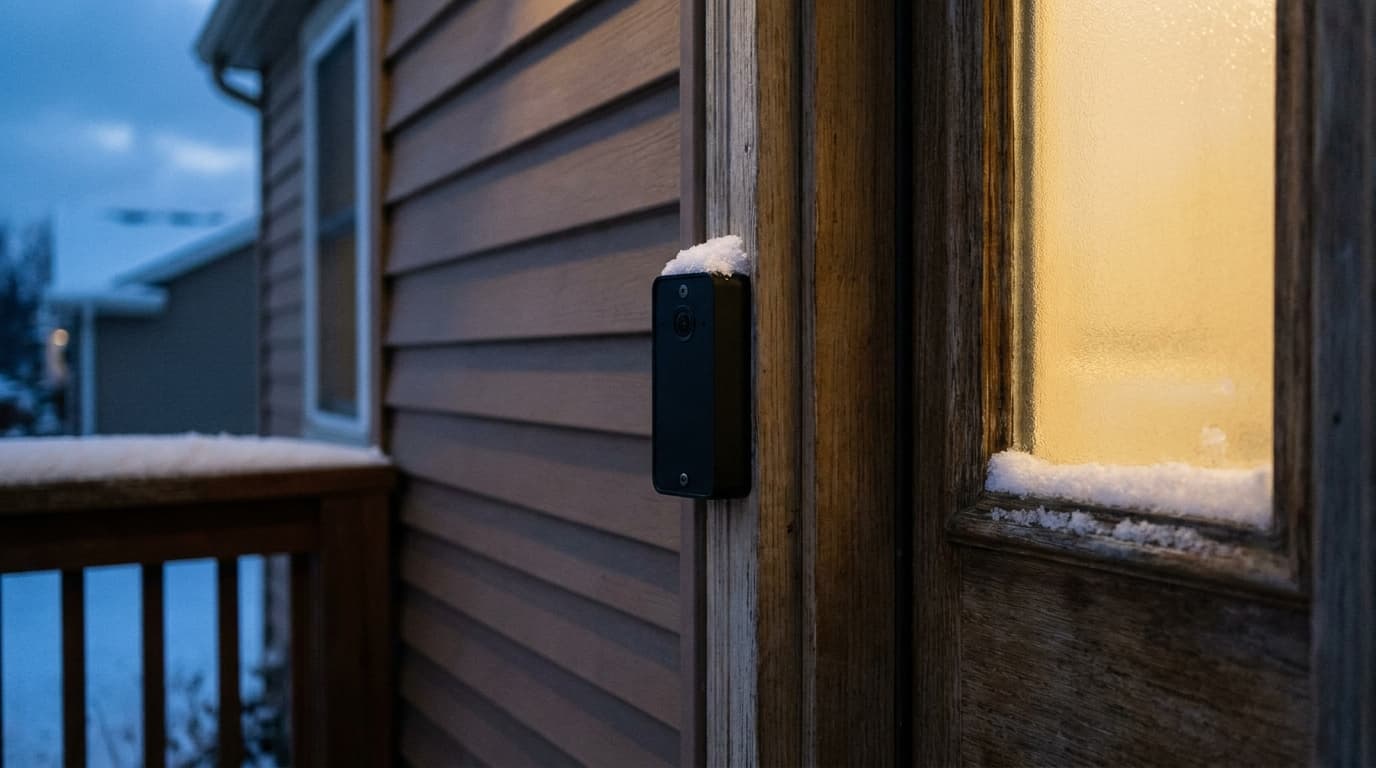
Home security cameras and video doorbells are legal across Canada, but the moment a device records audio of a conversation you are not part of, a separate federal law is engaged that plain video recording never touches.
Is it legal to have a security camera or doorbell camera in Canada?
Yes. There is no federal or provincial law that prohibits homeowners from installing security cameras or video doorbells on their own property. Millions of Canadian homes use them, and no jurisdiction in Canada requires a permit, registration, or neighbour consent to record silent video of your own porch, driveway, or yard.
The legal analysis changes once the device does more than passively record your own property, or once it captures audio. Canadian law treats video and audio very differently, and understanding that split is the key to using these devices without legal exposure.
The core distinction: video-only versus audio recording
Canada is a one-party consent country for recorded conversations. Under Criminal Code s 184(2)(a), it is lawful to record a conversation you are personally a party to, without telling the other person. R v Duarte, [1990] 1 SCR 30, is the governing Supreme Court of Canada authority on this point, and it establishes that unauthorized third-party interception of private communications is what the law targets, not participant recording.
But a home security camera or doorbell camera is not a participant in anyone's conversation. It is a fixed device that can passively pick up audio between two other people standing on the sidewalk, in a neighbour's yard, or on your own porch when you are not present. That is where Criminal Code s 184(1) comes in: it is an offence to wilfully intercept a private communication using an electro-magnetic, acoustic, mechanical, or other device, unless an exception applies.
Video alone, with no audio, does not "intercept a private communication" in the sense the Criminal Code means. Recording someone's image on your porch camera is a privacy-law and tort-law question, not a wiretap question. The moment the same device also records the audio of a conversation between two people who are not you, s 184 is squarely in play.
Why this matters for doorbell cameras specifically
Most popular video doorbells ship with audio recording turned on by default, because manufacturers market two-way talk and audio alerts as features. Many buyers never check the settings and do not realize their doorbell is recording every conversation held near the front door, including conversations between delivery drivers, visitors, or passersby who never approached the door.
That default audio capture is the practical trap. A camera that only records video of someone walking up your driveway raises little legal risk. The same camera recording the audio of a private conversation between two neighbours standing near your property line, without either of their knowledge, is capturing communications the Criminal Code was written to protect.
| Scenario | Video only | Video + audio |
|---|---|---|
| Recording your own porch/driveway | Legal, no consent needed | Legal if you are within earshot as a normal participant/observer of any conversation captured |
| Capturing a conversation between two neighbours you are not part of | Not an s 184 issue (still subject to privacy torts) | Can engage Criminal Code s 184(1) interception of a private communication |
| Pointed continuously into a neighbour's window or yard | Can support intrusion upon seclusion / nuisance claims | Same civil exposure, plus the s 184 audio risk above |
Where you point the camera matters as much as what it records
Aiming a security camera or doorbell camera at your own property, your own door, your own driveway, is not a privacy violation anywhere in Canada. The legal risk rises sharply once the camera's field of view is set up to continuously capture a neighbour's private space rather than your own.
Intrusion upon seclusion, the privacy tort recognized by the Ontario Court of Appeal in Jones v Tsige, 2012 ONCA 32, does not require publication of anything. It can be made out where someone intentionally intrudes, physically or otherwise, on another person's private affairs in a way a reasonable person would find highly offensive. A camera deliberately angled to record a neighbour's bedroom window, backyard sunbathing area, or the interior of their home through a window is the kind of fact pattern that can support this claim. Several provinces also recognize related nuisance or harassment causes of action for persistent, unwanted surveillance between neighbours.
Voyeurism under Criminal Code s 162 is a separate, criminal question. It applies where someone is observed or recorded in circumstances that give rise to a reasonable expectation of privacy, for a sexual purpose, or surreptitiously in a place like a bathroom, bedroom, or changing area. A security camera capturing someone through a window where they have undressed, even unintentionally, can raise s 162 exposure. This is a materially more serious legal problem than a privacy tort and is worth taking seriously when positioning any camera near a shared property line.
Does PIPEDA apply to my home security camera?
Generally, no, if you are a homeowner using the camera for personal, non-commercial reasons. The Personal Information Protection and Electronic Documents Act (PIPEDA) governs the collection, use, and disclosure of personal information in the course of commercial activity. The Office of the Privacy Commissioner of Canada (OPC) has long recognized a personal or domestic use exemption: an individual recording for their own household security purposes, not as part of a business, generally sits outside PIPEDA's scope.
That exemption disappears once the camera is operated in a commercial or organizational context. If any of the following apply to you, PIPEDA (or the applicable substantially similar provincial law) generally does reach your cameras:
- You run a business (a shop, a home-based business with customer visits, a short-term rental) and use cameras to monitor the premises.
- You are a landlord or property manager operating cameras in common areas, hallways, or entrances of a rental property.
- You sit on a condominium corporation board or manage cameras covering shared building areas on behalf of other unit owners.
In each of those cases, the OPC's video surveillance guidance for the private sector expects the operator to post visible notice that cameras are in use, limit retention of footage to a defined and reasonable period, restrict access to recordings to those who need it, and avoid pointing cameras at areas where individuals have a heightened expectation of privacy, such as washrooms or the interior of another dwelling.
Quebec: a stronger privacy layer
Quebec residents have privacy protection that goes beyond what most of the rest of Canada offers. The Civil Code of Quebec, articles 35 and 36, provide a freestanding right to privacy and specifically list acts that can constitute an invasion of that right, including watching or recording a person's private life by any means. This sits alongside the Quebec Charter of human rights and freedoms, which also guarantees respect for private life.
In practice, this means a Quebec resident whose neighbour trains a camera on their yard or windows may have a more direct and better-established civil remedy under the Civil Code than residents of most other provinces, in addition to any common law privacy tort claim that would apply elsewhere. Quebec's private-sector privacy statute, Law 25, primarily governs organizations rather than individual homeowners, but it reinforces how seriously Quebec treats surveillance of private life generally.
Practical compliance checklist
Follow these steps to keep a home security camera or doorbell camera on the right side of the law:
- Aim cameras at your own property. Frame the shot to cover your door, porch, or driveway rather than sweeping across a neighbour's yard or windows.
- Turn off audio recording if you do not need it. Check your device's settings; many doorbell cameras record audio by default, and disabling it removes the s 184 interception question entirely for that device.
- Never point a camera at a place with a reasonable expectation of privacy. That includes a neighbour's bathroom, bedroom, or any interior space visible only through a window.
- Post notice if you operate cameras for a business, rental property, or condo building. Visible signage is a basic OPC expectation once the personal-use exemption no longer applies.
- Limit how long you keep footage. Retain recordings only as long as you have a genuine security reason to, and restrict who can view them.
- If a neighbour dispute arises, address the camera's angle first. Many disputes are resolved simply by re-angling the camera or disabling audio, before any legal claim needs to be raised at all.
Frequently confused: this is not the same as recording phone calls
A security camera and a recorded phone call are governed by overlapping but distinct rules. Phone call recording sits squarely under Criminal Code s 184(2)(a)'s one-party consent exception because you are a participant in the call. See Recording Phone Calls in Canada for that separate analysis. For the full picture of how Canada's one-party consent rule works for recorded conversations generally, see Canada Recording Laws, the foundation this cluster builds on.
For how PIPEDA's commercial-activity trigger and its exemptions work in more depth, including what businesses operating any kind of camera or data collection need to do, see PIPEDA Explained.
Disclaimer: This article provides general legal information about Canadian federal and provincial privacy and recording law and is not legal advice. Camera placement disputes and voyeurism concerns can carry serious civil and criminal consequences; consult a licensed lawyer in your province for advice on your specific situation.
Frequently Asked Questions
Is it illegal to have a security camera pointed at my neighbour's house in Canada?
Not automatically, but continuously capturing a neighbour's windows, yard, or private living space can support a civil claim for intrusion upon seclusion under Jones v Tsige, 2012 ONCA 32, and in Quebec a claim under Civil Code articles 35 and 36. The safest approach is to angle cameras toward your own property.
Do doorbell cameras record audio in Canada, and is that legal?
Many doorbell cameras record audio by default. Video alone is not governed by the Criminal Code's wiretap provisions, but audio capture of a private conversation between people the camera owner is not part of can engage Criminal Code s 184(1), which prohibits wilfully intercepting a private communication.
Does PIPEDA apply to my home security camera?
Generally no. PIPEDA applies to personal information collected in the course of commercial activity, and the Office of the Privacy Commissioner has long recognized a personal or domestic use exemption for homeowners using cameras for their own household security.
Does PIPEDA apply if I run a business or rent out property with cameras installed?
Yes. Once cameras are operated by a business, landlord, or condominium corporation rather than for purely personal household use, PIPEDA or the applicable substantially similar provincial law generally applies, including expectations around notice signage, limited retention, and restricted access to footage.
Can a security camera catch someone committing voyeurism under Canadian law?
A camera itself is not the offence, but Criminal Code s 162 makes it a crime to observe or record a person in circumstances giving rise to a reasonable expectation of privacy, such as through a bathroom or bedroom window, particularly for a sexual purpose or surreptitiously. Camera placement near shared property lines should always avoid these areas.
Is Canada a one-party consent country for recordings?
Yes. Criminal Code s 184(2)(a) permits recording a conversation you are personally a party to without the other person's knowledge, as confirmed in R v Duarte, [1990] 1 SCR 30. No Canadian province requires all-party consent for recorded conversations, though provincial privacy torts and PIPEDA can still restrict how a recording is used or published.
Updates
Bill C-27, which would have created the Consumer Privacy Protection Act and the Artificial Intelligence and Data Act, died on the Order Paper when Parliament was prorogued and was never revived. PIPEDA remains the operative federal private-sector privacy law in Canada, and this page reflects that current state of the law.
The Law Behind This Article
This article rests on the statutory provisions below, held in our own legal record and retrieved from the official source. Tap a section to read the operative text.
Criminal Code
s. 162VoyeurismIn forcecited in 33 of our articles
(1) Every one commits an offence who, surreptitiously, observes — including by mechanical or electronic means — or makes a visual recording of a person who is in circumstances that give rise to a reasonable expectation of privacy, if (a) the person is in a place in which a person can reasonably be expected to be nude, to expose his or her genital organs or anal region or her breasts, or to be engaged in explicit sexual activity; (b) the person is nude, is exposing his or her genital organs or anal region or her breasts, or is engaged in explicit sexual activity, and the observation or recording is done for the purpose of observing or recording a person in such a state or engaged in such an activity; or (c) the observation or recording is done for a sexual purpose. (2) In this section, visual recording includes a photographic, film or video recording made by any means. (3) Paragraphs (1)(a) and (b) do not apply to a peace officer who, under the authority of a warrant issued under section 487.01, is carrying out any activity referred to in those paragraphs.
Official text (excerpt) · last checked 2026-08-12 · Read the full text in our law library · Verify at laws-lois.justice.gc.ca
Cited in 6 court opinions in our collectionLatest citing opinion in our collection: 2023
Opinions citing this section in our collection:
- R. v. Tim (Supreme Court of Canada 2022, 2022 SCC 12)
- R. v. Jarvis (Supreme Court of Canada 2019, 2019 SCC 10)
- Reference re Genetic Non‑Discrimination Act (Supreme Court of Canada 2020, 2020 SCC 17)
Identified automatically from the court opinions citing this section — not a ranking of which case controls.
Also relied on in: Canada Privacy Law: PIPEDA, Provincial Acts, and Recording Rules, Recording Phone Calls in Canada: One-Party Consent Rule, Canada Recording Laws: One-Party Consent Rules and Penalties (2026)
s. 184InterceptionIn forcecited in 55 of our articles
(1) Every person who, by means of any electro-magnetic, acoustic, mechanical or other device, knowingly intercepts a private communication is guilty of (a) an indictable offence and liable to imprisonment for a term of not more than five years; or (b) an offence punishable on summary conviction. (2) Subsection (1) does not apply to (a) a person who has the consent to intercept, express or implied, of the originator of the private communication or of the person intended by the originator thereof to receive it; (b) a person who intercepts a private communication in accordance with an authorization or pursuant to section 184.4 or any person who in good faith aids in any way another person who the aiding person believes on reasonable grounds is acting with an authorization or pursuant to section 184.4;
Official text (excerpt) · last checked 2026-08-12 · Read the full text in our law library · Verify at laws-lois.justice.gc.ca
Cited in 5 court opinions in our collectionLatest citing opinion in our collection: 2023
Opinions citing this section in our collection:
- X (Re) (Federal Court 2017, 2017 FC 1047)
- Canada (Information Commissioner) v. Canada (Transportation Accident Investigation and Safety Board) (Federal Court 2005, 2005 FC 384)
- Morgan v. Alta Flights (Charters)Inc. (Federal Court 2005, 2005 FC 421)
Identified automatically from the court opinions citing this section — not a ranking of which case controls.
Also relied on in: Canadian Law by Province: Federal and Provincial Guide, Dash Cam Laws in Canada: Rules, Audio Consent, Evidence, Workplace Privacy and Employee Monitoring in Canada
Search our full record of Canadian federal law — every consolidated Act, in English and French →
Sources and References
- Criminal Code, RSC 1985, c C-46, s 184 (interception of private communications)(laws-lois.justice.gc.ca).gov
- Criminal Code, RSC 1985, c C-46, s 162 (voyeurism)(laws-lois.justice.gc.ca).gov
- Personal Information Protection and Electronic Documents Act, SC 2000, c 5(laws-lois.justice.gc.ca).gov
- Office of the Privacy Commissioner of Canada: Guidance on covert video surveillance(priv.gc.ca).gov
- Jones v Tsige, 2012 ONCA 32 (CanLII)(canlii.org)
- R v Duarte, [1990] 1 SCR 30 (CanLII)(canlii.org)
- Civil Code of Quebec, CQLR c CCQ-1991, arts 35-36(legisquebec.gouv.qc.ca).gov