
New York
New York Workplace Recording Laws: Employee Rights and Employer Rules
Independently fact-checked against primary sources (last audited August 15, 2026). · Reviewed by the RecordingLaw editorial team. · Law checked current as of August 15, 2026. · 8 primary sources cited on this page. How we verify our legal content
New York is a one-party consent state under Penal Law 250.05, which means employees can legally record any workplace conversation they participate in without notifying coworkers or supervisors. Employers must provide written notice before monitoring phone calls, email, or internet use under Civil Rights Law Section 52-c.
New York's one-party consent law gives employees significant latitude to record workplace conversations. Under Penal Law Section 250.05, any employee can record phone calls, meetings, and in-person discussions they participate in without notifying coworkers, supervisors, or HR. At the same time, Civil Rights Law Section 52-c requires employers to notify employees about electronic monitoring practices.
This guide covers what employees and employers can and cannot record, the notice requirements for employer monitoring, whistleblower protections, NLRB considerations, and how workplace recordings function in employment disputes.
A pending bill, Senate Bill S5070 (2025-2026 session), remains in the Senate Codes Committee. If enacted, it would move New York from one-party to all-party consent, requiring the person recording to state aloud that a conversation is being recorded before it starts. It has not passed, and every recording right described in this guide reflects the one-party rule currently in force.
Employee Recording Rights
Your Legal Right to Record at Work
As a one-party consent state, New York allows you to record any conversation you are part of. In the workplace, this means you can:
- Record meetings you attend (one-on-one, team meetings, all-hands)
- Record conversations with your supervisor, manager, or HR representative
- Record phone calls with coworkers, clients, or business contacts
- Use a smartphone, dedicated voice recorder, or wearable device to capture conversations you participate in
- Record performance reviews, disciplinary meetings, and exit interviews
You do not need to inform anyone that you are recording. Your own participation in the conversation satisfies the one-party consent requirement under Penal Law 250.05.
What You Cannot Record
Even under one-party consent, certain workplace recordings are illegal:
- You cannot plant a recording device in a conference room and leave to capture conversations you are not part of
- You cannot secretly record coworkers' private conversations that you are not participating in
- You cannot access or intercept electronic communications (emails, messages) that are not addressed to you
- Recording in bathrooms, locker rooms, or changing areas is always illegal under Penal Law 250.45
Company Policy vs. State Law
There is an important distinction between what is legal and what your employer allows. While recording workplace conversations is legal under New York state law, your employer may have internal policies that prohibit recording. If you violate a company no-recording policy:
- Your employer can discipline you, up to and including termination
- The recording itself remains legally obtained under state law
- The recording may still be admissible as evidence in legal proceedings
- Termination for violating a recording policy may be challenged in some circumstances (see NLRB protections below)
Before recording at work, consider reviewing your employee handbook and company policies. Understanding the potential workplace consequences is important even when the recording is legally permitted.
Employer Electronic Monitoring: Civil Rights Law 52-c
The Notice Requirement
Civil Rights Law Section 52-c (effective May 7, 2022) requires every private employer in New York that monitors employees electronically to provide prior written notice. New York's Civil Rights Law has two separate sections both commonly called "52-c": this employer-monitoring provision, cited here as 52-C*2, and an unrelated section covering AI-generated deepfake disclosure. The two are not interchangeable. The statute applies to monitoring of:
- Telephone conversations and transmissions
- Electronic mail (email) and electronic transmissions
- Internet access and usage
The law covers monitoring done "by any electronic device or system, including but not limited to the use of a computer, telephone, wire, radio, or electromagnetic, photoelectronic or photo-optical systems."
How Employers Must Provide Notice
Employers must satisfy two notification requirements:
Individual notice upon hiring. Every new employee subject to electronic monitoring must receive written notice at the time of hire. The notice can be delivered in writing, as an electronic record, or in another electronic form. The employee must acknowledge receipt either in writing or electronically.
Workplace posting. The employer must also post the notice of electronic monitoring in a conspicuous place readily available for viewing by employees who are subject to monitoring. This posting requirement functions similarly to how employers must display wage and hour notices.
What the Notice Must Say
The notice must advise employees that "any and all telephone conversations or transmissions, electronic mail or transmissions, or internet access or usage by an employee by any electronic device or system ... may be subject to monitoring at any and all times and by any lawful means."
Penalties for Non-Compliance
| Violation | Maximum Civil Penalty |
|---|---|
| First offense | $500 |
| Second offense | $1,000 |
| Third and subsequent offenses | $3,000 each |
The New York Attorney General has enforcement authority over these provisions. Employers who fail to provide the required notice can face cumulative penalties for each instance of non-compliance.
What Section 52-c Does NOT Cover
The statute has important limitations:
- It applies only to private employers, not government agencies
- It does not require employer consent from employees to monitor, only notice
- It does not prohibit monitoring itself, just mandates disclosure
- It does not cover video surveillance in common work areas (though other laws may apply)
- It does not create a private right of action for employees (enforcement is through the Attorney General)
Employer Video Surveillance in the Workplace
Where Employers Can Place Cameras
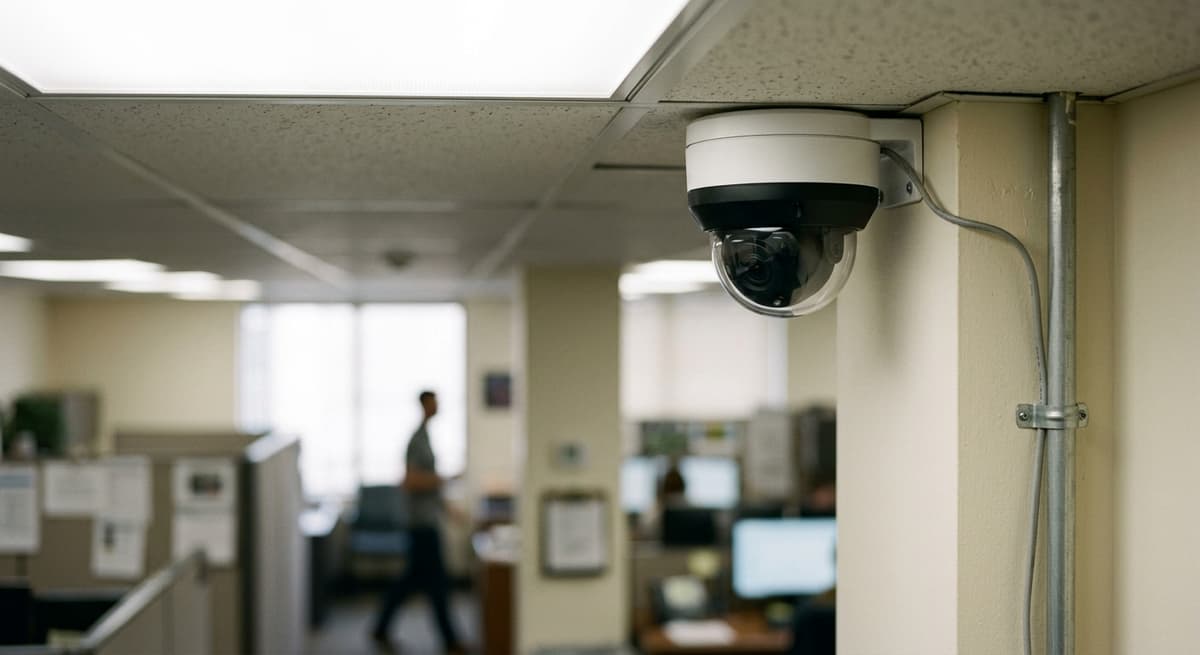
New York employers can install video cameras in common work areas where employees do not have a reasonable expectation of visual privacy:
- Entrances and exits
- Hallways and corridors
- Sales floors and customer-facing areas
- Warehouses and production floors
- Parking lots and loading docks
- Reception areas and lobbies
Where Cameras Are Prohibited
Under Penal Law 250.45, employers cannot place cameras in:
- Bathrooms and restrooms
- Locker rooms and changing areas
- Shower facilities
- Private nursing or lactation rooms
- Any area where employees have a reasonable expectation of privacy for disrobing
Violations constitute unlawful surveillance in the second degree, a Class E felony with up to 4 years in prison.
Audio Recording by Employers
If workplace cameras also capture audio, the eavesdropping provisions of Penal Law 250.05 apply. Employers who record audio in the workplace without being a party to the conversations or without consent from at least one participant could face eavesdropping charges. Many employers avoid audio recording specifically because of these legal risks.
Whistleblower Protections: Labor Law 740

Expanded Protections Since January 2022
Labor Law Section 740 provides broad whistleblower protections for New York employees. The law was significantly expanded effective January 26, 2022, through amendments that broadened its scope.
Under the expanded law, employers cannot take retaliatory action against an employee who:
- Discloses or threatens to disclose an employer activity, policy, or practice that the employee reasonably believes is in violation of a law, rule, or regulation, or that the employee reasonably believes poses a substantial and specific danger to public health or safety
- Provides information to, or testifies before, any public body conducting an investigation, hearing, or inquiry into such violations
- Objects to, or refuses to participate in, any activity that would violate a law, rule, or regulation
How Recordings Support Whistleblower Claims
Workplace recordings made under one-party consent can serve as critical evidence in whistleblower cases. An employee who records conversations documenting unsafe working conditions, fraudulent practices, or other employer misconduct has tangible proof to support their claims. Without recordings, whistleblower disputes often become a credibility contest between the employee and employer.
Remedies for Retaliation
Employees who experience retaliation for whistleblowing can seek:
- Reinstatement to the same or equivalent position
- Back pay with interest
- Compensation for damages, including litigation costs and attorney fees
- A civil penalty of up to $10,000
The statute of limitations for whistleblower retaliation claims under Section 740 is two years from the date of the retaliatory action.
NLRA Protections for Workplace Recording
Protected Concerted Activity
The National Labor Relations Act (NLRA) protects employees' rights to engage in "concerted activity" for mutual aid or protection. The National Labor Relations Board (NLRB) has addressed whether employer no-recording policies violate the NLRA.
Protected concerted activity includes:
- Talking with coworkers about wages, benefits, and working conditions
- Documenting unsafe working conditions
- Recording evidence of unfair labor practices
- Gathering information to support workplace organizing efforts
When No-Recording Policies May Be Unenforceable
The NLRB currently evaluates workplace rules, including no-recording policies, under the standard established in Stericycle, Inc., 372 NLRB No. 113 (2023), which applies a more employee-protective balancing test than the prior Boeing framework. Under Stericycle, a no-recording policy that could reasonably be interpreted as restricting protected concerted activity is presumptively unlawful unless the employer demonstrates that its legitimate business interest outweighs the burden on Section 7 rights.
On February 14, 2025, NLRB General Counsel Memo GC 25-05 rescinded eight prior General Counsel memoranda, including guidance on seeking full remedies for victims of unlawful conduct, Section 10(j) injunction initiatives, non-compete and stay-or-pay provisions, and the Cemex bargaining-order framework. This was a substantive rollback of employee-protective enforcement priorities, not an administrative cleanup. It did not overturn Stericycle itself, which remains controlling Board precedent. Employers can maintain narrowly tailored no-recording policies that serve legitimate business interests (trade secrets, patient privacy) but blanket prohibitions remain legally risky.
Key Limitations
NLRA protections apply primarily to employees in the private sector. Government employees, agricultural laborers, domestic workers, independent contractors, and supervisors (as defined by the NLRA) are generally not covered by these protections.
Recording in Specific Workplace Scenarios
Harassment and Discrimination Documentation
Recording evidence of workplace harassment or discrimination is one of the most common reasons employees record at work. Under New York's one-party consent law, you can record:
- A supervisor making discriminatory comments during a conversation you are part of
- Coworkers creating a hostile work environment during interactions you participate in
- HR meetings where you are told you have "no case" or are pressured to drop a complaint
- Conversations where you are threatened with retaliation for filing a complaint
These recordings can be valuable evidence in complaints filed with the New York State Division of Human Rights or the Equal Employment Opportunity Commission (EEOC).
Performance Reviews and Disciplinary Meetings
You can record your own performance reviews and disciplinary meetings. These recordings protect you by:
- Creating an accurate record of what was said (versus what may later be documented in writing)
- Capturing verbal promises about promotions, raises, or accommodations
- Documenting whether proper procedures were followed
- Preserving evidence if the employer later changes its position
Job Interviews
New York's one-party consent law applies to job interviews. Both the interviewer and the candidate can record the interview as participants. Recordings of job interviews can document discriminatory questions or statements, though company policies may still restrict the interviewer from recording.
Remote Work and Virtual Meetings
Remote employees working from New York can record virtual meetings (Zoom, Teams, Webex) they participate in. The same one-party consent rules apply to virtual meetings as to in-person conversations. If the meeting includes participants in two-party consent states, the stricter law may govern the recording with respect to those participants.
Wearable Recording Devices at Work
Employee Use of Wearable Recorders
New York's one-party consent law permits employees to use wearable recording devices like Plaud AI voice recorders, smartwatches with recording capability, or similar devices. You can wear these devices during meetings, conversations, and daily work interactions as long as you are a participant in the conversations being recorded.
Employer-Issued Wearable Monitoring
If an employer deploys body cameras, smart badges, or other wearable devices that record employee interactions, Civil Rights Law Section 52-c notice requirements apply. Employers must inform employees about this monitoring in writing at the time of hiring and through workplace postings.
Using Workplace Recordings in Legal Proceedings
Employment Lawsuits
Recordings made legally under one-party consent are generally admissible in New York employment lawsuits. They can support claims for:
- Wrongful termination
- Discrimination (age, race, sex, disability, religion, national origin)
- Sexual harassment
- Wage theft and unpaid overtime
- Retaliation for protected activity
Workers' Compensation and OSHA Complaints
Recordings documenting unsafe working conditions can support workers' compensation claims and complaints filed with the Occupational Safety and Health Administration (OSHA). Audio or video evidence of hazardous conditions is often more persuasive than written descriptions alone.
Unemployment Insurance Appeals
If you are terminated for allegedly violating a no-recording policy, the recording itself may be relevant in an unemployment insurance appeal. New York's Department of Labor evaluates whether the termination was for "misconduct" that would disqualify the employee from benefits. Whether violation of a recording policy constitutes disqualifying misconduct depends on the specific circumstances.
More New York Recording Laws
Audio Recording | Video Recording | Voyeurism and Hidden Cameras | Workplace Recording | Recording Police | Phone Call Recording | Security Cameras | Recording in Public | Landlord-Tenant Recording | Dashcam Laws | School Recording | Medical Recording
Back to New York Recording Laws
More New York Recording Topics
More New York Laws
Frequently Asked Questions
Can I record my boss in New York without telling them?
Yes. New York is a one-party consent state under Penal Law 250.05. As a participant in the conversation, you can record interactions with your boss without informing them. This includes meetings, phone calls, and in-person discussions. However, your employer may have an internal policy against recording, and violating that policy could result in discipline or termination even though the recording is legal under state law.
Does my employer have to tell me about electronic monitoring in New York?
Yes. Civil Rights Law Section 52-c requires all private employers in New York to provide written notice to employees upon hiring if the employer monitors telephone conversations, email, or internet usage. The employer must also post this notice in a conspicuous workplace location. Failure to provide notice carries fines of $500 for a first offense, $1,000 for a second, and $3,000 for each subsequent violation.
Can my employer put cameras in the workplace in New York?
Employers can install cameras in common work areas like hallways, entrances, sales floors, and parking lots. They cannot place cameras in bathrooms, locker rooms, changing areas, or any space where employees have a reasonable expectation of privacy for disrobing. Placing a camera in a prohibited area is unlawful surveillance under Penal Law 250.45, a Class E felony.
Can my employer fire me for recording a conversation at work in New York?
While recording workplace conversations is legal under New York state law, your employer can enforce internal no-recording policies through discipline, including termination. However, the NLRA may protect recordings made as part of protected concerted activity (such as documenting unsafe conditions or unfair labor practices). Additionally, recordings that support whistleblower claims may receive protection under Labor Law 740.
Can I use a workplace recording as evidence in a lawsuit in New York?
Yes. Recordings made legally under one-party consent are generally admissible as evidence in New York courts, including employment lawsuits, discrimination claims, and whistleblower retaliation cases. The recording must be authenticated, relevant, and complete. Illegally obtained recordings are inadmissible under CPLR 4506.
Updates
Corrected the date and substance of an NLRB General Counsel memo (it rescinded substantive employee-protective enforcement guidance in February 2025, not routine housekeeping in January), added a short discussion of a pending bill that would end one-party consent recording in New York, and repointed the Civil Rights Law 52-c employer-monitoring citation to the correct working statute (New York's Civil Rights Law has two unrelated sections both labeled 52-c).
Independently fact-checked against the cited primary sources; governing law re-checked for recent changes
Corrected the Labor Law 740(2)(a) retaliation-trigger description: the current statute (confirmed on nysenate.gov) states two independent triggers (violation of law/rule/regulation, or danger to public health/safety) and does not contain a separate 'healthcare fraud' category; that language was part of the pre-2022 version of the law and was replaced by the broader 2022 amendment.
Governing law re-checked for recent changes
Reviewed and approved by an editor
The Law Behind This Article
This article rests on the statutory provisions below, held in our own legal record and retrieved from the official source. Tap a section to read the operative text.
New York Penal Law
§ 250.05EavesdroppingIn forcecited in 14 of our articles
Eavesdropping. A person is guilty of eavesdropping when he unlawfully engages in wiretapping, mechanical overhearing of a conversation, or intercepting or accessing of an electronic communication. Eavesdropping is a class E felony.
Official text (excerpt) · last checked 2026-08-31 · Read the full text in our law library · Verify at legislation.nysenate.gov
Cited in 39 court opinions in our collectionLatest citing opinion in our collection: 2025
In the courts (editorial summary, independently checked):New York courts recognize a vicarious consent exception to the eavesdropping offense. The Appellate Term adopted it in People v. Clark (2008). The Court of Appeals then held in People v. Badalamenti (2016) that consent covers a parent with a good faith, objectively reasonable belief that recording serves the child's best interests.
Opinions citing this section in our collection:
- The People v. Anthony Badalamenti (New York Court of Appeals 2016, 27 N.Y.3d 423)✓A father's call to the mother's phone connected with no one speaking, and he recorded her boyfriend threatening to beat his five year old son; the court held that consent under Penal Law 250.05 includes a parent's vicarious consent, so the recording was admissible.
- People v. Badalamenti (Appellate Division of the Supreme Court of the State of New York 2015, 124 A.D.3d 672)✓Reviewing the same recording of a boyfriend threatening the father's young son, the Appellate Division adopted a vicarious consent exemption to Penal Law 250.05 where a parent has a good faith, objectively reasonable basis to believe recording serves the child's welfare.
- People v. Clark (Appellate Terms of the Supreme Court of New York 2008, 19 Misc. 3d 6)✓A mother slipped an audio recorder into the backpack of her nonverbal autistic eight year old before he boarded the school bus, capturing his bus matron; the Appellate Term held she could vicariously consent for him, so the recording did not violate Penal Law 250.05.
Identified automatically from the court opinions citing this section — not a ranking of which case controls.
Also relied on in: New York Audio Recording Laws: One-Party Consent Rules and Penalties, New York Smart Glasses Recording Laws 2026, New York AI Meeting Recording Laws (2026)
§ 250.00Eavesdropping; definitions of termsIn forcecited in 19 of our articles
Eavesdropping; definitions of terms. The following definitions are applicable to this article: 1. "Wiretapping" means the intentional overhearing or recording of a telephonic or telegraphic communication by a person other than a sender or receiver thereof, without the consent of either the sender or receiver, by means of any instrument, device or equipment. The normal operation of a telephone or telegraph corporation and the normal use of the services and facilities furnished by such corporation pursuant to its tariffs or necessary to protect the rights or property of said corporation shall not be deemed "wiretapping." 2. "Mechanical overhearing of a conversation" means the intentional overhearing or recording of a conversation or discussion, without the consent of at least one party thereto, by a person not present thereat, by means of any instrument, device or equipment. 3.
Official text (excerpt) · last checked 2026-07-29 · Read the full text in our law library · Verify at legislation.nysenate.gov
Cited in 56 court opinions in our collectionLatest citing opinion in our collection: 2023
Opinions citing this section in our collection:
- People v. Fata (New York County Courts 1988, 139 Misc. 2d 979)“…Fata had a justifiable expectation of privacy; and (c) that Penal Law § 250.00 et seq. prohibit the mechanical overh…”
- The People v. Anthony Badalamenti (New York Court of Appeals 2016, 27 N.Y.3d 423)“…t of “mechanical overhearing of a conversation” pursuant to Penal Law § 250.00 (2), includes vicarious consent, on beh…”
- Gurevich v. Gurevich (New York Supreme Court 2009, 24 Misc. 3d 808)“…11 ing” as they relate to Penal Law § 250.05 are defined in Penal Law § 250.00 (6) as: “the intentional acquiring, r…”
Identified automatically from the court opinions citing this section — not a ranking of which case controls.
Also relied on in: New York Dashcam Laws: Legality, Mounting Rules, and Evidence Use, New York Landlord-Tenant Recording Laws: Rights for Renters and Property Owners, New York Medical Recording Laws: Patient Rights and Healthcare Privacy
§ 250.45Unlawful surveillance in the second degreeIn forcecited in 18 of our articles
Unlawful surveillance in the second degree. A person is guilty of unlawful surveillance in the second degree when: 1. For his or her own, or another person's amusement, entertainment, or profit, or for the purpose of degrading or abusing a person, he or she intentionally uses or installs, or permits the utilization or installation of an imaging device to surreptitiously view, broadcast or record a person dressing or undressing or the sexual or other intimate parts of such person at a place and time when such person has a reasonable expectation of privacy, without such person's knowledge or consent; or 2. For his or her own, or another person's sexual arousal or sexual gratification, he or she intentionally uses or installs, or permits the utilization or installation of an imaging device to surreptitiously view, broadcast or record a person dressing or undressing or the sexual or other intimate parts of such person at a place and time when such person has a reasonable expectation of privacy, without such person's knowledge or consent; or 3.
Official text (excerpt) · last checked 2026-08-31 · Read the full text in our law library · Verify at legislation.nysenate.gov
Cited in 51 court opinions in our collectionLatest citing opinion in our collection: 2025
In the courts (editorial summary, independently checked):People v. Piznarski (2013) held Penal Law 250.45 reaches a participant who secretly records consensual sex, that the victim kept a reasonable expectation of privacy, and that the one-party consent rule for eavesdropping does not apply. People v. Evans (2006) applied section 250.45(3) to a camera hidden in a bedroom.
Opinions citing this section in our collection:
- People v. Evans (Appellate Division of the Supreme Court of the State of New York 2006, 27 A.D.3d 905)✓A man placed a video camera in his girlfriend's 12-year-old daughter's bedroom and recorded her undressing, then pleaded guilty under Section 250.45(3); the court affirmed, holding the plea needed no express admission of no legitimate purpose given the statutory presumption.
- People v. Lema (Appellate Division of the Supreme Court of the State of New York 2017, 152 A.D.3d 440)✓A man used a phone camera to record under women's skirts on a subway train, but dark lighting produced no image of intimate parts; the court affirmed, holding Section 250.45(4) is satisfied when a device is used for the purpose of making such a recording.
- People v. Piznarski (Appellate Division of the Supreme Court of the State of New York 2013, 113 A.D.3d 166)✓A student secretly recorded sex with two women using a camera left in view on his bedroom desk; the court affirmed under Section 250.45, holding the statute reaches a participant who records a consensual encounter and that a visible camera can still be used surreptitiously.
Identified automatically from the court opinions citing this section — not a ranking of which case controls.
Also relied on in: New York Laws on Recording in Public: Rights, Limits, and Privacy Rules, New York School Recording Laws: Student, Parent, and Teacher Rights, New York Security Camera Laws: Rules for Homes, Businesses, and Rentals
New York Labor Law
§ 740Retaliatory action by employers; prohibitionIn forcecited in 3 of our articles
Retaliatory action by employers; prohibition. 1. Definitions. For purposes of this section, unless the context specifically indicates otherwise: (a) "Employee" means an individual who performs services for and under the control and direction of an employer for wages or other remuneration, including former employees, or natural persons employed as independent contractors to carry out work in furtherance of an employer's business enterprise who are not themselves employers. (b) "Employer" means any person, firm, partnership, institution, corporation, or association that employs one or more employees. (c) "Law, rule or regulation" includes: (i) any duly enacted federal, state or local statute or ordinance or executive order; (ii) any rule or regulation promulgated pursuant to such statute or ordinance or executive order; or (iii) any judicial or administrative decision, ruling or order.
Official text (excerpt) · last checked 2026-09-14 · Read the full text in our law library · Verify at legislation.nysenate.gov
Cited in 349 court opinions in our collectionLatest citing opinion in our collection: 2026
Opinions citing this section in our collection:
- Leibowitz v. Bank Leumi Trust Co. (Appellate Division of the Supreme Court of the State of New York 1989, 152 A.D.2d 169)“…lletta, J. Does a complaint state a cause of action under Labor Law § 740, the so-called "Whistleblowers’ Statute…”
- Horn v. New York Times (New York Court of Appeals 2003, 100 N.Y.2d 85)“…out the Legislature's enactment of the Whistleblower's Law (Labor Law § 740; Civil Service Law § 75-b). Although we…”
- Webb-Weber v. Community Action for Human Services, Inc. (New York Court of Appeals 2014, 23 N.Y.3d 448)“…OPINION OF THE COURT Pigott, J. Labor Law § 740 (2), commonly referred to as the “whist…”
Identified automatically from the court opinions citing this section — not a ranking of which case controls.
United States Code Title 18
§ 2511Interception and disclosure of wire, oral, or electronic communications prohibitedIn forcecited in 422 of our articles
Except as otherwise specifically provided in this chapter any person who— intentionally intercepts, endeavors to intercept, or procures any other person to intercept or endeavor to intercept, any wire, oral, or electronic communication; intentionally uses, endeavors to use, or procures any other person to use or endeavor to use any electronic, mechanical, or other device to intercept any oral communication when— such device is affixed to, or otherwise transmits a signal through, a wire, cable, or other like connection used in wire communication; or such device transmits communications by radio, or interferes with the transmission of such communication; or such person knows, or has reason to know, that such device or any component thereof has been sent through the mail or transported in interstate or foreign commerce; or such use or endeavor to use (A) takes place on the premises of any business or other commercial establishment the operations of which affect interstate or foreign commerce; or (B) obtains or is for the purpose of obtaining information relating to the operations of any business or other commercial establishment the operations of which affect interstate or foreign…
Official text (excerpt) · last checked 2026-09-17 · Read the full text in our law library · Verify at uscode.house.gov
Cited in 2,045 court opinions in our collectionLatest citing opinion in our collection: 2026
In the courts (editorial summary, independently checked):Griggs-Ryan v. Smith (1990) applied the Section 2511(2)(d) prior-consent exception, treating a tenant repeatedly told that all incoming calls were taped as having impliedly consented. United States v. United States District Court (1972) read the then-current Section 2511(3) as conferring no presidential surveillance power.
Opinions citing this section in our collection:
- Mitchell v. Forsyth (Supreme Court of the United States 1985, 472 U.S. 511)✓The Attorney General authorized a warrantless 1970 national security wiretap that caught the plaintiff's calls; the Court held the since-repealed Section 2511(3) disclaimer left the tap lawful under Title III, and that Mitchell had qualified immunity.
- United States v. United States District Court for the Eastern District of Michigan (Supreme Court of the United States 1972, 407 U.S. 297)✓The Attorney General approved warrantless wiretaps on members of a domestic group accused of bombing a CIA office; the Court read Section 2511(3) as a congressional disclaimer conferring no surveillance power, then held the Fourth Amendment required prior judicial approval.
- Forsyth v. Barr (Court of Appeals for the Fifth Circuit 1994, 19 F.3d 1527)✓Dallas police used, in an internal affairs probe of an officer, calls private parties allegedly intercepted illegally; assuming that was unlawful, the Fifth Circuit held Section 2517(1) and (2) allowed the disclosure and use, defeating the Section 2511(1)(c) and (d) claims.
Identified automatically from the court opinions citing this section — not a ranking of which case controls.
Also relied on in: Connecticut Recording Laws (2026): Hybrid Consent Rules Explained, Oregon Recording Laws (2026): Hybrid One-Party and All-Party Rules, US Recording Laws by State (2026): All 50 States Explained
Search our full record of US law — 2.1 million sections, every state + federal →
Sources and References
- N.Y. Penal Law 250.00 - Eavesdropping Definitions(nysenate.gov).gov
- N.Y. Civil Rights Law 52-C*2 - Employer Electronic Monitoring(nysenate.gov).gov
- N.Y. Labor Law 740 - Whistleblower Protections(nysenate.gov).gov
- N.Y. Penal Law 250.45 - Unlawful Surveillance Second Degree(nysenate.gov).gov
- NLRB - Protected Concerted Activity(nlrb.gov).gov
- NLRB - Employee Rights(nlrb.gov).gov
- N.Y. Division of Human Rights(dhr.ny.gov).gov
- Senate Bill S5070 - Recording Notice Requirement(nysenate.gov).gov
- 18 U.S.C. 2511 - Federal Wiretap Act(law.cornell.edu)