
France
Boundary Trees and Hedges in France: Planting Distances Explained
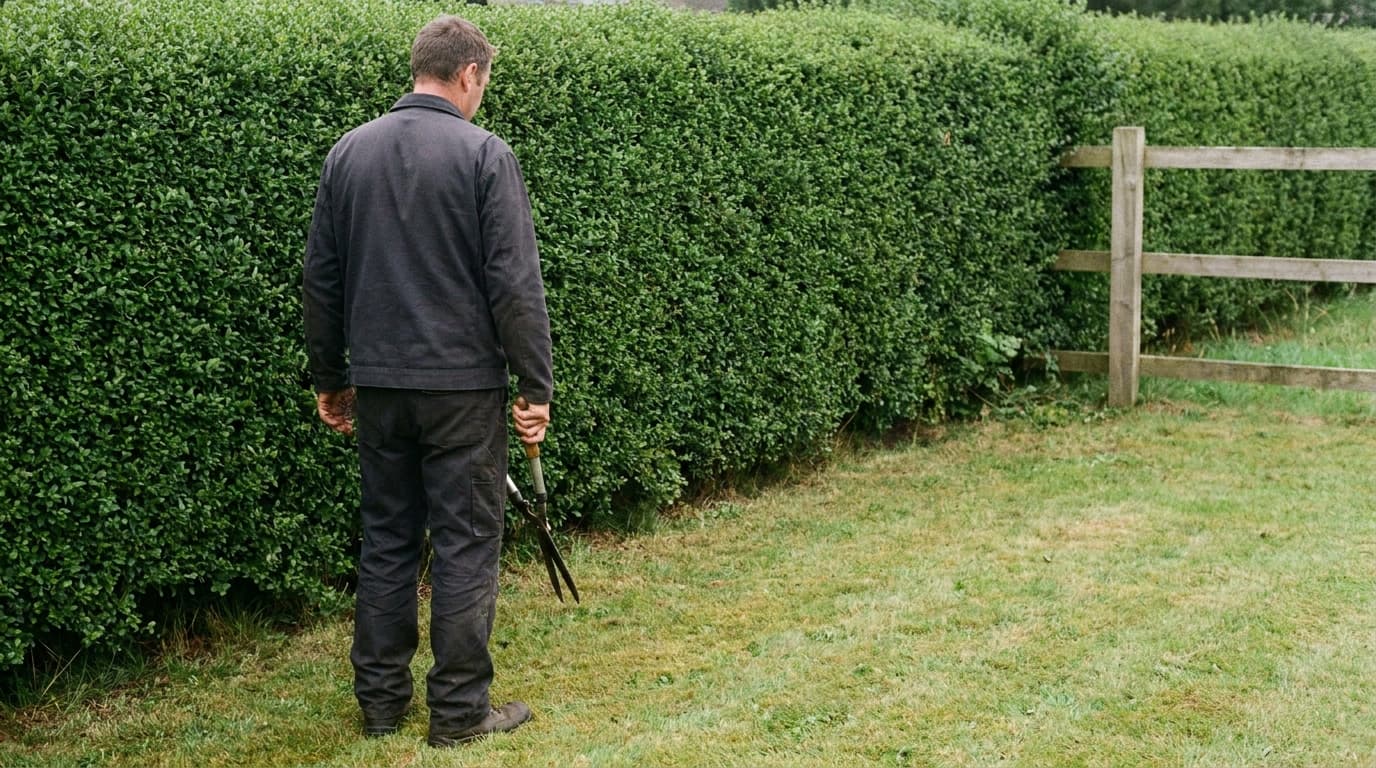
Boundary planting in France is governed by precise figures, and neighbours get them wrong more often than almost any other rule of property life. The Code civil sets two simple distances for how close a tree or hedge may sit to the line between two properties, adds a separate set of rules for branches and roots that stray across the boundary, and treats a hedge grown on the line itself as jointly owned. Getting the metres right at planting time is far cheaper than a dispute years later.
This page explains the planting distances in Article 671, the removal right in Article 672 and its 30-year exception, the branch-and-root rules in Article 673, how a shared hedge (haie mitoyenne, a hedge on the boundary owned by both neighbours) works, and the bornage survey that fixes the line in the first place. For the broader framework of neighbour law, see the property disputes hub and the page on general neighbour disputes.
Information last verified on 22 July 2026. This page presents general legal information, not legal advice.
The two-metre and half-metre planting distances (Article 671)
Article 671 of the Code civil sets the core rule. Where no local regulation or established local usage says otherwise, a tree, shrub, or bush whose height exceeds 2 metres must be planted at least 2 metres from the dividing line between the two properties. A plant that stays at 2 metres or under may be planted at least 0.5 metre from the line.
Two measurement details decide most arguments. Height is counted from the ground up to the top of the plant, so a tree that grows past 2 metres over time can move from the 0.5-metre band into the 2-metre band. The distance itself is measured from the centre of the trunk, not from the outer branches or the edge of the foliage.
The same article allows plants to be trained flat against a dividing boundary wall as espaliers, with no minimum distance, provided they do not rise above the top of the wall. That is the one place the distance rule does not apply to a plant set against the line.
When a tree is too close: cutting back and removal (Article 672)
If a neighbour has planted closer than the legal distance, Article 672 gives you a remedy. You can require that the offending tree, shrub, or bush be uprooted, or cut back to the height the previous article allows. In practice that means a plant in the 0.5-metre band can be forced down to 2 metres or removed if it was set too close.
The right is not automatic in every case. Article 672 preserves three defences for the neighbour: a title granting the right to keep the plant where it is, an original layout established when the two properties were once held together, and prescription trentenaire, the 30-year rule described in the next section.
Where none of those defences applies, the usual path is a written request to prune or remove, followed if necessary by an application to the tribunal judiciaire. A court can order removal and, in some cases, damages for harm the planting has caused.
The 30-year exception (prescription trentenaire)
The most common reason a too-close tree can lawfully stay is time. If a planting has stood in breach of the legal distance, openly and without interruption, for 30 years, the neighbour acquires the right to keep it. This is prescription trentenaire, and it is a defence to the removal right in Article 672.
The 30 years run from the moment the breach became visible, for example when a tree in the half-metre band first grew past 2 metres. Tolerating an encroaching plant for decades therefore has legal consequences: the right to demand its removal can be lost even though the distance was never respected.
By contrast, the right to deal with branches and roots that cross the line, under Article 673, is expressly imprescriptible. No lapse of time removes it. That difference matters: a tree may become impossible to remove after 30 years, yet its overhanging branches can still be dealt with at any point.
Overhanging branches and invading roots (Article 673)
Article 673 draws a sharp line between branches and roots, and readers frequently reverse it.
For branches that overhang your property, you may compel the owner to cut them, but you may not cut them yourself. The obligation to prune sits with the tree's owner. If an informal request fails, a written demand and, ultimately, a court order are the correct route. Any fruit that falls naturally from those branches onto your land belongs to you.
For roots, brambles, and twigs (racines, ronces ou brindilles) that advance onto your land, the rule flips: you may cut them yourself, at the boundary line. You do not need the owner's permission for these, and as noted above this right never lapses with time.
Keeping the two straight avoids a costly mistake. Cutting a neighbour's overhanging branch yourself, rather than requiring the owner to do it, can expose you to a claim, even though cutting an invading root yourself is perfectly lawful.
Shared hedges on the boundary (haie mitoyenne)
A hedge is treated like any other planting when it sits on one side of the line: the 2-metre and 0.5-metre distances of Article 671 apply to it. But a hedge grown on the boundary line itself is different. It is presumed to be a haie mitoyenne, a jointly owned hedge, under the mitoyennete (shared-ownership) rules of the Code civil.
A shared hedge belongs to both neighbours and is maintained by both at shared cost. Each neighbour trims the face of the hedge on their own side, and the produce of the hedge is shared. Because it stands on the line rather than set back from it, the planting-distance figures do not apply.
A co-owner may remove a haie mitoyenne up to their own property line, but only on condition that they build a wall on that line (Code civil Article 668); short of that they may not tear it out unilaterally. Either owner can require a retained shared hedge to be properly maintained. If a hedge is on one owner's land rather than on the line, it is that owner's alone, and the ordinary distance and pruning rules govern it.
Bornage: fixing the boundary line first (Article 646)
Many planting disputes are really disputes about where the boundary is. Article 646 of the Code civil provides the answer: either neighbour can compel a bornage, the formal demarcation of the line between two properties. It is a distinct action from any argument about distances or branches.
A bornage is normally carried out by a land surveyor (geometre-expert), who identifies the line, places boundary markers, and prepares a report the owners sign. Done by agreement it is an amicable bornage; if a neighbour refuses, a court can order a judicial bornage.
Fixing the line first is often the sensible step. A distance measured from the centre of a trunk means nothing until both neighbours agree where the line the distance is measured to actually runs.
Local rules can change the distances
The 2-metre and 0.5-metre figures apply only where no local rule or established local usage says otherwise. Article 671 expressly defers to particular regulations and to constant, recognised local usages, and a local planning document (plan local d'urbanisme, or PLU) or a municipal rule can set different distances for a given commune.
Before planting near a boundary, it is worth checking with the mairie (town hall) whether a local rule or usage varies the default figures. Where a valid local rule exists, it prevails over the general Code civil distances.
How to resolve a planting dispute
Most neighbour planting disputes are best resolved without a courtroom. The usual sequence is an informal approach, then a written request (a recorded-delivery letter setting out the article relied on and what you ask), and only then a court.
For many small neighbour disputes, an attempt at amicable resolution through a conciliateur de justice (a free volunteer conciliator) is required before the tribunal judiciaire can be seised. The conciliator meets the parties, tries to broker an agreement, and records any settlement reached.
If conciliation fails, the tribunal judiciaire hears the claim. It can order a tree cut back or removed, require branches to be pruned, confirm a boundary through bornage, or award damages. For the general escalation framework that applies across neighbour law, see the neighbour disputes page, and for other French legal topics start at France.
Frequently Asked Questions
How far from my neighbour's boundary can I plant a tree in France?
Under Code civil Article 671, a tree, shrub, or bush whose height exceeds 2 metres must be planted at least 2 metres from the dividing line between the two properties. A plant that stays 2 metres or under may be planted as close as 0.5 metre from the line. Height is counted from the ground to the top of the plant, and the distance is measured from the centre of the trunk. Local rules or established local usages can set different figures, so it is worth checking with your commune before planting.
Can I cut my neighbour's branches that hang over my garden?
No. Article 673 lets you compel your neighbour to cut back branches that overhang your land, but it does not let you cut those branches yourself. You must ask the owner to prune them, in writing if an informal request fails, and if they refuse you can seek an order from the tribunal judiciaire. The rule is different for roots, brambles, and twigs that cross the line: those you are entitled to cut yourself, at the boundary. Fruit that falls naturally from overhanging branches belongs to you.
My neighbour's tree is far too close to the line but has been there for years. Can I still have it removed?
Possibly not. Article 672 gives you the right to require a plant set closer than the legal distance to be uprooted or cut back to the permitted height. That right is defeated by a title, by an established original layout, or by prescription trentenaire, meaning the planting has grown in breach of the distance and been tolerated for 30 years. Once 30 years of uninterrupted, visible non-compliance have run, the neighbour can keep the tree where it is.
Who is responsible for a hedge that grows on the boundary line itself?
A hedge planted directly on the dividing line is presumed to be a haie mitoyenne, a jointly owned hedge, so both neighbours own and maintain it together and share the cost of upkeep. Each side is trimmed by the neighbour on that side. Because it sits on the line rather than set back from it, the 2-metre and 0.5-metre distances of Article 671 do not apply to it. Either owner can ask that the shared hedge be maintained, and neither may remove it without the other's agreement.
What should I do first if I do not know where the exact boundary is?
Ask for a bornage. This is the formal demarcation of the property line, governed by Article 646 of the Code civil, and either neighbour can compel it. A land surveyor (geometre-expert) identifies the line, sets boundary markers, and draws up a report that both owners sign. Doing this first matters, because a planting-distance argument cannot be settled until everyone agrees where the line actually runs. If the neighbour refuses an amicable survey, a court can order a judicial bornage.
Sources and References
- Code civil, Article 671 (planting distances: 2 metres and 0.5 metre)(legifrance.gouv.fr).gov
- Code civil, Article 672 (right to require uprooting or cutting back; title, layout, 30-year prescription)(legifrance.gouv.fr).gov
- Code civil, Article 673 (overhanging branches, roots, brambles and twigs)(legifrance.gouv.fr).gov
- Code civil, Article 668 (co-owner right to remove a haie mitoyenne, subject to building a wall)(legifrance.gouv.fr).gov
- Code civil, Article 646 (bornage: fixing the boundary line)(legifrance.gouv.fr).gov
- Service-Public: Plantations (haies, arbres, arbustes) - fiche F614(service-public.gouv.fr).gov
- Service-Public: Bornage d'un terrain - fiche F3037(service-public.gouv.fr).gov
- Code civil, Section 1: Du mur et du fosse mitoyens (Articles 653 to 673)(legifrance.gouv.fr).gov