
France
Délit de Fuite in France: Penalties for Leaving the Scene of an Accident
Information last verified on 20 July 2026. This article presents general legal information, not legal advice.
Jurisdiction scope: This article covers délit de fuite and related road offences under the French Code pénal. It does not address rules outside France.
What Is Délit de Fuite
Délit de fuite is the French offence of failing to stop after being involved in an accident, while knowing that an accident occurred. It is defined and punished under Article 434-10 of the Code pénal, and applies to a driver who deliberately leaves the scene rather than stopping to identify themselves and address the situation, regardless of whether the driver caused the accident or was simply involved in it.
The base penalty for délit de fuite is up to 3 years imprisonment and a fine of up to 75,000 EUR, with 6 points withdrawn from the driver's license. This penalty applies to the act of fleeing itself, independent of whether the underlying accident caused injury, death, or only property damage. A driver can face this penalty even where the accident itself would not otherwise have led to any criminal charge, purely because of the decision to leave rather than to stop. For context on other driving offences covered by French criminal and administrative law, see the main France driving laws hub.
Because délit de fuite is a délit rather than a contravention, it is a criminal offence prosecuted through the ordinary criminal courts rather than handled through the administrative forfaitaire fine system used for many lesser traffic infractions. Investigators identifying the driver who fled typically rely on evidence such as vehicle registration data, witness accounts, nearby camera footage, and information from insurers and repair shops, since the offence depends on establishing who was driving and what they knew at the time.
The offence applies whether the driver caused the underlying accident or was simply one of the parties involved in it. A driver who was not at fault for the initial collision can still commit délit de fuite by knowingly leaving the scene rather than remaining to exchange information and cooperate with the process that follows any road accident, since the offence is defined around the act of fleeing with knowledge, not around who caused the accident in the first place.
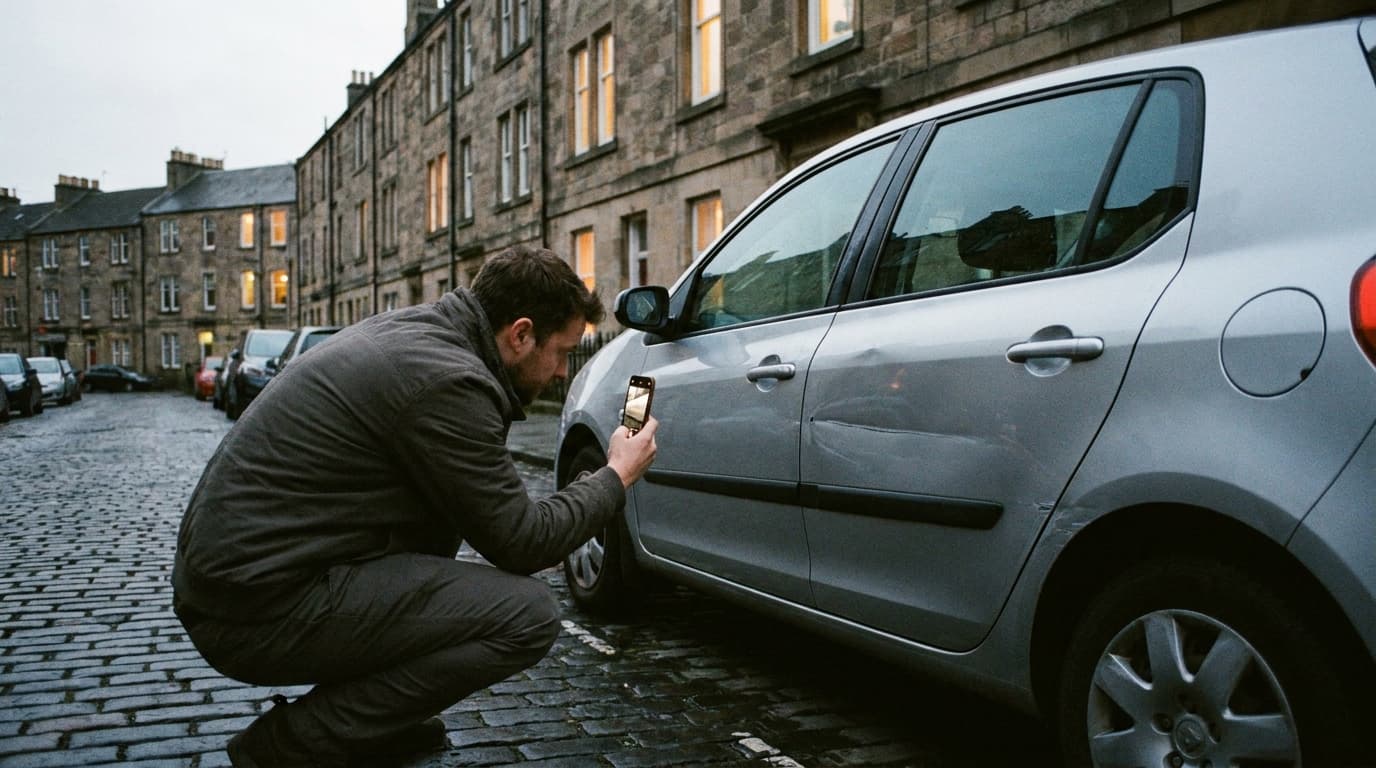
Délit de fuite can also arise from an accident involving only property damage, with no injury to any person, since the offence is defined around leaving the scene while knowing an accident occurred, not around the severity of the accident itself. A driver who damages a parked vehicle and leaves without providing identification, for example, can face délit de fuite even though no one was hurt, though the surrounding facts of any given incident, including whether the driver genuinely realised an accident had occurred, are what a prosecution ultimately turns on.
When Délit de Fuite Is Combined With Homicide or Injury
Article 434-10 addresses what happens when délit de fuite is combined with a homicide or injury caused by the same accident. The mechanism written into the article is precise, and it is easy to state it incorrectly by assuming the délit de fuite penalty itself simply doubles.
Where the accident also amounts to involuntary homicide under Article 221-6 of the Code pénal, or involuntary injury under Article 222-19, the penalties provided for those offences are doubled because the driver also fled the scene. In other words, it is the homicide or injury penalty that doubles as a consequence of the flight; the délit de fuite penalty defined under Article 434-10, the 3 years and 75,000 EUR figure described above, does not itself simply double alongside it.
Article 434-10 also carves out an exception for cases where the newer homicide routier or blessures routières offences, described below, apply instead of the older involuntary homicide or involuntary injury offences. Those newer offences carry their own dedicated penalty scale, set out in their own articles, and are not reached through this older doubling mechanism at all.
This structure means the consequences of fleeing the scene of a fatal or injury causing accident depend heavily on which underlying offence applies to the accident itself. A driver who flees an accident that qualifies as ordinary involuntary homicide faces the doubling described above; a driver who flees an accident that instead qualifies as the newer homicide routier faces the separate, generally higher, fixed penalty described in the next section, with flight itself potentially counting as one of the aggravating factors that helped bring the case within that newer offence in the first place.
The 2025 Reform: Homicide Routier and Blessures Routières
A reform enacted in 2025, loi n. 2025-622 du 9 juillet 2025, created two new offences addressing fatal and injury causing road accidents: homicide routier and blessures routières. These were inserted into the Code pénal as a new set of articles, separate from the general homicide involontaire and blessures involontaires offences that previously covered all such cases, including road accidents, without a dedicated road-specific category.
Homicide routier applies where a driver causes the death of another person without intending to, and where at least one qualifying circumstance listed in Article 221-18 of the Code pénal is present. That list is longer than most summaries suggest: it runs to ten circumstances, including a manifestly deliberate breach of a specific safety or care obligation imposed by law or regulation; driving under the influence of alcohol, or refusing an alcohol test; drug use, or refusing a drug test; the voluntary consumption of psychoactive substances; driving without a licence, or with a licence that has been suspended or annulled; exceeding the speed limit by 30 km/h or more; leaving the scene or failing to assist; prohibited use of a handheld phone; failing to stop when ordered to by police; and breach of Article L236-1 of the Code de la route. Any one of those is enough to bring the offence within homicide routier, and where two or more are present the penalty rises to the aggravated tier of 10 years and 150,000 EUR.
Where multiple aggravating factors combine in the same case, for example a manifestly deliberate safety violation together with drug impairment, the offence moves to an aggravated tier carrying a higher maximum penalty than the standard tier described above. Flight from the scene can itself be one of the aggravating factors that contributes to a case reaching a higher tier, but it is not, by itself, a required element of homicide routier; a fatal accident can qualify for the standard tier through intoxication or a safety violation alone, with no flight involved at all.
Blessures routières is the companion injury offence, and it is graded by the length of the victim's total incapacity for work (ITT). Where the ITT is more than three months, Article 221-19 sets 5 years and 75,000 EUR, rising to 7 years and 100,000 EUR where an aggravating circumstance applies. Where the ITT is three months or less, Article 221-20 sets 3 years and 45,000 EUR, rising to 5 years and 75,000 EUR. The qualifying circumstances are the same ten that apply to homicide routier, since they are shared across the chapter.
How Homicide Routier Differs From Homicide Involontaire
Before the 2025 reform, a fatal road accident caused without intent to kill would generally be prosecuted as homicide involontaire, the general involuntary manslaughter offence found elsewhere in the Code pénal. That general offence carries a lower maximum penalty than homicide routier and applies across many contexts beyond driving, since it was never written specifically with road accidents in mind.
Homicide routier was created specifically to give fatal accidents involving certain aggravating circumstances, a manifestly deliberate safety violation, manifest alcohol impairment, or drug use, their own dedicated and harsher legal treatment, reflecting a policy judgment that these circumstances warrant separate recognition distinct from ordinary involuntary homicide. A fatal road accident that does not involve one of these qualifying circumstances can still be prosecuted under the general homicide involontaire offence rather than homicide routier, since the new offence did not eliminate the older one, it created an additional, more targeted category alongside it.
The practical effect of the distinction is that two fatal accidents with broadly similar outcomes can be prosecuted very differently, depending on whether the driver's conduct meets one of the specific qualifying circumstances written into homicide routier. A death caused by an ordinary lapse in attention, without a manifestly deliberate safety violation, manifest intoxication, or drug use, generally remains within the older homicide involontaire framework, while a death involving one of those specific circumstances is treated under the newer, harsher homicide routier scale instead.
Points and License Consequences of Délit de Fuite
The 6 points withdrawn for délit de fuite recover under the same general timeline that applies across the French points system for a délit level offence: automatically after 3 years without a new infraction. This is the same 3 year window that applies to other délits and to the most serious contraventions, longer than the 2 year window that applies to lesser contraventions and the 6 month window that applies where only a single point was lost.
This point recovery timeline runs independently of any prison sentence, fine, or license suspension a court may impose for the underlying offence. Where délit de fuite is prosecuted alongside homicide routier, blessures routières, or the older involuntary homicide or injury offences, the points consequence described here applies specifically to the délit de fuite conviction, separate from whatever additional licensing consequence follows from the more serious offence itself.
What a Driver Must Do After a Collision
Under French law, a driver involved in a collision is required to stop. Délit de fuite is defined around a driver who knew an accident had occurred and deliberately failed to do so, rather than around a driver who was genuinely unaware that any collision had taken place, which is a meaningfully different situation from the offence itself.
Because the offence turns on the driver's knowledge and intent, leaving the immediate scene briefly to summon emergency help, for example to reach a working phone or to move an injured person to safety, is a materially different situation from deliberately leaving the area to avoid being identified or held responsible for the accident. The distinction matters in how a specific incident is assessed, though the underlying facts of any individual case should be evaluated with the assistance of a qualified French avocat rather than treated as a fixed rule that applies identically to every scenario.
This is why délit de fuite is defined around knowledge and intent rather than around the simple fact of a driver's vehicle no longer being at the scene when help or police arrive. A driver who returns to the scene after briefly stepping away, or who otherwise makes clear they had no intention of evading responsibility, is in a different factual position from a driver who leaves the area and makes no attempt to be identified. Related driving offences that can arise around the same incident, including how excessive speed or alcohol consumption is separately penalised, and how a driver can contest an underlying traffic fine, are covered in our companion articles on speeding penalties in France, drink driving law in France, and contesting a traffic fine in France.
Disclaimer
This article is for general informational purposes only and is not legal advice. French traffic and criminal law changed significantly during 2025, and figures published before those reforms may no longer be accurate. Readers facing a specific infraction, prosecution, or licensing decision should consult the official sources cited above or a qualified French avocat.
Frequently Asked Questions
What is the penalty for délit de fuite in France?
Up to 3 years imprisonment and a 75,000 EUR fine, with 6 points withdrawn from the driver's license.
Are the penalties for délit de fuite doubled if someone is killed or injured?
When délit de fuite is combined with involuntary homicide or involuntary injury, it is the penalty set out for that homicide or injury offence that is doubled, not the délit de fuite penalty itself.
What is homicide routier?
A distinct offence created by a 2025 reform, punishing a driver who causes a death through a manifestly deliberate safety breach, manifest alcohol impairment, or drug use, with up to 7 years imprisonment and a 100,000 EUR fine, rising further when multiple aggravating factors combine.
What is blessures routières?
The companion injury offence to homicide routier, created by the same reform, with a penalty scale that varies according to the severity of the injury and whether aggravating factors are present.
Does homicide routier replace homicide involontaire for road deaths?
No. It creates a separate, more severe qualification for road deaths involving specific aggravating circumstances. Road deaths without those circumstances can still fall under the general homicide involontaire offence.
What must a driver do after being involved in a collision in France?
French law requires a driver involved in an accident to stop. Leaving briefly to summon emergency help is treated differently from deliberately leaving the scene to avoid identification or responsibility.
Is fleeing the scene always what triggers the higher homicide routier penalties?
No. Flight is one of several aggravating factors that can qualify a fatal accident for the homicide routier scale. Manifest alcohol impairment or drug use can also qualify it, independent of flight.
Sources and References
- Article 434-10 - Code pénal (délit de fuite)(legifrance.gouv.fr).gov
- LOI n° 2025-622 du 9 juillet 2025 créant l'homicide routier et visant à lutter contre la violence routière(legifrance.gouv.fr).gov
- En quoi consistent les délits d'homicide routier et de blessures routières(service-public.gouv.fr).gov
- Récupération des points du permis de conduire(service-public.gouv.fr).gov