Texas Video Recording Laws: What Is Legal and What Is Not
Independently fact-checked against primary sources (last audited August 15, 2026). · Reviewed by the RecordingLaw editorial team. · Law checked current as of August 7, 2026. · 6 primary sources cited on this page. How we verify our legal content

Texas law permits video recording anywhere a person lacks a reasonable expectation of privacy, including public streets, parks, and government buildings. Audio recorded alongside video follows one-party consent under Tex. Penal Code Section 16.02, while Tex. Penal Code Section 21.15 prohibits invasive visual recording in private spaces or of intimate areas without consent.
Overview of Texas Video Recording Laws
Texas does not have a single statute governing all video recording. Instead, several laws address different aspects of visual recording depending on the location, subject, and purpose of the recording. The [parent Texas recording laws page provides the broader framework, while this page focuses specifically on video.
The key statutes governing video recording in Texas include Tex. Penal Code Section 21.15 (invasive visual recording), Tex. Penal Code Section 21.16 (nonconsensual disclosure of intimate visual material), and Tex. Penal Code Section 16.02 (which governs audio captured with video).
The Texas State Law Library maintains a comprehensive guide to visual recording laws, including links to the full statutory text and plain-language explanations.
Video Recording in Public Spaces
The First Amendment Right to Film
The First Amendment to the U.S. Constitution protects the right to record video in public spaces. The U.S. Court of Appeals for the Fifth Circuit, which covers Texas, has recognized this right as a form of protected expression. In Turner v. Lieutenant Driver, 848 F.3d 678 (5th Cir. 2017), the court held that a First Amendment right to record the police "does exist, subject only to reasonable time, place, and manner restrictions." The court still granted the officers qualified immunity for the 2015 encounter itself, because that right was not yet clearly established at the time.
This constitutional protection extends beyond filming police. In Texas, a person can legally record video of anything plainly visible from a public space, including:
- Streets, sidewalks, and public parks
- Government buildings open to the public
- Public protests and demonstrations
- Commercial activity visible from public areas
- Traffic, accidents, and other public events
The ACLU of Texas provides guidance on the right to record in public, emphasizing that this right applies as long as the recording does not interfere with the lawful activities of others.
Limitations on Public Recording
While public recording is broadly protected, certain restrictions apply:
- Interference with public duties: Tex. Penal Code Section 38.15 prohibits interference with public duties, including police activities. Recording is legal, but physically obstructing an officer is not.
- Trespass: The right to record does not include the right to enter private property without permission. A person who trespasses to record video can face criminal trespass charges under Tex. Penal Code Section 30.05.
- Restricted government facilities: Some government buildings, including courtrooms during proceedings and secure military installations, may restrict photography and video recording through posted rules or court orders.
The Ex Parte Thompson Decision
In 2014, the Texas Court of Criminal Appeals struck down part of the former "improper photography" statute in Ex parte Thompson (442 S.W.3d 325). The court ruled 8-1 that the statute was overly broad and violated the First Amendment because it criminalized photography in public places based solely on the photographer's intent, without requiring any invasion of privacy.
This decision reinforced that taking photographs and recording video of people in public spaces is constitutionally protected activity, even when the subject has not consented. The legislature responded by passing a revised statute focused on invasive visual recording in private settings.
Invasive Visual Recording: Tex. Penal Code Section 21.15
What the Statute Prohibits
Tex. Penal Code Section 21.15 criminalizes invasive visual recording. A person commits an offense if, without the other person's consent and with intent to invade the privacy of the other person, the person:
- Photographs or by videotape or other electronic means records, broadcasts, or transmits a visual image of an intimate area of another person
- Photographs or records a visual image of another person in a bathroom, changing room, or similar private space
The statute defines "intimate area" as the naked or clothed genitals, pubic area, anus, buttocks, or female breast of a person.
2025 Amendments and Expanded Protections
The 89th Texas Legislature passed H.B. 1465, enacting significant amendments to Section 21.15, effective September 1, 2025. These changes include:
- Expanded definition of protected spaces: Section 21.15(a)(3-a) now defines "a place in which a person has a reasonable expectation of privacy" as a place where a reasonable person would believe they could disrobe without being photographed, visually recorded, or having such images broadcast or transmitted by another.
- Sex offender registration requirement: The Legislature (H.B. 1465) amended Article 62.001(5)(A) of the Code of Criminal Procedure to add invasive visual recording to the list of offenses requiring sex offender registration. The bill did not add the offense to the separate list of 'sexually violent offenses' that triggers automatic lifetime registration, so for offenses committed on or after September 1, 2025, a single conviction, adjudication, or deferred adjudication generally carries a 10-year registration period; a second reportable conviction of any kind triggers lifetime registration under the Code of Criminal Procedure's general registration rules.
Penalties for Invasive Visual Recording
Invasive visual recording is classified as a state jail felony in Texas:
| Element | Detail |
|---|---|
| Offense Level | State Jail Felony |
| Prison Term | 180 days to 2 years in a state jail |
| Maximum Fine | $10,000 |
| Sex Offender Registration | Required for offenses on or after September 1, 2025 |
The sex offender registration requirement adds a significant collateral consequence to this conviction, affecting housing, employment, and community standing for the duration of the registration period.
Nonconsensual Disclosure of Intimate Visual Material: Section 21.16
The Revenge Porn Statute
Texas enacted Tex. Penal Code Section 21.16 in 2015 through the Relationship Privacy Act. This law criminalizes the nonconsensual disclosure of intimate visual material, commonly referred to as "revenge porn."
A person commits an offense under Section 21.16 by:
- Intentionally disclosing visual material depicting another person with intimate parts exposed or engaged in sexual conduct
- Without the depicted person's effective consent
- With the intent to harm the depicted person
The statute also covers threatening to disclose such material with the intent to obtain a benefit, and promoting such material on websites or other platforms.
Key Legal Points
Several important aspects of the revenge porn statute include:
- Consent to creation does not equal consent to distribution: It is not a defense that the depicted person created or consented to the creation of the visual material. Voluntarily sending an intimate image to someone does not authorize that person to share it with others.
- State jail felony: A conviction under Section 21.16 is a state jail felony, carrying 180 days to 2 years in state jail and fines up to $10,000.
- Civil remedies available: Victims of revenge porn can also pursue civil remedies, including injunctive relief and damages.
Video Recording and Audio: When Both Laws Apply

The Overlap Between Video and Audio Recording Law
Many modern recording devices capture both video and audio simultaneously. In Texas, the legality of such recordings depends on the interaction between the visual recording statutes and the audio wiretapping statute.
Pure video recording without audio does not fall under Tex. Penal Code Section 16.02, which specifically covers wire, oral, and electronic communications. Silent video in public spaces is generally unrestricted.
When video recording includes audio, the one-party consent rule applies to the audio component. This means:
- A participant in a conversation can record video with audio without notifying others
- A non-participant who records audio of other people's private conversations may violate Section 16.02
- In public settings where there is no reasonable expectation of privacy, recording audio alongside video is generally permissible
Practical Implications
For most personal recording situations, the audio and video rules align in practice. A person filming their own interaction with another person can legally capture both video and audio because they are a party to the conversation. The one-party consent rule covers the audio, and no separate consent is needed for the video component when filmed in a place without privacy expectations.
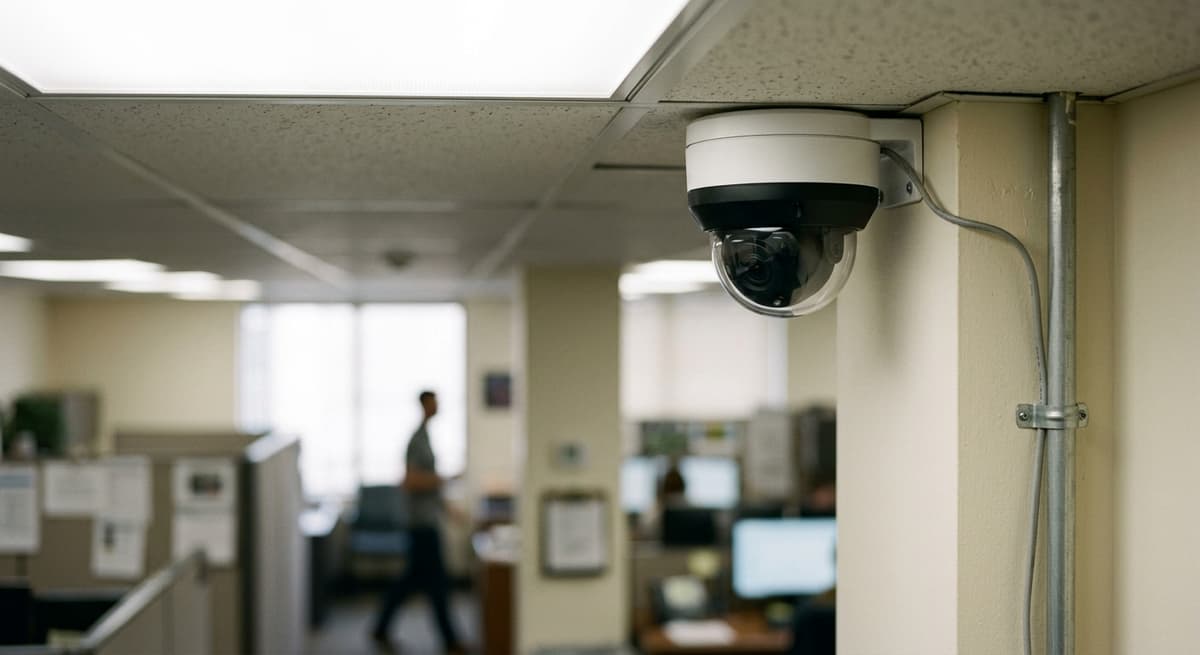
The distinction matters most for surveillance situations. A security camera that records audio in a workplace, for example, must comply with the one-party consent rule for the audio portion, even though the video component alone may be unrestricted.
Video Recording on Private Property
Property Owner Rights
Property owners in Texas have broad authority to install video recording systems on their own property. This includes residential homeowners, commercial property operators, and landlords recording common areas of rental properties.
Property owners can record video in:
- Driveways, parking lots, and exterior areas
- Retail spaces and commercial lobbies
- Hallways and common areas of multi-unit buildings
- Warehouses and storage facilities
Privacy Restrictions on Private Property
Even on their own property, property owners cannot install cameras in areas where people have a reasonable expectation of privacy. Prohibited locations include:
- Bathrooms and restrooms
- Changing rooms and locker rooms
- Private bedrooms (in rental properties)
- Any area where a person would reasonably expect to disrobe
Installing cameras in these locations can result in prosecution under Tex. Penal Code Section 21.15, regardless of who owns the property.
Licensing for Commercial Installations
The Texas Department of Public Safety, Private Security Bureau regulates the installation of security camera systems for commercial purposes. Businesses or individuals who install, service, or maintain security cameras for others generally need a license issued by the Private Security Bureau.
This licensing requirement applies to professional security installers and monitoring companies, not to individuals or businesses installing cameras on their own property for their own security purposes.
Video Recording in Specific Texas Settings

Courtrooms
Texas courts have authority to set rules regarding video recording during proceedings. Under the Texas Rules of Judicial Administration, judges can permit or restrict media recording in their courtrooms. Some courts allow cameras during certain proceedings, while others prohibit all recording.
The Texas Supreme Court and the Court of Criminal Appeals have issued guidelines for electronic media coverage of court proceedings, generally allowing recording at the judge's discretion.
Schools
Texas school districts can establish their own policies regarding video recording on school grounds. The Family Educational Rights and Privacy Act (FERPA) restricts the recording and disclosure of personally identifiable student information, which can affect how video recordings are handled in educational settings.
Hospitals and Medical Facilities
Medical facilities in Texas can establish policies restricting video recording. While Texas law permits a patient to record their own medical appointment, hospitals and clinics may prohibit recording in areas where other patients' privacy could be compromised, such as waiting rooms, shared hospital rooms, and surgical areas.
Penalties Summary: Texas Video Recording Violations
| Offense | Statute | Classification | Prison Term | Fine |
|---|---|---|---|---|
| Invasive visual recording | Sec. 21.15 | State Jail Felony | 180 days to 2 years | Up to $10,000 |
| Revenge porn disclosure | Sec. 21.16 | State Jail Felony | 180 days to 2 years | Up to $10,000 |
| Illegal audio interception (with video) | Sec. 16.02 | Second-Degree Felony | 2 to 20 years | Up to $10,000 |
| Interference with public duties while filming | Sec. 38.15 | Class B Misdemeanor | Up to 180 days | Up to $2,000 |
Deepfakes and AI-Generated Video: 89R Trilogy (S.B. 441, H.B. 421)
The 89th Texas Legislature enacted three statutes targeting AI-generated and deepfake intimate imagery, all effective September 1, 2025.
S.B. 441 amended Tex. Penal Code § 21.165 to replace "deep fake video" with "deep fake media," reaching still images, AI-generated, and machine-learning-generated visual depictions of real persons with intimate parts exposed or in sexual conduct, without effective written consent. A new Class B misdemeanor covers threats to produce or distribute deepfake media with intent to coerce, extort, harass, or intimidate. Third-degree felony enhancements apply to repeat offenders and depictions of minors.
S.B. 441 also amended Tex. Civ. Prac. & Rem. Code Chapter 98B to extend civil liability to "artificial" (AI-generated) intimate visual material, adding a 72-hour website takedown duty for platforms that receive a valid removal request from the depicted person.
H.B. 421 added Chapter 121 to the Texas Business and Commerce Code, targeting AI deepfake generator tools. Operators must use commercially reasonable age-verification methods, obtain written consent before generating explicit material depicting any adult, and categorically refuse to generate explicit deepfake material depicting a minor. The chapter creates a private cause of action for actual damages, mental anguish, attorney fees, and exemplary damages.
At the federal level, the TAKE IT DOWN Act, S. 146, 119th Cong. (signed May 19, 2025) criminalizes knowing publication of nonconsensual intimate visual depictions and digital deepfakes via interactive computer service. The platform notice-and-removal compliance deadline is May 19, 2026, requiring covered platforms to act within 48 hours of valid notice. Texas subjects of such material have three parallel removal pathways: the TAKE IT DOWN Act federal notice-and-removal, Chapter 98B 72-hour state takedown duty, and copyright-based DMCA notice.
Recent Developments in Texas Video Recording Law
2025 Legislative Changes
The most significant recent change is the September 1, 2025, amendment to the invasive visual recording statute. The expanded definition of protected spaces and the addition of sex offender registration (generally 10 years for a single conviction, life upon a second reportable conviction) represent a substantial increase in the consequences for this offense.
The core video recording framework remains otherwise stable. Texas has not enacted any new restrictions on public filming, and the First Amendment right to record in public spaces continues to be upheld by federal courts in the Fifth Circuit.
Texas Data Privacy and Security Act
The Texas Data Privacy and Security Act (TDPSA), which took effect in July 2024, established new requirements for businesses processing sensitive personal data. This law can affect how businesses use video surveillance systems that incorporate facial recognition or other biometric technologies. Businesses collecting biometric data through video surveillance must comply with the TDPSA's consent and data protection requirements.
More Texas Recording Laws
Audio Recording | Video Recording | Voyeurism & Hidden Cameras | Workplace Recording | Recording Police | Phone Call Recording | Security Cameras | Recording in Public | Landlord-Tenant | Dashcam Laws | Schools | Medical Recording
← Back to Texas Recording Laws
More Texas Recording Topics
More Texas Laws
Frequently Asked Questions
Is it legal to record video in public in Texas?
Yes. Texas has no general prohibition on video recording in public spaces. The First Amendment protects the right to film anything plainly visible from a public location, including streets, parks, government buildings, and public events. The Fifth Circuit Court of Appeals confirmed this right in Turner v. Driver (2017).
What is invasive visual recording in Texas?
Invasive visual recording under Tex. Penal Code Section 21.15 is the act of photographing or recording an intimate area of another person without consent and with intent to invade their privacy, or recording someone in a private space like a bathroom or changing room. It is a state jail felony carrying 180 days to 2 years in prison.
Does Texas require sex offender registration for invasive visual recording?
Yes, as of September 1, 2025. The 89th Texas Legislature (H.B. 1465) amended Article 62.001(5)(A) of the Code of Criminal Procedure to include invasive visual recording among offenses requiring sex offender registration for offenses committed on or after that date. A single conviction generally carries a 10-year registration period; the offense was not added to the list that triggers automatic lifetime registration, though a second reportable conviction of any kind does trigger lifetime registration.
Is sharing intimate images without consent illegal in Texas?
Yes. Tex. Penal Code Section 21.16 criminalizes the nonconsensual disclosure of intimate visual material (revenge porn). It is a state jail felony punishable by 180 days to 2 years in state jail and fines up to $10,000. The fact that the depicted person originally consented to creating the material is not a defense.
Does the audio on a video recording require separate consent in Texas?
Audio captured with video follows the one-party consent rules under Tex. Penal Code Section 16.02. If the person recording is participating in the conversation being captured, no additional consent is needed. In public spaces with no reasonable expectation of privacy, audio recording alongside video is generally permissible.
Updates
Removed a fabricated direct quotation attributed to the Fifth Circuit's Turner v. Driver decision and replaced it with the court's actual verbatim holding, verified against the official opinion text.
Independently fact-checked against the cited primary sources
Corrected the definition of 'intimate area' under Tex. Penal Code Section 21.15 to match the statute's actual enumerated list (genitals, pubic area, anus, buttocks, female breast, naked or clothed), rather than an open-ended 'any area covered by clothing' description.
Corrected an overstatement that invasive visual recording convictions always require lifetime sex offender registration in Texas; H.B. 1465 (2025) made the offense registrable, but a single conviction generally carries a 10-year registration period unless the person has another reportable conviction.
Governing law re-checked for recent changes
Added H.B. 1465 explicit bill citation to 2025 amendments for § 21.15. Added 89R deepfake trilogy section (S.B. 441 amending § 21.165 and Ch. 98B; H.B. 421 adding Tex. Bus. & Com. Code Ch. 121). Added federal TAKE IT DOWN Act (signed May 19, 2025; platform compliance May 19, 2026) with three-pathway takedown framing. Fixed Turner citation to Turner v. Lieutenant Driver, 848 F.3d 678 (5th Cir. 2017). Replaced Findlaw § 21.16 link with official Texas statutes URL.
Reviewed and approved by an editor
The Law Behind This Article
This article rests on the statutory provisions below, held in our own legal record and retrieved from the official source. Tap a section to read the operative text.
Texas Penal Code
§ 21.15INVASIVE VISUAL RECORDINGIn forcecited in 15 of our articles
(a) In this section: (1) "Female breast" means any portion of the female breast below the top of the areola. (2) "Intimate area" means the naked or clothed genitals, pubic area, anus, buttocks, or female breast of a person. (3) "Changing room" means a room or portioned area provided for or primarily used for the changing of clothing and includes dressing rooms, locker rooms, and swimwear changing areas. (3-a) "Place in which a person has a reasonable expectation of privacy" means a place in which a reasonable person would believe that the person could disrobe in privacy, without being concerned that the act of undressing would be photographed or visually recorded by another or that a visual image of the person undressing would be broadcasted or transmitted by another. The term includes a bathroom, bedroom, and changing room. (4) "Promote" has the meaning assigned by Section 43.21.
Official text (excerpt) · last checked 2026-08-31 · Read the full text in our law library · Verify at statutes.capitol.texas.gov
Cited in 44 court opinions in our collectionLatest citing opinion in our collection: 2025
In the courts (editorial summary, independently checked):The Court of Criminal Appeals struck down the 2007 improper photography provision at Penal Code 21.15(b)(1), and Ex parte Shay (2016) set aside a conviction under it. The Legislature re-enacted the section in 2015, and Ex Parte Kamilah a Hamilton (2020) held the current subsection (b)(1) survives strict scrutiny and is not overbroad.
Opinions citing this section in our collection:
- Ex Parte Nyabwa (Texas Court of Appeals, 14th District (Houston) 2011, 366 S.W.3d 719)✓Charged with improper photography, Nyabwa attacked section 21.15(b)(1) by pretrial habeas; the court of appeals held the 2007 subsection regulated the photographer's intent rather than speech and was neither overbroad nor vague. Ex parte Thompson struck it down in 2014.
- Ex parte Shay (Court of Criminal Appeals of Texas 2016, 507 S.W.3d 731)✓Shay pleaded guilty under section 21.15(b)(1) before Ex parte Thompson struck that subsection down; the Court of Criminal Appeals held his favorable plea bargain did not estop habeas relief, set aside the conviction, and remanded to dismiss the indictment.
- Ex Parte Kamilah a Hamilton (Texas Court of Appeals, 14th District (Houston) 2020)✓Indicted under the 2015 version of section 21.15(b)(1) for broadcasting an image of a complainant's intimate area, Hamilton claimed facial overbreadth; the court held the rewritten subsection survives strict scrutiny, is not overbroad, and affirmed denial of relief.
Identified automatically from the court opinions citing this section — not a ranking of which case controls.
Also relied on in: Texas Landlord-Tenant Recording Laws: Cameras, Privacy, and Rights, Texas Laws on Recording in Public: Rights, Limits, and Exceptions, Texas School Recording Laws: Classrooms, Cameras, and Student Privacy
§ 38.15INTERFERENCE WITH PUBLIC DUTIESIn forcecited in 3 of our articles
(a) A person commits an offense if the person with criminal negligence interrupts, disrupts, impedes, or otherwise interferes with: (1) a peace officer while the peace officer is performing a duty or exercising authority imposed or granted by law; (2) a person who is employed to provide emergency medical services including the transportation of ill or injured persons while the person is performing that duty; (3) a fire fighter, while the fire fighter is fighting a fire or investigating the cause of a fire; (4) an animal under the supervision of a peace officer, corrections officer, or jailer, if the person knows the animal is being used for law enforcement, corrections, prison or jail security, or investigative purposes; (5) the transmission of a communication over a citizen's band radio channel, the purpose of which communication is to inform or inquire about an emergency; (6) an officer with responsibility for animal control in a county or municipality, while the officer is performing a duty or exercising authority imposed or granted under Chapter 821 or 822, Health and Safety Code; (7) a person who: (A) has responsibility for assessing, enacting, or enforcing public…
Official text (excerpt) · last checked 2026-07-28 · Read the full text in our law library · Verify at statutes.capitol.texas.gov
Cited in 90 court opinions in our collectionLatest citing opinion in our collection: 2026
Opinions citing this section in our collection:
- Duncantell v. State (Texas Court of Appeals, 14th District (Houston) 2007, 230 S.W.3d 835)“…ence with the duties of a public servant. See Tex. Penal Code Ann. § 38.15 (a)(1) (Vernon 2003). We affirm.…”
- Faust v. State (Court of Criminal Appeals of Texas 2015, 491 S.W.3d 733)“…iment, or interference alleged “consisted of speech only.” Tex. Penal Code Ann. § 38.15 (d) (West 2013). This is why one court…”
- Carney v. State (Texas Court of Appeals, 3rd District (Austin) 2000, 31 S.W.3d 392)“…erence with the duties of a peace officer. See Tex.Penal Code Ann. § 38.15 (West Supp.2000). The jury, having foun…”
Identified automatically from the court opinions citing this section — not a ranking of which case controls.
Also relied on in: Texas Recording Laws (2026): One-Party Consent Rules, Texas Laws on Recording Police: Rights, Limits, and Body Cameras
Texas Code of Criminal Procedure
§ 62.001Art. 62.001. DEFINITIONSIn forcecited in 2 of our articles
In this chapter: (1) "Department" means the Department of Public Safety. (2) "Local law enforcement authority" means, as applicable, the office of the chief of police of a municipality, the office of the sheriff of a county in this state, or a centralized registration authority. (3) "Penal institution" means a confinement facility operated by or under a contract with any division of the Texas Department of Criminal Justice, a confinement facility operated by or under contract with the Texas Juvenile Justice Department, or a juvenile secure pre-adjudication or post-adjudication facility operated by or under a local juvenile probation department, or a county jail. (4) "Released" means discharged, paroled, placed in a nonsecure community program for juvenile offenders, or placed on juvenile probation, community supervision, or mandatory supervision.
Official text (excerpt) · last checked 2026-07-28 · Read the full text in our law library · Verify at statutes.capitol.texas.gov
Cited in 66 court opinions in our collectionLatest citing opinion in our collection: 2026
Opinions citing this section in our collection:
- Crabtree, Mark Alan (Court of Criminal Appeals of Texas 2012)“…to register, even in the absence of a TDPS ruling. See Tex. Code Crim. Proc. art. 62.001(5)(H). Because the criminal pro…”
- Texas Department of Public Safety v. Garcia (Texas Court of Appeals, 3rd District (Austin) 2010, 327 S.W.3d 898)“…is listed in SORA as a reportable offense. See Tex.Code Crim. Proc. Ann. art. 62.001(5)(A); Tex. Penal Code Ann. § 22.011 .…”
- Ex Parte Warren (Court of Criminal Appeals of Texas 2011, 353 S.W.3d 490)“…F.3d 818 , 831 (9th Cir.1997)). 12 . Tex.Code Crim. Proc. Ann. art. 62.001(5) (Vernon 2009). 13…”
Identified automatically from the court opinions citing this section — not a ranking of which case controls.
Also relied on in: Texas Voyeurism and Hidden Camera Laws: Statutes and Penalties
Search our full record of US law — 2.1 million sections, every state + federal →
Sources and References
- Tex. Penal Code Section 21.15 - Invasive Visual Recording(statutes.capitol.texas.gov).gov
- Tex. Penal Code Chapter 16(statutes.capitol.texas.gov).gov
- Tex. Penal Code Section 38.15(statutes.capitol.texas.gov).gov
- Tex. Code of Criminal Procedure Article 62.001(statutes.capitol.texas.gov).gov
- Texas State Law Library - Visual Recording Laws(guides.sll.texas.gov).gov
- ACLU of Texas - Your Right to Film Police(aclutx.org)
- Texas DPS - Private Security Bureau(dps.texas.gov).gov
- RCFP - Texas Recording Guide(rcfp.org)