
Italy
Home Security Cameras in Italy: What You Can Legally Film
Independently fact-checked against primary sources (last audited July 20, 2026). · 9 primary sources cited on this page. How we verify our legal content
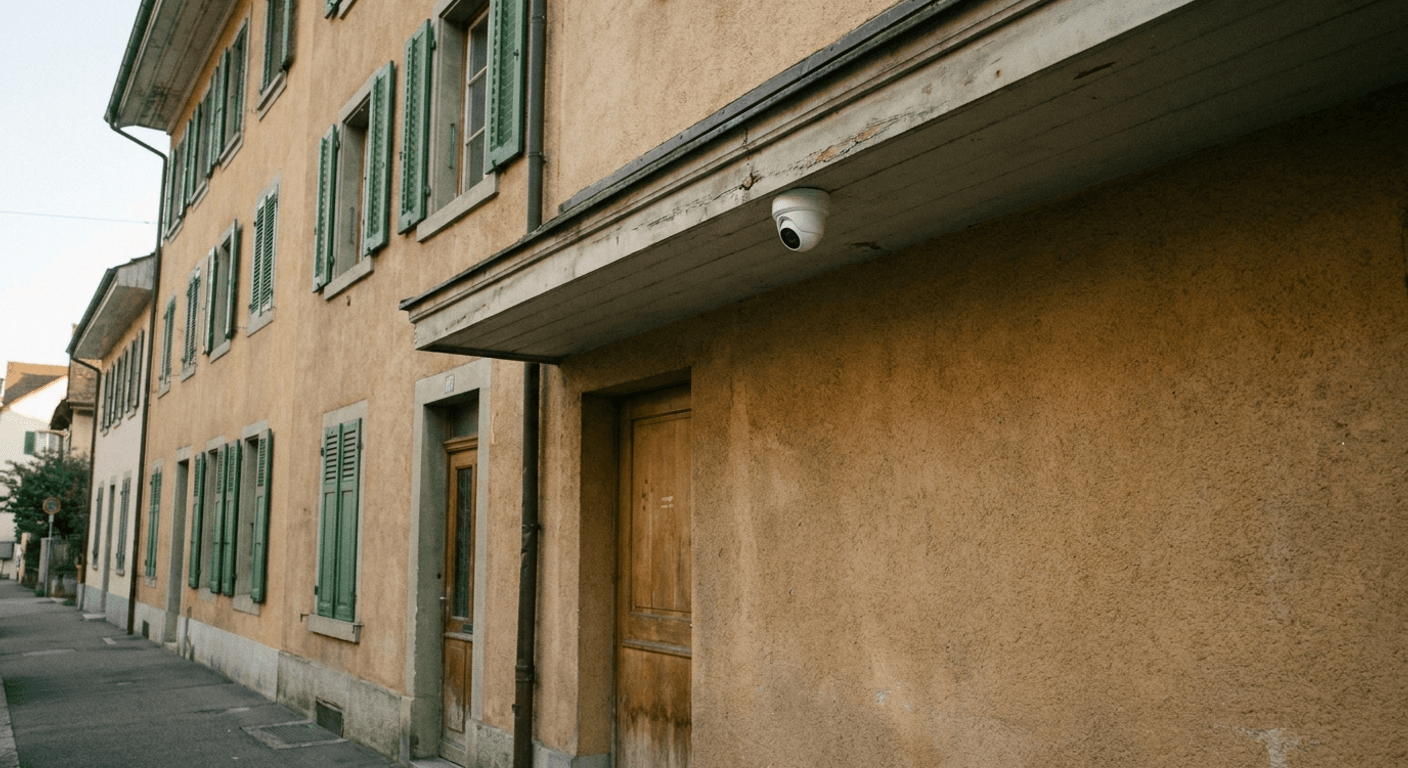
Italy lets you put a camera on your own house without asking anyone's permission first. It does not let that camera watch the street, your neighbour's gate, or the shared courtyard, and the line between the two is where most home-camera problems in Italy actually start.
Information verified on 20 July 2026. This page provides general legal information and does not constitute legal advice for an individual situation.
Jurisdiction scope: This article covers private and domestic video surveillance law in Italy only. Cameras on condominium common parts, at a workplace, or operated by a public authority follow different rules not covered in full detail here.
The household exemption: what you can film without asking anyone
A private individual in Italy may set up a video surveillance system to protect people or property in a personal or domestic setting, such as a home security camera or a video-citofono (video intercom), without needing any prior authorisation or administrative formality. This is confirmed in the Garante's own guidance for private, domestic systems (Provvedimento 8 aprile 2010, and the Garante's later informational sheet for individuals installing home CCTV).
The exemption exists because the ordinary duties of a data controller under the GDPR and the Codice Privacy (D.Lgs. 196/2003) are built for organisations processing other people's data at scale, not for a homeowner pointing a camera at their own front door. Strictly personal or household use of a camera is treated as outside that framework, provided the use genuinely stays personal.
That "provided" is doing real work. The exemption is conditional on scope, not a blanket right to record anything a homeowner's camera can physically reach.
Where the household exemption ends
The Garante draws the boundary at the camera's field of view. A private system is expected to frame only the spaces belonging exclusively to the owner: their own entrance, garden, driveway, or the inside of their home. It must exclude, even without actually storing the footage, any area shared with others: a shared courtyard, stairwell, landing, or common garage, and any part of a neighbour's property.
It must also exclude the public street and any area of public passage. A camera cannot be justified as "protecting my car" if what it actually records is the pavement or the road in front of the house, because that framing captures the movements of people who are not the household and never consented to being filmed.
Crossing that line does two things at once. First, it takes the camera out of the household exemption, so the ordinary GDPR and Codice Privacy obligations, an informativa, a lawful basis, proportionality, a defined retention period, apply in full. Second, it exposes the installer to the criminal offence at art. 615-bis c.p. (interferenze illecite nella vita privata), which punishes anyone who uses a recording device to improperly obtain images or information about the private life of others in a protected space, with reclusione from six months to four years. The basic offence is punishable only on a querela from the person affected, so nothing happens unless they actively complain. A harsher penalty, reclusione from one to five years, and prosecution ex officio instead, applies in two separate situations: where the act is committed by a public official or a person charged with a public service who abuses their powers or breaches the duties of the office, and, separately, where it is committed by anyone practising the profession of private investigator, including without a licence. The second case carries no abuse-of-position requirement at all.
Scenario: a camera aimed at your own front door
A homeowner installs a camera above their front door, angled steeply down so it only captures the doormat, the door itself, and a narrow strip of the owner's own path. No part of the neighbour's property or the public road enters the frame.
This sits squarely inside the household exemption. No authorisation is needed, and the ordinary data-protection paperwork, informativa, registro dei trattamenti, and so on, does not apply, because the footage never leaves the strictly personal sphere. The homeowner should still avoid sharing that footage publicly (for example posting a clip online), since sharing pushes the use outside "personal or domestic" and back under the GDPR.
Scenario: a camera that also catches part of the street or a neighbour's gate
A different homeowner installs a similar camera, but the wider lens also picks up several metres of public pavement, part of the road, and the corner of a neighbour's driveway gate.
This camera has left the household exemption for the portion of the frame that is not the owner's own property, even though the owner's intent was purely defensive. Two problems follow: the wider framing needs a lawful basis and an informativa under the GDPR and Codice Privacy for that public and third-party portion, and the owner is exposed to a complaint under art. 615-bis c.p. from anyone whose private movements are being recorded without consent.
The practical fix in most real cases is not to remove the camera, but to narrow its field of view, through a physical mask, a repositioned angle, or a lens change, so the frame stops at the boundary of the owner's own property. Several commercial systems include a software "privacy zone" tool for this purpose, though the legal test is the area actually captured, not the feature's marketing label.
Video-citofono and doorbell cameras
A connected doorbell or video intercom follows the same rule as any other home camera: no special category exists for it. A doorbell camera angled narrowly enough to see only the doorstep and the visitor standing at it can sit inside the household exemption. Once its field of view sweeps a wider arc across the street, a neighbour's entrance, or a shared hallway, the same public-space and third-party limits described above apply, and the same art. 615-bis c.p. exposure follows.
Dashcams
A dashcam raises a related but distinct question, since it necessarily records public roads while driving. That continuous recording of the public road sits in a grey area the fixed-camera household exemption does not cleanly answer. Keep recordings for the shortest time needed, and avoid publishing footage that identifies other people, since publication removes any personal-use argument entirely.
Signage and the informativa
Inside the strictly personal household exemption, the Garante's guidance does not require a homeowner to post a sign for a camera pointed only at their own property. Once a camera's use extends beyond that personal sphere, whether part of the frame reaches shared or public space, or footage is used beyond simple personal security, an informativa (a notice telling people a camera is in use, who operates it, and why) becomes a normal part of GDPR compliance, as the enforcement record below shows the Garante checking directly.
How long you may keep the footage
Italian data protection law does not set a single fixed number of days for how long a household camera's footage may be kept. The general principle is that footage should not be kept longer than necessary for the purpose it was collected for.
The Garante's own material on video surveillance repeatedly points toward short retention windows for typical private systems, on the order of a few days up to about a week, with longer retention expected to be justified by a specific, documented need. Treat this as a benchmark for good practice, not a hard statutory ceiling written into a specific article of law.
A homeowner whose system automatically overwrites older footage on a rolling weekly cycle, exporting a clip only when an incident actually happens, is applying that principle correctly. A homeowner who retains three months of continuous footage "in case something happens eventually" is well outside it.
Cameras on condominium common parts are a different question
Everything above concerns a camera an individual owner points at their own property. A camera mounted on a condominium's common parts, the entrance, the courtyard, a shared parking area, the stairwell, is governed by a different rule entirely: art. 1122-ter c.c., inserted by the 2012 condominium reform.
Under that article, a decision to install video surveillance on the building's common parts must be approved by the condominium assembly, with the majority set out in the second comma of art. 1136 c.c. (a majority of those attending the meeting, representing at least half the value of the building). An individual owner, or even the amministratore (building manager) acting alone, cannot lawfully install cameras on shared areas without that vote.
The Garante enforces this directly. In a Provvedimento of 26 October 2023, it fined a condominium administrator 1.000 euro for installing two external cameras covering the parking area and entrance gate, after finding the system had gone in without the assembly resolution art. 1122-ter c.c. requires, with residents only informed by email after the fact. This article does not walk through the full condominium-camera framework, since it deserves its own dedicated treatment; a separate guide to condominium video surveillance is planned to cover the assembly-vote process, permitted zones, and access rules in full.
Scenario: what happens if a neighbour complains
A homeowner installs a camera that, on review, does capture a strip of the neighbour's driveway. The neighbour notices, asks the homeowner informally to adjust it, and nothing changes.
The neighbour has several realistic paths forward. They can raise the issue directly and in writing, creating a documented record. They can also file a reclamo with the Garante per la protezione dei dati personali, which has its own procedure and its own timescales.
Because the facts here also touch a possible art. 615-bis c.p. offence, the neighbour can separately report the matter to the police or the Procura, a criminal-law question distinct from the GDPR complaint. Most disputes over domestic videosorveglianza end with the camera's angle being narrowed or masked once the owner understands the boundary, rather than with a fine or a prosecution. The exposure is real all the same, and it is not limited to large or repeat offenders, as the 1.000 euro condominium sanction above shows.
For the wider Italian data-privacy framework these camera rules sit inside, see our overview of Italy's data privacy laws. For the fuller range of Italy coverage on this site, see the Italy hub.
Frequently Asked Questions
Can I put a security camera on my house in Italy without permission?
Yes, for personal or domestic use, provided the camera's field of view stays within your own property. No prior authorisation is required for a strictly private, household camera under the Garante's guidance.
Can I film the street in front of my house to protect my car?
No. The household exemption excludes public areas and areas of public passage. A camera that captures the street or the pavement, even to protect a parked vehicle, falls outside the exemption for that part of the frame.
What happens if my camera also catches my neighbour's garden or gate?
That portion of the footage falls outside the personal-use exemption, which brings GDPR duties such as an informativa into play, and it can also expose the camera's owner to the criminal offence at art. 615-bis c.p. (interferenze illecite nella vita privata). Narrowing the camera's angle is the usual fix.
How long can I keep footage from my home camera?
There is no single fixed number of days set by statute for a private household camera. The Garante's guidance points toward short retention, typically a matter of days up to around a week for ordinary personal systems, as good practice rather than a hard legal ceiling.
Do I need a sign warning people about my home camera?
For a camera that stays strictly within the household exemption, filming only your own property, the Garante's guidance does not require signage. Once the camera's use extends beyond that personal sphere, an informativa becomes a normal part of compliance.
Can I install a camera in the entrance of my condominio on my own?
No. Video surveillance on a condominium's common parts requires a resolution of the assembly under art. 1122-ter c.c., passed with the majority set out in art. 1136 c.c. An individual owner or the amministratore acting alone cannot install it unilaterally, and the Garante has fined administrators who tried.
Is a dashcam treated the same as a home security camera in Italy?
Not exactly. A dashcam necessarily records the public road while driving, which the fixed-camera household exemption does not cleanly cover. Keeping recordings only as long as needed and avoiding publishing footage that identifies other people is the safer practice.
What can my neighbour do if my camera films their property?
They can raise it with you directly, file a reclamo with the Garante, or, since an out-of-scope camera can also touch the criminal offence at art. 615-bis c.p., report the matter to the police or the Procura. Most disputes are resolved by adjusting or masking the camera's angle.
Updates
Independently fact-checked against the cited primary sources
Sources and References
- Garante per la protezione dei dati personali, Provvedimento in materia di videosorveglianza, 8 aprile 2010 [1712680](garanteprivacy.it).gov
- Codice penale, art. 615-bis (Interferenze illecite nella vita privata)(normattiva.it).gov
- Codice civile, art. 1122-ter (Impianti di videosorveglianza sulle parti comuni)(normattiva.it).gov
- Codice civile, art. 1136 (Costituzione dell’assemblea e validità delle deliberazioni)(normattiva.it).gov
- Garante per la protezione dei dati personali, Provvedimento del 26 ottobre 2023 [9960920], sanzione ad amministratore di condominio(garanteprivacy.it).gov
- Garante per la protezione dei dati personali, Sistemi di videosorveglianza installati da persone fisiche in ambito personale o domestico: le regole da seguire (scheda informativa)(garanteprivacy.it).gov
- Regolamento (UE) 2016/679 (GDPR)(eur-lex.europa.eu).gov
- Decreto Legislativo 30 giugno 2003, n. 196, Codice in materia di protezione dei dati personali(normattiva.it).gov
- Codice penale, art. 614 (Violazione di domicilio)(normattiva.it).gov