
South Africa
Recording Conversations in South Africa: Scenarios and Evidence (2026)
Independently fact-checked against primary sources (last audited July 23, 2026). · 2 primary sources cited on this page. How we verify our legal content
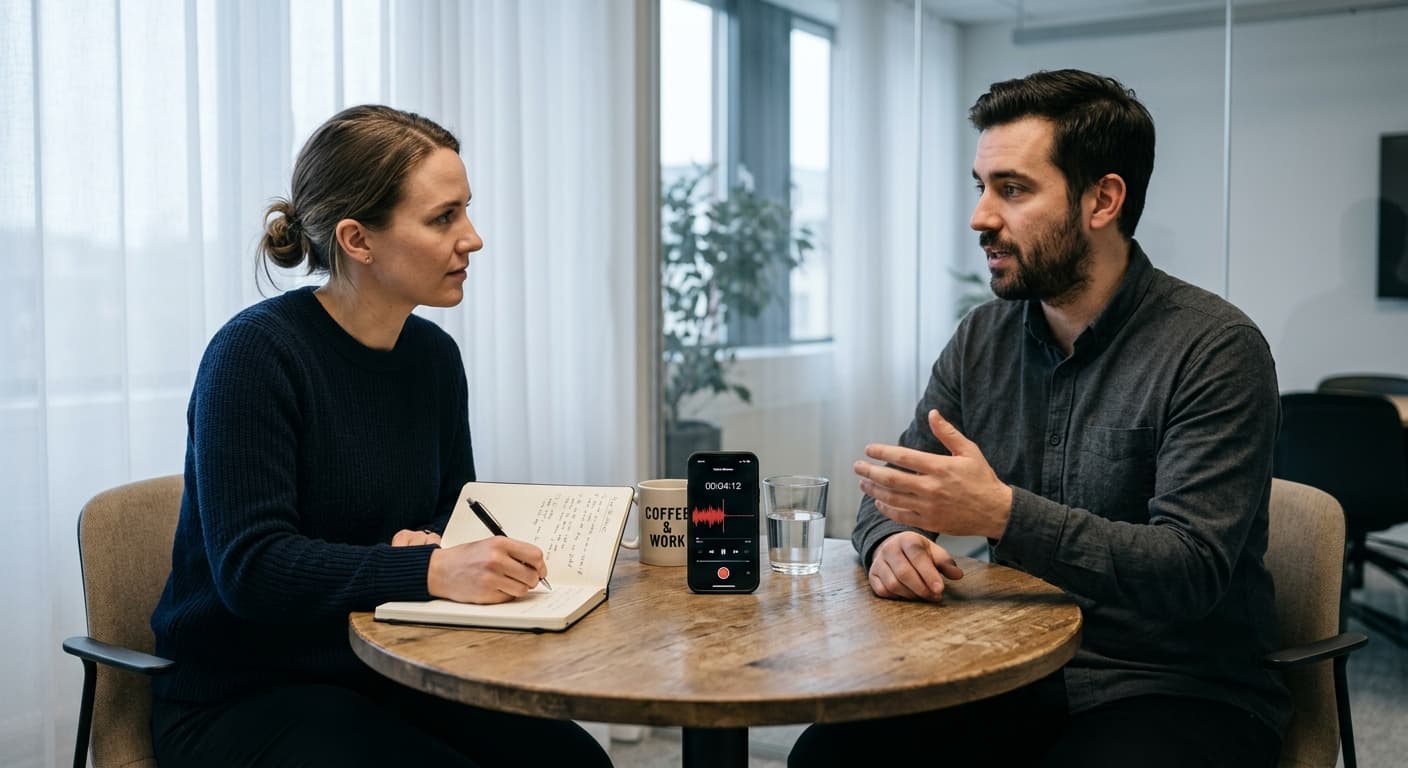
This page works through common recording scenarios in South Africa under RICA, the Regulation of Interception of Communications and Provision of Communication related Information Act 70 of 2002, and explains when a recording is usable as evidence. For the statute's core rules and penalties, see South Africa's recording laws and the recording laws overview.
Information last verified on 23 July 2026. This page provides general legal information about South African law and does not constitute legal advice in an individual case.
The Rule That Applies to Most Scenarios
RICA section 4(1) provides that "any person, other than a law enforcement officer, may intercept any communication if he or she is a party to the communication, unless such communication is intercepted by such person for purposes of committing an offence." Once you are a participant in a conversation, whether by phone, in person, or in writing, you may record it on that basis alone. The scenarios below apply this rule to specific situations.
Phone Calls You Are Part Of
If you are on the call, section 4 covers you. You do not need to tell the other person you are recording, and you do not need their consent, provided you are not recording for the purpose of committing an offence such as blackmail or extortion. This is the everyday case RICA is built around.
Meetings and Disciplinary Hearings You Attend
An employee sitting in their own disciplinary hearing is present and taking part in that meeting. That is a "direct communication" in RICA's own terms, an oral communication occurring in the immediate presence of the people participating. Applying section 4(1), an employee who is present at their own hearing may lawfully record it, because they are a participant, not a third party. This is a direct application of the statute, not a rule that comes from a specific reported case.
What RICA's legality does not resolve is a separate question: whether recording the hearing without telling anyone could still be raised by an employer as a distinct workplace issue, such as a breach of trust, apart from the recording's legality under RICA. That question is open, and this page does not assert an answer either way.
Workplace Monitoring by the Employer
Section 6 lets an employer intercept communications on its own business system, such as recorded calls or monitored email, where the interception is by or with the consent of the person in control of the system, for a purpose such as record keeping or detecting unauthorised use, and where the employer has made all reasonable efforts to inform users in advance that communications on the system may be monitored. Section 6 does not cover face to face meetings; an employer that wants to record those needs to rely on section 4 (being a party) or section 5 (a party's prior written consent).
Monitoring under section 6 does not sit outside POPIA. An employer processing employee communications data on a work system is processing personal information in the ordinary course of business, not a purely personal or household activity, so POPIA's household exclusion in section 6(1)(a) does not apply to the employer's side of the monitoring. The employer separately has to meet POPIA's conditions for lawful processing, including purpose specification and openness, which reinforces RICA section 6's own advance notice requirement rather than replacing it.
Silent Video Without Audio
RICA defines a "direct communication" as an oral communication or utterance, and an "indirect communication" as the transfer of information, including visual images, but only where it "is transmitted in whole or in part by means of a postal service or a telecommunication system." A silent video recorded locally, such as a handheld phone video or a standalone camera that is not transmitting images over a telecommunications system, does not fit either definition on a plain reading of the Act, and RICA's section 2 prohibition, which is a prohibition on intercepting a "communication," does not appear to apply to it. This is a reasoned reading of RICA's own definitions, presented here as such rather than as settled case law or a regulator ruling.
A silent video call is different. A muted video call over an app or platform is transmitted over a telecommunications system, so it fits the definition of an indirect communication, and recording it silently is still governed by RICA's section 4 and section 5 party consent rules.
Either way, POPIA applies separately and in addition to RICA. Silent video of an identifiable person is still personal information under POPIA's definition, so a "no RICA issue" conclusion for a silent recording says nothing about whether POPIA is satisfied. See CCTV and Neighbour Cameras for how this plays out with cameras specifically.
Is a Recording Admissible as Evidence?
South African civil courts do not apply an automatic exclusionary rule to evidence obtained unlawfully. In Harvey v Niland and Others [2015] ZAECGHC 149, the court held that "at common law, all relevant evidence which was not rendered inadmissible by an exclusionary rule was admissible in a civil court irrespective of how it was obtained," and that this rule "is not absolute: it is subject to a discretion to exclude unlawfully obtained evidence." The court set out the balancing factors: "the extent to which, and the manner in which, one party's right to privacy (or other right) has been infringed, the nature and content of the evidence concerned, whether the party seeking to rely on the unlawfully obtained evidence attempted to obtain it by lawful means," weighed against the idea that "the courts cannot countenance...unrestrained reliance on the philosophy that the end justifies the means." On the facts before it, the court admitted the disputed evidence.
Harvey v Niland itself quotes and applies an earlier judgment, Protea Technology Ltd and Another v Wainer and Others, 1997 (9) BCLR 1225 (W), which held that the statute criminalising unlawful interception "does not expressly or by necessary inference render the production of recordings made in contravention of its terms inadmissible in evidence before a court trying a civil dispute," and that relevant factors include "the purpose of the legislation, the evil which the legislation intends to combat," and "the degree of inconvenience and impropriety which could result from avoiding the Act."
The practical answer for a civil case is: a recording is usable, subject to the court's discretion, not automatically admissible and not automatically excluded. A court weighs the value of the evidence against how the recording was made and how badly it intruded on someone's privacy.
The CCMA and Workplace Disputes
CCMA arbitrations are not bound by the formal rules of evidence. That is an established feature of how the CCMA operates as an informal dispute resolution forum under the Labour Relations Act. Following directly from that, and from the Harvey v Niland and Protea Technology reasoning above, a commissioner has at least as much discretion as a civil court to admit a covert recording as evidence in a dismissal or workplace dispute. This page does not cite a specific CCMA arbitration award for that proposition, because no such award could be verified against a primary source; treat any online reference to a specific CCMA award on this point with caution.
Sharing or Publishing a Recording
Making a recording lawfully under RICA is a separate question from what you do with it afterwards. Once you share, publish, or store a recording beyond your own personal use, POPIA's conditions for lawful processing can apply if the recording contains someone else's personal information, and sharing a recording that damages someone's reputation can also raise a civil defamation claim under the ordinary law of delict. See POPIA Explained for the conditions that apply once a recording is shared or stored beyond personal use.
For the full statutory text, the AmaBhungane litigation over state surveillance, and the pending RICA amendment bill, see South Africa's recording laws. For the wider South Africa hub, see South Africa Laws.
This page is general legal information about South African law and is not legal advice. For advice on a specific situation, consult an attorney, or contact Legal Aid South Africa on 0800 110 110 if you cannot afford one.
Frequently Asked Questions
Can I record my own disciplinary hearing at work?
Yes. As an employee attending your own disciplinary hearing, you are a party to that meeting, so RICA section 4 lets you record it on the same basis as any conversation you take part in. Whether doing so covertly could raise a separate workplace trust issue is not settled and is not addressed by RICA itself.
Is a secretly recorded conversation admissible in court in South Africa?
There is no automatic rule against it. Harvey v Niland [2015] ZAECGHC 149 confirms a South African civil court has a discretion to admit or exclude unlawfully obtained evidence, weighing its relevance against how badly the recording intruded on someone's privacy and whether there was a lawful alternative.
Can the CCMA accept a covert recording as evidence?
The CCMA is not bound by the formal rules of evidence that apply in a civil court, so a commissioner has at least as much discretion to admit a covert recording as a civil court does. This page does not rely on any specific CCMA award for that point, because none could be verified against a primary source.
Does RICA apply to a silent video with no sound?
On a reasoned reading of RICA's own definitions, a silent video recorded locally and not transmitted over a telecommunications system falls outside both direct communication and indirect communication as RICA defines them, so RICA's interception prohibition does not appear to apply to it. POPIA can still apply to that footage separately.
Can I share or publish a recording I made legally under RICA?
Making the recording lawfully under RICA does not automatically clear you to share or publish it. POPIA's conditions for lawful processing can apply once the recording contains another person's personal information and is used beyond your own personal purpose, and publishing a recording that harms someone's reputation can separately raise a civil defamation claim.
Does an employer only need to comply with RICA when it monitors staff communications?
No. RICA section 6 covers whether the interception itself is lawful, but an employer monitoring employee communications on its own systems is also processing personal information in the ordinary course of business, so it separately has to satisfy POPIA's conditions for lawful processing, such as purpose specification and openness, alongside RICA's own advance notice requirement.
Updates
Independently fact-checked against the cited primary sources
Sources and References
- Regulation of Interception of Communications and Provision of Communication related Information Act 70 of 2002 (RICA), sections 2, 4, 5 and 6(justice.gov.za).gov
- Harvey v Niland and Others (5021/2015) [2015] ZAECGHC 149; 2016 (2) SA 436 (ECG) (3 December 2015), paras 38 to 53 (discretion to admit unlawfully obtained evidence in a civil court)(saflii.org)
- Protea Technology Ltd and Another v Wainer and Others, 1997 (9) BCLR 1225 (W), quoted at paras 41 to 42 of Harvey v Niland(saflii.org)
- Protection of Personal Information Act 4 of 2013 (POPIA), section 6(1)(a) (purely personal or household exclusion) and section 1 (definition of personal information)(inforegulator.org.za).gov
- South Africa recording laws: RICA's one party consent rule, penalties and the AmaBhungane update(recordinglaw.com)
- CCTV and neighbour cameras: POPIA and your remedies(recordinglaw.com)