
Arizona
Arizona Nursing Home Camera Laws (2026): SB1564 Reporting Only
Independently fact-checked against primary sources (last audited August 14, 2026). · 3 primary sources cited on this page. How we verify our legal content
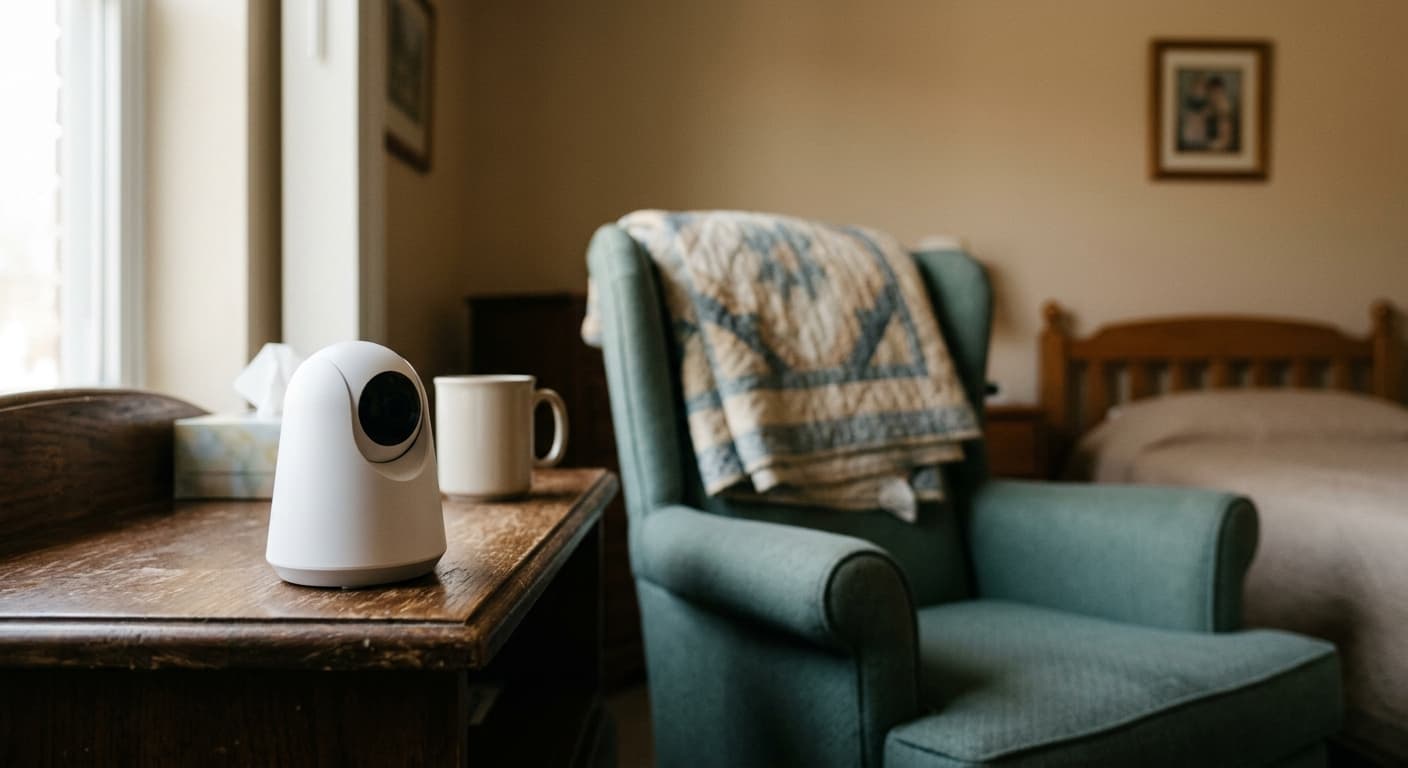
Arizona has no law giving a resident the right to install a camera in a nursing home or assisted living room. A bill that would have created that right, HB2914, died in the Senate in 2026. The law that did pass that year, SB1564, is a disclosure law: it requires facilities to report their electronic monitoring practices to the state, and it took effect on September 12, 2026.
Information last verified on 2026-08-14. This article has not yet been reviewed by a licensed lawyer.
This page covers Arizona's 2026 disclosure law, the bill that would have created a real monitoring right and failed, the pattern of repeated failed attempts before it, and the state's one-party consent overlay for audio. It does not cover general home-security cameras; see Arizona Recording Laws for the state's one-party consent framework.
SB1564: A Disclosure Law, Not a Right to Monitor
The only nursing-home monitoring legislation Arizona has actually enacted is SB1564. Governor Katie Hobbs signed it on June 19, 2026, and it was filed with the Secretary of State on June 22, 2026 as Laws 2026, Chapter 183, adding A.R.S. § 36-420.06 to Title 36. Arizona's online statutes now publish the section as A.R.S. § 36-420.08, while a different section on radiation protection appears at 36-420.06, so this page cites it as § 36-420.08.
Chapter 183 carries no emergency clause and sets no special effective date, so it took effect on the session's general effective date. The Legislature adjourned sine die on June 13, 2026, which makes the general effective date for the 57th Legislature, Second Regular Session September 12, 2026. The section has been in force since that date.
It is important to be precise about what this law does, because it is frequently mistaken for a right-to-monitor statute. It is not. Section 36-420.08 requires every assisted living facility and nursing care institution to disclose three separate things to the Arizona Department of Health Services:
- Whether the facility allows a resident to install an electronic monitoring device in the resident's room or personal space.
- Whether the facility itself uses electronic monitoring in common spaces.
- Whether the facility uses a technology solution that identifies the persons who enter and exit a resident's room and monitors movement in the room.
The statute is not limited to cameras. Subsection D defines an electronic monitoring device as any device or technology that has a placed, fixed or otherwise installed location and that captures, records or broadcasts audio or video, and defines electronic monitoring as the use of such a device in a resident's room to record or transmit sounds or activity to or for the resident, the resident's authorized representative, or an authorized third party. A fixed audio-only device sits inside that definition exactly as a camera does.
An investigative report on the bill's passage put the underlying point plainly: "there is no state law allowing cameras in nursing homes, each facility decides independently whether to permit them."
What SB1564 changes is transparency, not permission. Facilities must make their first disclosure on or before December 1, 2026 or at initial licensure, must report any later change in their monitoring practices to the department, and the Department of Health Services must make the information it receives available on its public website. That lets a prospective resident or family compare facilities before choosing one.
HB2914: The Bill That Would Have Created a Real Right, and Died
A separate bill, HB2914, would have done what SB1564 does not: authorize families to install monitoring devices in assisted living and skilled nursing facilities when every resident of the room consented, along with notice requirements, roommate consent requirements, facility and signage duties, installation and maintenance responsibilities, and rules on who could access recorded footage.

HB2914 passed the Arizona House 40-15 on March 10, 2026, crossed over to the Senate, was read a second time on March 17, 2026, and was referred to the Senate Rules and Government Efficiency committees. No further action is recorded after that referral. The bill died at sine die when the 2026 session ended on June 13, 2026, without ever reaching a Senate floor vote, a governor's signature, or a veto.
This was not the first time a bill like this failed in Arizona. A nonprofit public health association's own session summary lists HB2914 under bills it supported that died, with the note that the Arizona Health Care Association, the nursing home industry group, "kills this every year." An earlier predecessor bill, SB1041, also failed to advance in a prior session, described in the same investigative reporting as part of a pattern stretching back several years.
What This Means for an Arizona Family Today
Because HB2914 did not pass, an Arizona nursing home or assisted living resident has no statutory right to install a personal monitoring device as of this writing. A facility can permit, condition, or flatly refuse a monitoring request as a matter of its own admission agreement and internal policy.
SB1564's practical effect for a family is narrower but real. With § 36-420.08 in force since September 12, 2026, once facilities file their disclosures on or before December 1, 2026, a facility's monitoring practices should become a matter of public record through the state health department rather than something a family has to ask about directly. The disclosure also runs in both directions: it covers not only whether a family may install a device, but whether the facility is itself monitoring common spaces or tracking who comes and goes from a resident's room. None of it obliges a facility to say yes to a resident's request.
Audio Recording: Arizona's One-Party Consent Overlay
Arizona is a one-party consent state under A.R.S. § 13-3005, which makes it a class 5 felony to intentionally intercept a wire or electronic communication a person is not a party to, or to intercept an in-person conversation without the consent of a party to it. Because only one party's consent is required, a resident who is personally part of a conversation happening in their own room can generally record audio lawfully, even without staff or roommate consent. A device capturing a conversation the resident is not part of, such as staff members talking to each other, still raises the same one-party consent question that governs any Arizona recording. For the general framework, see Arizona Recording Laws.
Using Camera Footage as Evidence of Abuse or Neglect
Where a facility has permitted a camera as a matter of its own policy, resulting footage can support a report to the Long-Term Care Ombudsman Program or a civil claim for abuse or neglect. Footage on its own typically does not resolve a claim; it is reviewed together with the resident's medical records, staffing documentation, and care plan.
Harmed by a product or exposure? Speak with an attorney about your options
If you or a loved one may have been harmed, you can speak with an attorney about your legal options at no cost. Whether you have a claim depends on the specific facts. This is attorney advertising, not a guarantee that you qualify or of any particular outcome.
Getting Help: The Long-Term Care Ombudsman
Arizona's Long-Term Care Ombudsman Program, part of the Department of Economic Security's Division of Aging and Adult Services, investigates complaints of abuse, neglect, and rights violations in long-term care facilities and can help a family navigate a facility that declines a monitoring request. Reach the program at (602) 542-6454, extension 9, or through des.az.gov/LTCOP.

Related Resources
- Nursing Home Camera Laws by State covers the 18 states with an enacted electronic-monitoring statute and how Arizona's disclosure-only approach differs.
- Arizona Recording Laws covers the state's one-party consent framework for any recorded conversation.
- Nursing Home Abuse & Neglect covers how an abuse or neglect claim works once evidence, including camera footage, is in hand.
- Surveillance Camera Laws by State covers the general legal framework for security and hidden cameras outside a nursing facility setting.
Last updated: 2026-08-14. Bill status and statute cited reflect their status as of this date.
Frequently Asked Questions
Does Arizona law let me put a camera in a nursing home room?
No Arizona statute creates that right. A bill that would have authorized it, HB2914, died in the Senate in 2026. Whether a facility allows a camera is a matter of its own policy.
What does Arizona's SB1564 actually do?
SB1564, now A.R.S. § 36-420.08, requires assisted living facilities and nursing care institutions to disclose three things to the Arizona Department of Health Services: whether they allow a resident to install an electronic monitoring device in the resident's room or personal space, whether the facility itself uses electronic monitoring in common spaces, and whether it uses technology that identifies who enters and exits a resident's room. It does not create a right to install one.
Does the Arizona law cover audio devices or only cameras?
Both. Section 36-420.08 defines an electronic monitoring device as any device or technology with a fixed or installed location that captures, records or broadcasts audio or video, so a fixed audio-only device is inside the disclosure requirement just as a camera is.
Why did HB2914 fail?
It passed the House 40-15 in March 2026 but stalled in the Senate after a second reading and committee referral, dying without a vote when the 2026 session ended. Industry opposition from the state's nursing home association has defeated similar bills in prior sessions as well.
Can an Arizona nursing home refuse to let me install a camera?
Yes. There is no statutory right to a self-install camera in Arizona, so a facility can permit, condition, or refuse a request as a matter of its own policy.
Can I record audio in an Arizona nursing home room?
Arizona is a one-party consent state, so a resident who is personally part of a conversation can generally record it lawfully. A device capturing a conversation the resident is not part of raises the same one-party consent question that applies to any Arizona recording.
When did Arizona's monitoring-disclosure requirement take effect?
Section 36-420.08 took effect on September 12, 2026, the general effective date for bills passed in the 2026 regular session, because Chapter 183 carries no emergency clause. Facilities must make their first report to the Arizona Department of Health Services on or before December 1, 2026 or at initial licensure, and the department publishes that information for the public.
Updates
Updated to reflect that Arizona's nursing home electronic-monitoring disclosure law took effect on September 12, 2026 and is now published as A.R.S. § 36-420.08 (enacted as § 36-420.06).
Corrected the Arizona nursing-home monitoring section: SB1564 was signed on June 19, 2026 as Laws 2026, Chapter 183 and takes effect September 12, 2026, and the page now states all three disclosures A.R.S. § 36-420.06 requires and that the law reaches fixed audio devices as well as cameras.
Independently fact-checked against the cited primary sources
The Law Behind This Article
This article rests on the statutory provisions below, held in our own legal record and retrieved from the official source. Tap a section to read the operative text.
Arizona Revised Statutes, Title 36: Public Health and Safety, Chapter 4 (Health Care Institutions), Article 1
§ 36-420.06Electronic monitoring; disclosure; posting; definitionsIn forcecited in 2 of our articles
36-420.06. Electronic monitoring; disclosure; posting; definitions A. On or before December 1, 2026 or on initial licensure, each assisted living facility and nursing care institution shall disclose to the department in a department-APPROVED format whether the assisted living facility or nursing care institution: 1. allows residents to install an electronic monitoring device in the resident's room or personal space. 2. Uses electronic monitoring devices in the common spaces of the assisted living facility or nursing care institution. 3. Uses a technology solution that allows the assisted living facility or nursing care institution to monitor and identify who enters and exits a resident's room and the movement or activity of the person while in the resident's room. B. a licensee for an assi
Official text (excerpt) · last checked 2026-09-02 · Read the full text in our law library · Verify at azleg.gov
Also relied on in: Nursing Home Camera Laws by State
Arizona Revised Statutes, Title 13 (Criminal Code), Chapter 30 (EAVESDROPPING AND COMMUNICATIONS)
§ 13-3005Interception of wire, electronic and oral communications; installation of pen register or trap and trace device; classification; exceptionsIn forcecited in 23 of our articles
A. Except as provided in this section and section 13-3012, a person is guilty of a class 5 felony who either: 1. Intentionally intercepts a wire or electronic communication to which he is not a party, or aids, authorizes, employs, procures or permits another to so do, without the consent of either a sender or receiver thereof. 2. Intentionally intercepts a conversation or discussion at which he is not present, or aids, authorizes, employs, procures or permits another to so do, without the consent of a party to such conversation or discussion. 3. Intentionally intercepts the deliberations of a jury or aids, authorizes, employs, procures or permits another to so do. B. Except as provided in sections 13-3012 and 13-3017, a person who intentionally and without lawful authority installs or uses a pen register or trap and trace device on the telephone lines or communications facilities of another person which are utilized for wire or electronic communication is guilty of a class 6 felony.
Official text (excerpt) · last checked 2026-08-31 · Read the full text in our law library · Verify at azleg.gov
Cited in 7 court opinions in our collectionLatest citing opinion in our collection: 2025
In the courts (editorial summary, independently checked):State v. Morrison (2002) held that 13-3005 criminalizes unlawful interception but provides no exclusionary remedy, so a recording made in violation of it is not automatically inadmissible. State v. Hauss (1984) held the section inapplicable to a police station interview room talk where no reasonable expectation of privacy existed.
Opinions citing this section in our collection:
- State v. Morrison (Court of Appeals of Arizona 2002, 203 Ariz. 489)“…ause it was made without his or her consent in violation of A.R.S. § 13-3005 and 18 U.S.C. § 2511 and was, therefo…”
- State v. Hauss (Court of Appeals of Arizona 1984, 142 Ariz. 159)✓Police secretly recorded an arrested suspect's talk with his girlfriend in a station interview room, after telling her the room was being monitored; the court held there was no reasonable expectation of privacy in that setting, so section 13-3005 did not apply.
- State v. Allgood (Court of Appeals of Arizona 1992, 171 Ariz. 522)“…communication.” (Emphasis added.) See also A.R.S. § 13-3005. (penalizing as a class 5 felony interc…”
Identified automatically from the court opinions citing this section — not a ranking of which case controls.
Also relied on in: Arizona Recording Laws (2026): One-Party Consent Rules, One-Party Consent States: Complete 2026 Guide, Arizona Audio Recording Laws: Complete Guide to Consent Rules
Search our full record of US law — 2.1 million sections, every state + federal →
Sources and References
- A.R.S. § 13-3005, unlawful interception or recording of wire, electronic, or oral communications(azleg.gov).gov
- SB1564 (2026), health care institutions; electronic monitoring reporting, LegiScan bill text and metadata(legiscan.com)
- ABC15 Arizona, Bill to allow cameras inside nursing homes fails in AZ legislature(abc15.com)
- BillTrack50, HB2914 (2026) status and disposition, Died at Sine Die(billtrack50.com)
- FastDemocracy, HB2914 (2026) action history(fastdemocracy.com)
- Arizona Department of Economic Security, Long-Term Care Ombudsman Program(des.az.gov).gov
- Arizona Laws 2026, Chapter 183 (SB1564), adding A.R.S. § 36-420.06, electronic monitoring disclosure by assisted living facilities and nursing care institutions; approved by the Governor June 19, 2026(azleg.gov)
- Arizona State Legislature, adjournment sine die June 13, 2026 and general effective date September 12, 2026 for the 57th Legislature, Second Regular Session(azleg.gov)
- A.R.S. § 36-420.08, Electronic monitoring; disclosure; posting; definitions (Arizona Legislature)(azleg.gov).gov