
United Kingdom
Party Wall Agreements: Notices, Rules and Awards Explained
Independently fact-checked against primary sources (last audited September 29, 2026). · Law checked current as of September 29, 2026. · 7 primary sources cited on this page. How we verify our legal content
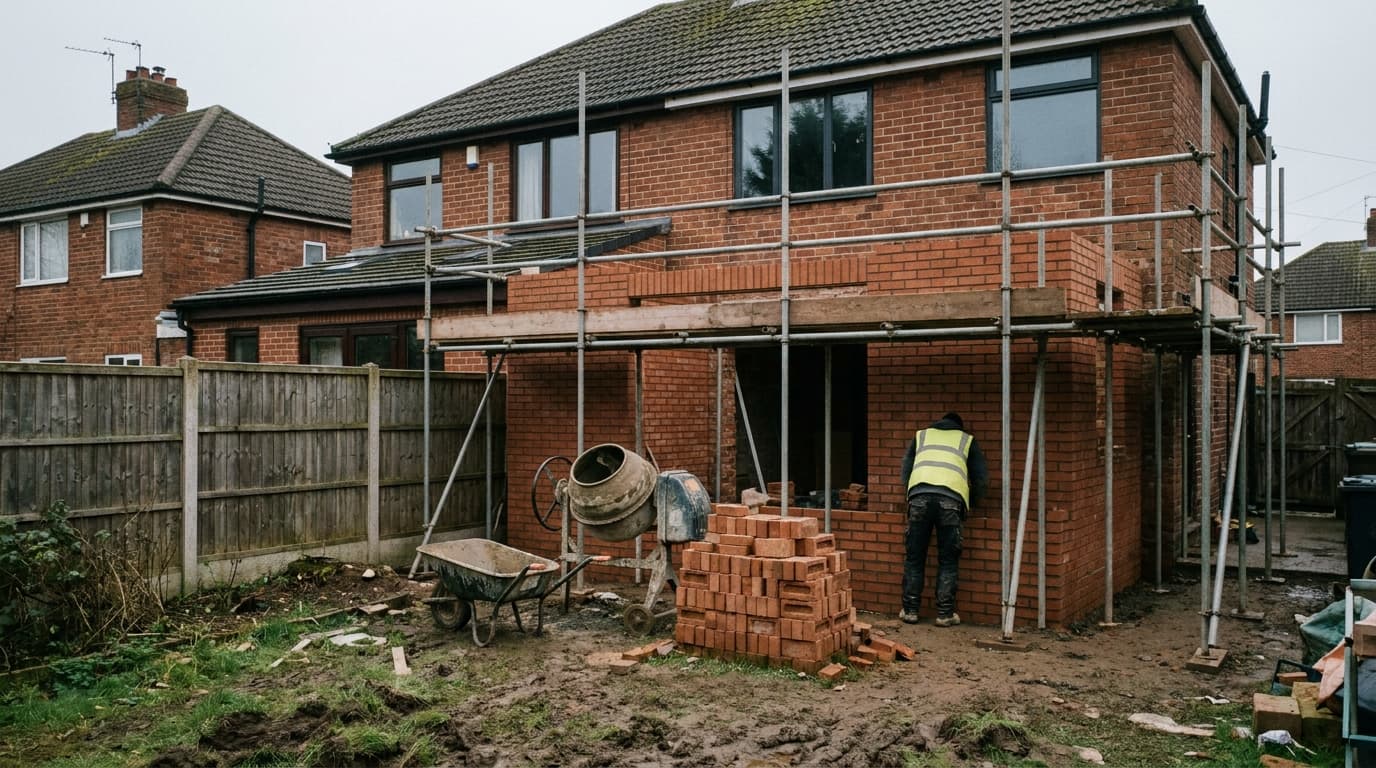
A party wall agreement is the outcome of a formal notice-and-response process under the Party Wall etc. Act 1996, the law that governs building work on or near a shared wall in England and Wales. It exists to stop building work from becoming a fight, by forcing an exchange of notice before anyone puts a spade in the ground.
What the Party Wall etc. Act 1996 Actually Covers
The Party Wall etc. Act 1996 applies to building work in England and Wales that involves a wall shared with a neighbouring property, a new wall built on or near the boundary, or excavation close to a neighbour's foundations. Section 22(4) of the Act states plainly that it "extends to England and Wales only." Scotland and Northern Ireland have no equivalent statute; that difference is covered fully below.
The Act uses three defined terms, set out in section 20:
- Party wall: a wall that stands on the land of two different owners, or a wall that separates buildings belonging to different owners.
- Party structure: a broader term that also covers floors, partitions and other structures separating parts of a building that are approached from separate entrances or staircases, such as in a converted house split into flats.
- Party fence wall: a freestanding wall (not part of a building) that stands on the line of junction between two properties, typically an old garden boundary wall.
The Three Types of Notice
Almost everything under the Act comes down to giving the right notice, at the right time, before starting work.
Line of Junction Notice (Section 1)
If you plan to build a new wall on the boundary line itself, section 1 requires at least one month's notice to the adjoining owner before work starts. The adjoining owner then has 14 days to consent to the wall being built astride the boundary; without that consent, the wall is generally built wholly on the building owner's own land instead.
Party Structure Notice (Section 3)
If the work involves an existing party wall or party structure, such as cutting into it, underpinning it, raising its height, or demolishing and rebuilding it, section 3 requires at least two months' notice. This notice lapses if the work has not begun within 12 months of it being served and is not being carried out with due diligence, so a notice served but not acted on cannot sit indefinitely.
Notice of Adjacent Excavation (Section 6)
Digging near a neighbour's building carries its own notice rule under section 6, requiring at least one month's notice. Two distances matter here, and both are measured from the neighbour's building:
- The 3-metre rule (s.6(1)): notice is required if you will excavate within 3 metres of the neighbour's building and the work will go deeper than the bottom of their foundations.
- The 6-metre rule (s.6(2)): notice is required if you will excavate within 6 metres of the neighbour's building and the work would cut below a line drawn down at a 45-degree angle from the bottom of their foundations.
A basement dig, an extension with deep foundations, or even a large tree removal near a boundary can trigger one or both of these rules, so it is worth checking distances carefully before work starts.
Deemed Dissent: Why Silence Counts as a Dispute
Section 5 of the Act sets out what happens if the adjoining owner simply does nothing. If they do not respond in writing with consent within 14 days of a party structure notice, the law treats this as a "deemed dissent," meaning a dispute is automatically considered to have arisen, whether or not either side feels particularly disputatious about it.
This is one of the most misunderstood parts of the Act. Deemed dissent is not a legal attack and does not mean the neighbour has "refused" anything in an adversarial sense. It simply moves the matter into the Act's built-in dispute-resolution process, which exists precisely so that building work is not held up indefinitely by an unanswered letter.
Resolving a Dispute: Surveyors and the Party Wall Award
Once a dispute exists, whether through an active objection or deemed dissent, section 10 sets out how it gets resolved. The two owners can either:

- Appoint a single agreed surveyor who acts impartially for both sides, or
- Each appoint their own surveyor, with those two surveyors then selecting a third surveyor to break any deadlock between them.
The surveyor, or surveyors, then produce a party wall award: a binding document that sets out what work can be done, how and when it can be carried out, and how any resulting costs are to be split. The award is not a formality; it is the mechanism that actually gives the building owner legal permission to proceed and protects the adjoining owner's interests while the work happens.
If either owner is unhappy with the award, section 10(17) allows an appeal to the county court within 14 days of the award being served. Party wall practitioners generally treat this window as strict, with no general power for the court to extend it, though the exact date it starts running can depend on how and when the award was served, so it is worth checking the current position with a party wall surveyor or solicitor if an appeal is being considered.
Party Wall Act Consent Is Separate From Planning Permission and Building Regulations
A common misunderstanding is that getting party wall consent, planning permission, or building regulations approval covers the other two. It does not. GOV.UK guidance is explicit that these are three independent processes: a project can have full planning permission and still need a party wall notice, and a party wall award does not itself authorise work that also needs planning permission or building regulations sign-off. Anyone planning building work near a boundary needs to check all three separately.
No Equivalent in Scotland or Northern Ireland
There is no party wall agreement process in Scotland or Northern Ireland. In Scotland, shared and boundary walls are instead governed by common law, sometimes described as the law of "common interest," with flats and tenements additionally covered by the Tenements (Scotland) Act 2004. In Northern Ireland, there is likewise no Party Wall Act. The Access to Neighbouring Land Act 1992, which lets a court order access to a neighbour's land for repairs, covers England and Wales only, and Northern Ireland has no equivalent statute, so access there depends on agreement with the neighbour and the common law, rather than the notice-and-award system used in England and Wales.

If you are building near a shared wall in Scotland or Northern Ireland, the England & Wales notice periods, the 3-metre and 6-metre excavation rules, and the surveyor-award process described above simply do not apply. A solicitor familiar with the relevant local law is the right starting point instead.
This guide explains the notice periods and process under the Party Wall etc. Act 1996 in general terms; it is not legal advice, and the right notice, timing and process for a specific project should be confirmed with a qualified party wall surveyor or solicitor. For the boundary itself rather than a shared wall, see boundary disputes and fence and boundary law. For the wider picture, see the UK Property & Neighbour Disputes hub.
Frequently Asked Questions
Do I always need a party wall agreement to extend my house?
Only if the work falls within the Party Wall etc. Act 1996: building on the boundary line, working on an existing shared wall or structure, or excavating within 3 or 6 metres of a neighbour's building at certain depths. Many smaller projects, such as internal work with no shared wall involved, do not trigger the Act at all.
What happens if my neighbour ignores my party wall notice?
If they do not respond in writing with consent within 14 days of a party structure notice, section 5 treats this as a 'deemed dissent'. A dispute is then considered to have arisen automatically, and the matter moves into the Act's surveyor-based dispute resolution process.
Who pays for the party wall surveyor?
This is usually set out in the party wall award itself. In many cases the building owner carrying out the work pays the reasonable costs of the surveyor process, but the award, produced under section 10, is what actually determines cost allocation for a specific project.
Can I refuse to let my neighbour build on the boundary?
You cannot generally block reasonable, lawful work, but you have the right to notice, and to have any dispute resolved through the Act's surveyor process rather than agreed informally. If you do not consent to a new wall being built astride the boundary under a section 1 notice, it is generally built wholly on the other owner's land instead.
Does a party wall award mean I don't need planning permission as well?
No. A party wall award, planning permission, and building regulations approval are three separate processes under GOV.UK guidance. Getting one does not satisfy the requirement for either of the others, so all three need to be checked independently for any given project.
Is the Party Wall etc. Act 1996 the same in Scotland?
No. Section 22(4) of the Act states it extends to England and Wales only. Scotland has no equivalent party wall statute; shared walls are instead governed by common law, and flats also fall under the Tenements (Scotland) Act 2004.
What is the difference between a party wall, a party structure and a party fence wall?
A party wall stands on the land of two owners or separates buildings in different ownership. A party structure is the broader term covering things like floors and partitions between separately-accessed parts of a building. A party fence wall is a freestanding boundary wall, not part of a building, built on the line of junction.
Updates
We clarified that a party structure notice lapses only if work has not begun within 12 months and is not being carried out with due diligence, and that Northern Ireland has no statute equivalent to the Access to Neighbouring Land Act 1992.
Independently fact-checked against the cited primary sources; governing law re-checked for recent changes
The Law Behind This Article
This article rests on the statutory provisions below, held in our own legal record and retrieved from the official source. Tap a section to read the operative text.
Party Wall etc. Act 1996
s. 10Resolution of disputes.In force
(1) Where a dispute arises or is deemed to have arisen between a building owner and an adjoining owner in respect of any matter connected with any work to which this Act relates either— (a) both parties shall concur in the appointment of one surveyor (in this section referred to as an “ agreed surveyor ”); or (b) each party shall appoint a surveyor and the two surveyors so appointed shall forthwith select a third surveyor (all of whom are in this section referred to as “ the three surveyors ”). (2) All appointments and selections made under this section shall be in writing and shall not be rescinded by either party. (3) If an agreed surveyor— (a) refuses to act; (b) neglects to act for a period of ten days beginning with the day on which either party serves a request on him; (c) dies before the dispute is settled; or (d) becomes or deems himself incapable of acting, the proceedings for settling such dispute shall begin de novo .
Official text (excerpt) · last checked 2026-08-14 · Read the full text in our law library · Verify at legislation.gov.uk
s. 22Short title, commencement and extent.In force
(1) This Act may be cited as the Party Wall etc. Act 1996. (2) This Act shall come into force in accordance with provision made by the Secretary of State by order made by statutory instrument. (3) An order under subsection (2) may— (a) contain such savings or transitional provisions as the Secretary of State thinks fit; (b) make different provision for different purposes. (4) This Act extends to England and Wales only.
Official text (excerpt) · last checked 2026-08-14 · Read the full text in our law library · Verify at legislation.gov.uk
s. 6Adjacent excavation and construction.In force
(1) This section applies where— (a) a building owner proposes to excavate, or excavate for and erect a building or structure, within a distance of three metres measured horizontally from any part of a building or structure of an adjoining owner; and (b) any part of the proposed excavation, building or structure will within those three metres extend to a lower level than the level of the bottom of the foundations of the building or structure of the adjoining owner. (2) This section also applies where— (a) a building owner proposes to excavate, or excavate for and erect a building or structure, within a distance of six metres measured horizontally from any part of a building or structure of an adjoining owner;
Official text (excerpt) · last checked 2026-08-14 · Read the full text in our law library · Verify at legislation.gov.uk
Search our record of UK legislation — retrieved from legislation.gov.uk →
Sources and References
- Party Wall etc. Act 1996 (full text)(legislation.gov.uk).gov
- Party Wall etc. Act 1996, s.6 (adjacent excavation)(legislation.gov.uk).gov
- Party Wall etc. Act 1996, s.10 (resolution of disputes)(legislation.gov.uk).gov
- Party Wall etc. Act 1996, s.22 (extent: England and Wales only)(legislation.gov.uk).gov
- GOV.UK: Preventing and resolving disputes in relation to party walls(gov.uk).gov
- Party Wall etc. Act 1996, section 3 (party structure notices; 12-month lapse)(legislation.gov.uk).gov
- Access to Neighbouring Land Act 1992, section 9 (extent: England and Wales only)(legislation.gov.uk).gov