
Indiana
Indiana Window Tint Laws (2026): Legal VLT Limits
Independently fact-checked against primary sources (last audited August 18, 2026). · Reviewed by the RecordingLaw editorial team. · Law checked current as of August 18, 2026. How we verify our legal content
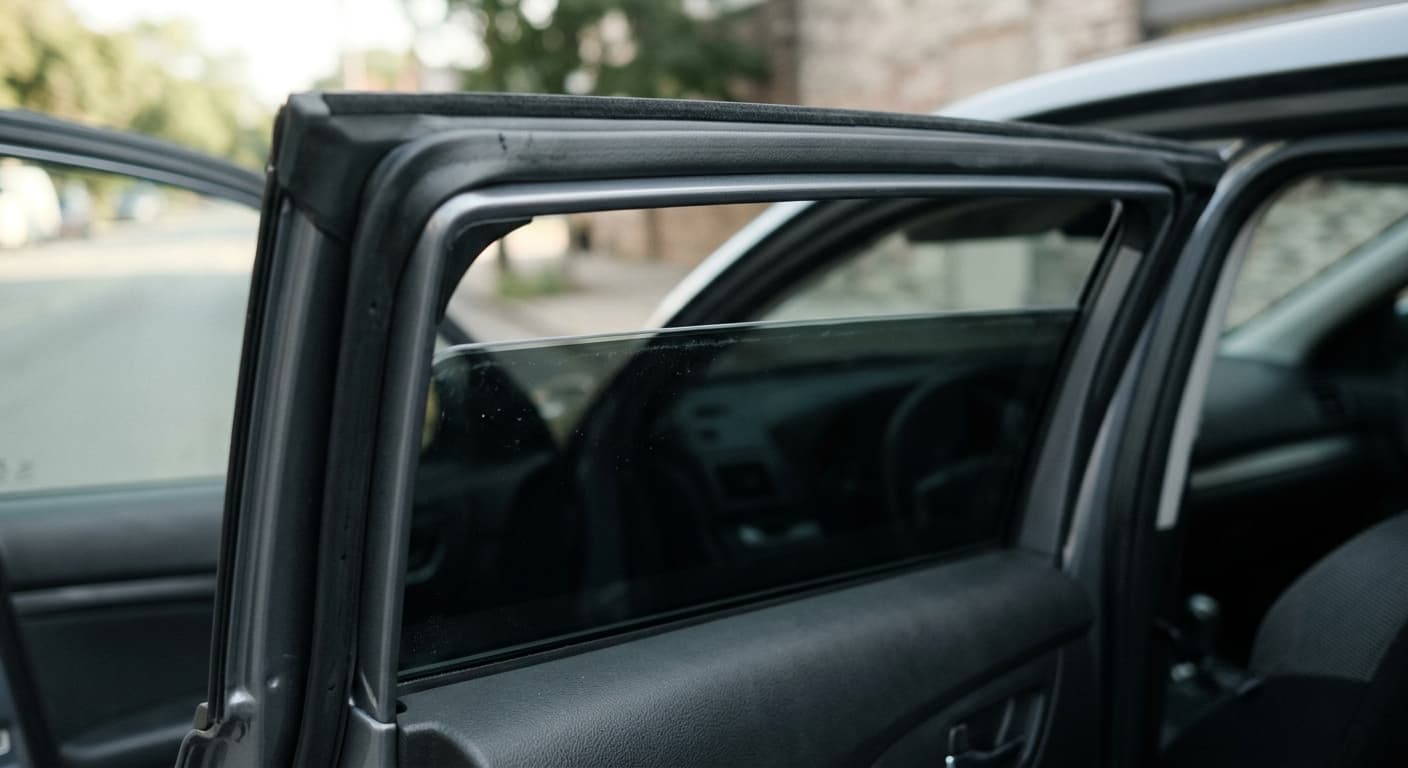
Indiana regulates window tint by window type, not by a single uniform rule. Under Ind. Code 9-19-19-4(c), the 30% visible light transmission floor and 25% reflectance cap apply only to the windshield strip, the side wing, the side window that is part of a front door, and the rear back window. Side windows located behind the front doors, such as second-row windows on a sedan, SUV, or van, are not listed in that subsection and are not subject to a state VLT minimum. They are not unregulated, though: Ind. Code 9-19-19-3(b) separately bars driving with sunscreening material on the side or rear windows that obstructs the driver's clear view of the highway.
What is the legal tint limit in Indiana?
Indiana law (Ind. Code 9-19-19-4) does not regulate every window the same way. Subsection (c) lists exactly four panes that must allow at least 30% visible light transmission and no more than 25% total solar reflectance: the windshield (top strip only), the side wing, the side window that is part of a front door, and the rear back window. Side windows located behind the front doors, such as second-row windows on a sedan, SUV, or van, are not on that list and are not subject to a state VLT minimum. A separate provision, Ind. Code 9-19-19-3(b), still applies to them: it bars driving with sunscreening material on the front windshield, side wings, or side or rear windows that obstructs the driver's clear view of the highway or an intersecting highway. That is a view-obstruction standard rather than a numeric VLT threshold, so it is judged case by case rather than by meter reading.
A higher VLT percentage means lighter (more transparent) tint, and a lower VLT percentage means darker film. A window that allows only 5% of light through (common "limo" tint) would be clearly illegal on any of the four panes listed in 9-19-19-4(c). On side windows behind the front doors, 5% film does not violate 9-19-19-4, but tint that dark can still run into the clear-view rule in 9-19-19-3(b).
| Window Position | Indiana Rule |
|---|---|
| Front-door side windows | 30% VLT minimum |
| Side windows behind the front doors | No VLT minimum under 9-19-19-4; must still not obstruct the driver's clear view (9-19-19-3(b)) |
| Rear back window | 30% VLT minimum |
| Windshield | Non-reflective strip above the AS-1 line only |
Indiana does not publish a measurement tolerance in the statute, so the 30% limit is taken as stated. When selecting film, aim for a combined VLT (film plus factory glass) that comfortably clears 30% to account for meter variation during a roadside check.
Film VLT vs. combined VLT: what actually gets measured
This distinction matters more than most drivers realize. When a film is labeled "35% VLT," that percentage describes how much light the film alone transmits. It does not tell you what the window will read after the film is applied over your factory glass.

Your factory glass already blocks some light. Most production vehicles have front side glass in the range of 70% to 80% VLT from the factory. To find the combined (net) VLT, multiply the film VLT by the glass VLT and express the result as a percentage. For example: a 35% VLT film over 72% factory glass produces a combined reading of approximately 25% (0.35 x 0.72 = 0.252). That result is below Indiana's 30% minimum and would be illegal.
To clear 30% combined on typical 70% factory glass, you need a film rated at roughly 43% VLT or higher (0.43 x 0.70 = 0.301). On glass that reads 80%, a 38% film would work (0.38 x 0.80 = 0.304). The takeaway: always ask your installer to measure your actual factory glass before selecting a film, because the number printed on the film box does not tell the whole story.
Because Indiana's statute states no measurement tolerance, there is no built-in buffer the way some states allow plus or minus 3%. A meter reading of 29% is over the line. Choose film that leaves a genuine margin.
Windshield tint rules in Indiana
Indiana allows non-reflective tint on the windshield only above the manufacturer's AS-1 line. That line is typically etched near the top edge of the windshield by the glass manufacturer; it marks the boundary of the "critical driving zone." Below the AS-1 line, the windshield must remain clear.
Indiana does not specify banned colors for the windshield strip. The 25% total solar reflectance cap does reach the windshield, because 9-19-19-4(c)(1) lists it as one of the four covered panes alongside the side wing, the front-door side window, and the rear back window. A mirrored or highly metallic strip can therefore violate the statute even when it sits entirely above the AS-1 line.
Medical exemptions
Indiana does allow a medical exemption for darker window tint under Ind. Code 9-19-19-4. A licensed Indiana physician or optometrist must provide a written attestation that the owner of the vehicle or a habitual passenger has a medical condition requiring reduced light exposure. Under Ind. Code 9-19-19-4(b) the physician's or optometrist's certification of that condition must be carried in the vehicle, and the certificate must be renewed annually.
The statute does not specify a minimum VLT for the exemption, leaving the appropriate level to be documented by the certifying physician. Conditions that commonly support an exemption include lupus, photosensitivity disorders, albinism, severe migraines triggered by light, and certain post-surgical eye conditions. The certifying practitioner determines what darkness level is medically appropriate for the specific patient.
The attestation covers a specific individual (the owner or named habitual passenger), not the vehicle generally. If the vehicle changes hands the exemption does not transfer to the new owner. The new owner would need to obtain their own attestation if darker tint is to remain on the vehicle. Keep the certification in the vehicle at all times. The statute requires only that the physician's or optometrist's certification be carried in the vehicle; it draws no distinction between an original and a copy.
How tint is measured and what documentation you need
Law enforcement in Indiana uses VLT meters to evaluate window tint during traffic stops or at safety inspections. The officer places the meter's jaws around the window glass and the device emits a light beam across the pane; the reading is the percentage of visible light that passes through the entire window, film and glass together. A reading of 30% or above means the window is compliant.
Ind. Code 9-19-19-4(f) sets an important limit on what that stop can become. It allows a vehicle to be stopped to determine compliance with the tint rules, but it provides that the vehicle, its contents, the driver, or a passenger may not be inspected, searched, or detained solely because of a violation of that section. A tint violation on its own is therefore not a lawful basis for searching the car or holding the occupants; an officer would need some separate justification for either step.
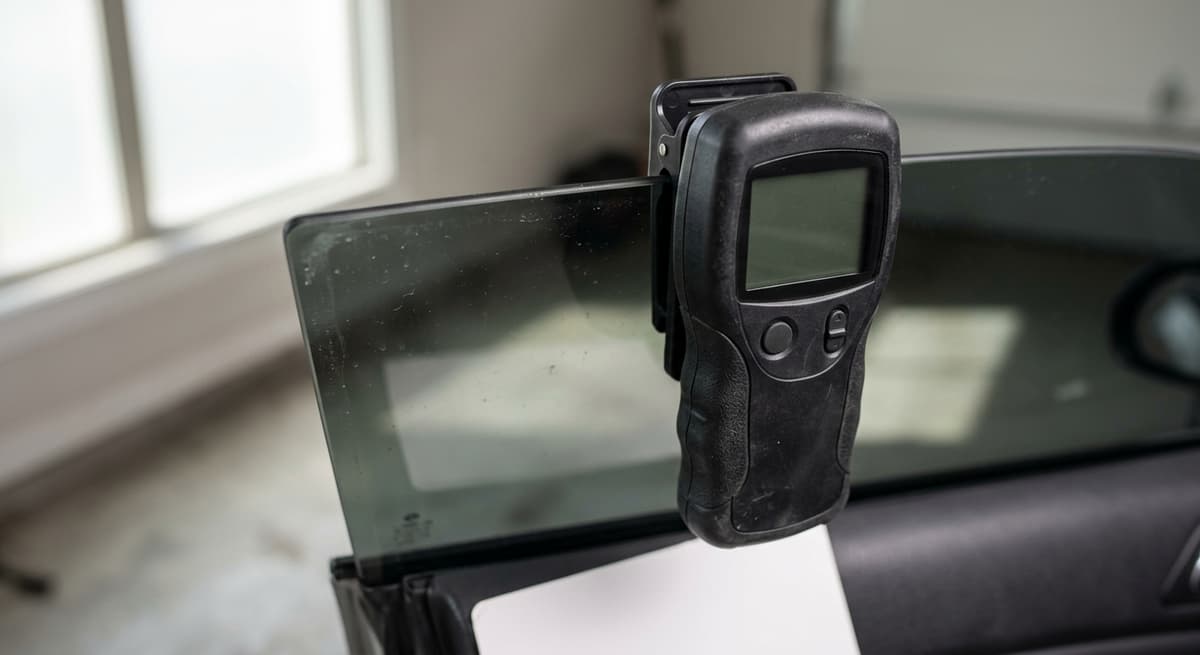
Indiana does not require a compliance sticker affixed to the glass. Instead, the statute requires carried paperwork: for factory-tinted glass, proof from the manufacturer, supplier, or installer that the tinting complies with FMVSS205 must be carried in the vehicle. For a medical exemption, the physician's or optometrist's certificate serves the same role. If you have tint applied by a professional installer, ask for documentation of FMVSS205 compliance to keep in the vehicle. This paperwork serves as on-vehicle documentation of compliance and can reduce friction during a traffic stop, because the officer can see at a glance that the tint is documented as compliant.
Ask your installer for the manufacturer's data sheet for the specific film used. The data sheet will list the film's standalone VLT, solar rejection, and infrared rejection. Keep the data sheet in your glove box alongside the installer's invoice and any FMVSS205 compliance proof. That combination, the compliance documentation, the data sheet, and the invoice, gives you multiple layers of documentation if your car is questioned.
Choosing compliant film in Indiana
A few practical guidelines when shopping for tint:
Start with your factory glass VLT. Many installers have a database of factory glass readings by make, model, and year, or they will measure your glass directly. Do not skip this step, because the same film will produce different combined readings on different vehicles.
For front-door side windows, a film labeled 40% to 50% VLT layered over typical 70-75% factory glass will land comfortably above the 30% threshold. The rear back window follows the same 30% rule, so the same math holds there. Side windows behind the front doors are not covered by 9-19-19-4, so Indiana law sets no minimum VLT for them, but 9-19-19-3(b) still bars film on those windows that obstructs the driver's clear view of the highway.
Avoid metallic or mirrored films on any of the four panes listed in 9-19-19-4(c). Indiana caps total solar reflectance at 25% on the windshield strip, the side wings, the front-door side windows, and the rear back window alike. Highly reflective film can create glare hazards for other drivers and will attract officer attention even if the VLT reading is technically legal.
Penalties for illegal tint in Indiana
A window tint violation in Indiana is a civil infraction rather than a criminal offense. Ind. Code 9-19-19-7(b) classifies a violation of the chapter as a Class C infraction, and Ind. Code 34-28-5-4(c) caps the judgment for a Class C infraction at $500. The amount actually assessed varies by court and the number of violations. Because this is a civil infraction, it does not carry jail time, but judgments can accumulate if multiple windows violate the law.
The shop that installs the film carries much heavier exposure than the driver. Ind. Code 9-19-19-4(e) makes it unlawful to tint or otherwise treat a covered pane so that driving the vehicle afterward would violate subsection (c) or (d), and Ind. Code 9-19-19-8 makes a violation of 4(e) a Class A infraction, which Ind. Code 34-28-5-4(a) allows a judgment of up to $10,000 for. The statute gives the installer one way out: the work is not a violation if it is performed for a customer who first submits the physician's or optometrist's statement described in 9-19-19-4(b). If you are having tint applied under a medical exemption, give your installer that certificate before the work begins.

Indiana does not use a fix-it ticket system for window tint in the way some states do. Paying the fine does not immunize you from further citations if the illegal tint remains on the vehicle. Remove or replace non-compliant film promptly after a citation to avoid a second violation on the same windows.
This article is general legal information, not legal advice. Window tint limits vary by state and change, and enforcement depends on local practice and your specific vehicle. For a definitive answer, check your state DMV or consult a local attorney.
Indiana drivers should also review Indiana Windshield Mounting Restrictions for rules on items mounted on the glass.
More Indiana Laws
Frequently Asked Questions
What is the legal tint in Indiana?
Indiana's 30% visible light transmission (VLT) floor applies only to specific windows: the windshield strip above the AS-1 line, the side wing, the side window that is part of a front door, and the rear back window (Ind. Code 9-19-19-4(c)). Side windows behind the front doors, such as second-row windows on a sedan or SUV, are not covered by the statute.
How dark can my front windows be in Indiana?
The darkest legal front side window tint in Indiana is 30% VLT measured through the film and glass combined. Any film that brings the combined transmittance below 30% is illegal and subject to a civil infraction fine.
Is 20% tint legal in Indiana?
It depends on the window. A 20% VLT combined reading is below the 30% minimum required on the front-door side windows, the rear back window, and the windshield strip, so it would be illegal there. Side windows behind the front doors are not covered by Indiana Code 9-19-19-4, so no VLT floor applies to them, but they are not unregulated: Indiana Code 9-19-19-3(b) bars sunscreening material on a side or rear window that obstructs the driver's clear view of the highway.
Can I get a medical exemption for window tint in Indiana?
Yes. An Indiana-licensed physician or optometrist must provide a written attestation for the vehicle owner or a habitual passenger. Indiana Code 9-19-19-4(b) requires that the certification be carried in the vehicle and that the certificate be renewed annually. The exemption does not transfer if the vehicle is sold.
What is the penalty for illegal tint in Indiana?
For the driver, illegal window tint is a Class C infraction under Indiana Code 9-19-19-7(b), which carries a judgment of up to $500 under Indiana Code 34-28-5-4(c). There is no jail time, but the judgment can be reassessed if the illegal tint is not removed. The installer faces more: performing the non-compliant work violates Indiana Code 9-19-19-4(e), which Indiana Code 9-19-19-8 makes a Class A infraction, carrying a judgment of up to $10,000.
Is windshield tint legal in Indiana?
Only above the manufacturer's AS-1 line. Below that line, the windshield must remain clear. Non-reflective film on the top strip is allowed.
Do SUVs have different tint rules in Indiana?
No, but not for the reason you might expect. Indiana Code 9-19-19-4 does not distinguish by vehicle type at all; it distinguishes by window position. The front-door side windows and the rear back window must meet the 30% VLT floor on a sedan, SUV, van, or truck alike, and the side windows behind the front doors fall outside that VLT floor on every vehicle type, not just SUVs. Those rear side windows are still subject to the clear-view rule in Indiana Code 9-19-19-3(b) regardless of vehicle type.
What is the difference between film VLT and combined VLT in Indiana?
Film VLT is the light transmission of the tint film alone. Combined VLT is the reading after the film is applied over the factory glass, which is what Indiana law and officers actually measure. To find the combined reading, multiply the film VLT by the factory glass VLT. A 40% film over 70% factory glass produces roughly 28% combined, which would be illegal. Always verify the combined reading with your installer before finalizing your film choice.
Does Indiana have a tint measurement tolerance?
Indiana's statute does not specify a measurement tolerance, unlike some states that allow plus or minus 3%. In practice, aim for a combined VLT that is several points above 30% to protect against any meter variation or glass aging that could lower the reading over time.
Updates
Corrected the window tint rules for side windows behind the front doors, which are outside the 30% VLT floor but still subject to Indiana's clear-view rule, confirmed that the 25% reflectance cap covers the windshield, added the Class C infraction classification and the installer's Class A exposure, added the statutory limit on searches during a tint stop, and removed an unsupported requirement to carry an original medical certificate.
Corrected the Indiana window tint page: Ind. Code 9-19-19-4 regulates only the windshield strip, the side wing, the front-door side windows, and the rear back window -- side windows behind the front doors (second-row windows on any vehicle) are not covered by the statute at all, contrary to the page's prior claim that the 30% floor applied to every side window on every vehicle. Also hedged an unsourced $120 fine floor.
Independently fact-checked against the cited primary sources; governing law re-checked for recent changes
Removed the fabricated window-affixed compliance sticker requirement (Ind. Code 9-19-19-4 requires only carried FMVSS205/medical-exemption paperwork, not a glass sticker) and added the statute's required annual renewal of the medical-exemption physician/optometrist certificate, which the article had omitted.
Governing law re-checked for recent changes
Reviewed and approved by an editor
The Law Behind This Article
This article rests on the statutory provisions below, held in our own legal record and retrieved from the official source. Tap a section to read the operative text.
Indiana Code, TITLE 9. MOTOR VEHICLES
§ 9-19-19-4Tinting, glazing, or sunscreening vehicle windowsIn forcecited in 2 of our articles
Sec. 4. (a) This section does not apply to a manufacturer's tinting or glazing of motor vehicle windows or windshields that is otherwise in compliance with or permitted by FMVSS205 as promulgated in 49 CFR 571.205. Proof from the manufacturer, supplier, or installer that the tinting or glazing is in compliance with or permitted by FMVSS205 must be carried in the vehicle. (b) This section does not apply to the driver of a vehicle: (1) that is owned by an individual required for medical reasons to be shielded from the direct rays of the sun; or (2) in which an individual required for medical reasons to be shielded from the direct rays of the sun is a habitual passenger. The medical reasons must be attested to by a physician or optometrist licensed to practice in Indiana, and the physician's or optometrist's certification of that condition must be carried in the vehicle. The physician's or optometrist's certificate must be renewed annually.
Official text (excerpt) · last checked 2026-09-01 · Read the full text in our law library · Verify at iga.in.gov
Cited in 9 court opinions in our collectionLatest citing opinion in our collection: 2022
In the courts (editorial summary, independently checked):Indiana courts have applied section 9-19-19-4 to stops where officers could not identify occupants through a window. Gregory Johnson v. State of Indiana (2013) upheld such a stop even assuming the tint was legal, and Clayton Doctor v. State of Indiana (2016) held later proof of compliance would not negate reasonable suspicion.
Opinions citing this section in our collection:
- Erving Sanders v. State of Indiana (Indiana Court of Appeals 2013, 981 N.E.2d 616)“…id basis to stop Sanders’s vehicle. The State asserts that Ind. Code § 9-19-19-4 does not require an officer to conclus…”
- Abbott v. State (Indiana Supreme Court 2012, 961 N.E.2d 1016)“…separate opinion in which DICKSON, J., concurs. . See Ind.Code § 9-19-19-4. . The trial court also sentenced…”
- Gregory Johnson v. State of Indiana (Indiana Court of Appeals 2013, 992 N.E.2d 955)✓An officer stopped a minivan whose factory-standard rear tint he could not see through to identify the occupants; the court held his good-faith mistake still supplied reasonable suspicion under the tint statute and that the stop was reasonable under the Indiana Constitution.
Identified automatically from the court opinions citing this section — not a ranking of which case controls.
Also relied on in: Indiana Windshield Mounting Laws (2026 Guide)
§ 9-19-19-3Decals, signs, posters, sunscreens, or other nontransparent materialIn forcecited in 2 of our articles
Sec. 3. (a) This section does not apply to the display of a decal required by the United States Department of Defense on the following: (1) A military vehicle. (2) A motor vehicle owned by a person in the service of the armed forces of the United States. (3) A motor vehicle owned by a person employed by the armed forces of the United States. (4) A motor vehicle authorized to display the decal by the military police of the armed forces of the United States. (b) A person may not drive a motor vehicle with a sign, poster, sunscreening material, or other nontransparent material upon the front windshield, side wings, or side or rear windows of the vehicle that obstructs the driver's clear view of the highway or an intersecting highway. However, signs, posters, or other nontransparent material not larger than four (4) inches square may be placed upon the front windshield, side wings, or side or rear windows in the lower corner farthest removed from the driver's position. [Pre-1991 Recodification Citation: 9-8-6-38(b).]
Official text (excerpt) · last checked 2026-09-07 · Read the full text in our law library · Verify at iga.in.gov
Cited in 1 court opinions in our collectionLatest citing opinion in our collection: 2018
Opinions citing this section in our collection:
- John W. Anthony v. State of Indiana (Indiana Court of Appeals 2018, 103 N.E.3d 696)“…dows . . . that obstructs the driver’s clear view.” Ind. Code § 9-19-19-3. The State did not present such…”
Identified automatically from the court opinions citing this section — not a ranking of which case controls.
§ 9-19-19-7United States Department of Transportation regulations; classification of violationsIn forcecited in 2 of our articles
Sec. 7. (a) This section does not apply to a person who owns or operates a vehicle or combination of vehicles that: (1) contains parts and accessories; and (2) is equipped; as required under regulations of the United States Department of Transportation. (b) Except as provided in section 8 of this chapter, a person who violates this chapter commits a Class C infraction. [Pre-1991 Recodification Citation: 9-8-6-2(a).]
Official text (excerpt) · last checked 2026-07-29 · Read the full text in our law library · Verify at iga.in.gov
§ 9-19-19-8Action of tinting or applying sunscreening so vehicle occupants not easily identified; classification of offenseIn forcecited in 2 of our articles
Sec. 8. A person who violates section 4(e) of this chapter commits a Class A infraction.
Official text (excerpt) · last checked 2026-07-29 · Read the full text in our law library · Verify at iga.in.gov
Indiana Code, TITLE 34. CIVIL LAW AND PROCEDURE
§ 34-28-5-4Costs; deposit of funds; findings required for judgment; special provisions for moving violationsIn forcecited in 4 of our articles
Sec. 4. (a) A judgment of up to ten thousand dollars ($10,000) may be entered for a violation constituting a Class A infraction. (b) A judgment of up to one thousand dollars ($1,000) may be entered for a violation constituting a Class B infraction. (c) Except as provided in subsection (f), a judgment of up to five hundred dollars ($500) may be entered for a violation constituting a Class C infraction. (d) A judgment of up to twenty-five dollars ($25) may be entered for a violation constituting a Class D infraction. (e) Subject to section 1 of this chapter, a judgment: (1) up to the amount requested in the complaint; and (2) not exceeding any limitation under IC 36-1-3-8; may be entered for an ordinance violation.
Official text (excerpt) · last checked 2026-07-29 · Read the full text in our law library · Verify at iga.in.gov
Cited in 5 court opinions in our collectionLatest citing opinion in our collection: 2024
Opinions citing this section in our collection:
- John Doe 1 v. Indiana Department of Child Services (Indiana Supreme Court 2017, 81 N.E.3d 199)“…ine of up to $10,000. See I.C. § 5-14-3-10(a) (Supp. 2012); I.C. § 34-28-5-4(a) (Supp. 2012). Second, that employee…”
- State v. Jackson (Indiana Court of Appeals 2007, 864 N.E.2d 431)“…s, and instead a judgment of only up to $500 may be issued. Ind.Code § 34-28-5-4. Also, the OWHTV statute makes no refer…”
- Rory Kerwood v. Elkhart County Sheriff's Department (Indiana Court of Appeals 2024)“…ine of up to $10,000. See Ind. Code § 5-14-3-10(a); Ind. Code § 34-28-5-4(a). [12] The Indiana legislature, i…”
Identified automatically from the court opinions citing this section — not a ranking of which case controls.
Also relied on in: Indiana Car Seat Laws (2026): Ages, Exemptions & Penalties
Search our full record of US law — 2.1 million sections, every state + federal →