
South Dakota
South Dakota Slip and Fall Laws: Proving Premises Liability

To win a slip and fall claim in South Dakota, an injured person must prove that the property owner was negligent, had actual or constructive notice of the hazard, and that the hazard caused the injury. South Dakota uses a distinctive slight/gross comparative negligence rule, and an open-and-obvious hazard can bar the claim entirely.
Proving a slip and fall claim in South Dakota
A landowner in South Dakota owes a duty of reasonable care to invitees, which includes customers, tenants, and other people lawfully present on the property. That duty is grounded in Restatement (Second) of Torts sections 343 and 343A, adopted by the South Dakota Supreme Court in Stenholtz v. Modica, 264 N.W.2d 514 (S.D. 1978), and reaffirmed in Janis v. Nash Finch Co., 2010 S.D. 27, 780 N.W.2d 497. The owner does not guarantee your safety, but must act as a reasonably prudent person would under the circumstances.
The most contested element in most slip and fall cases is notice. You must show the owner either knew the hazard existed (actual notice) or that the hazard had been present long enough that a reasonable inspection would have found it (constructive notice). A spill moments old is treated very differently from one that sat for an hour in a busy aisle.
Causation is equally essential. You must connect the specific hazard to your specific injury. Photographs from the scene, surveillance footage, incident reports, and witness statements all help establish that the condition, not some independent cause, was responsible for your fall and your damages.
The open-and-obvious doctrine in South Dakota
South Dakota uses open-and-obvious as a duty bar, not merely a comparative-fault factor. Under Restatement (Second) of Torts section 343A, which the South Dakota Supreme Court adopted in Stenholtz v. Modica, 264 N.W.2d 514 (S.D. 1978), and applied in Janis v. Nash Finch Co., 2010 S.D. 27, 780 N.W.2d 497, 502, a land possessor is not liable to invitees for physical harm from a condition whose danger is known or obvious to them.

The reason the rule operates as a duty bar is grounded in doctrine: the duty of care is premised on the possessor's superior knowledge of the property's dangers. When the danger is obvious to the visitor, that superior-knowledge rationale disappears, and with it the duty itself. This is different from states that fold open-and-obvious into comparative fault and simply reduce the plaintiff's recovery.
There is an important exception: if the possessor should have anticipated that harm would occur despite the obvious danger, the duty revives. Common examples include situations where the layout forces the visitor through the only available path, where a reasonable distraction (such as a cluttered entryway that directs attention away from a step) caused the person to fail to notice the hazard, or where it is foreseeable that the invitee will proceed past the hazard anyway. If these circumstances exist, the owner cannot rely on open-and-obvious to defeat the claim.
South Dakota has not adopted the modern comparative-only approach to open-and-obvious that several other states have moved toward. If you fell on a hazard that appears obvious in hindsight, the open-and-obvious doctrine is a serious defense to address early in evaluating your claim.
Ice, snow, and natural accumulation in South Dakota
South Dakota does NOT follow the no-duty natural-accumulation rule that immunizes landowners for falls on naturally accumulated ice and snow. Instead, South Dakota imposes an ordinary reasonable-care duty that extends to naturally accumulated ice and snow, including ice in parking lots and other areas surrounding a property.
The duty is straightforward: a possessor must use reasonable care to inspect the premises and make them reasonably safe, or warn invitees of ice and snow hazards within a reasonable time. This standard was applied directly in Tammen v. K&K Management Services, Inc. (Fry'n Pan Restaurant), S.D. Sup. Ct. No. 28664, a black-ice slip-and-fall case in which the court treated the duty to keep the premises reasonably safe from ice as a non-delegable obligation. Hiring a snow-removal contractor does not by itself discharge the duty.
This is a meaningful protection for South Dakota slip and fall victims. A fall on black ice in a restaurant parking lot is not automatically defeated by the fact that the ice formed naturally. The question is whether the owner used reasonable care to inspect and address the hazard within a reasonable time after it arose.
How fault is shared: South Dakota's slight/gross negligence rule
South Dakota is the only state in the country using the slight/gross comparative negligence system under SDCL 20-9-2. This rule is meaningfully different from the percentage-based modified comparative fault that most states use, and it carries serious consequences for an injured plaintiff who bears any share of responsibility.
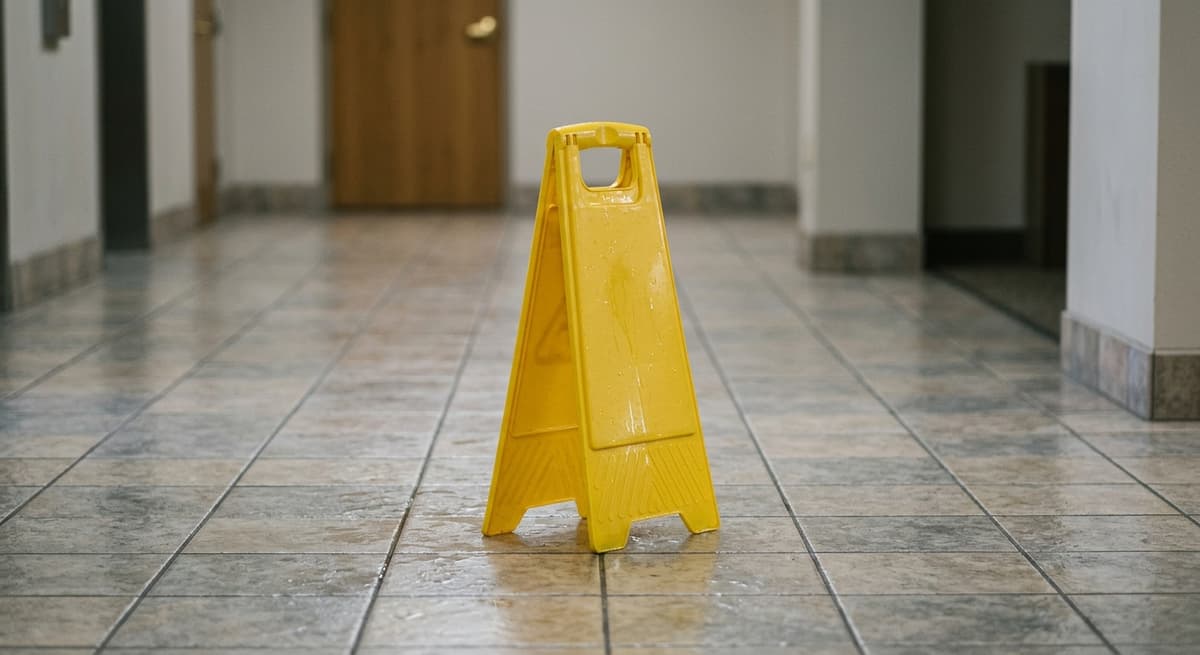
Under the slight/gross rule, an injured plaintiff may recover damages only if their own negligence was "slight" compared with the defendant's negligence. If a jury determines the plaintiff's fault was more than slight, recovery is barred entirely. There is no fixed percentage in the statute: the jury characterizes the relative fault as slight or otherwise as a qualitative judgment, not a numerical one.
A 1998 amendment makes this rule more opaque in practice: the jury is not permitted to hear the plaintiff's percentage of fault during deliberations. The jury simply decides whether the plaintiff's fault was slight or not, then reduces damages proportionally if they find it was slight. This means even what might seem like a small degree of shared blame, such as glancing at a phone or wearing flip-flops in an icy parking lot, could be characterized as more than slight depending on the jury's view of the overall picture.
The practical takeaway is that any meaningful fault on your part poses a serious risk to the entire claim under South Dakota's unusual system. This is considerably more restrictive than the 50-percent or 51-percent threshold used in most comparative-fault states.
Deadlines: statute of limitations and government claims
South Dakota's personal injury statute of limitations is 3 years under SDCL 15-2-14(3). The clock begins running from the date the cause of action accrued, which is ordinarily the date of the fall. You can review how South Dakota's deadlines compare to other states on the South Dakota statute of limitations page.
Government property falls carry a separate and much earlier deadline that operates independently of the 3-year lawsuit window. Under SDCL 3-21-2, no action for personal injury caused by a public entity or its employees may proceed unless the injured person gave written notice of the time, place, and cause of the injury within 180 days after the injury occurred. Missing this notice deadline is an independent bar: even if the 3-year SOL has not expired, a failure to give timely notice will defeat the claim.
Under SDCL 3-21-3, the notice must be given to the correct officer: the attorney general for the State of South Dakota; the auditor or clerk for a county, township, road district, or school district; the city finance officer or mayor for a municipality; and otherwise to an officer who could be served with process. A written notice that goes to the wrong officer does not satisfy the requirement.
If your fall happened on a city sidewalk, a public school parking lot, or any other government-owned property, the 180-day notice deadline is the first, non-negotiable clock to protect.
What a South Dakota slip and fall claim is worth
A successful slip and fall claim in South Dakota can include both economic and non-economic damages. Economic damages cover your calculable financial losses: past and future medical bills, lost wages, reduced earning capacity, and out-of-pocket expenses tied to your injury and recovery.
Non-economic damages compensate for the less tangible harms: physical pain and suffering, emotional distress, loss of enjoyment of life, and permanent disability or disfigurement. South Dakota does not impose a general cap on non-economic damages in private premises liability cases.
Your recovery is reduced proportionally if a jury finds your fault was slight compared with the defendant's. If a jury finds your fault was more than slight under the slight/gross rule, you recover nothing. The open-and-obvious doctrine operates as an earlier gate: if the hazard was obvious and no distraction or compulsion exception applies, the owner may owe no duty at all.
To get a rough sense of potential value ranges, use our South Dakota slip and fall settlement calculator.
This article is general legal information, not legal advice. Premises liability law varies by state and changes, and case values depend on the specific facts. For advice about a specific fall, consult a licensed attorney in South Dakota.
Explore more on the slip and fall laws hub or see how other states compare. For a rough estimate of your claim's potential value, visit the South Dakota slip and fall settlement calculator.
More South Dakota Laws
Frequently Asked Questions
How do I prove a slip and fall in South Dakota?
You must show the property owner owed you a duty of reasonable care, that a hazardous condition existed on the premises, that the owner had actual or constructive notice of the hazard and failed to address it, and that the hazard directly caused your injury. Document the scene immediately with photographs, preserve the footwear you were wearing, and gather contact information for any witnesses. The open-and-obvious nature of the hazard and your own conduct are both likely to be examined closely under South Dakota's doctrine.
Is South Dakota an open-and-obvious state?
Yes. South Dakota treats open-and-obvious as a duty bar. Under Restatement (Second) of Torts section 343A, adopted in Stenholtz v. Modica and applied in Janis v. Nash Finch Co. (2010 S.D. 27), a landowner is not liable for injury from an obvious hazard unless it should have anticipated harm despite the obviousness. This is not just a fault factor that reduces your recovery; it can eliminate the owner's duty entirely. However, if circumstances show the owner should have anticipated you would encounter the hazard (distraction, forced path, etc.), the duty revives.
Can I sue for falling on ice in South Dakota?
Yes. South Dakota does not follow the natural-accumulation no-duty rule. Landowners owe an ordinary reasonable-care duty that extends to naturally accumulated ice and snow, including black ice in parking areas. The question is whether the owner used reasonable care to inspect the premises and address or warn of the hazard within a reasonable time. This duty is non-delegable, so hiring a snow-removal contractor does not by itself shield the owner from liability.
How long do I have to file a slip and fall lawsuit in South Dakota?
You have 3 years from the date of your injury under SDCL 15-2-14(3). But if your fall occurred on government property (a city sidewalk, public school, state building), you must give written notice to the correct public officer within 180 days of the injury under SDCL 3-21-2. Missing that 180-day notice deadline bars the claim regardless of how much time remains on the 3-year SOL.
Can I recover if I was partly at fault for my fall in South Dakota?
Only if your fault was 'slight' compared with the defendant's under SDCL 20-9-2, South Dakota's distinctive slight/gross comparative negligence rule. If a jury concludes your fault was more than slight, you recover nothing; there is no fixed percentage cutoff. South Dakota is the only state using this system. Even conduct that might seem minor, such as being distracted or wearing improper footwear, could tip the characterization against you.
How much is a South Dakota slip and fall claim worth?
It depends on your medical costs, lost wages, long-term disability, and the severity of your pain and suffering. South Dakota has no general cap on non-economic damages in private premises liability cases. However, the slight/gross negligence rule can reduce or eliminate your recovery if you share any meaningful fault, and the open-and-obvious doctrine can eliminate the owner's duty entirely if the hazard was apparent. Use our slip and fall settlement calculator for a rough estimate based on your specific numbers.
Injured in South Dakota? Get a free case review from a personal-injury attorney
If someone else's negligence caused your injury, you may be owed compensation for medical bills, lost wages, and pain and suffering. Get a free, no-obligation review from a South Dakota personal-injury attorney. Most work on contingency, so there is no upfront cost.
Sources and References
- SDCL 3-21-2 (public-entity notice of claim, 180 days)(sdlegislature.gov).gov
- SDCL 3-21-3 (designated officers for notice of claim)(sdlegislature.gov).gov
- SDCL 20-9-2 (slight/gross comparative negligence)(sdlegislature.gov).gov
- SDCL 15-2-14(3) (3-year personal injury statute of limitations)(sdlegislature.gov).gov