
United Kingdom
High Hedges and Overhanging Trees: UK Neighbour Law Explained
Independently fact-checked against primary sources (last audited September 29, 2026). · Law checked current as of September 29, 2026. · 9 primary sources cited on this page. How we verify our legal content
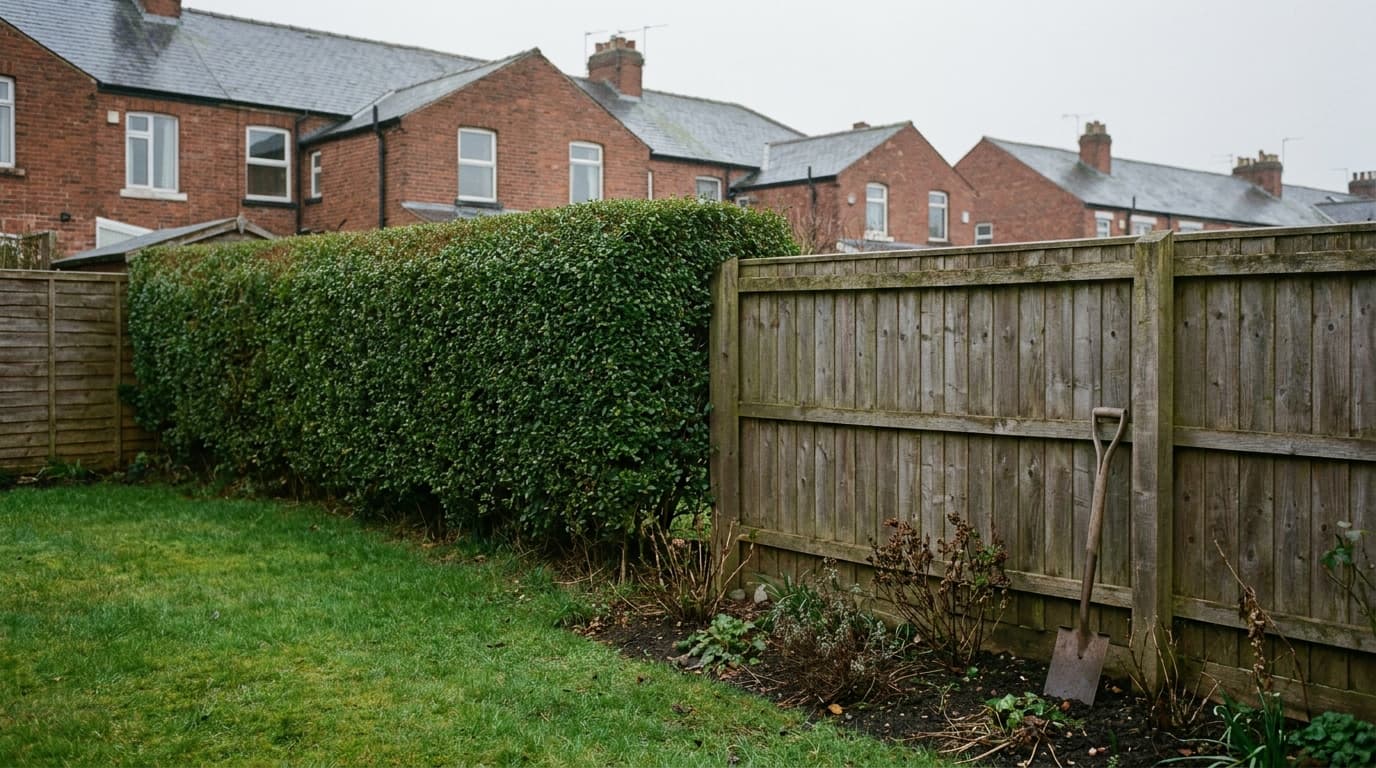
A hedge that blocks your light is not automatically something you can force your neighbour to cut down, and a branch hanging over your fence is not something you need permission to trim. UK law treats high hedges, overhanging branches, and protected trees as three separate problems, each with its own process. This guide explains all three, and where Scotland and Northern Ireland part ways from England and Wales.
High Hedges: The Anti-social Behaviour Act 2003
In England and Wales, complaints about a hedge blocking light or access are handled under Part 8 of the Anti-social Behaviour Act 2003, not through the courts as a first step. The Act defines a "high hedge" quite specifically: it must be formed wholly or mostly of a line of two or more evergreen or semi-evergreen trees or shrubs, and it must rise to more than 2 metres above ground level. A single tree, however large, does not qualify on its own, and neither does a hedge of deciduous plants that lose their leaves in winter.
The complaint has to be about the hedge's effect on the reasonable enjoyment of a domestic property, most commonly a loss of light, though the Act is also engaged where a hedge blocks access. Purely aesthetic objections to a hedge, or a dispute involving a business premises rather than a home, generally fall outside this scheme.
Before You Complain: Try to Resolve It Directly
Councils will not normally accept a high hedge complaint unless you can show that you have already tried to sort the problem out directly with your neighbour, and that this has failed or your neighbour has not engaged with it. This is a genuine gatekeeping requirement, not just good practice. A complaint that looks like it has skipped straight past a conversation with the neighbour can be rejected without a full investigation. Keep a written record, letters, emails, or notes of conversations, showing what you raised and when.

Making a Formal Complaint to the Council
If direct discussion does not resolve things, you can make a formal written complaint to your local council, usually using a specific high hedge complaint form. You will typically need to describe the hedge's position, height, and type, and set out the specific way it affects your property's reasonable enjoyment.
Councils are entitled to charge a fee for investigating a high hedge complaint, and this fee is not usually refunded even if your complaint succeeds, though reduced fees may be available for people on low incomes. Once a complaint is accepted, the council will gather evidence, which can include a site visit and speaking to other affected neighbours, before deciding whether the hedge is having an unreasonable effect on your enjoyment of your property.
What the Council Can (and Cannot) Order
If the council upholds a complaint, it issues a remedial notice to the hedge owner setting out what work must be done and by when. Importantly, the council's powers are limited by design: a remedial notice cannot require the hedge to be reduced below 2 metres, and it cannot require the hedge to be removed altogether. The aim of the scheme is to restore reasonable enjoyment of light or access, not to let a neighbour dictate that a hedge disappears completely.
Failing to comply with a remedial notice without a reasonable excuse is an offence. Either the complainant or the hedge owner can appeal the council's decision, generally within 28 days, with appeals in England decided by the Planning Inspectorate on the Secretary of State's behalf, and in Wales by the Welsh Government.
Scotland and Northern Ireland: Separate High Hedges Laws
The high hedges scheme described above is an England and Wales creation. Scotland has its own, separate statute, the High Hedges (Scotland) Act 2013, and Northern Ireland has its own High Hedges Act (Northern Ireland) 2011. Both follow a broadly similar shape: a high hedge is defined by reference to a 2-metre threshold and a barrier to light, direct resolution is expected first, and the local authority handles formal complaints. They are, however, legally distinct Acts, so do not assume a decision, a piece of guidance, or a procedural detail under the England and Wales scheme applies north or west of the border. If your hedge dispute is in Scotland or Northern Ireland, check the guidance for the relevant Act rather than the 2003 Act.

Overhanging Branches and Roots: Your Right of Self-Help
A hedge that is not "high" under the statutory definition, or a single overhanging tree, is not covered by the high hedges scheme at all. Instead, common law gives you a long-standing right of self-help for overhanging branches and intruding roots, established in the House of Lords case Lemmon v Webb [1895] AC 1.
The core rule is straightforward: you can cut back branches, and roots, that cross the boundary onto your land, back to the boundary line itself, from your own side. You do not need the tree owner's permission, and you do not have to give them advance notice before doing so, although notice is generally good practice and can help avoid an unnecessary argument.
There are important limits. You cannot go onto the neighbour's land to do the work, and you cannot cut back beyond the boundary line into the body of the tree itself. Anything you remove, branches, fruit, or timber, technically remains the tree owner's property, and the sensible approach is to offer it back to them rather than simply disposing of it or keeping it. You also cannot carry out work that would kill or seriously damage the tree; abatement is about restoring your own boundary, not punishing the tree owner or destroying their property.
Tree Preservation Orders and Conservation Areas
Before you reach for the loppers, check whether the tree is protected. Under the Town and Country Planning Act 1990, a council can protect an individual tree, a group of trees, or an area of woodland with a Tree Preservation Order. Cutting down, uprooting, wilfully damaging, or topping and lopping a protected tree in a way likely to destroy it, without the council's consent, is a criminal offence under section 210, punishable by an unlimited fine whether the case is heard in the magistrates' court or the Crown Court, and a court must take into account any financial benefit the offender gained from the work. Any other work that breaches a Tree Preservation Order, such as pruning without consent in a way not likely to destroy the tree, is a separate offence under section 210(4), with a fine of up to level 4 on the standard scale.
Even without an individual Tree Preservation Order, a tree standing in a conservation area gets a lighter form of protection under section 211: anyone intending to carry out work on it generally has to give the local planning authority six weeks' written notice first. If the authority does not object, or issue a Tree Preservation Order, within that six-week window, the work can then go ahead.
This means your right to cut back overhanging branches from your own side of the boundary can still be constrained if the tree is protected. It is worth checking with the council before doing more than light, routine pruning of anything that looks like a mature or notable tree, particularly in a conservation area. Scotland and Northern Ireland run their own, separate planning Acts covering tree protection, rather than the Town and Country Planning Act 1990. In Wales, the Planning (Wales) Act 2026 re-enacts tree preservation orders and conservation-area tree protection, but as of late September 2026 those provisions had not been brought into force; until the Welsh Ministers commence them, the 1990 Act continues to apply in Wales.
There Is No General "Right to Light" for Gardens or Trees
People sometimes assume that a hedge or tree blocking sunlight from a garden must be some kind of legal wrong in itself, similar to blocking a window. It is not. A right to light in English law is a narrow property right, an easement, that attaches only to a defined opening in a building, typically a window or skylight, and can be acquired after 20 years of uninterrupted enjoyment of light through that specific opening.

There is no equivalent right protecting a garden, patio, or open outdoor space from being overshadowed by a neighbour's hedge or tree. If a hedge is blocking light to your garden rather than a window, your route is the high hedges scheme described above, not a right to light claim, and a single overhanging tree that is not part of a qualifying hedge may have no direct statutory remedy for the light it blocks at all.
This article is general information about high hedges and tree disputes in the United Kingdom, not legal advice, and focuses on England and Wales unless stated otherwise. For related neighbour disputes, see noise complaints and boundary disputes, or return to the UK Property Law hub.
Frequently Asked Questions
How tall does a hedge have to be before I can complain to the council?
Under the Anti-social Behaviour Act 2003, a 'high hedge' must rise above 2 metres and be formed mostly of evergreen or semi-evergreen trees or shrubs in a line of two or more.
Can the council make my neighbour remove their hedge completely?
No. A council's remedial notice can require the hedge to be reduced, generally to around 2 metres, but it cannot require the hedge to be cut below 2 metres or removed entirely.
Do I need my neighbour's permission to cut back branches overhanging my garden?
Generally no. Under the common-law right established in Lemmon v Webb, you can cut back overhanging branches and roots to the boundary line from your own side, without permission or advance notice, provided the tree is not protected by a Tree Preservation Order or in a conservation area.
What should I do with the branches after I cut them?
The cuttings remain the tree owner's property. The sensible approach is to offer them back to your neighbour rather than disposing of them or keeping them yourself.
Can I trim a tree that has a Tree Preservation Order on it?
Generally not without the council's consent, apart from narrow exceptions such as work strictly necessary to prevent or abate a legal nuisance. Damaging or destroying a protected tree without consent is a criminal offence, and even trees in a conservation area generally need six weeks' notice to the council before work begins.
Does high hedges law apply the same way in Scotland and Northern Ireland?
No. Scotland has its own High Hedges (Scotland) Act 2013 and Northern Ireland its own High Hedges Act (Northern Ireland) 2011, both separate from the England and Wales scheme under the 2003 Act.
Can I complain that a tree is blocking sunlight to my garden?
Not under right to light law, which only protects defined openings like windows in buildings, not gardens. If a qualifying hedge is the cause, the high hedges scheme may apply; a single tree blocking a garden generally has no equivalent statutory remedy.
Updates
We clarified that unauthorised pruning of a protected tree is a separate offence under section 210(4), that the section 210(1) fine is unlimited in either court, that a narrow nuisance-abatement exemption exists, and that the Planning (Wales) Act 2026 will replace the tree rules in Wales once commenced.
Independently fact-checked against the cited primary sources; governing law re-checked for recent changes
The Law Behind This Article
This article rests on the statutory provisions below, held in our own legal record and retrieved from the official source. Tap a section to read the operative text.
Town and Country Planning Act 1990
s. 210Penalties for non-compliance with tree preservation order regulations .In force
(1) If any person, in contravention of a tree preservation order tree preservation regulations — (a) cuts down, uproots or wilfully destroys a tree, or (b) wilfully damages, tops or lops a tree in such a manner as to be likely to destroy it, or (c) causes or permits the carrying out of any of the activities in paragraph (a) or (b), he shall be guilty of an offence. (2) A person guilty of an offence under subsection (1) shall be liable on summary conviction, or on conviction on indictment, to a fine . (3) In determining the amount of any fine to be imposed on a person convicted . . . of an offence under subsection (1), the court shall in particular have regard to any financial benefit which has accrued or appears likely to accrue to him in consequence of the offence. (4) If any person contravenes the provisions of a tree preservation order tree preservation regulations otherwise than as mentioned in subsection (1), he shall be guilty of an offence and liable on summary conviction to a fine not exceeding level 4 on the standard scale.
Official text (excerpt) · last checked 2026-08-14 · Read the full text in our law library · Verify at legislation.gov.uk
s. 211Preservation of trees in conservation areas.In force
(1) Subject to the provisions of this section and section 212, any person who, in relation to a tree to which this section applies, does any act which might by virtue of section 198(3)(a) be prohibited by a tree preservation order which might by virtue of section 202C be prohibited by tree preservation regulations shall be guilty of an offence. (1A) Subsection (1) does not apply so far as the act in question is authorised by an order granting development consent or by infrastructure consent order . (2) Subject to section 212, this section applies to any tree in a conservation area in respect of which no tree preservation order is for the time being in force. (3) It shall be a defence for a person charged with an offence under subsection (1) to prove— (a) that he served notice of his intention to do the act in question (with sufficient particulars to identify the tree) on the local planning authority in whose area the tree is or was situated;
Official text (excerpt) · last checked 2026-08-14 · Read the full text in our law library · Verify at legislation.gov.uk
Search our record of UK legislation — retrieved from legislation.gov.uk →
Sources and References
- Anti-social Behaviour Act 2003, Part 8 (high hedges)(legislation.gov.uk).gov
- gov.uk: High hedges - complaining to the council(gov.uk).gov
- Town and Country Planning Act 1990, section 210 (tree preservation order offences)(legislation.gov.uk).gov
- Town and Country Planning Act 1990, section 211 (trees in conservation areas)(legislation.gov.uk).gov
- High Hedges (Scotland) Act 2013(legislation.gov.uk).gov
- High Hedges Act (Northern Ireland) 2011(legislation.gov.uk).gov
- HM Land Registry Practice Guide 62A: rights to light or air(gov.uk).gov
- Town and Country Planning (Tree Preservation)(England) Regulations 2012, regulation 14: Exceptions(legislation.gov.uk).gov
- Planning (Wales) Act 2026, section 409: Coming into force(legislation.gov.uk).gov