
Maine
Maine Window Tint Laws (2026): Legal VLT Limits
Independently fact-checked against primary sources (last audited August 18, 2026). · Reviewed by the RecordingLaw editorial team. · Law checked current as of August 18, 2026. · 1 primary source cited on this page. How we verify our legal content

In Maine, front side windows must allow at least 35% visible light transmission (VLT) through the combined film and glass. Rear side windows and the rear window may be any darkness, provided the vehicle has outside mirrors on both sides.
What is the legal tint limit in Maine?
Maine's tint law is set out in 29-A M.R.S. 1916. The front side windows (the windows next to the driver and front passenger) must allow at least 35% VLT through the combined film and glass together. A higher VLT percentage means lighter tint; a lower VLT percentage means darker tint. So 35% is moderately dark, not the darkest you can go, but a firm legal floor.
The windows behind the driver have a much more permissive rule. Rear side windows and the rear window may be tinted to any darkness as long as the vehicle is equipped with outside mirrors on both sides. Those dual mirrors substitute for visibility through the darkened rear glass.
| Window | VLT Minimum |
|---|---|
| Front side windows | 35% (film + glass combined) |
| Rear side windows | Any darkness (dual outside mirrors required) |
| Rear window | Any darkness (dual outside mirrors required) |
| Windshield | Strip above the AS-1 line, or the top 5 inches if there is no AS-1 line |
There is no sedan vs. SUV/multipurpose vehicle distinction in Maine for the rear windows. The dual-mirror requirement applies to all vehicle types alike.
Film VLT vs. combined VLT: the number that counts
A film sold as "35% VLT" transmits 35% of visible light through the film itself in isolation. That is not the number Maine law enforces. Maine measures the combined VLT, meaning the light that passes through both the aftermarket film and the factory glass together.
Factory side glass on most production vehicles reads between 70% and 80% VLT. To find the expected combined reading, multiply the film VLT by the glass VLT. For example: a 35% film over 75% factory glass yields about 26% combined (0.35 x 0.75 = 0.263), which is below Maine's 35% front-window minimum and would fail.
To reliably reach 35% combined on 75% glass, you need a film rated approximately 47% or higher (0.47 x 0.75 = 0.353). On glass that reads 80%, a film rated around 44% would clear the threshold (0.44 x 0.80 = 0.352). Because Maine does not specify a measurement tolerance, there is no statutory buffer between a passing and failing reading. A calibrated meter reading of 34% on a front side window is a violation.
Ask your installer to measure your factory glass before selecting a film. A reputable shop will use a dedicated VLT meter for this step. The resulting film choice, and the light-transmittance certificate documenting it, will keep you compliant at the annual inspection.
How enforcement works: the VLT meter
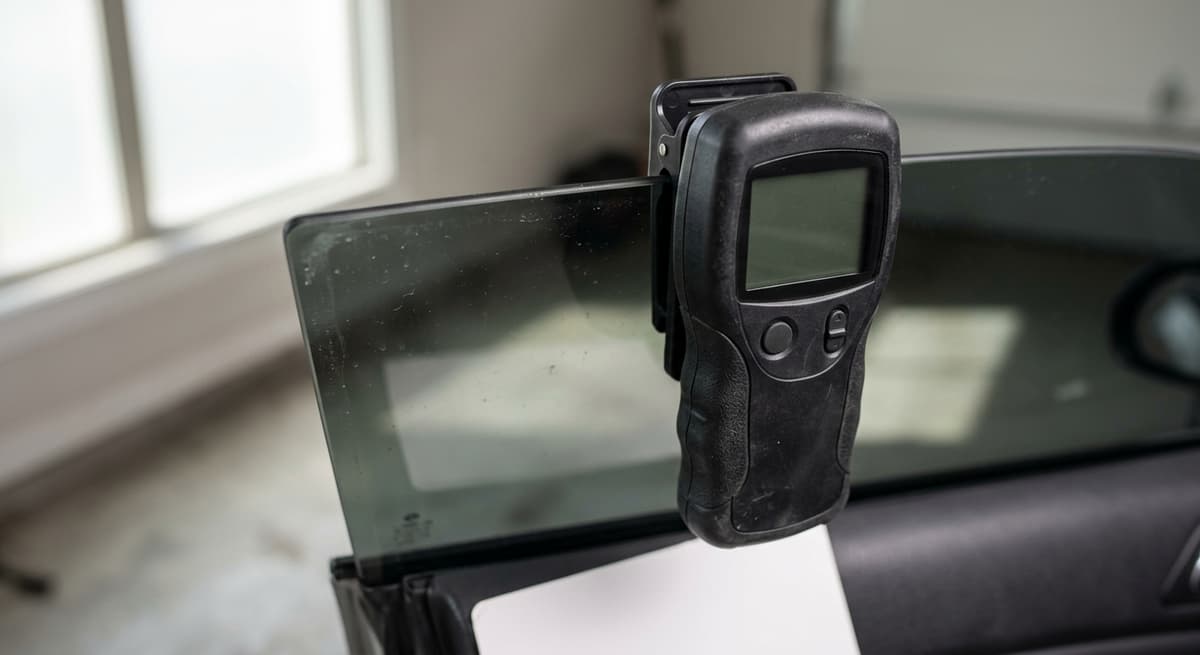
Law enforcement officers and inspection mechanics measure window tint with a handheld VLT meter. The device clamps across the window edge and passes a calibrated light beam through the glass; the display shows the percentage of light that gets through the combined window. A reading at or above 35% on the front side windows means the vehicle passes. A reading below 35% is a violation of 29-A M.R.S. 1916.
Maine does not publish a measurement tolerance in the statute. Some states allow a plus-or-minus 3% margin before a citation is issued, but Maine provides no such cushion in writing. Practically, officers exercise some discretion on borderline readings, but the prudent approach is to aim for a combined reading of 38% or higher to provide your own margin against meter calibration drift, glass aging, or tint darkening over time.
Rear side windows and the rear window have no VLT minimum, so officers do not need to meter those as long as the vehicle has dual outside mirrors.
Windshield tint rules in Maine
Maine permits tint on the windshield only in the uppermost strip: above the AS-1 line (the line marked on your windshield by the manufacturer) or, if your windshield carries no AS-1 line, within the top 5 inches. The full windshield below that strip must remain clear.
Reflective material is prohibited on vehicle windows under 29-A M.R.S. 1916(1)(A), so mirror-finish and highly metallic films are not allowed on the windows of a vehicle in Maine. That prohibition does not reach the permitted windshield strip itself. Section 1916(2)(A) exempts sun-screening or window-tinting material above the AS-1 line, or along the top 5-inch strip, from subsection 1 as a whole, and subsection 1 is where the reflective-material ban sits. The statute imposes no separate reflectivity condition on that strip.
No specific banned tint colors are called out under the Maine statute beyond the general reflective-material prohibition.
Medical exemptions
Maine does provide a medical exception process. Under 29-A M.R.S. 1916(2)(A)(4), the Chief of the Maine State Police may grant an exception for a motor vehicle because the health of the owner, or of a person who usually occupies that vehicle, is adversely affected by sunlight. Conditions that commonly form the basis of such a request include lupus, xeroderma pigmentosum, albinism, photosensitivity disorders, and severe post-surgical eye conditions.

To apply, contact Maine State Police and request the exemption process. You will need documentation from a licensed physician establishing the medical necessity, including the specific diagnosis and the recommended level of light reduction. Once the Chief issues the certificate, keep it in the vehicle at all times. If you are stopped or questioned, produce the certificate; it authorizes the darker film that would otherwise violate the 35% front-window rule.
The exception is granted for a particular motor vehicle, not issued as a personal permit that follows a driver from car to car. The statute directs the Chief to provide the certificate of exemption to the owner of the motor vehicle, and it must be displayed at the request of a law enforcement officer. The statute does not address what happens to an existing exception when a vehicle is sold, so if you change vehicles, contact Maine State Police about an exception for the new one.
Inspection certificate requirement
Maine does not require a permanent compliance sticker affixed between the film and the glass, unlike some states. The light-transmittance certificate is narrower than it is often described. Under 29-A M.R.S. 1916(3), the requirement falls on the owner or operator of a motor vehicle with tinted windows that are not replaced in accordance with Federal Motor Vehicle Safety Standard 205, or with windows covered by or treated with tinting material. Those owners must acquire a light-transmittance certificate and show it to the inspection mechanic at the time of inspection. A vehicle whose only tint is its original FMVSS 205 factory glazing does not need one; a vehicle carrying aftermarket film does. The certificate is typically issued by the installer and documents the specific film used, its standalone VLT rating, and the calculated or measured combined VLT with the vehicle's factory glass.
Keep this certificate in your glove box permanently. If you sell the vehicle, pass the certificate to the buyer so they can produce it at the next inspection. If you lose the certificate, contact your installer for a replacement or have the windows re-measured by a shop that can issue a new one.
Penalties for illegal tint in Maine
Driving with window tint that does not comply with 29-A M.R.S. 1916 is a traffic infraction in Maine. The penalty is a forfeiture of at least $100. Unlike some states, Maine does not classify tint violations as misdemeanors, but the infraction still shows up on your driving record and you may be required to remove the non-compliant film before the vehicle can pass its next inspection.
Officers may stop a vehicle if the front side windows appear to violate the 35% VLT rule. The clearest way to avoid a citation is to have your installer verify the combined VLT reading and to carry the light-transmittance certificate in the vehicle.
If you want to tint your windows in Maine
If you plan to add aftermarket film to your vehicle in Maine, follow these steps to stay on the right side of the law.
First, confirm your front side window target. The 35% minimum applies to the film and the factory glass combined. Most factory glass reads somewhere between 70% and 80% VLT, and the film you need depends on where in that range your own glass falls. Divide 35 by your measured glass VLT to get the minimum film rating: glass at 70% needs a film of about 50% or higher, glass at 75% needs about 47%, and glass at 80% needs about 44%. A 44% film is only sufficient on glass near 80%. Over 70% glass that same film lands at roughly 31% combined (0.44 x 0.70 = 0.308), which fails. Ask your installer to measure your specific glass before cutting film.
Second, get the light-transmittance certificate from your installer before you leave the shop. Maine requires it at inspection. Keep it in your glove box permanently.
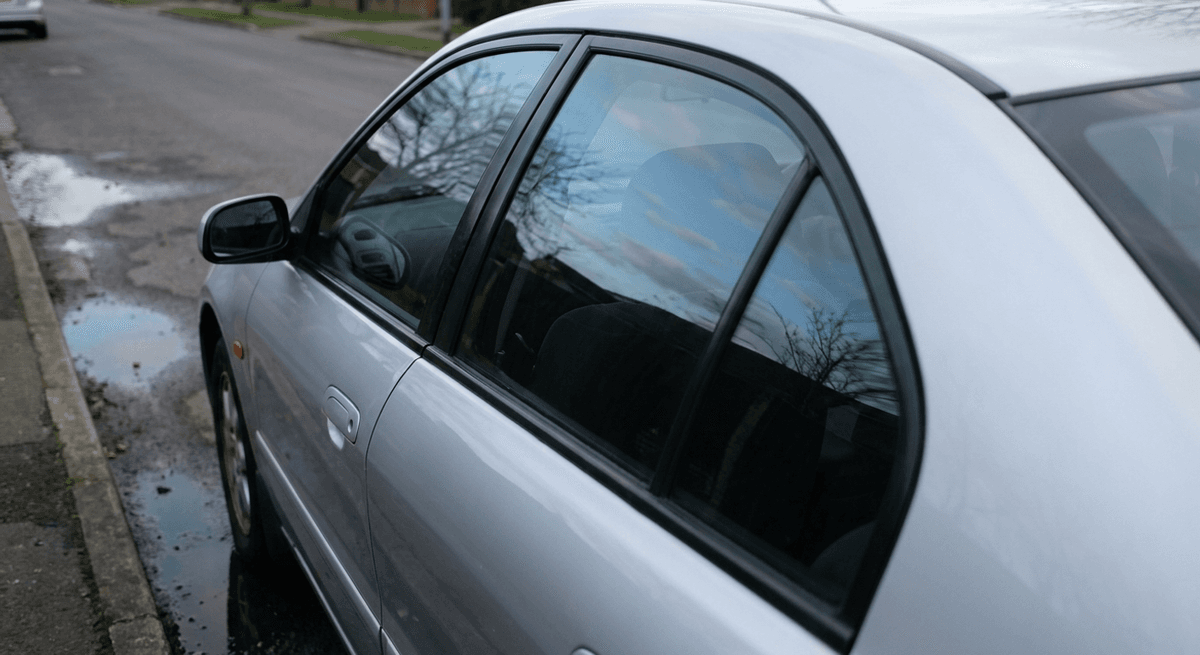
Third, if you want to go darker on the rear side windows or rear window, you are free to choose any darkness provided you have outside mirrors on both sides of the vehicle. Most passenger cars already have factory-fitted dual mirrors, but confirm yours are properly adjusted and not damaged.
Fourth, if you have a qualifying medical condition, contact Maine State Police to apply for an exemption certificate before having the tint applied. Having the paperwork in place first prevents any dispute during a stop.
This article is general legal information, not legal advice. Window tint limits vary by state and change, and enforcement depends on local practice and your specific vehicle. For a definitive answer, check your state DMV or consult a local attorney.
Related pages:
- Window Tint Laws by State (hub)
- Maine Windshield Mounting Restrictions: /us-laws/windshield-mounting-restrictions/maine-windshield-mounting-laws
More Maine Laws
Frequently Asked Questions
What is the legal tint in Maine?
Maine requires front side windows to allow at least 35% visible light transmission (VLT) through the combined film and glass. Rear side windows and the rear window may be any darkness if the vehicle has dual outside mirrors on both sides.
How dark can my front windows be in Maine?
The darkest legal front side window tint in Maine is 35% VLT measured through the film and glass together. Going below 35% on the front side windows violates 29-A M.R.S. 1916 and can result in a traffic infraction and at least a $100 fine.
Is 20% tint legal in Maine?
Not on the front side windows. A 20% VLT film on the front side windows would almost certainly push the combined reading below Maine's 35% minimum. It is, however, legal on the rear side windows and rear window as long as you have dual outside mirrors.
Can I get a medical exemption for window tint in Maine?
Yes. Under 29-A M.R.S. 1916(2)(A)(4) the Chief of the Maine State Police may grant an exception for a motor vehicle because the health of the owner, or of a person who usually occupies it, is adversely affected by sunlight, and may provide the owner with a certificate of exemption. The exception is granted for that vehicle, so keep the certificate in it and display it when a law enforcement officer asks.
What is the penalty for illegal tint in Maine?
Illegal window tint in Maine is a traffic infraction carrying a forfeiture of at least $100. You may also be required to remove the non-compliant tint before your vehicle can pass its next inspection.
Is windshield tint legal in Maine?
Only in the top strip. Maine allows tint above the AS-1 line or, if the windshield has no AS-1 line, within the top 5 inches. No tint is permitted on the main viewing area of the windshield below that strip. Section 1916(2)(A) exempts that strip material from subsection 1 in full, so the statute sets no separate reflectivity condition on it.
Do SUVs have different tint rules in Maine?
No. Maine does not distinguish between sedans and SUVs or multipurpose vehicles. The 35% VLT rule applies to front side windows for all vehicle types, and rear windows may be any darkness for all vehicles as long as dual outside mirrors are present.
What is the difference between film VLT and combined VLT in Maine?
Film VLT is the light-transmittance rating of the aftermarket film alone. Combined VLT is what you get after the film is applied over the factory glass, and it is the combined reading that Maine law measures. Multiply the film VLT by the factory glass VLT to estimate the combined result. A 35% film over typical 75% factory glass produces about 26% combined, which would fail Maine's 35% front-window minimum.
Do I need a sticker for tinted windows in Maine?
Maine does not require a compliance sticker between the film and the glass. Under 29-A M.R.S. 1916(3), a light-transmittance certificate is required only for a vehicle with tinted windows that were not replaced in accordance with Federal Motor Vehicle Safety Standard 205, or with windows covered by or treated with tinting material. If you have aftermarket film, get the certificate from your installer, keep it in the vehicle, and show it to the inspection mechanic. A vehicle with only its original factory glazing does not need one.
Updates
Corrected the medical exception (it is granted for a specific vehicle under 29-A M.R.S. 1916(2)(A)(4), not tied to a named individual), removed an unsupported non-reflective requirement on the permitted windshield strip, scoped the light-transmittance certificate to aftermarket film and non-FMVSS 205 replacement glass as section 1916(3) provides, and fixed film-selection guidance that recommended a 44% film across a 70-80% glass range where it would fail the 35% combined minimum.
Corrected the statute citation's descriptive label to match its actual section heading.
Independently fact-checked against the cited primary sources; governing law re-checked for recent changes
Governing law re-checked for recent changes
Reviewed and approved by an editor
The Law Behind This Article
This article rests on the statutory provisions below, held in our own legal record and retrieved from the official source. Tap a section to read the operative text.
Maine Revised Statutes, Title 29-A: MOTOR VEHICLES AND TRAFFIC, Chapter 17: EQUIPMENT
§ 1916Reflective and tinted glassIn forcecited in 3 of our articles
1. Windows to be unobscured. A person may not operate a motor vehicle required to be registered in this State and an inspection mechanic may not issue a certificate of inspection for a motor vehicle, if: A. A window is composed of, covered by or treated with any material that is reflective; [PL 1993, c. 683, Pt. A, §2 (NEW); PL 1993, c. 683, Pt. B, §5 (AFF).] B. The front windshield is composed of, covered by or treated with a material that reduces the light transmittance through the window more than the original installation window or an original replacement window; [PL 1993, c. 683, Pt. A, §2 (NEW); PL 1993, c. 683, Pt. B, §5 (AFF).] C. A side window or rear window is composed of, covered by or treated with a material that allows a light transmittance of less than 35% net of glass and material; or [PL 2007, c. 186, §1 (AMD).] D. A front windshield, front door window or window at either end of a rear passenger seat does not contain 2-way glass that provides the occupants with a clear view of the road and a person outside the vehicle with a clear view of the occupants and the interior of the vehicle. [PL 1993, c. 683, Pt. A, §2 (NEW); PL 1993, c. 683, Pt. B, §5 (AFF).] 2.
Official text (excerpt) · last checked 2026-09-01 · Read the full text in our law library · Verify at legislature.maine.gov
Also relied on in: Maine Dashcam Laws: Mounting Rules, Audio Recording, and Evidence (2026), Maine Windshield Mounting Laws (2026 Guide)
Search our full record of US law — 2.1 million sections, every state + federal →
Sources and References
- Maine Legislature, 29-A M.R.S. 1916 (Reflective and Tinted Glass)(legislature.maine.gov).gov