
Kentucky
Kentucky Window Tint Laws (2026): Legal VLT Limits
Independently fact-checked against primary sources (last audited August 18, 2026). · Reviewed by the RecordingLaw editorial team. · Law checked current as of August 18, 2026. · 1 primary source cited on this page. How we verify our legal content
Kentucky law requires front side windows to allow at least 35% of visible light through. Windows behind the driver must allow at least 18% VLT, but multipurpose passenger vehicles get a lower floor of 8% VLT on those windows.
What is the legal tint limit in Kentucky?
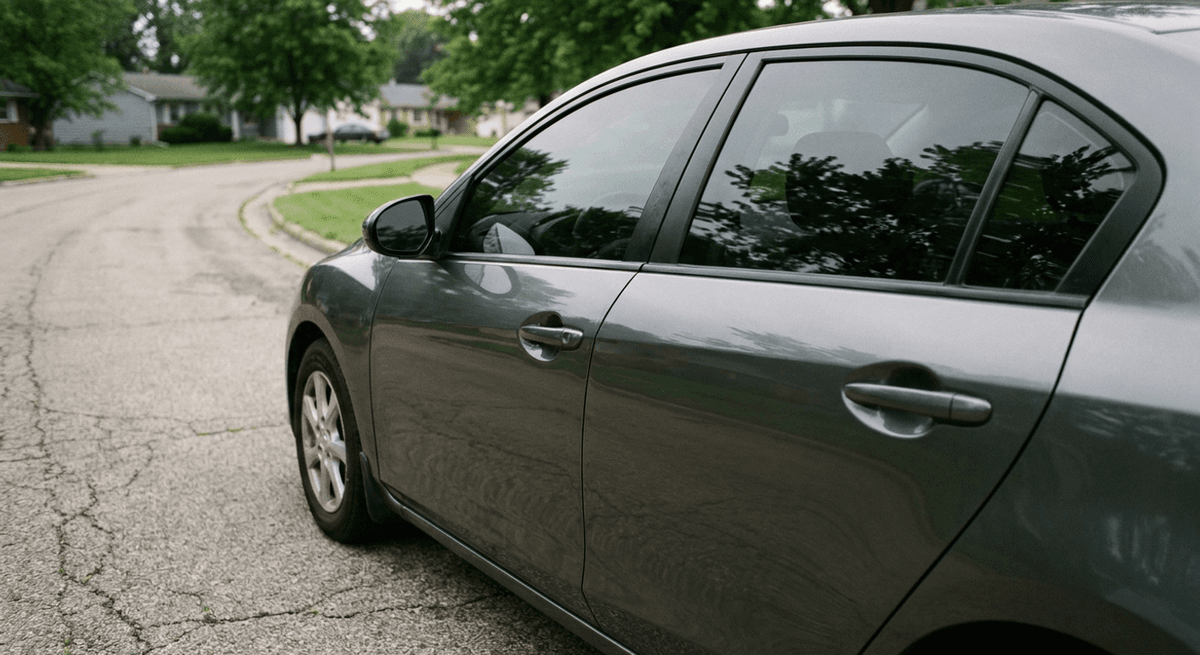
Kentucky's window tint law is set out in KRS 189.110. The front side windows on every vehicle must transmit at least 35% of visible light. A quick concept worth knowing before you go further: a higher VLT percentage means lighter tint, and a lower VLT percentage means darker tint. So 35% is a moderately dark shade, and anything below that number would be illegal on the front side windows.
Every window behind the driver requires a minimum of 18% VLT under KRS 189.110(4)(a). That is considerably darker than the front, giving drivers meaningful privacy and heat rejection in the rear. The same paragraph drops the floor to 8% VLT, but only on "multipurpose passenger vehicles." KRS 189.010 does not define that term, so it carries its federal meaning: 49 CFR 571.3 defines a multipurpose passenger vehicle as one built on a truck chassis or with special features for occasional off-road operation, which covers most SUVs and vans, and classifies a vehicle designed primarily to carry property as a "truck" instead. Because Kentucky has not defined the term itself, pickup owners should confirm their vehicle's classification before assuming the 8% floor rather than treating it as settled.
A separate rule in KRS 189.110(5) covers mirrors. Any vehicle required to be registered in the Commonwealth whose rear window is made nontransparent must be equipped with side mirrors on both sides. That requirement turns on the rear window alone, not on vehicle class or VLT tier, so a sedan with a nontransparent rear window is covered exactly as an SUV is.
| Window | Most vehicles | Multipurpose passenger vehicles |
|---|---|---|
| Front side windows | 35% VLT minimum | 35% VLT minimum |
| Back side windows | 18% VLT minimum | 8% VLT minimum |
| Rear window | 18% VLT minimum | 8% VLT minimum |
Windshield tint rules in Kentucky
Kentucky permits a strip of sunscreening material at the top of the windshield under KRS 189.110(2)(b), provided the material is transparent and does not encroach on the AS/1 portion of the windshield. The AS-1 line is a marking etched into most windshields near the top; on vehicles that do not have one, the top few inches serve as a practical guide. Kentucky also allows sunscreening material across the windshield's main viewing area below the AS-1 line under KRS 189.110(2)(c), but only if it transmits at least 70% of visible light and is not red or yellow in color.
Reflectivity is capped at 25% on front side windows and 35% on windows behind the driver, per KRS 189.110(3) and (4). The statute's color restriction (material must not be red or yellow) applies specifically to the windshield sunscreening option under KRS 189.110(2)(c); the side-window provisions do not include a color restriction.
Those reflectance caps do not reach the windshield. KRS 189.110(2)(b) requires only that the top strip be transparent, and (2)(c) requires only 70% light transmittance and a color that is not red or yellow, so the statute sets no reflectance limit on the windshield itself.
Medical exemptions
Kentucky drivers with a photosensitive condition such as lupus, albinism, or xeroderma pigmentosum sometimes seek a medical exemption for tint darker than the legal standard, but KRS 189.110 as currently in force does not contain a subsection establishing that process; KRS 189.110(5) is actually the rear-window dual-mirror requirement, not a medical exemption. Confirm current exemption procedures directly with Kentucky State Police before relying on one.
Because the statute creates no exemption, it also sets out no application, no certifying-physician form, and no document to carry in the vehicle. Treat any tint darker than the limits above as enforceable against you unless Kentucky State Police confirm an authority for an exemption that this section does not supply.
How tint is measured and certified
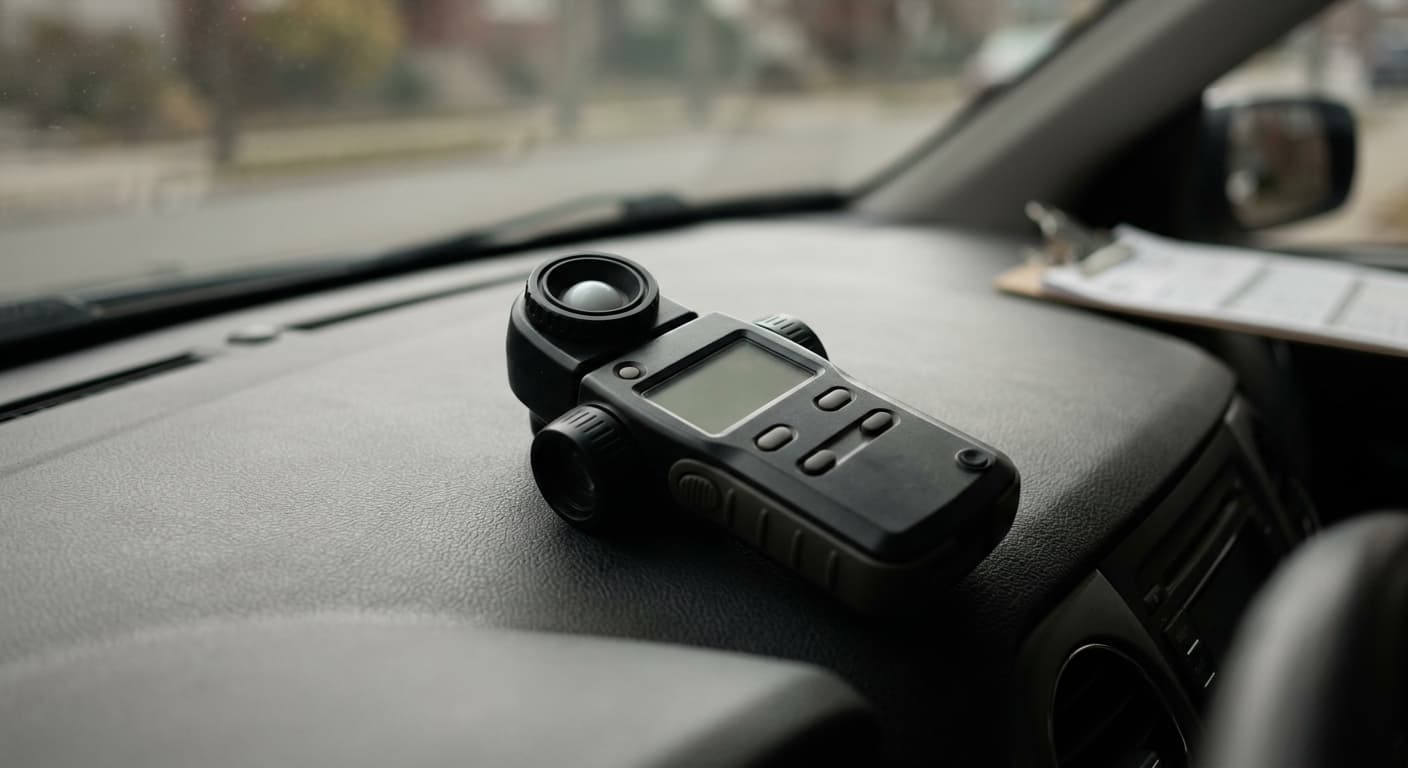
Kentucky law enforcement uses a VLT meter (also called a photometer or tint meter) during traffic stops and vehicle inspections to measure the percentage of visible light passing through a window. The legal tolerance is plus or minus 3%, so a window that reads between 32% and 38% on a meter would pass a 35% standard.

KRS 189.110(6) puts the labeling duty on the installer or seller, not on you. Each installer or seller must give the purchaser a nonremovable vinyl-type label stating that the material complies with the statute, listing the trade name of the film and the installer's or seller's business name, and each installer must affix that label to the inside left door jamb. Factory glazing that complies with Federal Motor Vehicle Safety Standard No. 205 needs no label at all. The label is still worth keeping intact as evidence of the film's rating, but nothing in the section makes its absence a citable offense against the driver.
When purchasing a vehicle with pre-existing tint, have a tint shop or law enforcement verify the readings before assuming the film is legal. Window film can shift in VLT over time as it ages or bubbles, and film applied out of state may not meet Kentucky's specific limits.
Penalties for illegal tint in Kentucky
Two different penalties apply, and which one you face depends on what you did. If you are simply driving a vehicle whose tint violates KRS 189.110, the penalty comes from KRS 189.990(1)(a), which lists 189.110 by number and sets a fine of not less than $20 and not more than $100 for each offense.
The Class B misdemeanor in KRS 189.110(9) is narrower. By its terms it reaches "a person who applies sunscreening materials in violation of this section," so it falls on whoever applied the film rather than on a motorist who bought the car already tinted. On conviction that carries a fine of up to $250 under KRS 534.040(2)(b) and a term of imprisonment of up to 90 days under KRS 532.090(2). KRS 534.040(1) makes the fine and the jail term non-exclusive, so a court may impose either or both.
KRS 189.110(8) separately bars installing tint below the minimum standards and requires that noncompliant material be removed immediately; the statute does not provide for a fixed correction window like a 10-day fix-it ticket.
Whether an officer gives you an informal opportunity to correct the tint before issuing a citation is a matter of discretion, not a codified option under KRS 189.110. In either case, you will still need to remove or replace the non-compliant film to avoid further enforcement.
A driver who tints their own windows can face both, since they are the operator and the applier. Having a licensed installer provide written documentation of the film's VLT protects you if compliance is ever questioned.
If you want to tint your windows in Kentucky
Start by choosing a VLT that meets the 35% minimum on front side windows. Many drivers select 35% film, which sits right at the legal floor and provides solid heat and glare reduction while staying within the meter tolerance. On the windows behind the driver, any film at 18% VLT or lighter is permitted on any vehicle. The 8% floor is available only on multipurpose passenger vehicles.
Choose a tint installer who knows Kentucky law and will place the required compliance sticker on the left door jamb. Ask for a written receipt or certificate listing the VLT of the film on each window and keep it in your glove box.
If you have a qualifying medical condition, talk to your physician and confirm current exemption procedures with Kentucky State Police before installation, since KRS 189.110 does not itself establish a medical-exemption process for tint darker than 35% on the front. If you are counting on the 8% floor, confirm in writing that your vehicle is a multipurpose passenger vehicle and which windows that covers, since the front side windows still require 35% on every vehicle.
This article is general legal information, not legal advice. Window tint limits vary by state and change, and enforcement depends on local practice and your specific vehicle. For a definitive answer, check your state DMV or consult a local attorney.
For the full national picture, see our Window Tint Laws by State hub. Kentucky drivers may also want to review Kentucky Windshield Mounting Restrictions for related vehicle equipment rules.
More Kentucky Laws
Frequently Asked Questions
What is the legal tint in Kentucky?
Kentucky requires front side windows to allow at least 35% visible light transmission (VLT) on all vehicles. Windows behind the driver require at least 18% VLT, though multipurpose passenger vehicles get a lower floor of 8% VLT under KRS 189.110(4)(a). Separately, any registered vehicle whose rear window is made nontransparent must have side mirrors on both sides, whatever its class.
How dark can my front windows be in Kentucky?
Your front side windows must transmit at least 35% of visible light. Film with a lower VLT number is not legal on front side windows. The meter tolerance is plus or minus 3%, so film reading at least 32% on a meter would still comply with the 35% standard.
Is 20% tint legal in Kentucky?
Not on front side windows. A 20% VLT is darker than the 35% minimum required for front side windows. Behind the driver it is legal on any vehicle: a higher VLT number means lighter film, so 20% transmits more light than the 18% floor in KRS 189.110(4)(a) and clears it. The film must also stay within the 35% reflectance cap, and if it makes the rear window nontransparent the vehicle needs side mirrors on both sides.
Can I get a medical exemption for window tint in Kentucky?
It is unclear. KRS 189.110(5) is actually the rear-window dual-mirror requirement, not a medical exemption, and no subsection of KRS 189.110 as currently in force establishes a medical-exemption process for photosensitive conditions. Confirm current procedures directly with Kentucky State Police before relying on one.
What is the penalty for illegal tint in Kentucky?
It depends on your role. A driver operating a vehicle with illegal tint is fined $20 to $100 per offense under KRS 189.990(1)(a), which lists KRS 189.110 by number. The Class B misdemeanor in KRS 189.110(9) applies to the person who applies the film, and on conviction carries up to $250 under KRS 534.040(2)(b) plus up to 90 days under KRS 532.090(2), which KRS 534.040(1) allows a court to impose together. KRS 189.110(8) requires noncompliant tint be removed immediately, and the statute provides no codified fix-it-ticket process.
Is windshield tint legal in Kentucky?
A strip of sunscreening material at the top is permitted under KRS 189.110(2)(b) if it is transparent and does not encroach on the AS/1 portion of the windshield. Kentucky also allows sunscreening material across the windshield's main viewing area if it transmits at least 70% of visible light and is not red or yellow. The statute sets no reflectance limit on the windshield; the 25% and 35% reflectance caps apply to the side windows and the windows behind the driver.
Do SUVs have different tint rules in Kentucky?
Multipurpose passenger vehicles get a lower floor of 8% VLT on the windows behind the driver, versus 18% on other vehicles. KRS 189.010 does not define that term, so it takes its federal meaning under 49 CFR 571.3, which covers vehicles built on a truck chassis or with special off-road features and classifies property-carrying vehicles separately as trucks. The 35% VLT minimum applies to front side windows on every vehicle type, and the both-sides mirror rule applies to any vehicle with a nontransparent rear window, not just to this class.
Updates
Corrected the Kentucky tint penalties to distinguish the driver's $20 to $100 fine under KRS 189.990(1)(a) from the Class B misdemeanor KRS 189.110(9) imposes on whoever applies the film, fixed an FAQ that wrongly called 20% tint illegal on a sedan's rear windows, removed an unsupported windshield reflectivity ban and a label duty the statute places on installers rather than drivers, and clarified that the 8% floor and the both-sides mirror rule follow the statute's own terms rather than a flat SUV-and-truck split.
Corrected the Kentucky window tint page's penalty section: KRS 189.110 has no 10-day fix-it-ticket process. It requires noncompliant tint be removed immediately (189.110(8)) and makes a violation a Class B misdemeanor (189.110(9)) carrying a fine of up to $250 under KRS 534.040(2)(b) plus court costs.
Independently fact-checked against the cited primary sources; governing law re-checked for recent changes
Corrected the windshield tint rule (KRS 189.110(2)(c) allows 70%+ VLT sunscreening below the AS-1 line, not a flat ban), the SUV/van/truck rear-window floor (8% VLT per KRS 189.110(4)(a), not any darkness), the color-ban scope (yellow, not amber, and windshield-only), and removed a mis-cited medical exemption (KRS 189.110(5) is the rear-window dual-mirror rule, not a medical exemption).
Governing law re-checked for recent changes
Reviewed and approved by an editor
The Law Behind This Article
This article rests on the statutory provisions below, held in our own legal record and retrieved from the official source. Tap a section to read the operative text.
Kentucky Revised Statutes, Chapter 189: TRAFFIC REGULATIONS -- VEHICLE EQUIPMENT AND STORAGE
§ 189.110Unobstructed windshields -- Display of American flag -- Windshield wipersIn forcecited in 3 of our articles
(1) A windshield in a fixed and upright position, that is equipped with safety glazing as required by federal safety-glazing material standards, is required on every motor vehicle which is operated on the public highways, roads, and streets, except on a motorcycle or implement of husbandry. (2) A person shall not operate a motor vehicle on a public highway, road, or street with any sign, sunscreening material, product, or covering attached to, or located in or upon the windshield, except the following: (a) A certificate or other paper required to be displayed by law; (b) Sunscreening material along a strip at the top of the windshield, if the material is transparent and does not encroach upon the driver's direct forward viewing area as defined in Federal Motor Vehicle Safety Standards No. 205 as the AS/1 portion of the windshield; or (c) Sunscreening material or other product or material applied to the windshield, when used in conjunction with the safety glazing materials of the windshield, if it has a light transmittance of not less than seventy percent (70%) and is not red or yellow in color.
Official text (excerpt) · last checked 2026-09-07 · Read the full text in our law library · Verify at apps.legislature.ky.gov
Cited in 6 court opinions in our collectionLatest citing opinion in our collection: 2023
In the courts (editorial summary, independently checked):Garcia v. Commonwealth (2006) held that KRS 189.110 governs sunscreening, tinting, safety glazing and wipers, and that a cracked windshield is not a violation of it, so it could not justify the stop. Fultz v. Commonwealth (2018) held the $100 fine for excessive window tinting under the statute was not subject to indigency waiver.
Opinions citing this section in our collection:
- Garcia v. Commonwealth (Court of Appeals of Kentucky 2006, 185 S.W.3d 658)✓A trooper cited a driver for a cracked windshield under the statute; the court held the statute covers tinting, safety glazing and wipers but says nothing about cracks, so a cracked windshield cannot violate it, and the marijuana had to be suppressed.
- Greer v. Commonwealth (Court of Appeals of Kentucky 2017, 514 S.W.3d 566)✓An officer stopped a car whose windows were dark enough that he could not make out the driver, citing the tint provision; though a grand jury refused to indict on it and the installer testified the tint complied, the court held his trained visual estimate supported the stop.
- Fultz v. Commonwealth (Court of Appeals of Kentucky 2018, 554 S.W.3d 385)“…case, the offense of excessive window tinting is defined by KRS 189.110. At the time of the offense, KRS 189.99…”
Identified automatically from the court opinions citing this section — not a ranking of which case controls.
Also relied on in: Kentucky Windshield Mounting Laws (2026 Guide), Kentucky Dashcam Laws: Legality, Mounting Rules, and Evidence Use
§ 189.010Definitions for chapterIn forcecited in 2 of our articles
As used in this chapter: (1) "Department" means the Department of Highways; (2) "Crosswalk" means: (a) That part of a roadway at an intersection within the connections of the lateral lines of the sidewalks on opposite sides of the highway measured from the curbs or in the absence of curbs, from the edges of the traversable roadway; or (b) Any portion of a roadway at an intersection or elsewhere distinctly indicated for pedestrian crossing by lines or other markings on the surface; (3) "Highway" means any public road, street, avenue, alley or boulevard, bridge, viaduct, or trestle and the approaches to them and includes private residential roads and parking lots covered by an agreement under KRS 61.362, off-street parking facilities offered for public use, whether publicly or privately owned, except for- hire parking facilities listed in KRS 189.700; (4) "Intersection" means: (a) The area embraced within the prolongation or connection of the lateral curb lines, or, if none, then the lateral boundary lines of the roadways of two (2) highways which join one another, but do not necessarily continue, at approximately right angles, or the area within which vehicles traveling upon…
Official text (excerpt) · last checked 2026-07-29 · Read the full text in our law library · Verify at apps.legislature.ky.gov
Cited in 31 court opinions in our collectionLatest citing opinion in our collection: 2025
Opinions citing this section in our collection:
- Commonwealth v. Plowman (Kentucky Supreme Court 2002, 86 S.W.3d 47)“…or which derives its power from overhead rails."). [10] KRS 189.010(19)(a) ("`Vehicle' includes: 1. All age…”
- louisville/jefferson v. Tdc Group (Kentucky Supreme Court 2009, 283 S.W.3d 657)“…s" as contemplated by Kentucky's traffic regulations. See KRS 189.010(4)(a) ("`Intersection' means ... [t]he…”
- Withers v. Marshall (Court of Appeals of Kentucky (pre-1976) 1949, 311 Ky. 659)“…thousand pounds of freight or merchandise, therefore, under KRS 189.010(10) a license is required if it is prop…”
Identified automatically from the court opinions citing this section — not a ranking of which case controls.
Also relied on in: Kentucky E-Scooter Laws: Sidewalk, Helmet & Age Rules (2026)
§ 189.990PenaltiesIn forcecited in 9 of our articles
(1) (a) Any person who violates any of the provisions of KRS 189.020 to 189.040, 189.050(1) or (4), 189.060 to 189.080, 189.090(1) to (3), 189.100, 189.110, 189.130 to 189.160, 189.190(2) to (4), 189.195, 189.200, 189.285, 189.290(1) or (2), 189.300 to 189.360, 189.380, 189.400 to 189.430, 189.450 to 189.458, 189.4595 to 189.480, 189.520(1), 189.540, 189.570 to 189.590, except 189.580(1)(b) or (6)(b), 189.345, 189.456(6), and 189.960 shall be fined not less than twenty dollars ($20) nor more than one hundred dollars ($100) for each offense. (b) Any person who violates KRS 189.580(1)(a) shall be fined not less than twenty dollars ($20) nor more than two thousand dollars ($2,000) or imprisoned in the county jail for not more than one (1) year, or both, unless the accident involved death or serious physical injury and the person knew or should have known of the death or serious physical injury, in which case the person shall be guilty of a Class D felony. (c) Any person who violates KRS 189.390(5)(c) shall be fined not less than eleven dollars ($11) nor more than thirty dollars ($30). Neither court costs nor fees shall be taxed against any person violating KRS 189.390(5)(c).
Official text (excerpt) · last checked 2026-07-29 · Read the full text in our law library · Verify at apps.legislature.ky.gov
Cited in 25 court opinions in our collectionLatest citing opinion in our collection: 2026
Opinions citing this section in our collection:
- Commonwealth v. Fox (Kentucky Supreme Court 2001, 48 S.W.3d 24)“…om the statute at that time was the prior language: “KRS 189.990 and 189.993 to the contrary notwithstan…”
- Murphy v. City of Lake Louisvilla (Court of Appeals of Kentucky 1957, 303 S.W.2d 307)“…conviction under said ordinance.” Reference is then made to KRS 189.990, which provides a fine of not less than…”
- Phelps v. Louisville Water Co. (Kentucky Supreme Court 2003, 103 S.W.3d 46)“…ic control (at worst)" is a $100 fine under KRS 189.337 and KRS 189.990(1). While this may be the maximum fine…”
Identified automatically from the court opinions citing this section — not a ranking of which case controls.
Also relied on in: Kentucky Hit and Run Laws: Penalties and What to Do, Kentucky Car Seat Laws (2026): Booster Rules & 3-Tier Fines, Kentucky License Plate Reader Laws (2026)
Kentucky Revised Statutes, Chapter 534: FINES
§ 534.040Fines for misdemeanors and violationsIn forcecited in 3 of our articles
(1) Fines and imprisonment for misdemeanors shall not be mutually exclusive. In any case where imprisonment is authorized, a fine may be levied in addition to the imprisonment, or a fine may be levied as an alternative to imprisonment. Similarly, a fine may be levied in lieu of imprisonment. Whether the fine is to be levied as the sole penalty or as an additional or alternative penalty shall be in the discretion of the judge or jury as the case may be. If the trial is by jury, the jury shall have the discretion. This rule shall apply in all cases where a fine is not the exclusive penalty authorized by law. (2) Except as otherwise provided for an offense defined outside this code, a person who has been convicted of any offense other than a felony shall be sentenced, in addition to any other punishment imposed upon him, to pay a fine in an amount not to exceed: (a) For a Class A misdemeanor, five hundred dollars ($500); or (b) For a Class B misdemeanor, two hundred fifty dollars ($250); or (c) For a violation, two hundred fifty dollars ($250). (3) This section shall not apply to a corporation.
Official text (excerpt) · last checked 2026-07-29 · Read the full text in our law library · Verify at apps.legislature.ky.gov
Cited in 39 court opinions in our collectionLatest citing opinion in our collection: 2025
Opinions citing this section in our collection:
- Trigg v. Commonwealth (Kentucky Supreme Court 2015, 460 S.W.3d 322)“…on, under KRS Chapter 31, and therefore, in accordance with KRS 534.040(4), the imposition of the fine was erro…”
- Terry v. Commonwealth (Kentucky Supreme Court 2008, 253 S.W.3d 466)“…d imposition of a fine is contrary to, among other matters, KRS 534.040(4). [30] We note in passing that Ter…”
- Roberts v. Commonwealth (Kentucky Supreme Court 2013, 410 S.W.3d 606)“…a total of $1,500. We hold it clearly erred by doing so. KRS 534.040(1) and (2) authorize the imposition of…”
Identified automatically from the court opinions citing this section — not a ranking of which case controls.
Also relied on in: Kentucky Surveillance Camera Laws (2026 Guide), Kentucky Assault Laws: Four Degrees, Felonies and Penalties (2026)
Kentucky Revised Statutes, Chapter 532: CLASSIFICATION AND DESIGNATION OF OFFENSES -- AUTHORIZED DISPOSITION
§ 532.090Sentence of imprisonment for misdemeanorIn forcecited in 4 of our articles
A sentence of imprisonment for a misdemeanor shall be a definite term and shall be fixed within the following maximum limitations: (1) For a Class A misdemeanor, the term shall not exceed twelve (12) months; and (2) For a Class B misdemeanor, the term shall not exceed ninety (90) days.
Official text (excerpt) · last checked 2026-07-29 · Read the full text in our law library · Verify at apps.legislature.ky.gov
Cited in 30 court opinions in our collectionLatest citing opinion in our collection: 2026
Opinions citing this section in our collection:
- Hoskins v. Maricle (Kentucky Supreme Court 2004, 150 S.W.3d 1)“…e to each offense. KRS 532.060 (imprisonment for felonies); KRS 532.090 (imprisonment for misdemeanors); KRS 53…”
- Johnson v. Commonwealth (Kentucky Supreme Court 2003, 105 S.W.3d 430)“…n aggregate maximum penalty of twelve months incarceration, KRS 532.090(1), KRS 532.110(1)(b), were, pursuant t…”
- Commonwealth v. Hager (Kentucky Supreme Court 2001, 41 S.W.3d 828)“…y of twelve months in jail and a $500 fine. KRS 508.030(2); KRS 532.090(1); KRS 534.040(2)(a). Since the jurors…”
Identified automatically from the court opinions citing this section — not a ranking of which case controls.
Also relied on in: Kentucky Recording Laws (2026): One-Party Consent Rules
Code of Federal Regulations Title 49
§ 571.3Definitions.In forcecited in 3 of our articles
(a) Statutory definitions. All terms defined in section 102 of the Act are used in their statutory meaning. (b) Other definitions. As used in this chapter— Act means the National Traffic and Motor Vehicle Safety Act of 1966 (80 Stat. 718). Approved, unless used with reference to another person, means approved by the Secretary. Boat trailer means a trailer designed with cradle-type mountings to transport a boat and configured to permit launching of the boat from the rear of the trailer. Bus means a motor vehicle with motive power, except a trailer, designed for carrying more than 10 persons. Curb weight means the weight of a motor vehicle with standard equipment; maximum capacity of engine fuel, oil, and coolant; and, if so equipped, air conditioning and additional weight optional engine. Designated seating capacity means the number of designated seating positions provided.
Official text (excerpt) · last checked 2026-07-28 · Read the full text in our law library · Verify at ecfr.gov
Cited in 25 court opinions in our collectionLatest citing opinion in our collection: 2023
Opinions citing this section in our collection:
- Lacurtis v. Express Medical Transporters, Inc. (District Court, E.D. Missouri 2016, 189 F. Supp. 3d 903)“…and Motor Vehicle Safety Act of 1966. The DOT regulation, 49 C.F.R. § 571.3 (b)(1), provides that “[f|or the sole p…”
- Suiter v. Mitchell Motor Coach Sales, Inc. (Court of Appeals for the Tenth Circuit 1998, 151 F.3d 1275)“…4 manufacturer as the loaded weight of a single vehicle.” 49 C.F.R. § 571.3(b).…”
- Center for Auto Safety v. National Highway Traffic Safety Administration (District Court, District of Columbia 2000, 93 F. Supp. 2d 1)“…deployed, and the “seating reference point,” as defined in 49 C.F.R. § 571.3 . The following manufacturers st…”
Identified automatically from the court opinions citing this section — not a ranking of which case controls.
Also relied on in: Connecticut Window Tint Laws (2026): Legal VLT Limits, New Hampshire Window Tint Laws (2026): Legal VLT Limits
Search our full record of US law — 2.1 million sections, every state + federal →
Sources and References
- KRS 189.110 - Window tinting restrictions, Kentucky Legislature(apps.legislature.ky.gov).gov
- KRS 189.990 - Penalties (subsection (1)(a) sets the $20 to $100 fine for a KRS 189.110 violation), Kentucky Legislature(apps.legislature.ky.gov)
- KRS 532.090 - Sentence of imprisonment for misdemeanor (Class B: not to exceed 90 days), Kentucky Legislature(apps.legislature.ky.gov)
- KRS 534.040 - Fines for misdemeanors and violations (Class B: up to $250; fines and imprisonment not mutually exclusive), Kentucky Legislature(apps.legislature.ky.gov)
- 49 CFR 571.3 - Definitions of "multipurpose passenger vehicle" and "truck", U.S. Government Publishing Office(www.govinfo.gov)
- KRS 189.010 - Definitions for chapter (contains no definition of "multipurpose passenger vehicle"), Kentucky Legislature(apps.legislature.ky.gov)