
Hawaii
Hawaii Window Tint Laws (2026): Legal VLT Limits
Independently fact-checked against primary sources (last audited August 18, 2026). · Reviewed by the RecordingLaw editorial team. · Law checked current as of August 18, 2026. · 1 primary source cited on this page. How we verify our legal content

In Hawaii, front side windows must allow at least 35% of visible light through (VLT). Under 2025 Act 129, rear windows may be any darkness on any motor vehicle, and back side windows may be any darkness on sedans, vans, minivans, trucks, and buses, provided the vehicle has rearview mirrors on both sides.
What is the legal tint limit in Hawaii?
Hawaii's window tint law, Haw. Rev. Stat. 291-21.5, sets a 35% VLT minimum for front side windows. That means the film must let at least 35 out of every 100 units of visible light pass through to the vehicle's interior. A higher VLT percentage is lighter; a lower VLT percentage is darker. So 35% is the darkest film legally allowed on the front side windows.
Rear and back side windows were liberalized by 2025 Act 129, approved May 29, 2025, but not to the same extent. HRS 291-21.5(e)(9) is written as two clauses with different reach. The rear-window clause exempts rear windows, including the rear windshield, on sedans, vans, minivans, trucks, buses, or other motor vehicles. The back side window clause exempts only side windows to the rear of the driver on sedans, vans, minivans, trucks, or buses, with no catch-all for anything else. Both clauses apply only if the vehicle has rearview mirrors on both sides.
That asymmetry matters. Before Act 129 the exemption covered vans, minivans, trucks, and buses only. The act added sedans and opened the rear window up to any motor vehicle, but it did not add a catch-all for back side windows. A vehicle that is not a sedan, van, minivan, truck, or bus, such as a crossover, coupe, or wagon, therefore has an exempt rear window but no express exemption in the statute for the side windows behind the driver. Act 129 also narrowed subsection (e)(8) so that it now reaches only front side windows adjacent to the driver, so there is no longer a stated 35% allowance for back side windows either. The statute does not define sedan, truck, or van, so whether a given SUV falls inside the list is unsettled. If your vehicle is not clearly one of those five body types, do not assume unlimited darkness behind the driver.
| Window | VLT Minimum |
|---|---|
| Front side windows | 35% |
| Back side windows | Any darkness on sedans, vans, minivans, trucks, buses (mirrors on both sides); no express exemption for other body types |
| Rear window | Any darkness on any motor vehicle (mirrors on both sides) |
| Windshield (below AS-1) | 70% (no aftermarket tint below the strip) |
The law includes a plus-or-minus 6% measurement tolerance, which is among the more generous tolerances in the country. A tint reading as low as 29% on a front side window would still technically pass under the tolerance, though aiming at 35% or lighter is safest.
Windshield tint rules in Hawaii
Hawaii requires the windshield to maintain at least 70% visible light transmission across its full surface, a figure set by the federal FMVSS 205 glazing standard that HRS 291-21.5(a)(1) incorporates by reference rather than stating as a standalone percentage. Aftermarket tint film may only appear on the topmost portion, above the manufacturer's AS-1 line (the dotted line near the top of the windshield) or within the top 4 inches, whichever is lower on the glass. That narrow strip is the only permissible location for a tint band on the windshield.
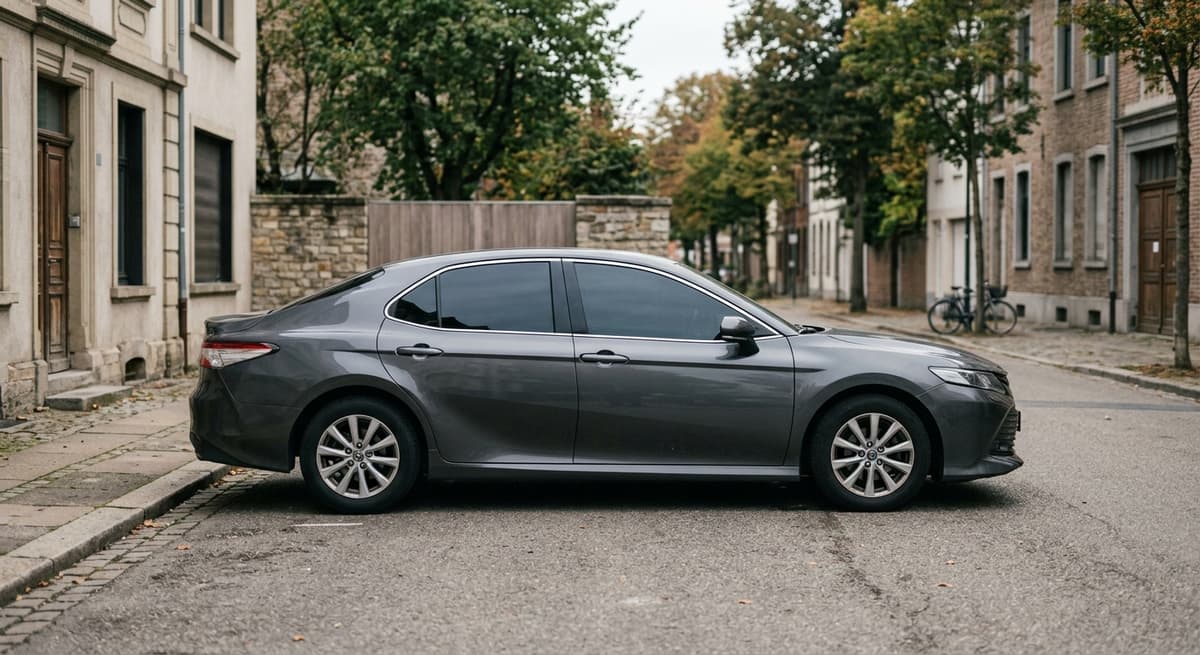
Hawaii bans mirrored or highly reflective tint film that produces a red, yellow, amber, or blue appearance as viewed from outside the vehicle, on any window including the windshield strip. The statute states the prohibition without giving a reason for it, and subsection (g) lets the Department of Transportation adopt rules setting standard criteria or visual references for enforcing the color and reflectivity limits. Non-reflective, neutral-density films in gray, smoke, and similar tones are the safest choice for Hawaiian drivers.
Medical exemptions
Hawaii does not offer a medical exemption for window tint. The statute does not say so in as many words; it simply never mentions medical conditions at all. The exemption list in Haw. Rev. Stat. 291-21.5(e) covers only physical features and film placements, such as rearview mirrors, sun visors, wiper motors, trunk lid hinges, small windshield stickers, the film strip above the AS-1 line, motor-home drapes, and the windows described above. Nothing in the section authorizes darker front side tint for a driver or passenger with a medical need.
Drivers who have medical conditions that make them sensitive to sunlight, such as lupus or xeroderma pigmentosum, therefore have no statutory pathway to darker front side tint in Hawaii. If you need UV protection for a medical reason, consider clear or very light UV-blocking films that still pass the 35% VLT minimum, or use sun-protective clothing and accessories inside the vehicle. Consultation with a local traffic attorney is advisable before relying on any film-based workaround.
How tint is measured and certified in Hawaii
Hawaii enforces its tint rules through both roadside stops and the annual safety inspection program. Subsection (c) requires the safety inspection to include a test that the glazing material and any sun screening devices meet the statute's requirements, and inspectors use a VLT meter (also called a tintometer) to measure how much visible light passes through the glass. The 35% rule applies to the front side windows. Rear windows, and back side windows on the vehicle types the statute names, are checked for prohibited colors and reflectivity rather than for a VLT level.
The measurement tolerance is plus or minus 6%. That means a reading as low as 29% on a front side window is still within the allowed range, though the target should be 35% or above. That tolerance is not new: the same thirty-five per cent plus or minus six per cent language appears in the 2010 version of the statute and was carried forward unchanged by Act 129.
After installation, the installer must issue the vehicle owner a certificate stating that the device complies with the law, and that certificate must be stored in the vehicle at all times. It certifies compliance, not licensure; the statute creates no licensing scheme for tint installers. If the certificate is not in the vehicle when a citation is issued, its absence is prima facie evidence that the installer did not comply, and an installer's failure to issue the certificate is itself a violation. A receipt from the installer, if you are carrying one, is prima facie evidence of who did the work.
Penalties for illegal tint in Hawaii
Hawaii has relatively steep penalties compared with most states. Owners found driving with non-compliant tint face fines between $300 and $550. Installers who fit tint that does not meet state standards face steeper penalties: $700 to $1,200. Additionally, the installer must reinstall compliant film free of charge or reimburse the owner for the cost of having another installer do it.
2025 Act 129 raised those fines, from a prior range of $250 to $500 for owners and $500 to $1,000 for installers. The same act added a roll-down requirement, and it is a standing mandate rather than an officer's discretionary request: all drivers and passengers of a motor vehicle with applied tint must fully roll down their windows when stopped by a law enforcement officer at a traffic stop. A driver's or a passenger's failure to comply may be cited as a noncriminal traffic infraction in its own right, separate from any tint violation. The requirement does not apply to a person who cannot comply because of a physical disability or a mechanical failure, provided the driver communicates or cooperates through other means reasonably available.
If you receive a tint citation, check whether your film was measured accurately and whether the reading was taken with a calibrated tintometer. A certificate from your installer showing the VLT at the time of installation can be a useful defense if the film has not been altered since then.
If you want to tint your windows in Hawaii
The process for staying compliant is straightforward. First, decide what darkness works for your needs. On front side windows, stay at 35% VLT or lighter. On the rear window, any darkness is permitted after 2025 Act 129 as long as the vehicle has rearview mirrors on both sides. On the side windows behind the driver, unlimited darkness is permitted only if your vehicle is a sedan, van, minivan, truck, or bus.
Choose an installer familiar with Hawaii's updated rules under Act 129. Hawaii does not license tint installers, so there is no state tint license to check; what the law does require is that the installer give you a compliance certificate. Before the job is done, confirm that the front side film meets 35% VLT and that no mirrored or highly reflective film producing a prohibited color (red, yellow, amber, or blue) will be used on any window. Once the work is complete, make sure the installer provides that certificate and keep it in the vehicle permanently, since the statute requires it to be stored there at all times.
At your next annual safety inspection, the inspection must include a test that your glazing and any sun screening devices meet the statute's requirements. Keeping a clean installation record makes that process smooth. If you ever sell or transfer the vehicle, pass the certificate along or have the new owner obtain a fresh inspection.
This article is general legal information, not legal advice. Window tint limits vary by state and change, and enforcement depends on local practice and your specific vehicle. For a definitive answer, check your state DMV or consult a local attorney.
Related reading
If you are also researching what is allowed on your windshield specifically, see Hawaii Windshield Mounting Restrictions.
More Hawaii Laws
Frequently Asked Questions
What is the legal tint in Hawaii?
Hawaii requires front side windows to allow at least 35% visible light transmission. Under 2025 Act 129, the rear window may be any darkness on any motor vehicle, and the side windows behind the driver may be any darkness on sedans, vans, minivans, trucks, and buses, in each case if the vehicle has rearview mirrors on both sides. Mirrored or highly reflective tints that appear red, yellow, amber, or blue from outside the vehicle are prohibited on all windows.
How dark can my front windows be in Hawaii?
The darkest film legally allowed on front side windows is 35% VLT. Hawaii applies a plus-or-minus 6% tolerance, so a meter reading as low as 29% may pass, but aiming for 35% or lighter gives you the most protection against a citation.
Is 20% tint legal in Hawaii?
Not on the front side windows. A 20% VLT film there would fail Hawaii's 35% minimum even accounting for the 6% tolerance. On the rear window, 20% or darker is allowed on any motor vehicle with rearview mirrors on both sides. On the side windows behind the driver, it is allowed only if the vehicle is a sedan, van, minivan, truck, or bus, because the statute's exemption for those windows names no other body type.
Can I get a medical exemption for window tint in Hawaii?
No. Hawaii does not have a medical exemption process for window tint. Haw. Rev. Stat. 291-21.5 does not authorize darker-than-legal front side tint for any medical condition.
Do I have to roll my windows down at a traffic stop in Hawaii?
Yes. Since 2025 Act 129, all drivers and passengers of a vehicle with applied tint must fully roll down their windows when stopped by a law enforcement officer at a traffic stop. A driver's or a passenger's failure to do so may be cited as a noncriminal traffic infraction on its own. The rule does not apply to someone who cannot comply because of a physical disability or a mechanical failure, as long as the driver communicates or cooperates through other means reasonably available.
What is the penalty for illegal tint in Hawaii?
Owners face fines of $300 to $550. Installers who fit non-compliant film face $700 to $1,200 and must reinstall compliant film free of charge or reimburse the owner for another installer's cost. Penalties were increased by 2025 Act 129.
Is windshield tint legal in Hawaii?
Only a non-reflective strip above the AS-1 line or within the top 4 inches of the windshield is allowed. The rest of the windshield must maintain at least 70% VLT. Mirrored or highly reflective film producing a red, yellow, amber, or blue appearance is banned even in the strip.
What did Hawaii's 2025 Act 129 change?
Approved May 29, 2025, Act 129 added sedans to the exemption for side windows behind the driver and extended the rear-window exemption to any motor vehicle, where the prior law had covered only vans, minivans, trucks, and buses. It also banned mirrored or highly reflective film in red, yellow, amber, or blue, raised owner and installer fines, added the traffic-stop roll-down requirement for drivers and passengers, and made the absence of the installer's certificate from the vehicle prima facie evidence of installer noncompliance.
Updates
Corrected the back side window rules: Hawaii's unlimited-darkness exemption covers the rear window on any vehicle but the side windows behind the driver only on sedans, vans, minivans, trucks and buses; also removed a non-existent installer licensing requirement, stated the traffic-stop roll-down mandate and its separate penalty for drivers and passengers, and dropped two unsupported explanations of why the law was written as it is.
Clarified that Hawaii's color ban applies to mirrored or highly reflective film producing red, yellow, amber, or blue, not to any colored film, and that the windshield's 70% figure comes from the federal FMVSS 205 standard the state statute incorporates rather than a percentage the statute states directly.
Independently fact-checked against the cited primary sources; governing law re-checked for recent changes
Governing law re-checked for recent changes
Reviewed and approved by an editor
The Law Behind This Article
This article rests on the statutory provisions below, held in our own legal record and retrieved from the official source. Tap a section to read the operative text.
Hawaii Revised Statutes, Chapter 291: TRAFFIC VIOLATIONS
§ 291-21.5Regulation of motor vehicle sun screening devices; penaltyIn forcecited in 2 of our articles
(a) No person shall operate, permit the operation of, cause to be operated, or park any motor vehicle on a public highway if the glazing material of the motor vehicle: (1) Does not meet the requirements of the Federal Motor Vehicle Safety Standards 205 in effect at the time of its manufacture; or (2) Is used in conjunction with sun screening devices not exempted from this section by subsection (e). (b) No person shall install, mount, adhere, affix, or use any sun screening device or combination of devices in conjunction with the glazing material of a motor vehicle: (1) That does not meet the requirements of the Federal Motor Vehicle Safety Standards 205 in effect at the time of the glazing material's manufacture except as provided in this section; and (2) With mirrored or high reflective finishes that produce a red, yellow, amber, or blue appearances as viewed from the exterior of the motor vehicle. Any person who violates this section shall be liable for the removal of any sun screening device applied contrary to this section.
Official text (excerpt) · last checked 2026-09-01 · Read the full text in our law library · Verify at capitol.hawaii.gov
Also relied on in: Hawaii Windshield Mounting Laws (2026 Guide)
Search our full record of US law — 2.1 million sections, every state + federal →
Sources and References
- Haw. Rev. Stat. 291-21.5 (2025 Act 129 / HB 226) - Hawaii window tint statute(capitol.hawaii.gov).gov
- 2025 Haw. Sess. Laws Act 129 (H.B. 226), approved May 29, 2025 - slip law amending HRS 291-21.5(capitol.hawaii.gov)
- 2010 Haw. Sess. Laws Act 103 - prior text of HRS 291-21.5 (pre-Act 129 vehicle list and 35% plus or minus 6% tolerance)(capitol.hawaii.gov)