
Connecticut
Connecticut Window Tint Laws (2026): Legal VLT Limits
Independently fact-checked against primary sources (last audited August 18, 2026). · Reviewed by the RecordingLaw editorial team. · Law checked current as of August 18, 2026. · 4 primary sources cited on this page. How we verify our legal content
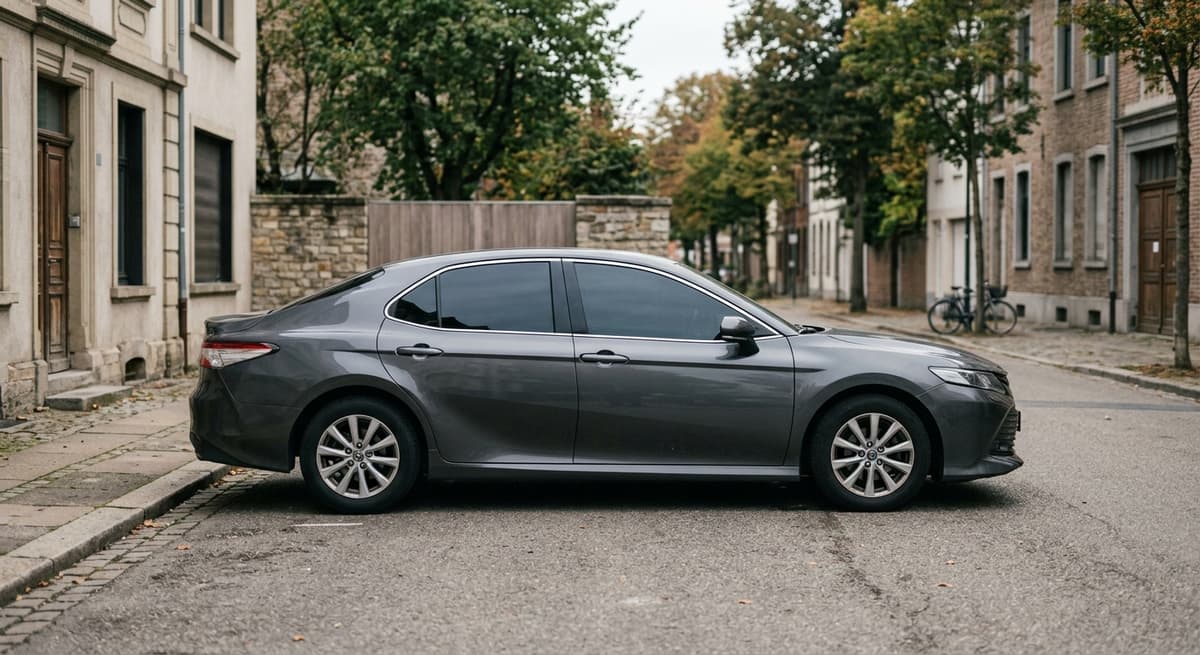
Connecticut law requires that front side windows let through at least 35% of visible light. Rear side windows must also meet 35% on a vehicle certified as a passenger car, while a vehicle certified as a truck, bus, or multipurpose passenger vehicle may use any darkness behind the driver, and the rearmost window on any vehicle may be any darkness, in both cases only if the vehicle carries outside mirrors on the left and right sides.
What is the legal tint limit in Connecticut?
Connecticut sets a minimum Visible Light Transmission (VLT) of 35% for front side windows on all vehicles. VLT is the percentage of visible light a window allows through: a higher number means lighter tint, a lower number means darker tint. A window showing 35% VLT lets 35 out of 100 units of light pass through, which is a moderately dark shade.
For the windows behind the driver, the rule turns on how the vehicle is certified, not on its body style. Conn. Gen. Stat. 14-99g(c)(6) extends the darker allowance to a truck, motor bus, trailer, mobile manufactured home, or multipurpose passenger vehicle "as defined in the Code of Federal Regulations, Title 49, Section 571.3." That designation appears on the manufacturer's certification label in the driver's door jamb, so a given SUV or crossover may be certified as an MPV or as a passenger car. A vehicle in the MPV class may use any tint darkness on the windows behind the driver, but only if it is equipped with outside mirrors on the left and right sides located so as to show the driver at least 200 feet of highway to the rear. Under 14-99g(c)(10) the rearmost window on any vehicle may be any darkness, subject to the same dual-mirror condition. Without those mirrors, neither allowance applies.
| Window | Passenger cars | Trucks, buses, and MPVs |
|---|---|---|
| Front side | 35% minimum | 35% minimum |
| Back side | 35% minimum | Any darkness (outside mirrors on both sides required) |
| Rear window | Any darkness (outside mirrors on both sides required) | Any darkness (outside mirrors on both sides required) |
| Windshield | Topmost strip only (29 in. above driver's seat) | Topmost strip only (29 in. above driver's seat) |
A factory-installed tint that meets FMVSS 205 standards generally satisfies Connecticut's requirement. If you add aftermarket film, the combined VLT of the glass plus the film must meet 35% on the front side windows.
Windshield tint rules in Connecticut
Connecticut limits windshield tint to a topmost strip defined by statute, not a manufacturer AS-1 line. The bottom edge of the tinted material must sit at least 29 inches above the undepressed driver's seat, measured from a point five inches in front of the bottom of the backrest with the seat in its rearmost and lowermost position on a level surface. The material also may not be red or amber in color.
No tint of any kind may extend below that 29-inch measurement line onto the area of the windshield used for driving vision. Connecticut has no periodic safety inspection for ordinary passenger vehicles: the DMV states that "generally, personal vehicles (e.g., cars and trucks) do not require a safety inspection," and the statewide biennial program is an emissions test that does not measure tint. Tint is checked instead at roadside stops, on warning tickets, and in the DMV inspection lane.
Connecticut's reflectivity rules extend to all tinted windows: front side windows must not reflect more than 27% of light, and back side windows must not exceed 21% luminous reflectance. Metallic or mirror-like films that exceed these levels are not permitted.
Medical exemptions
Connecticut does allow a medical exemption for drivers or frequent passengers whose medical condition requires them to be shielded from direct sunlight. Conn. Gen. Stat. 14-99g(b) requires a written application to the Commissioner of Motor Vehicles supported by the written documentation of a physician or optometrist licensed to practice in Connecticut.
The exemption is banded, not unlimited. The DMV states that "if a medical condition exists that requires your window tint to be between 32 percent and not less than 20 percent, a medical exemption may be granted," and that "window tint with a light transmittance of less than 20 percent fail the measurement and are not issued an exemption." Tint darker than 20% VLT cannot be approved on medical grounds.
The process runs through the DMV's Commercial Vehicle Safety Division. You request the application and special permit for exemption from tinted window requirements (Form E-220), then bring the vehicle to the inspection lane at the Wethersfield DMV location for a tint measurement. The division validates the request once the vehicle passes.
Carry the validated form in the vehicle at all times so you can present it to law enforcement during a stop. Without it, an officer may still issue an infraction for windows that appear to violate the standard limit. The DMV also states that compliance stickers "should not be affixed to windows in exempted vehicles," so an exempt vehicle carries the validated form rather than the certification labels described below.
If your condition changes or the certification lapses, you should renew it before it expires to keep the exemption valid. Connecticut does not publish a specific renewal interval in the statute, so confirm the renewal requirements with your certifying physician and the Connecticut DMV.
How tint is measured and certified
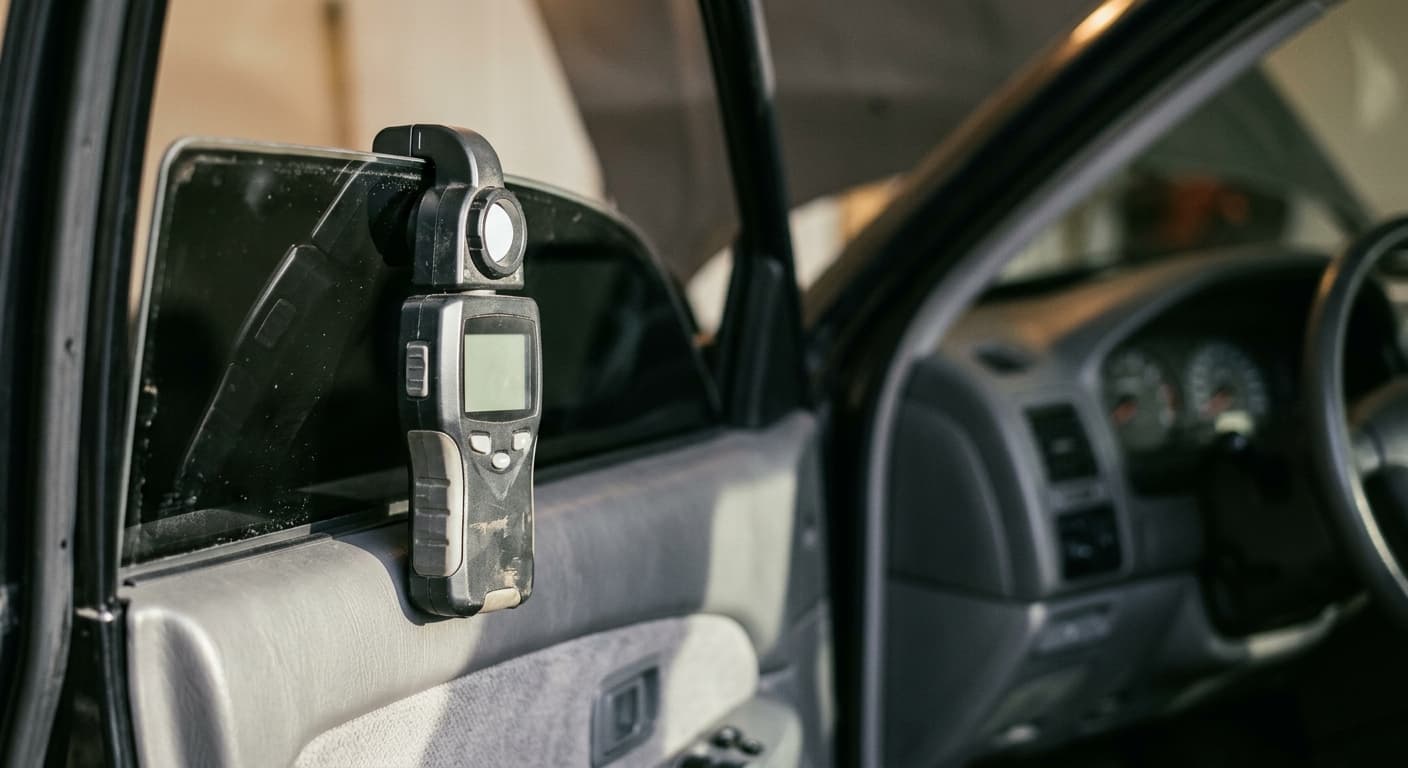
Connecticut uses a VLT meter (photometer) to measure tint compliance. An officer places the meter on the window glass and takes a reading. A tolerance of plus or minus 3% is applied, meaning a window measuring between 32% and 38% on the meter may still pass for a 35% legal minimum.
Connecticut requires a compliance sticker on each window tinted after factory delivery. Conn. Gen. Stat. 14-99g(e) attaches the requirement to a window "tinted or darkened with any tinted material after factory delivery," and DMV Form R-317 states that "each window on the vehicle that has a tint material applied (other than factory tinted windows) must have a certification label affixed in the lower left corner." Factory tint is not covered. The sticker must be no larger than one square inch and self-destructive, meaning it voids if removed.
Getting that sticker involves the DMV, not only the installer. Section 14-99g(g) requires the owner of a vehicle with film applied after factory delivery to present the vehicle to the Department of Motor Vehicles to receive a compliance sticker, and the DMV states that windows "need to have an allowable light transmittance of no less than 35 percent, plus or minus three percent to receive a sticker" and that the sticker "must be affixed to the window by the DMV." Do not assume the shop that installed your film has completed this step for you.
Penalties for illegal tint in Connecticut
A violation of Connecticut's window tint law is an infraction for each offense under Conn. Gen. Stat. 14-99g(f). That is the statute's own phrasing; it does not set out a per-window count, so how a single stop involving several windows is charged is left to the officer and the court rather than spelled out in the tint statute. Connecticut infractions carry a fine set by the court's fee schedule.
Connecticut's statute does create a remove-and-report pathway, and it is a mandatory duty rather than an optional fix-it offer. Under 14-99g(f), a person who violates the obstruction provision "shall remove such object or material which obstructs his clear and full view of the road and report within sixty days to the police department which issued the infractions complaint to present his vehicle for inspection and to demonstrate compliance with the provisions of this section."
Ignoring that duty escalates the consequence. The same subsection provides that if the person fails to report to the police department and is then cited for a subsequent violation, "his vehicle shall be impounded after notice and opportunity for hearing." Removing non-compliant film before a stop avoids the fine, the 60-day inspection trip, and the impoundment exposure entirely.
If you want to tint your windows in Connecticut
Choose a film that leaves at least 35% VLT on your front side windows and, if your vehicle is certified as a passenger car, your rear door windows as well. Have the installer measure the combined VLT of the film plus your existing factory glass before finalizing the job. Factory glass on most modern vehicles is already tinted to around 70-75% VLT, so the film alone must be dark enough to bring the combined reading no lower than 35%.

After installation, plan on a DMV visit. A vehicle with film applied after factory delivery has to be presented to the DMV for testing and for the certification label, which the DMV affixes in the lower-left corner of each such window. If you are relying on a medical exemption instead, carry the validated Form E-220 rather than compliance stickers, which the DMV says should not be affixed to exempted vehicles.
For the windows behind the driver, check the certification label in the driver's door jamb before assuming your vehicle qualifies for the darker allowance. A vehicle certified as a truck, bus, or multipurpose passenger vehicle may run any darkness behind the driver, and any vehicle may run any darkness on the rearmost window, in both cases only with outside mirrors on the left and right sides. Make sure your installer does not accidentally apply front-grade film to windows where darker film is legal and you want maximum privacy.
Cross-check Connecticut's current rules in Conn. Gen. Stat. 14-99g on the Connecticut General Assembly site and on the Connecticut DMV inspection page, both linked in the Sources section, since tint standards and DMV procedure can change. Your installer should also be familiar with the current state rules.
This article is general legal information, not legal advice. Window tint limits vary by state and change, and enforcement depends on local practice and your specific vehicle. For a definitive answer, check your state DMV or consult a local attorney.
More Connecticut Laws
Frequently Asked Questions
What is the legal tint in Connecticut?
Connecticut requires front side windows to allow at least 35% of visible light through (35% VLT), with a plus or minus 3% tolerance. Back side windows must also meet 35% on a vehicle certified as a passenger car. A vehicle certified as a truck, bus, or multipurpose passenger vehicle may use any darkness behind the driver, and any vehicle may use any darkness on the rearmost window, in both cases only if the vehicle has outside mirrors on the left and right sides.
How dark can my front windows be in Connecticut?
The darkest legal front side window tint in Connecticut is 35% VLT, subject to a plus or minus 3% measurement tolerance. A lower VLT percentage means darker tint, so 35% is the darkest shade the law allows without a medical exemption. With a DMV-approved medical exemption, the DMV can approve tint between 32% and no darker than 20%.
Is 20% tint legal in Connecticut?
Not for standard vehicles. Connecticut's minimum is 35% VLT on front side windows. A 20% tint on the front is only legal with a DMV-approved medical exemption, and 20% is the DMV's floor: the DMV states that window tint with a light transmittance of less than 20 percent fails the measurement and is not issued an exemption. On the windows behind the driver of a vehicle certified as a truck, bus, or multipurpose passenger vehicle, any darkness including 20% is permitted when the vehicle has outside mirrors on both sides.
Can I get a medical exemption for window tint in Connecticut?
Yes, but it is a banded exemption rather than a blanket one. A licensed physician or optometrist must certify the medical necessity in writing to the Commissioner of Motor Vehicles. You then request Form E-220 and bring the vehicle to the DMV inspection lane in Wethersfield, where the Commercial Vehicle Safety Division validates the request after the tint passes measurement. The DMV grants the exemption for tint between 32 percent and not less than 20 percent, and tint below 20 percent is not issued an exemption. Carry the validated form in the vehicle at all times.
What is the penalty for illegal tint in Connecticut?
Illegal tint is an infraction for each offense in Connecticut, carrying a fine set by the court fee schedule. The statute also imposes a follow-up duty: a driver cited for obstructing the view of the road must remove the material and report within 60 days to the police department that issued the complaint, to present the vehicle for inspection and demonstrate compliance. Failing to report and then being cited for a subsequent violation can result in the vehicle being impounded after notice and an opportunity for hearing.
Is windshield tint legal in Connecticut?
Only a strip at the very top of the windshield is permitted, defined by statute as the area whose bottom edge sits at least 29 inches above the driver's seat. No tint may extend below that line into the driver's line of sight, and the material may not be red or amber in color.
Do SUVs have different tint rules in Connecticut?
It depends on how the vehicle is certified, not on its body style. Connecticut's darker allowance applies to trucks, buses, and multipurpose passenger vehicles as defined in 49 CFR 571.3, which is the designation shown on the manufacturer's certification label in the driver's door jamb. A vehicle in that class may use any tint darkness on the windows behind the driver and on the rearmost window, but only if it has outside mirrors on the left and right sides located to show at least 200 feet of road to the rear. Front side windows must still meet 35% VLT regardless of vehicle type.
Updates
Corrected the medical exemption to the DMV-granted 32% to 20% band with the Form E-220 inspection process, replaced the incorrect per-window penalty and the claim that no remove-and-report pathway exists with the statutory 60-day reporting duty and impoundment sanction, limited the compliance sticker to windows tinted after factory delivery and to DMV issuance, removed the inaccurate reference to enforcement at safety inspections, and restated the darker-tint allowance by MPV certification with its required outside mirrors.
Independently fact-checked against the cited primary sources; governing law re-checked for recent changes
Corrected three fabricated Conn. Gen. Stat. 14-99g claims: replaced the invented windshield 'AS-1 line' with the statute's actual 29-inch seat-referenced measurement, swapped the front/rear reflectance ceilings back to the statute's 27%/21% (article had them reversed), and replaced the invented '20% VLT' medical-exemption floor with the statute's actual full exemption from the standard limits.
Governing law re-checked for recent changes
Reviewed and approved by an editor
The Law Behind This Article
This article rests on the statutory provisions below, held in our own legal record and retrieved from the official source. Tap a section to read the operative text.
Connecticut General Statutes, Title 14 (Motor Vehicles. Use of the Highway By Vehicles. Gasoline), Chapter 246
§ 14-99gDefinitions. Tinted or reflectorized windows. Obstruction of view prohibited. Exceptions. Sale or delivery of motor vehicles having tinted or reflectorized windows prohibited. Stickers required. Penalty. Window tinting businesses. Regulations.In forcecited in 2 of our articles
(a) As used in this section, unless the context otherwise requires: (1) “Light transmission” means the ratio of the amount of total light, expressed in percentages, which is allowed to pass through a product or material including the glazing to the amount of total light falling on the product or material and the glazing. (2) “Luminous reflectance” means the ratio of the amount of total light, expressed in percentages, which is reflected outward by a product or material to the amount of total light falling on the product or material. (3) “Manufacturer” means (A) a person who engages in the manufacturing or assembling of sun screening products or materials designed to be used in conjunction with vehicle glazing materials, or (B) a person who fabricates, laminates or tempers the glazing material incorporating the capacity to reflect or to reduce the transmittance of light during the manufacturing process.
Official text (excerpt) · last checked 2026-09-01 · Read the full text in our law library · Verify at cga.ct.gov
Cited in 1 court opinions in our collectionLatest citing opinion in our collection: 2025
Opinions citing this section in our collection:
- United States v. Poller (Court of Appeals for the Second Circuit 2025, 129 F.4th 169)“…than thirty-five per cent plus or minus three per cent.” Conn. Gen. Stat. Ann. § 14-99g(c)(1) & (5). Indeed, Poller conceded t…”
Identified automatically from the court opinions citing this section — not a ranking of which case controls.
Also relied on in: Connecticut Windshield Mounting Laws (2026 Guide)
Code of Federal Regulations Title 49
§ 571.3Definitions.In forcecited in 3 of our articles
(a) Statutory definitions. All terms defined in section 102 of the Act are used in their statutory meaning. (b) Other definitions. As used in this chapter— Act means the National Traffic and Motor Vehicle Safety Act of 1966 (80 Stat. 718). Approved, unless used with reference to another person, means approved by the Secretary. Boat trailer means a trailer designed with cradle-type mountings to transport a boat and configured to permit launching of the boat from the rear of the trailer. Bus means a motor vehicle with motive power, except a trailer, designed for carrying more than 10 persons. Curb weight means the weight of a motor vehicle with standard equipment; maximum capacity of engine fuel, oil, and coolant; and, if so equipped, air conditioning and additional weight optional engine. Designated seating capacity means the number of designated seating positions provided.
Official text (excerpt) · last checked 2026-07-28 · Read the full text in our law library · Verify at ecfr.gov
Cited in 25 court opinions in our collectionLatest citing opinion in our collection: 2023
Opinions citing this section in our collection:
- Lacurtis v. Express Medical Transporters, Inc. (District Court, E.D. Missouri 2016, 189 F. Supp. 3d 903)“…and Motor Vehicle Safety Act of 1966. The DOT regulation, 49 C.F.R. § 571.3 (b)(1), provides that “[f|or the sole p…”
- Suiter v. Mitchell Motor Coach Sales, Inc. (Court of Appeals for the Tenth Circuit 1998, 151 F.3d 1275)“…4 manufacturer as the loaded weight of a single vehicle.” 49 C.F.R. § 571.3(b).…”
- Center for Auto Safety v. National Highway Traffic Safety Administration (District Court, District of Columbia 2000, 93 F. Supp. 2d 1)“…deployed, and the “seating reference point,” as defined in 49 C.F.R. § 571.3 . The following manufacturers st…”
Identified automatically from the court opinions citing this section — not a ranking of which case controls.
Also relied on in: Kentucky Window Tint Laws (2026): Legal VLT Limits, New Hampshire Window Tint Laws (2026): Legal VLT Limits
Search our full record of US law — 2.1 million sections, every state + federal →
Sources and References
- Conn. Gen. Stat. 14-99g (Connecticut window tint law)(eregulations.ct.gov).gov
- Conn. Gen. Stat. 14-99g: tinted or reflectorized windows, exceptions, stickers, penalty(cga.ct.gov).gov
- Connecticut DMV: Get a Vehicle Inspection (window tint medical exemption band, Form E-220, compliance stickers)(portal.ct.gov).gov
- Connecticut DMV Form R-317: Application for Certification of Tinted Windows(portal.ct.gov).gov