
Alaska
Alaska Car Accident Laws: Fault, Insurance, and Your Claim
Independently fact-checked against primary sources (last audited August 17, 2026). · Reviewed by the RecordingLaw editorial team. · Law checked current as of August 17, 2026. · 6 primary sources cited on this page. How we verify our legal content
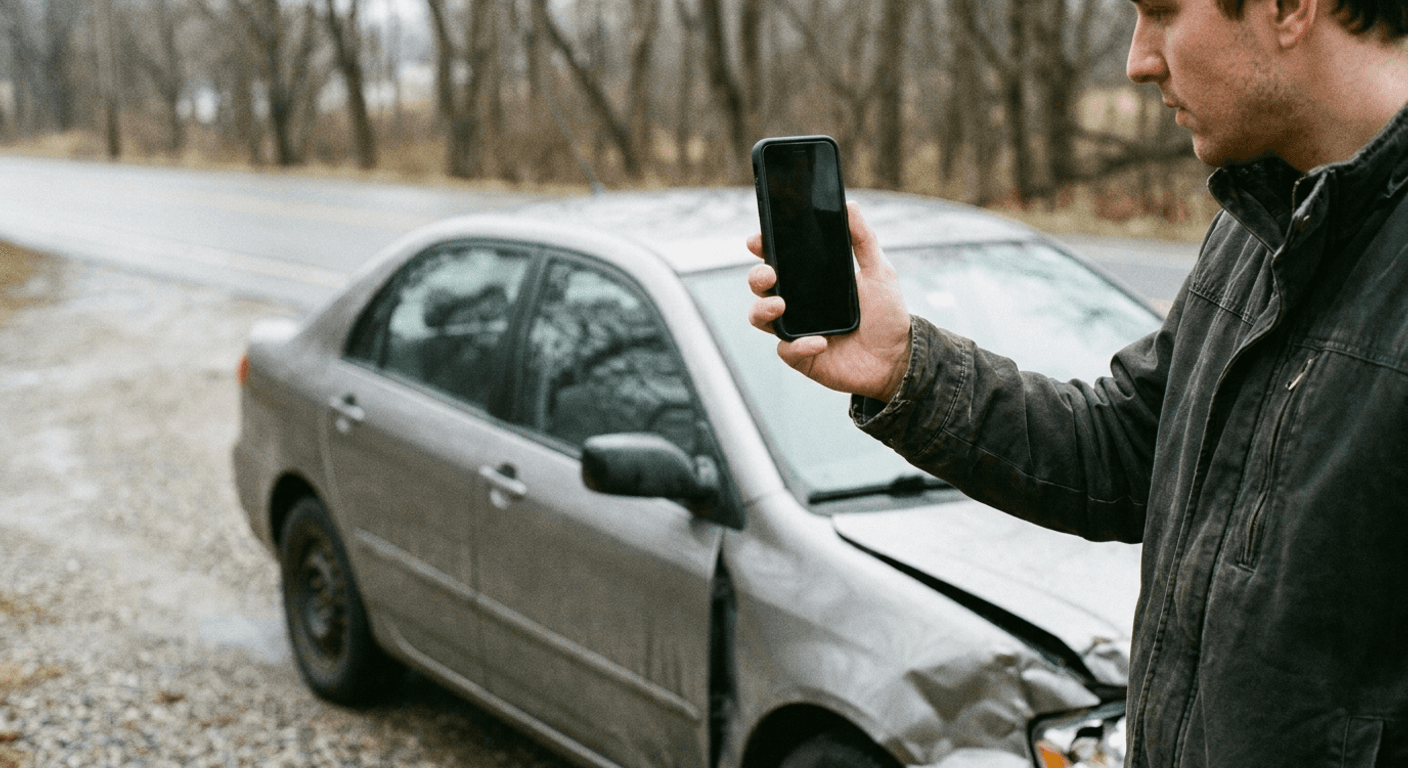
Alaska is an at-fault (tort) state that follows pure comparative negligence, meaning the at-fault driver pays and your recovery is reduced by your share of fault but never completely barred, even if you were mostly responsible for the crash.
Is Alaska a no-fault or at-fault state?
Alaska is a pure at-fault (tort) state. There is no statutory personal-injury protection (PIP) or no-fault insurance scheme anywhere in Alaska law. When a crash happens, the injured party looks to the at-fault driver's liability insurer for compensation, not to their own insurer as the first payer. Because Alaska has no "serious injury" verbal threshold or monetary threshold to clear before suing, any person injured in an auto accident may bring a negligence action directly against the responsible driver and recover the full range of damages: medical bills, lost wages, future costs, and pain and suffering. The one damages consideration to keep in mind is the statutory cap on non-economic damages under AS 09.17.010 (roughly $400,000 for ordinary injuries, rising to roughly $1,000,000 for severe permanent impairment), but that cap applies only to the size of a recovery, not to your right to sue.
How fault is shared: Alaska's negligence rule
Alaska follows pure comparative negligence under AS 09.17.060 and AS 09.17.080. Under this rule, a jury or adjuster assigns each party a percentage of fault, and your damages are reduced proportionally by your own percentage. If you are found 30% responsible for a crash and your total damages are $100,000, you recover $70,000. If you are found 70% responsible, you still recover $30,000. Unlike the modified comparative negligence rules used by most states (which cut off recovery at 50% or 51% fault), Alaska's pure comparative system never bars recovery based solely on percentage of fault. This is favorable to injured plaintiffs who share substantial responsibility. Insurance adjusters will still use your percentage of fault as leverage to reduce settlement offers, so documenting the other driver's negligence thoroughly (police report, photos, witness statements) remains critical.

Minimum car insurance in Alaska
Alaska law requires all drivers to carry minimum liability coverage of 50/100/25: $50,000 for bodily injury per person, $100,000 for bodily injury per accident, and $25,000 for property damage per accident (AS 28.22.101; AS 28.20.440). A combined single limit of $125,000 also satisfies the requirement. These minimums are notably higher than the 25/50/25 floor used in many other states, which offers somewhat better protection when the at-fault driver only carries minimum coverage. AS 28.22.011(a) allows the mandatory-insurance duty to be met in only two ways: a motor vehicle liability policy that complies with the chapter, or a certificate of self-insurance under AS 28.20.400. Self-insurance is narrow. A person with 25 or fewer registered vehicles must satisfy the department that they have and will continue to have the ability to pay a judgment of at least $125,000, and a person with more than 25 registered vehicles applies to the department for a certificate. There is no option to deposit cash or securities with the state; AS 28.20.490, which once allowed money or securities as proof, was repealed in 1984. A surety bond under AS 28.20.470 is proof of financial responsibility for the future under the Safety Responsibility Act, which is triggered by accidents and unpaid judgments under AS 28.20.230, so it is not a substitute for the mandatory-insurance requirement.
There is no mandatory PIP in Alaska. Optional medical payments (MedPay) coverage can pay your own medical bills regardless of fault, but it is not required by law.
Uninsured and underinsured motorist (UM/UIM) coverage is built into the mandatory policy rather than sold as an optional add-on. AS 28.22.101(e) requires every motor vehicle liability policy to provide UM/UIM coverage "in the amounts set out in (d) of this section," and those are the same statutory 50/100/25 figures; AS 28.20.440(b)(3) likewise requires coverage in "not less than" those amounts. The only way to decline UM/UIM is to reject it in writing under AS 28.22.201(a)(3), and once rejected it stays off any supplemental, renewal, or replacement policy unless you later request it again in writing.
Note carefully what the statute does not say. The default is the statutory minimum amount, not whatever liability limits you happened to buy. If you carry 250/500 liability coverage, your UM/UIM does not automatically rise to match it. Ask your insurer what your UM/UIM limits actually are, and buy them up deliberately if you want that coverage to track your liability limits. This matters because UM/UIM is often the only meaningful money available when the at-fault driver is uninsured or carries bare minimum limits.
How long you have to file: the statute of limitations
Alaska's statute of limitations for personal-injury claims, including car accident negligence actions, is two years from the date of the accident under AS 09.10.070(a). The statute covers "any injury to the person or rights of another not arising on contract," which courts have consistently applied to auto torts. If you do not file suit within two years, the at-fault driver's attorney will almost certainly move to dismiss the case and the court will grant it, leaving you without a legal remedy regardless of how strong your case was. If the insurer has not settled your claim, get a free claim review from an Alaska injury lawyer before those two years run out (attorney advertising).

The two-year clock typically starts on the date of the crash. Discovery-rule tolling may apply in rare circumstances (for example, if a latent injury was not reasonably discoverable until later), but courts apply this narrow exception cautiously in straightforward collision cases. Government-claim timing is separate: if a state or municipal vehicle was involved, you may face a shorter notice-of-claim deadline before you can sue. Always consult an attorney promptly if a government entity may be liable.
For property-damage claims arising from a car accident, the same two-year limitations period under AS 09.10.070(a) applies. AS 09.10.050 governs waste or trespass upon real property and does not apply to vehicle damage claims.
What an Alaska car accident claim is worth
An Alaska car accident claim can include two broad categories of damages. Economic damages cover all out-of-pocket and future financial losses: medical bills (emergency care, surgery, rehabilitation, future treatment), lost wages and lost earning capacity, vehicle repair or replacement, and other documented costs. Economic damages are not capped in Alaska; even large awards for future medical care or lost earnings are recoverable in full.
Non-economic damages (pain and suffering, emotional distress, loss of enjoyment of life, and similar intangible harms) are available as well but subject to Alaska's statutory cap under AS 09.17.010. For most injury cases, the cap is roughly $400,000. For injuries causing severe permanent impairment, the cap rises to roughly $1,000,000. These figures are tied to life expectancy under a statutory formula, so the precise cap varies by claimant age and severity. Confirm the current calculation with an attorney.
Your overall recovery will also be reduced by your comparative-fault percentage. And practically speaking, the at-fault driver's policy limits often become the real ceiling: a policy with $50,000 per-person limits may be all the insurance standing between you and an uncollectible judgment. If the at-fault driver is underinsured, your own UM/UIM coverage (if not rejected) can bridge the gap.
Use the Alaska car accident settlement calculator to get a rough range based on injury type, fault split, and insurance limits. Then discuss the result with a lawyer before accepting any offer.
What to do after a car accident in Alaska
1. Make sure everyone is safe. Move vehicles out of traffic if it is safe to do so. Call 911 if anyone is injured or if the vehicles cannot be moved.

2. Report the accident. Alaska law requires you to report a crash to police when injury, death, or property damage above a threshold occurs. A police report creates an official record that is valuable in any subsequent insurance or legal proceeding.
3. Document everything at the scene. Photograph vehicle positions, damage, skid marks, traffic signs, and any visible injuries before vehicles are moved. Get the other driver's name, license number, insurance company, and policy number. Collect names and contact information for all witnesses.
4. See a doctor promptly. Even if you feel fine, get evaluated. Soft-tissue injuries and traumatic brain injuries can take hours or days to produce obvious symptoms. A gap in treatment is a common reason insurers reduce settlement offers, so create a medical record quickly.
5. Notify your insurer, but be careful with the other insurer. You are obligated to report the crash to your own insurer. You are not obligated to give a recorded statement to the other driver's insurer, and anything you say can be used to reduce your claim.
6. Talk to an attorney before accepting any settlement. Alaska's pure comparative negligence system means insurers have strong incentives to argue you share fault, because even a small assigned percentage reduces what they owe. A personal-injury attorney can help evaluate fault, calculate full damages (including future costs), and negotiate or litigate from a position of knowledge.
This article is general legal information, not legal advice. Car accident law varies by state and changes, and settlement values depend on the specific facts. For advice about a specific crash, consult a licensed attorney in Alaska.
Related pages:
More Alaska Laws
- Alaska Dashcam Laws
- Alaska Hit and Run Laws
- Alaska Slip and Fall Laws
- Alaska Statute of Limitations
- Alaska Workers Compensation Laws
Frequently Asked Questions
Is Alaska a no-fault state?
No. Alaska is an at-fault (tort) state with no no-fault or PIP system. After a crash, you claim against the at-fault driver's liability insurer for your injuries and property damage.
Is Alaska an at-fault state?
Yes. Alaska is a pure at-fault state. The driver who caused the crash is responsible for the other party's damages, and injured parties can sue directly for all losses including pain and suffering with no threshold to clear.
What is the statute of limitations for a car accident in Alaska?
Two years from the date of the accident under AS 09.10.070(a). If you do not file suit within that period, you generally lose the right to recover. Property-damage claims arising from a car accident are also governed by the two-year period under AS 09.10.070(a).
Can I still recover if I was partly at fault in Alaska?
Yes. Alaska follows pure comparative negligence under AS 09.17.060. Your damages are reduced by your percentage of fault, but recovery is never completely barred. Even if you were 90% at fault, you can still recover 10% of your damages.
What are the minimum car insurance requirements in Alaska?
Alaska requires minimum liability limits of 50/100/25: $50,000 per person and $100,000 per accident for bodily injury, plus $25,000 for property damage (AS 28.22.101). UM/UIM must be included at those same 50/100/25 amounts under AS 28.22.101(e) unless you reject it in writing under AS 28.22.201(a)(3); it does not default to your chosen liability limits.
How much is my Alaska car accident claim worth?
It depends on the severity of injuries, fault percentages, and available insurance. Economic damages (medical bills, lost wages) are uncapped. Non-economic damages (pain and suffering) are capped at roughly $400,000 for most injuries or $1,000,000 for severe permanent impairment under AS 09.17.010. Your share of fault reduces the total.
Does Alaska require PIP coverage?
No. Alaska has no personal-injury protection (PIP) requirement. Optional MedPay coverage can cover your own medical bills regardless of fault, but it is not mandatory. Because Alaska is an at-fault state, you generally rely on the at-fault driver's liability insurer first.
Updates
Corrected the uninsured/underinsured motorist section: the written-rejection rule is AS 28.22.201(a)(3) and coverage defaults to the statutory 50/100/25 minimums under AS 28.22.101(e), not to the policyholder's chosen liability limits, and removed a repealed cash-deposit option from the minimum-insurance requirements.
Independently fact-checked against the cited primary sources; governing law re-checked for recent changes
Governing law re-checked for recent changes
Reviewed and approved by an editor
The Law Behind This Article
This article rests on the statutory provisions below, held in our own legal record and retrieved from the official source. Tap a section to read the operative text.
Alaska Statutes, Title 9. Code of Civil Procedure, Chapter 17. Civil Damages and Apportionment of Fault
§ 09.17.060Effect of contributory faultIn forcecited in 8 of our articles
In an action based on fault seeking to recover damages for injury or death to a person or harm to property, contributory fault chargeable to the claimant diminishes proportionately the amount awarded as compensatory damages for the injury attributable to the claimant's contributory fault, but does not bar recovery.
Official text (excerpt) · last checked 2026-09-08 · Read the full text in our law library · Verify at akleg.gov
Cited in 20 court opinions in our collectionLatest citing opinion in our collection: 2025
In the courts (editorial summary, independently checked):Sowinski v. Walker (2008) described AS 09.17.060 as stating that a claimant cannot recover the portion of damages attributable to the claimant's own fault. Smith v. Ingersoll-Rand Co. (2000) held the 1986 act that enacted this rule broadened comparative fault in strict products liability to include a plaintiff's ordinary negligence.
Opinions citing this section in our collection:
- Sowinski v. Walker (Alaska Supreme Court 2008, 198 P.3d 1134)✓Two minors who drank liquor bought at DelRois Liquor Store died when their ATV struck a cable. The court described AS 09.17.060 as Alaska's codified comparative negligence rule and, with the pure several liability of AS 09.17.080, held the store owed only its 35 percent share.
- Loeb v. Rasmussen (Alaska Supreme Court 1991, 822 P.2d 914)✓A liquor store sold alcohol to a 17-year-old without checking her age, and she was hurt driving drunk. The court read AS 09.17.060 as leaving intact the rule barring the licensee from charging the minor's fault, but Sowinski (2008) called that passage dicta and superseded it.
- Smith v. Ingersoll-Rand Co. (Alaska Supreme Court 2000, 14 P.3d 990)“…s). 28 . Id. 29 . AS 09.17.060. 30 . AS 09.17.900…”
Identified automatically from the court opinions citing this section — not a ranking of which case controls.
Also relied on in: Alaska Dog Bite Laws: Liability and Victim Rights, Alaska Hit and Run Laws: Penalties and What to Do, Medical Malpractice Laws in Alaska (2026): Deadlines & Caps
§ 09.17.080Apportionment of damagesIn forcecited in 2 of our articles
(a) In all actions involving fault of more than one person, including third-party defendants and persons who have settled or otherwise been released, the court, unless otherwise agreed by all parties, shall instruct the jury to answer special interrogatories or, if there is no jury, shall make findings, indicating (1) the amount of damages each claimant would be entitled to recover if contributory fault is disregarded; and (2) the percentage of the total fault that is allocated to each claimant, defendant, third-party defendant, person who has been released from liability, or other person responsible for the damages unless the person was identified as a potentially responsible person, the person is not a person protected from a civil action under AS 09.10.055, and the parties had a sufficient opportunity to join that person in the action but chose not to; in this paragraph, sufficient opportunity to join means the person is (A) within the jurisdiction of the court; (B) not precluded from being joined by law or court rule; and (C) reasonably locatable.
Official text (excerpt) · last checked 2026-07-31 · Read the full text in our law library · Verify at akleg.gov
Cited in 93 court opinions in our collectionLatest citing opinion in our collection: 2025
Opinions citing this section in our collection:
- Evans Ex Rel. Kutch v. State (Alaska Supreme Court 2002, 56 P.3d 1046)“…020(j); (3) the comparative apportionment of damages under AS 09.17.080; (4) the revised offer of judgment proc…”
- L.D.G., Inc. v. Brown (Alaska Supreme Court 2009, 211 P.3d 1110)“…4 P.3d 136 , 140 (Alaska 2004)). 22 . AS 09.17.080(a)(2). 23 . Evans…”
- Bohna v. HUGHES, THORSNESS, GANTZ (Alaska Supreme Court 1992, 828 P.2d 745)“…The trial court apparently applied the current version of AS 09.17.080(d). [15] However, the current version…”
Identified automatically from the court opinions citing this section — not a ranking of which case controls.
Also relied on in: Alaska Slip and Fall Laws: Proving Premises Liability
§ 09.17.010Noneconomic damagesIn forcecited in 5 of our articles
(a) In an action to recover damages for personal injury or wrongful death, all damage claims for noneconomic losses shall be limited to compensation for pain, suffering, inconvenience, physical impairment, disfigurement, loss of enjoyment of life, loss of consortium, and other nonpecuniary damage. (b) Except as provided under (c) of this section, the damages awarded by a court or a jury under (a) of this section for all claims, including a loss of consortium claim, arising out of a single injury or death may not exceed $400,000 or the injured person's life expectancy in years multiplied by $8,000, whichever is greater. (c) In an action for personal injury, the damages awarded by a court or jury that are described under (b) of this section may not exceed $1,000,000 or the person's life expectancy in years multiplied by $25,000, whichever is greater, when the damages are awarded for severe permanent physical impairment or severe disfigurement. (d) Multiple injuries sustained by one person as a result of a single incident shall be treated as a single injury for purposes of this section.
Official text (excerpt) · last checked 2026-07-31 · Read the full text in our law library · Verify at akleg.gov
Cited in 26 court opinions in our collectionLatest citing opinion in our collection: 2025
Opinions citing this section in our collection:
- Evans Ex Rel. Kutch v. State (Alaska Supreme Court 2002, 56 P.3d 1046)“…1997:(1) the cap on noneconomic and punitive damages under AS 09.17.010 and .020; (2) the requirement that half…”
- L.D.G., Inc. v. Brown (Alaska Supreme Court 2009, 211 P.3d 1110)“…he non-economic damages were subject to a damages cap under AS 09.17.010, which would limit the non-economic dam…”
- State v. Carpenter (Alaska Supreme Court 2007, 171 P.3d 41)“…claim. Carpenter moved after trial for an order declaring AS 09.17.010(b) and AS 09.17.020(j) unconstitutional…”
Identified automatically from the court opinions citing this section — not a ranking of which case controls.
Also relied on in: Truck Accident Laws in Alaska (2026): Deadlines & Liability, Wrongful Death Laws in Alaska (2026): Deadlines & Who Can Sue, Motorcycle Accident Laws in Alaska (2026): Deadlines & Helmets
Alaska Statutes, Title 28. Motor Vehicles, Chapter 22. Mandatory Motor Vehicle Insurance
§ 28.22.101General coverage requirements; policy limitsIn force
(a) An owner's motor vehicle liability policy must designate by description or appropriate reference the motor vehicles that it covers and insure the person named against loss from the liability imposed by law for damages that arise from the ownership, maintenance, or use of a designated motor vehicle. (b) An operator's motor vehicle liability policy must insure the person named as insured against loss from the liability imposed by law for damages that arise from the use by the operator of a motor vehicle not owned by the operator. (c) A personal motor vehicle liability policy must insure the person named as insured against loss from liability imposed by law for damages that arise from the ownership, maintenance, or use by the named person of a motor vehicle whether owned or not owned by the person.
Official text (excerpt) · last checked 2026-07-31 · Read the full text in our law library · Verify at akleg.gov
Cited in 22 court opinions in our collectionLatest citing opinion in our collection: 2024
Opinions citing this section in our collection:
- Burton v. State Farm Fire & Casualty Co. (Alaska Supreme Court 1990, 796 P.2d 1361)“…ed motor vehicle.” AS 28.22.010(a)(3) (same language now in AS 28.22.101(e)). Burton falls within the scope of t…”
- State Farm Mutual Automobile Insurance Co. v. Houle (Alaska Supreme Court 2011, 269 P.3d 654)“…overage with limits "less than the limit in AS 28.20.440 or AS 28.22.101," statutory provisions that identify re…”
- Nelson v. Progressive Casualty Insurance Co. (Alaska Supreme Court 2007, 162 P.3d 1228)“…imum liability protection re *1236 quired by AS 28.22.101. She further asserts that Progressive F…”
Identified automatically from the court opinions citing this section — not a ranking of which case controls.
§ 28.22.011Motor vehicle liability insurance required; exemptionsIn forcecited in 2 of our articles
(a) The operator or owner of a motor vehicle subject to registration under AS 28.10.011 when driven on a highway, vehicular way or area, or on other public property in the state, shall be insured under a motor vehicle liability policy that complies with this chapter or a certificate of self-insurance that complies with AS 28.20.400 unless (1) the motor vehicle is being driven or moved on a highway, vehicular way, or a public parking place in the state that is not connected by a land highway or vehicular way to (A) the land-connected state highway system, or (B) a highway or vehicular way with an average daily traffic volume greater than 499; and (2) the operator has not been cited within the preceding five years for a traffic law violation with a demerit point value of six or more on the point schedule determined under regulations adopted by the department under AS 28.15.221. (b) The department shall annually publish a list of areas that meet the requirements of (a)(1) of this section. This list shall be available for public inspection at each office of the department.
Official text (excerpt) · last checked 2026-07-31 · Read the full text in our law library · Verify at akleg.gov
Cited in 11 court opinions in our collectionLatest citing opinion in our collection: 2021
Opinions citing this section in our collection:
- State, Department of Public Safety, Division of Motor Vehicles v. Fernandes (Alaska Supreme Court 1997, 946 P.2d 1259)“…urance nor a certifi *1260 cate of■ self-insurance. ■ See AS 28.22.011(a). Fernandes, however, accepted full r…”
- Progressive Insurance Co. v. Simmons (Alaska Supreme Court 1998, 953 P.2d 510)“…SLA 1989), does compel insurance coverage. See AS 28.22.011. 11 Although the AMAIA’s c…”
- Government Employees Insurance Co. v. Graham-Gonzalez (Alaska Supreme Court 2005, 107 P.3d 279)“…d at 489 . [7] Id. (quoting AS 28.20.010). [8] AS 28.22.011. [9] Order Granting Partial Summary…”
Identified automatically from the court opinions citing this section — not a ranking of which case controls.
§ 28.22.201Uninsured and underinsured motorists coverageIn forcecited in 2 of our articles
(a) The uninsured and underinsured motorists coverage required under this chapter (1) does not apply to bodily injury, sickness, disease, or death of an insured or damage to or destruction of property of an insured until the limits of liability bonds and policies that apply have been used up by payments or judgments or settlements; (2) must be a single combined coverage; and (3) may be rejected by the insured in writing; if the insured has rejected uninsured or underinsured coverage, the coverage may not be included in a supplemental, renewal, or replacement policy unless the insured subsequently requests uninsured or underinsured coverage in writing. (b) If both the owner and operator of a vehicle are unknown, payment under the uninsured and underinsured motorists coverage may be made only where direct contact between the motor vehicles has occurred. A vehicle and operator that have left the scene of an accident with another vehicle are presumed to be uninsured if the insured person reports the accident to the appropriate authorities within 24 hours.
Official text (excerpt) · last checked 2026-07-31 · Read the full text in our law library · Verify at akleg.gov
Cited in 8 court opinions in our collectionLatest citing opinion in our collection: 2024
Opinions citing this section in our collection:
- Wold v. Progressive Preferred Insurance Co. (Alaska Supreme Court 2002, 52 P.3d 155)“…he express terms *161 of AS 28.20.445(f) and AS 28.22.201(b). Cynthia thus essentially asks us to…”
- Ayres v. United Services Automobile Ass'n (Alaska Supreme Court 2007, 160 P.3d 128)“…is interpretation. As already noted, AS 28.20.445(e)(8) and AS 28.22.201(a)(8) each provide that UIM coverage "m…”
- Allstate Insurance Company v. Nathan Harbour, Allstate Insurance Company v. Kenneth N. Mattison (Alaska Supreme Court 2021, 491 P.3d 374)“…45 (setting out, in AMVSRA, requirements for UIM coverage); AS 28.22.201-.231 (setting out, in Alaska Mandatory…”
Identified automatically from the court opinions citing this section — not a ranking of which case controls.
Alaska Statutes, Title 9. Code of Civil Procedure, Chapter 10. Limitations of Actions
§ 09.10.070Actions for torts, for injury to personal property, for certain statutory liabilities, and against peace officers and coroners to be brought in two yearsIn forcecited in 14 of our articles
(a) Except as otherwise provided by law, a person may not bring an action (1) for libel, slander, assault, battery, seduction, or false imprisonment, (2) for personal injury or death, or injury to the rights of another not arising on contract and not specifically provided otherwise; (3) for taking, detaining, or injuring personal property, including an action for its specific recovery; (4) upon a statute for a forfeiture or penalty to the state; or (5) upon a liability created by statute, other than a penalty or forfeiture; unless the action is commenced within two years of the accrual of the cause of action. (b) A person may not bring an action against a peace officer or coroner upon a liability incurred by the doing of an act in an official capacity or by the omission of an official duty, including the nonpayment of money collected upon an execution, unless brought within two years. This subsection does not apply to an action for an escape.
Official text (excerpt) · last checked 2026-07-31 · Read the full text in our law library · Verify at akleg.gov
Cited in 228 court opinions in our collectionLatest citing opinion in our collection: 2026
In the courts (editorial summary, independently checked):Alaska courts apply the two-year limit of AS 09.10.070(a) to personal injury and other tort claims. Cikan v. ARCO Alaska, Inc. (2005) held mental incompetency under AS 09.10.140(a) can toll it, with the competency dispute resolved at a pretrial hearing. Robinson v. Alaska Hous. Fin. Corp. (2019) applied it to dismiss untimely tort claims.
Opinions citing this section in our collection:
- Adkins v. Nabors Alaska Drilling, Inc. (Alaska Supreme Court 1980, 609 P.2d 15)✓A worker who suffered a head injury tripping over a hose at a drilling site added a new defendant eight months after AS 09.10.070's two-year period ran. The court held his evidence of concussion and amnesia raised a fact issue on tolling, so summary judgment was improper.
- Evans Ex Rel. Kutch v. State (Alaska Supreme Court 2002, 56 P.3d 1046)✓Injured plaintiffs facially challenged Alaska's 1997 tort reform, including how AS 09.10.070's two-year limit works with the minors tolling rule. The court held the narrower tolling given to children hurt before their eighth birthday is rationally based and upheld the scheme.
- Cikan v. ARCO Alaska, Inc. (Alaska Supreme Court 2005, 125 P.3d 335)✓A woman who slipped on ice outside an office building and hit her head sued nearly nine years later. The court held AS 09.10.070(a)'s two-year limit would ordinarily bar the claim, but her evidence of post-concussion incompetency required a pretrial evidentiary hearing.
Identified automatically from the court opinions citing this section — not a ranking of which case controls.
Also relied on in: Alaska Defamation Laws: Libel, Slander & Suing (2026), Alaska Medical Records Retention Laws (2026 Guide), Alaska Statute of Limitations: Filing Deadlines by Case Type
§ 09.10.050Certain property actions to be brought in six yearsIn forcecited in 2 of our articles
Unless the action is commenced within six years, a person may not bring an action for waste or trespass upon real property.
Official text (excerpt) · last checked 2026-07-31 · Read the full text in our law library · Verify at akleg.gov
Cited in 74 court opinions in our collectionLatest citing opinion in our collection: 2022
Opinions citing this section in our collection:
- Howarth v. First National Bank of Anchorage (Alaska Supreme Court 1975, 540 P.2d 486)“…r 11, 1967, at which time his cause of action was barred by AS 09.10.050.” The statute of limitations beg…”
- Lee Houston & Associates, Ltd. v. Racine (Alaska Supreme Court 1991, 806 P.2d 848)“…y brought within the six-year limitation period provided by AS 09.10.050. We have held that the "gravamen" o…”
- Fernandes v. Portwine (Alaska Supreme Court 2002, 56 P.3d 1)“…erference with the Portwines' real property rights and that AS 09.10.050 therefore applied. Alaska Statute 09.10…”
Identified automatically from the court opinions citing this section — not a ranking of which case controls.
Alaska Statutes, Title 28. Motor Vehicles, Chapter 20. Motor Vehicle Safety Responsibility Act
§ 28.20.445Uninsured and underinsured motorists coverageIn force
(a) The maximum liability of the insurance carrier under the uninsured and underinsured motorists coverage required to be offered under AS 28.20.440 shall be the lesser of (1) the difference between the amount of the covered person's damages for bodily injury and property damage and the amount paid to the covered person by or for a person who is or may be held legally liable for the damages; and (2) the applicable limit of liability of the uninsured and underinsured motorist coverage. (b) An amount payable under the uninsured and underinsured motorist coverage shall be excess to an amount payable under automobile bodily injury, death, or medical payments coverage, or as workers' compensation benefits and may not duplicate amounts paid or payable under valid and collectible automobile bodily injury, death, or medical payments coverage, or as workers' compensation benefits. (c) If a person is entitled to uninsured or underinsured motorists coverage under more than one coverage when two or more vehicles are insured under one policy, the maximum amount payable may not exceed the highest limit of any one coverage under the policy.
Official text (excerpt) · last checked 2026-07-31 · Read the full text in our law library · Verify at akleg.gov
Cited in 23 court opinions in our collectionLatest citing opinion in our collection: 2024
Opinions citing this section in our collection:
- Hillman v. Nationwide Mutual Fire Insurance Co. (Alaska Supreme Court 1988, 758 P.2d 1248)“…Nationwide points to a statutory change now contained in AS 28.20.445(d): (d) Uninsured and underinsured mo…”
- Progressive Insurance Co. v. Simmons (Alaska Supreme Court 1998, 953 P.2d 510)“…car was an “un-derinsured motor vehicle,” we turn to former AS 28.20.445(h), which was in effect at the time of…”
- Curran v. Progressive Northwestern Insurance Co. (Alaska Supreme Court 2001, 29 P.3d 829)“…ka law. Because the underlying limits were not "used up" as AS 28.20.445(e)(1) requires, we hold that the offers…”
Identified automatically from the court opinions citing this section — not a ranking of which case controls.
§ 28.20.440Motor vehicle liability policy defined; required provisionsIn force
(a) In this chapter, motor vehicle liability policy means an owner policy or an operator's policy containing an agreement or endorsement as provided in this section, or certified as provided in AS 28.20.410 or 28.20.420 as proof of financial responsibility for the future, and issued, except as otherwise provided in AS 28.20.420, by an insurance carrier authorized to transact business in this state, to or for the benefit of the person named as insured. (b) The owner's policy of liability insurance must (1) designate by description or appropriate reference all vehicles that it covers; (2) insure the person named and every other person using the vehicle with the express or implied permission of the named insured, against loss from the liability imposed by law for damages arising out of the ownership, maintenance, or use of the vehicle within the United States or Canada, subject to limits exclusive of interest and costs, with respect to each vehicle, as follows: $50,000 because of bodily injury to or death of one person in any one accident, and, subject to the same limit for one person, $100,000 because of bodily injury to or death of two or more persons in any one accident, and…
Official text (excerpt) · last checked 2026-07-31 · Read the full text in our law library · Verify at akleg.gov
Cited in 35 court opinions in our collectionLatest citing opinion in our collection: 2024
Opinions citing this section in our collection:
- Werley v. United Services Automobile Association (Alaska Supreme Court 1972, 498 P.2d 112)“…even if we cannot apply AS 21.89.020, the 1966 amendment to AS 28.20.440 should be construed to have required al…”
- Hillman v. Nationwide Mutual Fire Insurance Co. (Alaska Supreme Court 1988, 758 P.2d 1248)“…icy, supra p. 3, is impliedly prohibited by law. In 1983, AS 28.20.440 provided: [2] (b) The owner's policy…”
- Progressive Insurance Co. v. Simmons (Alaska Supreme Court 1998, 953 P.2d 510)“…derinsured motorists coverage required to be offered under AS 28.20.440 shall be the lesser of (1) the d…”
Identified automatically from the court opinions citing this section — not a ranking of which case controls.
§ 28.20.230Proof of financial responsibility for the futureIn force
(a) The provisions of this chapter requiring the deposit of proof of financial responsibility for the future apply to persons who are convicted of or forfeit bail for certain offenses under motor vehicle laws or who, by ownership or operation of a vehicle of a type subject to registration under AS 28.10, are involved in an accident in this state that results in bodily injury to or death of a person or damage to the property of any one person exceeding $501. (b) [Repealed, 30 ch 108 SLA 1989.] (c) Notwithstanding any other provisions of this chapter, a person convicted of driving under the influence of an alcoholic beverage, inhalant, or controlled substance in violation of AS 28.35.030, or convicted of refusal to submit to a chemical test of breath under AS 28.35.032, shall maintain proof of financial responsibility for the future for (1) five years if the person has not been previously convicted; (2) 10 years if the person has been previously convicted once; (3) 20 years if the person has been previously convicted twice; (4) for as long as the person is licensed to drive under AS 28.15 if the person has been previously convicted three or more times.
Official text (excerpt) · last checked 2026-07-31 · Read the full text in our law library · Verify at akleg.gov
Cited in 3 court opinions in our collectionLatest citing opinion in our collection: 1982
Opinions citing this section in our collection:
- Hart v. National Indemnity Company (Alaska Supreme Court 1967, 422 P.2d 1015)“…AS 28.20.050-28.20.220. 14 . AS 28.20.230-28.20.600. 15 . AS…”
- Paulson v. National Indemnity Company (Alaska Supreme Court 1972, 498 P.2d 731)“…J„ nor participating. . AS 28.20.010-28.20.640. . AS 28.20.230(b) provides: The term ‘proof of finan…”
- Anderson v. Municipality of Anchorage (Court of Appeals of Alaska 1982, 645 P.2d 205)“…nicipal ordinances. For example, the municipality points to AS 28.20.230(b), 28.20.420(c), and 28.20.050(a), all…”
Identified automatically from the court opinions citing this section — not a ranking of which case controls.
§ 28.20.400Self-insurersIn force
(a) A person in whose name more than 25 vehicles are registered in this state may qualify as a self-insurer by obtaining a certificate of self-insurance issued by the department as provided in (b) of this section. A person in whose name 25 or fewer vehicles are registered qualifies as a self-insurer and shall be issued a certificate of self-insurance if the person provides proof satisfactory to the department that the person has and will continue to have the ability to pay a judgment for property damage, bodily injury, or both, in the amount of at least $125,000. (b) The department may issue a certificate of self-insurance when it is satisfied that the person has and will continue to have ability to pay judgments obtained against the person. The certificate may be issued authorizing a person to act as a self-insurer for either property damage or bodily injury, or both, or within the limits the department prescribes. (c) Upon not less than 10 days' notice and a hearing pursuant to the notice, the department may upon reasonable grounds cancel a certificate of self-insurance.
Official text (excerpt) · last checked 2026-07-31 · Read the full text in our law library · Verify at akleg.gov
Cited in 3 court opinions in our collectionLatest citing opinion in our collection: 2013
Opinions citing this section in our collection:
- State, Department of Public Safety, Division of Motor Vehicles v. Fernandes (Alaska Supreme Court 1997, 946 P.2d 1259)“…ied with the self-insurance provisions of Alaska law. See AS 28.20.400. Following an administrative hearing, D…”
- Titus v. State, Dept. of Administration, Division of Motor Vehicles (Alaska Supreme Court 2013, 305 P.3d 1271)“…tificate of self-insurance that complies with AS 28.20.400, shall show proof of this insurance whe…”
- Winterrowd v. State, Department of Administration, Division of Motor Vehicles (Alaska Supreme Court 2012, 288 P.3d 446)“…apter or a certificate of self-insurance that complies with AS 28.20.400 to the department; and (3) establishe…”
Identified automatically from the court opinions citing this section — not a ranking of which case controls.
§ 28.20.470Bond as proofIn force
Proof of financial responsibility may be evidenced by the bond of a surety company authorized to transact business in this state. The bond shall be conditioned for payment of the amounts specified in AS 28.20.230. The bond shall be filed with the department and may not be cancellable except after 10 days' written notice to the department.
Official text (excerpt) · last checked 2026-07-31 · Read the full text in our law library · Verify at akleg.gov
Cited in 1 court opinions in our collectionLatest citing opinion in our collection: 2026
Opinions citing this section in our collection:
- Kasey Malay v. State of Alaska, Kasey Malay v. State of Alaska (Court of Appeals of Alaska 2026)“…roviding proof of financial responsibility as nonresident); AS 28.20.470 (providing proof of financial responsib…”
Identified automatically from the court opinions citing this section — not a ranking of which case controls.
§ 28.20.490Money or securities as proof. [Repealed, 15 ch 70 SLA 1984.]Repealed
Official text (excerpt) · last checked 2026-07-31 · Read the full text in our law library · Verify at akleg.gov
Search our full record of US law — 2.1 million sections, every state + federal →
Sources and References
- AS 28.22.101 — mandatory minimum liability limits(akleg.gov).gov
- AS 28.20.440 — financial responsibility limits (50/100/25)(akleg.gov).gov
- AS 28.20.445 — UM/UIM offer and signed-rejection requirement(akleg.gov).gov
- AS 09.10.070(a) — two-year personal-injury statute of limitations(akleg.gov).gov
- AS 09.17.060 and AS 09.17.080 — pure comparative negligence and apportionment(akleg.gov).gov
- AS 09.17.010 — non-economic damages cap(akleg.gov).gov
- AS 28.22.101(d)-(e) - policy limits of 50/100/25 and the requirement that UM/UIM be provided in those same amounts(akleg.gov)
- AS 28.22.201(a)(3) - UM/UIM coverage may be rejected by the insured in writing(akleg.gov)
- AS 28.22.011(a) - mandatory insurance satisfied only by a complying liability policy or a certificate of self-insurance under AS 28.20.400(akleg.gov)
- AS 28.20.400(a) - self-insurance certificate; proof of ability to pay a judgment of at least $125,000(akleg.gov)
- AS 28.20.490 - Money or securities as proof [Repealed, sec. 15 ch 70 SLA 1984]; AS 28.20.470 - bond as proof of financial responsibility for the future(akleg.gov)
Paid attorney referral. RecordingLaw may receive compensation when you use an attorney-help link. RecordingLaw is not a law firm. Submitting a request does not guarantee that an attorney will accept your case and does not create an attorney-client relationship.