
Tennessee
Tennessee Window Tint Laws (2026): Legal VLT Limits
Independently fact-checked against primary sources (last audited August 18, 2026). · Reviewed by the RecordingLaw editorial team. · Law checked current as of August 18, 2026. How we verify our legal content
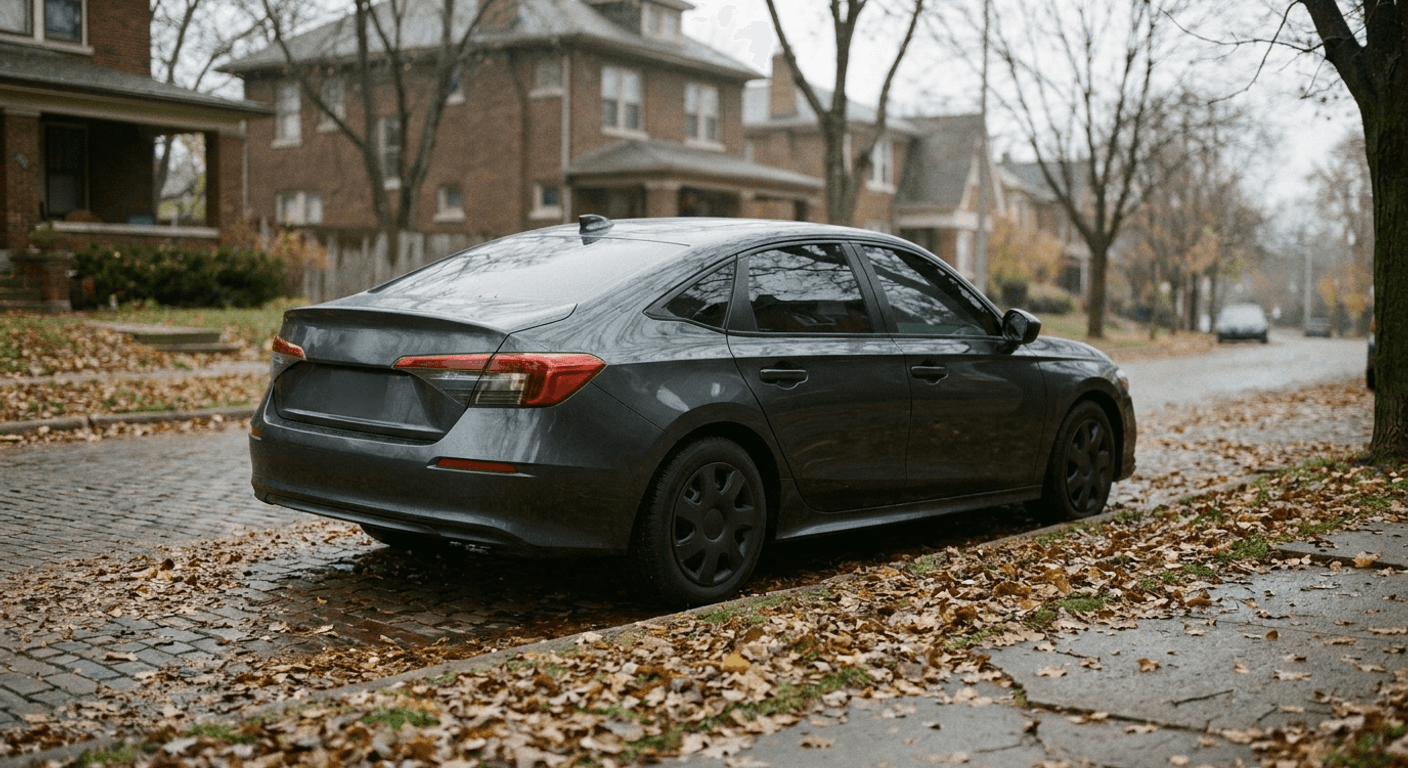
In Tennessee, front side windows must allow at least 35% visible light transmission (VLT). Tennessee Code Annotated 55-9-107 sets that same 35% VLT floor on every window of every vehicle, including back side windows and the rear window, with no separate rule for SUVs, vans, or other multipurpose vehicles.
What is the legal tint limit in Tennessee?
Tennessee window tint law is governed by T.C.A. 55-9-107. The single most important number is 35% VLT for front side windows, which applies to every vehicle on Tennessee roads. A higher VLT percentage means lighter tint and more light passing through; a lower VLT percentage means darker tint and less light.
For the windows behind the driver, Tennessee does not draw a line between sedan-type vehicles and multipurpose vehicles. The 35% VLT minimum applies to both back side windows and the rear window on every vehicle type, including SUVs, vans, and trucks.
| Window | Minimum VLT (all vehicle types) |
|---|---|
| Front side windows | 35% |
| Back side windows | 35% |
| Rear window | 35% |
| Windshield | Manufacturer's standard installed shade band only; main area must allow at least 70% VLT |
Tennessee's statute does not exempt SUVs, vans, or trucks from the 35% floor. The exemptions in the law are narrow and unrelated to vehicle body style. T.C.A. 55-9-107(a)(6)(A) lifts the restrictions for vehicle models that federal regulations permit to be equipped with non-conforming tinted windows, for vehicles bearing commercial license plates or government service license plates that are used for law enforcement purposes (for those windows rearward of the front doors, a test that turns on the plates rather than on whether the vehicle is marked), for vehicles registered in another state that meet the requirements of the state of registration, and for vehicles owned or leased by private investigators or by investigations companies licensed under title 62, chapter 26. Subsection (a)(6)(B) adds that none of these exemptions reaches the front door windows of any vehicle.
Windshield tint rules in Tennessee
Tennessee requires the main area of the windshield to allow at least 70% VLT. The statute is written as a prohibition on material that reduces windshield light transmittance below 70%, so a windshield sitting exactly at 70% complies and anything under that does not. T.C.A. 55-9-107 exempts only the manufacturer's standard installed shade band, the factory-applied tinted strip that comes on the windshield from the vehicle manufacturer, not an aftermarket strip an installer adds above the AS-1 line. No tint may extend below that factory shade band onto the primary driving field of the windshield.

Tennessee's statute regulates only visible light transmittance. T.C.A. 55-9-107 does not name banned colors and does not set a separate reflectivity or mirrored-finish rule, so a metallic or mirrored film is judged by the same 35% VLT floor as any other film (and by the 70% windshield floor). Highly reflective films often fail that VLT test in practice, and an officer can still cite a film that obstructs the driver's view, but the ban on mirrored tint that many tint shops describe is not in the Tennessee statute.
The 70% threshold for the full windshield is worth noting if you are considering a clear UV-blocking film across the entire windshield. Any full-windshield film must still leave the glass passing at least 70% of visible light to be legal.
Medical exemptions in Tennessee
Tennessee allows a tint exemption for a medical condition, but a physician's letter is not itself the exemption and is not the document that belongs in the car. Under T.C.A. 55-9-107(b)(1), a person with a medical condition that is adversely affected by ultraviolet light submits a statement from that person's physician to the commissioner of safety, certifying that the condition requires light transmission in the vehicle's windows below the standards in subsection (a). The commissioner then submits that certified statement to the department's medical review board for evaluation.
If the review board finds the exemption warranted, it recommends that the commissioner authorize it and recommends the degree of tinting exemption that is appropriate. Only at that point does the state issue the document that goes in the vehicle: the commissioner supplies a certificate or decal indicating the degree of exemption, and the applicant displays it in the motor vehicle. Installing darker film on the strength of a doctor's note alone, before the board has acted and the certificate or decal has been issued, leaves the vehicle out of compliance.
The Tennessee Department of Safety and Homeland Security runs the paperwork through its Driver Improvement unit. Its published guidance asks for the doctor's statement together with a copy of the vehicle registration and the driver license number, submitted to Driver.Improvement@tn.gov, and says an approved applicant receives a decal and a certificate carrying the commissioner's signature. The department estimates about three to four weeks to process a request.
The statute does not list qualifying diagnoses. It conditions relief on a medical condition that is adversely affected by ultraviolet light, evaluated case by case by the medical review board, and the board also decides how much darker the tint may be rather than granting a blanket pass. An applicant aggrieved by a decision of the medical review board or the commissioner may appeal under the Uniform Administrative Procedures Act, and may take that appeal to the chancery court of the county where the applicant resides.
How tint is measured and certified in Tennessee
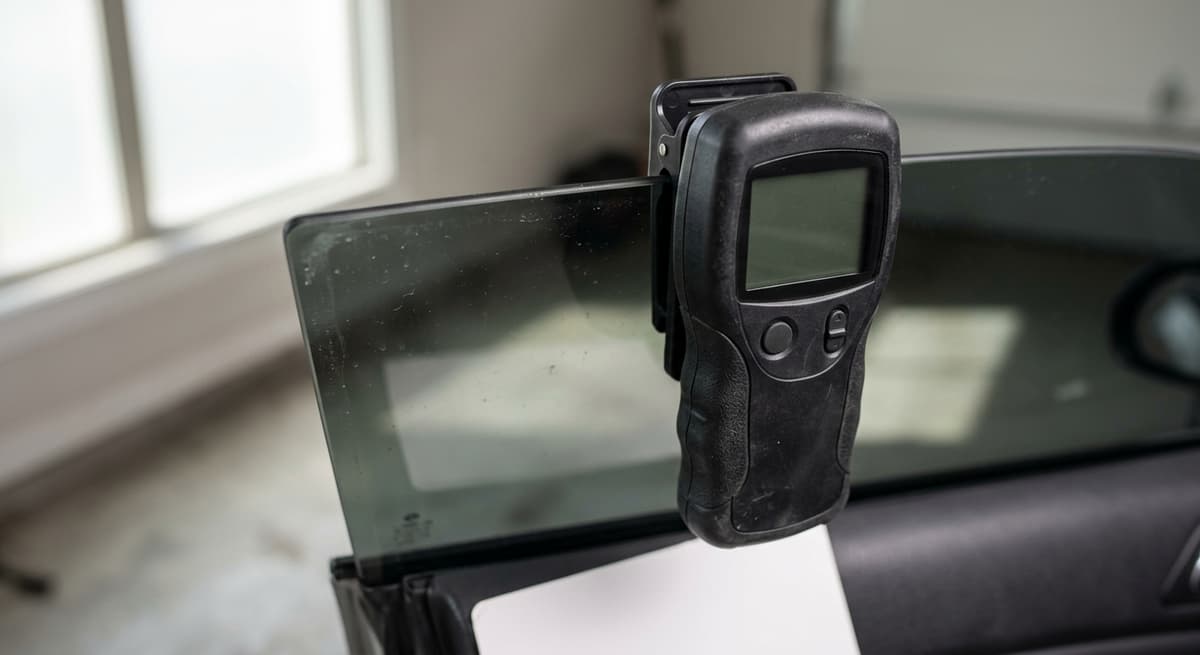
Tennessee law enforcement uses a VLT meter to test window tint during traffic stops. The officer measures the percentage of visible light passing through the glass, and if it falls below the legal limit, a citation can be issued. T.C.A. 55-9-107(c) supplies the authority for the stop itself: a POST-certified law enforcement officer who has a reasonable belief that a vehicle violates the limits in subsection (a)(1) has probable cause to detain that vehicle for the purpose of conducting a field comparison test. Subsection (e) directs the commissioner of safety to establish a standardized method and procedure for that test, so the roadside reading is meant to follow one statewide protocol.
The installer label is a duty on the shop rather than on the vehicle owner. T.C.A. 55-9-107(a)(3) requires professional installers, defined in (a)(2) as anyone who installs window tinting materials in Tennessee for profit, barter, wages, or commissions, to supply and affix an adhesive label to the lower right corner of the driver's window carrying the installer's business name and the legend stating that the vehicle complies with Tennessee Code Annotated section 55-9-107. Subsection (a)(4) separately requires the installer to give each customer a signed receipt showing the installation date, the vehicle's make, model, paint color and plate, a legend that the film complied at the date of installation, and a note that the receipt should be kept with the vehicle registration documents. Film a vehicle owner installs personally carries no labeling obligation.
What the statute does put on the owner is subsection (a)(5): the owner of any vehicle in question has the burden of proof that the motor vehicle is in compliance with this section. That provision is what makes the label and the receipt practically useful. Neither one is a defense on its own, but together they are the ordinary way an owner meets that burden after a roadside reading.
When choosing an installer, ask specifically whether they are familiar with T.C.A. 55-9-107 and whether they will provide the compliance label and the signed receipt the statute requires of them. Keep the receipt showing the VLT percentage of the film installed. If you are stopped and receive a citation you believe is in error, that paperwork and the label together form the basis of a challenge.
The Tennessee statute does not specify a published measurement tolerance, unlike South Dakota's broad plus or minus 9% or Alabama's plus or minus 3%. In practice, officers generally allow a small real-world variance for measurement equipment calibration, but there is no statutory protection for being slightly over the darkness limit.
Penalties for illegal tint in Tennessee
A violation of Tennessee's window tint law under T.C.A. 55-9-107 is a Class C misdemeanor. A Class C misdemeanor in Tennessee carries a maximum penalty of 30 days in jail and a fine of up to $50. In practice, tint violations are almost always resolved with a fine and a requirement to bring the vehicle into compliance. Jail time for a first-time tint offense is exceedingly rare.
Subsection (d) creates two separate offenses at that grade, and drivers usually hear about only one of them. It is a Class C misdemeanor for any person to otherwise violate any provision of the section, and it is independently a Class C misdemeanor for the operator of a motor vehicle to refuse to submit to the field comparison test when directed to do so by a POST-certified law enforcement officer. Refusing the meter is its own charge, and it stands whether or not the film turns out to be illegal.
If you are cited, you typically have the option to correct the violation (remove or replace the non-compliant tint) and present evidence of correction to the court, which may result in dismissal or reduction of the fine. Courts handle these corrections differently by county, so contacting the issuing court for their specific process is advisable.
A missing installer label is not an offense committed by the owner. The labeling duty in subsection (a)(3) runs to professional installers, so an absent sticker is a problem for the shop that skipped it. The cost to the driver is evidentiary rather than criminal: without the label and the receipt, the owner is left carrying the subsection (a)(5) burden of proving compliance with nothing but the officer's meter reading.
If you want to tint your windows in Tennessee
Here is how to get tint installed in Tennessee and stay on the right side of T.C.A. 55-9-107.

The 35% VLT minimum applies to every window position and every vehicle type in Tennessee, including SUVs, vans, and trucks. There is no extra flexibility for the rear windows of a multipurpose vehicle.
All four side windows and the rear window must meet the 35% threshold. Choosing a 35% film is legal, but a 40% film gives you a buffer in case of meter variation.
Ask your installer for the T.C.A. 55-9-107 compliance label the statute requires them to affix, and make sure it goes in the lower right corner of the driver's window. If an installer does not know about that labeling duty, find a different installer.
Keep a copy of the installation receipt with the film's VLT specs in the glove box. If you have a medical exemption, the item that belongs in the vehicle is the state-issued certificate or decal showing your authorized degree of exemption, displayed as the department directs, not the physician's letter that started the application.
Be cautious with metallic or mirrored film. Tennessee's statute does not ban it as such, but reflective films frequently measure below the 35% VLT floor, and the windshield may carry no aftermarket film at all beyond the manufacturer's shade band.
This article is general legal information, not legal advice. Window tint limits vary by state and change, and enforcement depends on local practice and your specific vehicle. For a definitive answer, check your state DMV or consult a local attorney.
Tennessee also regulates what items can be mounted on the windshield and what may obstruct the driver's view from inside the car. See Tennessee Windshield Mounting Restrictions for those rules.
More Tennessee Laws
Frequently Asked Questions
What is the legal tint in Tennessee?
Tennessee requires every window, front side windows, back side windows, and the rear window, to allow at least 35% VLT, and this applies to every vehicle type, including SUVs and vans.
How dark can my front windows be in Tennessee?
The darkest legal front side window tint in Tennessee is 35% VLT. This limit applies to all vehicle types, including SUVs and vans. Lower percentages are darker, so anything below 35% on a front side window is illegal.
Is 35% tint legal in Tennessee?
Yes. 35% VLT is exactly the legal minimum for front side, back side, and rear windows, for every vehicle type. It is exactly at the limit, so there is no additional buffer, but it is a lawful choice.
Do SUVs and vans have different tint rules in Tennessee?
No. Tennessee's 35% VLT minimum applies to every window, front side, back side, and rear, on every vehicle type. SUVs, vans, and trucks do not get any extra darkness allowance behind the driver.
Can I get a medical exemption for window tint in Tennessee?
Yes, but a physician's letter is not itself the exemption. Under T.C.A. 55-9-107(b)(1) the physician's statement goes to the commissioner of safety, who submits it to the department's medical review board. If the board finds the exemption warranted, it recommends the degree of exemption and the commissioner supplies a certificate or decal that the applicant displays in the vehicle. The Department of Safety and Homeland Security handles these through Driver Improvement and estimates about three to four weeks. An aggrieved applicant may appeal under the Uniform Administrative Procedures Act to the chancery court of the county where the applicant resides.
What is the penalty for illegal tint in Tennessee?
Illegal tint in Tennessee is a Class C misdemeanor under T.C.A. 55-9-107, which carries a maximum fine of $50 and up to 30 days in jail. Subsection (d) also makes it a separate Class C misdemeanor to refuse the roadside field comparison test when an officer directs you to submit to it. In practice, tint violations almost always result in a fine and a fix-it requirement.
Is windshield tint legal in Tennessee?
Only the manufacturer's standard installed factory shade band at the top of the windshield is exempt; there is no allowance for an aftermarket AS-1-line strip. The main windshield area must allow at least 70% VLT, because the statute bars material that reduces windshield light transmittance below 70%, and no tint film may extend below the factory shade band onto the primary driving field.
Do I need a sticker for my tinted windows in Tennessee?
The labeling duty belongs to the installer, not to you. T.C.A. 55-9-107(a)(3) requires professional installers, meaning those who install tint for profit, barter, wages, or commissions, to affix a label citing the statute to the lower right corner of the driver's window, and (a)(4) requires them to provide a signed receipt. Film you install yourself carries no labeling requirement, and the statute creates no owner offense for a missing sticker. What it does put on the owner is subsection (a)(5), the burden of proving the vehicle complies, which is why the label and receipt are worth keeping.
Updates
Corrected the medical exemption to the process the statute actually sets out (a physician's statement goes to the commissioner and the department's medical review board, which sets the degree of exemption before the state issues the certificate or decal that is displayed in the vehicle), moved the installer-label duty onto professional installers where the statute puts it and added the owner's burden of proving compliance, fixed the law-enforcement and private-investigator exemptions to track the statutory text, harmonised the windshield limit to at least 70% VLT, and added the separate offense of refusing a roadside field comparison test.
Corrected a fabricated sedan-versus-SUV tint distinction: Tennessee's 35% VLT minimum applies to every window on every vehicle type, with no extra allowance for SUVs or vans. Also corrected the windshield exception (a factory shade band, not an aftermarket strip) and fixed a dead statute citation.
Independently fact-checked against the cited primary sources; governing law re-checked for recent changes
Governing law re-checked for recent changes
Reviewed and approved by an editor
The Law Behind This Article
This article rests on the statutory provisions below, held in our own legal record and retrieved from the official source. Tap a section to read the operative text.
Tennessee Code Annotated
§ 55-9-107Tinted motor vehicle windows.In forcecited in 2 of our articles
(a)(1) It is unlawful for any person to operate, upon a public highway, street or road, any motor vehicle in which any window that has a visible light transmittance equal to, but not less than, that specified in the Federal Motor Vehicle Safety Standard No.…
Official text (excerpt) · last checked 2026-09-01 · Read the full text in our law library
Cited in 13 court opinions in our collectionLatest citing opinion in our collection: 2023
In the courts (editorial summary, independently checked):State of Tennessee v. Shaun Anthony Davidson and Deedra Lynette Kizer (2013) rejected vagueness and overbreadth challenges to the detention provision of section 55-9-107. State of Tennessee v. Joseph Sanford McNair, Jr. (2015) found reasonable suspicion from a windshield an officer could not see through.
Opinions citing this section in our collection:
- State v. Harton (Court of Criminal Appeals of Tennessee 2002, 108 S.W.3d 253)✓An interdiction agent stopped an out-of-state car for following too closely and for tint; the court noted the Tennessee tint law reaches only vehicles registered in the state, so that ground was improper, but held it did not invalidate the following-too-closely stop.
- State v. Jarnigan (Court of Criminal Appeals of Tennessee 1997, 958 S.W.2d 135)✓A driver cited under the tint law was convicted at a bench trial; the court treated the offense as a Class C misdemeanor carrying a jury-trial right and reversed the conviction because the record showed no written jury waiver.
- Young v. State, Department of Safety (Court of Appeals of Tennessee 1995, 911 S.W.2d 729)✓Officers cited the driver of a Kentucky-plated car under the tint law during a stop that led to a cash forfeiture; the court noted the statute does not reach a vehicle not registered in Tennessee and held the tint citation was incidental to a stop valid on other grounds.
Identified automatically from the court opinions citing this section — not a ranking of which case controls.
Also relied on in: Tennessee Windshield Mounting Laws (2026 Guide)
Search our full record of US law — 2.1 million sections, every state + federal →
Sources and References
- Tennessee Code Annotated 55-9-107 (Window Tint)(law.justia.com)
- Tennessee Department of Safety and Homeland Security, How do I obtain a window tint exemption?(safetysupport.tn.gov)
- Tennessee Public Chapter No. 602 (2024), amending T.C.A. 55-9-107 to substitute 'POST-certified law enforcement officer'(publications.tnsosfiles.com)