
North Carolina
North Carolina Window Tint Laws (2026): Legal VLT Limits
Independently fact-checked against primary sources (last audited August 18, 2026). · Reviewed by the RecordingLaw editorial team. · Law checked current as of August 18, 2026. · 1 primary source cited on this page. How we verify our legal content
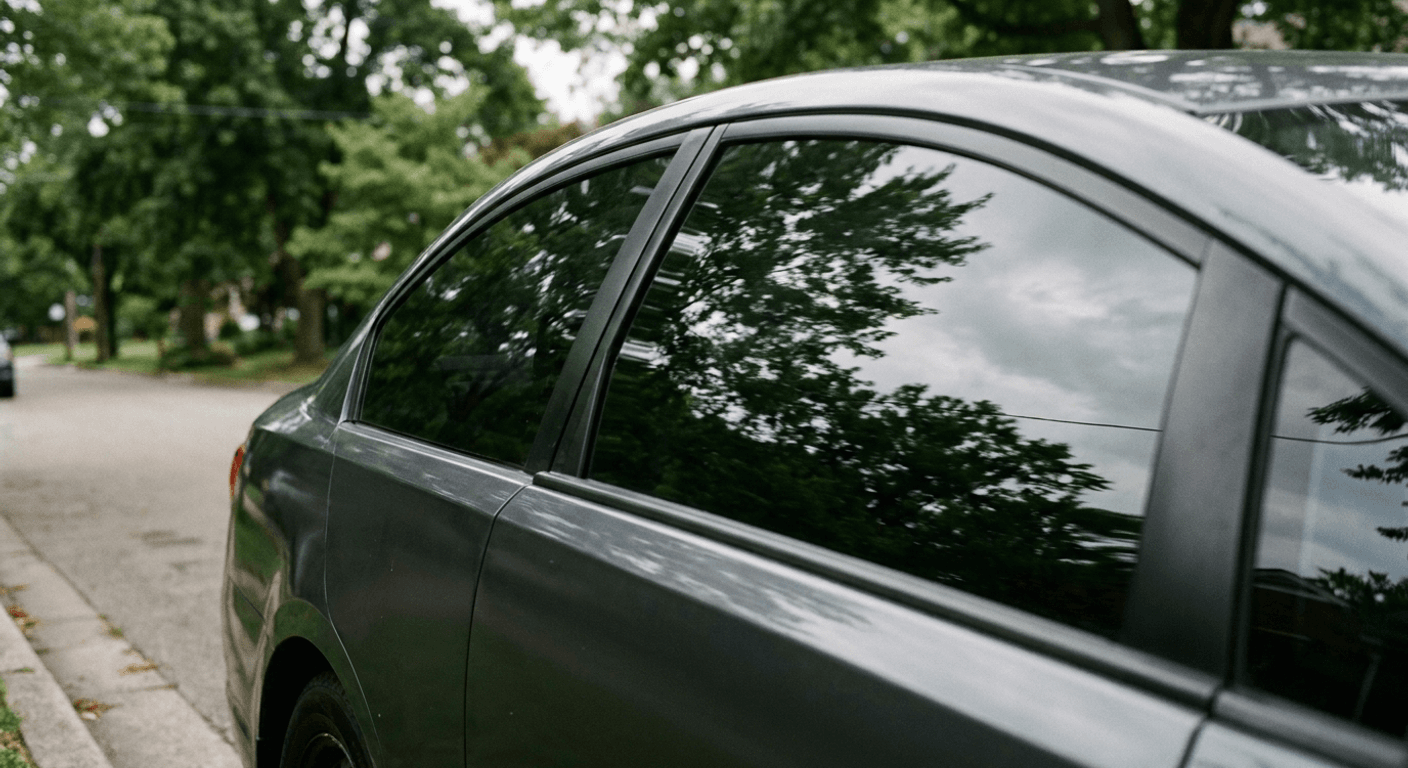
North Carolina requires front side windows to allow at least 35% visible light transmission (VLT), with a reading above 32% accepted as conclusively compliant. Back side and rear windows follow the same 35% standard (32%+ presumed compliant), and the windshield permits tint only on the top 5 inches or above the AS-1 line.
What is the legal tint limit in North Carolina?
North Carolina law sets a 35% VLT minimum for the front side windows, back side windows, and rear window. In other words, your tint must allow at least 35% of visible light to pass through. If a calibrated VLT meter reads above 32%, the state presumes that window meets the 35% standard, which gives a small tolerance for testing variation.
Higher VLT percentages mean lighter (less dark) tint, while lower percentages mean darker tint. A 35% tint is moderately dark but not extreme. North Carolina's law does distinguish multipurpose vehicles from sedans: G.S. 20-127(c)(9) exempts windows behind the driver in a multipurpose vehicle (a passenger vehicle built on a truck chassis or with special features for occasional off-road operation, carrying 10 or fewer passengers, including minivans and pickup trucks) from both the 35% VLT floor and the 20% reflectance cap.
| Window | Legal VLT Minimum | Presumed Compliant If |
|---|---|---|
| Front side windows | 35% | Reading above 32% |
| Back side windows | 35% | Reading above 32% |
| Rear window | 35% | Reading above 32% |
| Windshield | Factory glass (full); tint strip at top only | N/A |
This table's back side and rear window limits apply to sedans and other non-exempt vehicles. Multipurpose vehicles, such as minivans and pickup trucks, are exempt from the 35% VLT floor and the 20% reflectance cap on windows behind the driver under G.S. 20-127(c)(9).
Multipurpose vehicles are not the only carve-out. G.S. 20-127(c) lists several vehicle windows that the 35% VLT floor and the 20% reflectance cap do not reach. The one that matters most to visiting drivers and to people who have just moved is subdivision (c)(10): a window of a vehicle registered in another state, which meets the requirements of the state where it is registered, is exempt. If your car carries out-of-state plates and its tint is legal at home, North Carolina's 35% floor does not apply to it. The rear window of a property-hauling vehicle is exempt under (c)(6), and the list also covers excursion passenger vehicles, motor homes, ambulances, limousines, law enforcement vehicles, and any vehicle holding a medical exception permit.
Two rules survive every one of those exceptions. The windshield restrictions apply without exception to any vehicle, and subsection (c) lifts only the VLT floor in (b)(1) and the reflectance cap in (b)(2), so the ban on reflective film and on red, yellow, or amber tint in (b)(3) still applies to an exempt window.
One important update: effective December 1, 2025, tint is no longer evaluated during the mandatory annual safety inspection in North Carolina (Session Law 2025-47). However, that change does not affect roadside enforcement. Officers can still stop and cite a vehicle for illegal tint during a traffic stop or equipment check. The same session law also added a new roadside obligation: under G.S. 20-127(g), a driver with tinted windows must roll down the driver-side window when a law enforcement officer approaches the vehicle, or the passenger-side window if the officer approaches from that side.
Windshield tint rules in North Carolina
The front windshield has the strictest rules of any window. The law allows non-reflective tint only on the top 5 inches or above the manufacturer's AS-1 line (whichever extends lower). Below that line, the windshield must stay clear, because the driver's primary field of vision cannot be obstructed.
There is one significant exception: clear UV-blocking film that does not reduce visible light transmission is permitted on the entire windshield. This kind of film provides heat and UV protection without darkening the glass, making it a popular option for drivers who want protection without running afoul of the VLT rules.
Reflectivity rules apply to all tinted windows. North Carolina limits light reflectance to 20% on any window. Films with a mirrored or metallic appearance that bounce back more than 20% of light are not compliant. Red, yellow, and amber tint colors are banned outright on any window, including the windshield strip.
Medical exemptions
North Carolina does allow a medical exemption for drivers or passengers who have a documented photosensitive medical condition. The exemption is administered through the Drivers Medical Evaluation Program under N.C.G.S. 20-127(f). A physician must certify the medical need, and the driver applies to that program.
If granted, the exemption allows a vehicle to carry darker tint than the standard limits. The permit names the specific vehicle it covers, which windows may be tinted, and the levels of tinting allowed. G.S. 20-127(f) then requires that the permit be carried in the vehicle to which it applies whenever that vehicle is driven on a highway. That is a legal duty, not a precaution, so treat the permit the way you treat your registration. A compliance sticker must also be placed on the lower-left corner of the rear window. Driving with an approved medical exemption but without that sticker is itself an infraction carrying a $200 fine.
A medical exception permit is valid for five years from the date it is issued, unless the Drivers Medical Evaluation Program sets a shorter term, and renewing it requires a fresh medical recertification that the person still has a condition requiring tinting. No one may hold more than four valid medical exception permits at any one time.
How tint is measured and certified
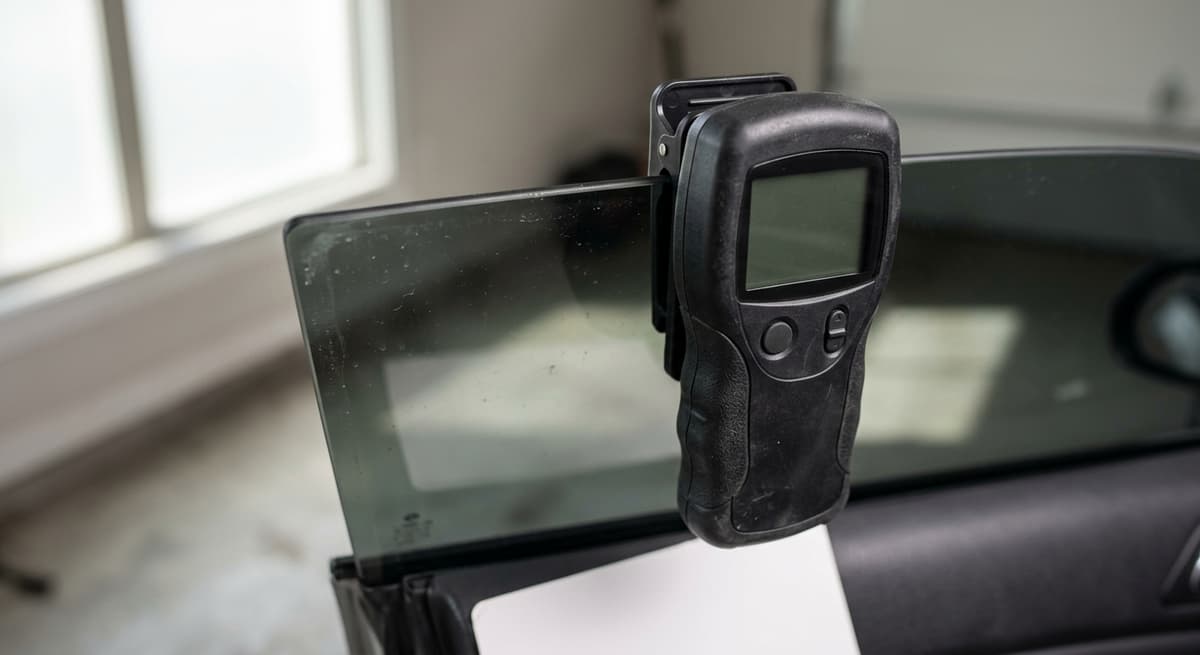
VLT is measured with a calibrated tint meter that shines light through the glass and calculates the percentage transmitted. In North Carolina, the measurement standard builds in a practical tolerance: any reading above 32% is conclusively presumed to meet the 35% minimum. This means borderline tint near 33-35% will generally pass a roadside check without issue.

The statute requires the VLT to be measured as the combined transmittance of the film and the factory glass together, not just the film alone. Factory glass already blocks some light, so a film sold as "35% VLT" may produce a combined reading lower than 35% if layered on glass that is already somewhat dark. Ask your installer to measure the combined reading before you leave the shop.
There is no state-mandated compliance sticker required for standard tint installations in North Carolina (the sticker requirement applies only to medical exemption vehicles). However, keeping your installer's certificate in the vehicle is a good practice if an officer questions the tint.
Penalties for illegal tint in North Carolina
A violation of N.C.G.S. 20-127 is a Class 3 misdemeanor, which is the lowest misdemeanor tier in the state. The law provides a defense under G.S. 20-127(e): if the tinting was removed within 15 days after the charge and the window now meets the restrictions, that correction is a defense to the charge.
Removing the film is only half of it. The same subsection requires the person charged to produce in court, or submit to the prosecuting attorney before trial, a certificate from the Division of Motor Vehicles or the Highway Patrol showing that the window complies with the restrictions. A driver who strips the tint and then shows up to court with nothing else cannot assert the defense. Arrange the DMV or Highway Patrol inspection and get that certificate in hand before your court date.
Additional penalties apply for medical exemption holders who fail to display the required sticker. That specific infraction carries a $200 fine separate from the general tint-violation charge. Installers who apply non-compliant tint can also face liability, since the statute reaches the installation of the film, not just operating the vehicle.
Because tint is no longer inspected during annual safety checks as of December 1, 2025, violations are now identified entirely through roadside enforcement. Drivers with non-compliant tint will not be flagged at inspection stations but can still be cited during any traffic stop.
If you want to tint your windows in North Carolina
Start by choosing a VLT value at or above 35% for all side and rear windows. Given the 32% presumption threshold, selecting a film in the 35-40% range gives you a comfortable buffer for measurement variation and aging of the film. Avoid any film in red, yellow, or amber tones, and confirm the final reflectivity will not exceed 20%.
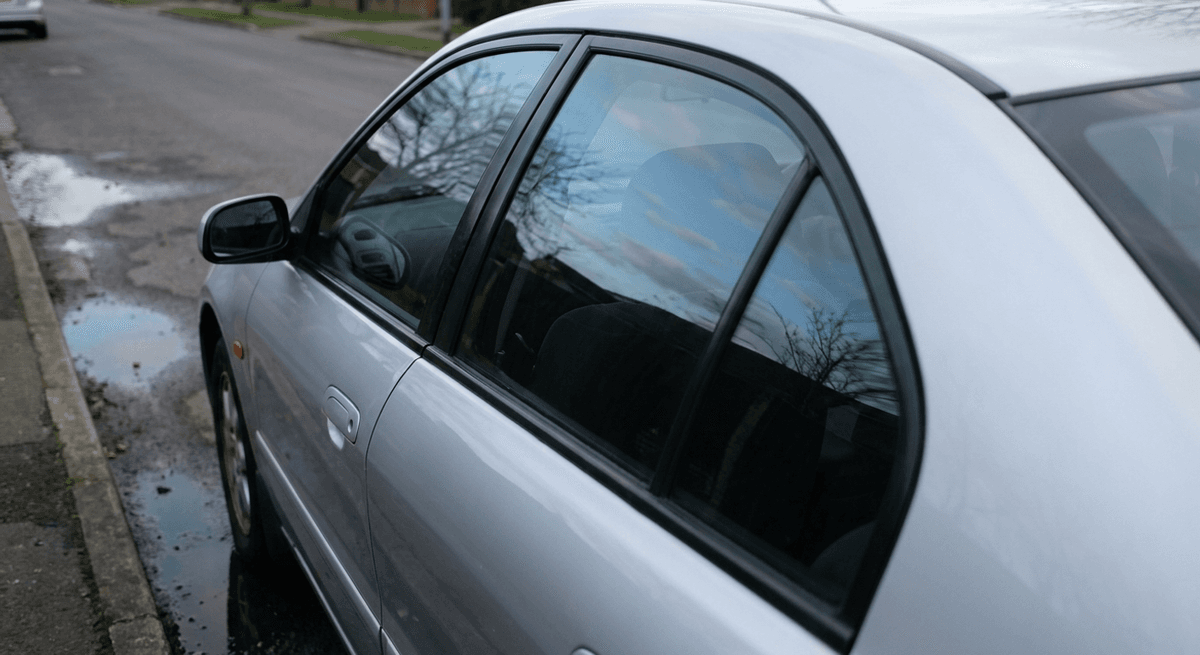
Use a licensed installer who will measure the combined VLT of your factory glass plus the new film before installation is complete. Ask for a written certificate showing the VLT and reflectance values for each window. While North Carolina does not require you to carry that certificate, it can help if an officer disputes the legality of your tint during a stop.
If you have a photosensitive medical condition, apply to the Drivers Medical Evaluation Program before installing darker-than-legal tint. Operating with a medical exemption tint without the proper sticker on the rear window results in a separate $200 fine, so get the sticker affixed before driving.
Remember that the December 1, 2025 inspection change only removes the inspection checkpoint. The underlying law has not changed: front, back, and rear windows must still let in 35% or more visible light, and roadside enforcement remains fully active.
This article is general legal information, not legal advice. Window tint limits vary by state and change, and enforcement depends on local practice and your specific vehicle. For a definitive answer, check your state DMV or consult a local attorney.
If you are also researching what you can mount on your windshield, see the North Carolina windshield mounting restrictions page.
More North Carolina Laws
Frequently Asked Questions
What is the legal tint in North Carolina?
North Carolina requires at least 35% VLT on front side, back side, and rear windows. A meter reading above 32% is conclusively presumed to meet the 35% limit. The windshield must stay clear except for a non-reflective strip on the top 5 inches.
How dark can my front windows be in North Carolina?
Front side windows must allow at least 35% of visible light through the combined film and glass. In practice, a meter reading above 32% is accepted as compliant. Darker film than 35% VLT is illegal and may result in a Class 3 misdemeanor.
Is 20% tint legal in North Carolina?
In most vehicles, no. North Carolina requires a minimum 35% VLT on side and rear windows. A 20% tint allows far less light through than the law permits and would be a violation subject to a misdemeanor charge. The main exceptions are multipurpose vehicles (minivans, pickup trucks, and similar SUV/truck-chassis vehicles), where windows behind the driver are exempt from the VLT floor under G.S. 20-127(c)(9), and vehicles registered in another state, which are exempt under G.S. 20-127(c)(10) if their windows meet the requirements of the state where they are registered.
Can I get a medical exemption for window tint in North Carolina?
Yes. North Carolina's Drivers Medical Evaluation Program grants medical exemptions under N.C.G.S. 20-127(f) when a physician certifies a photosensitive condition. The permit is valid for five years, renewal requires a fresh medical recertification, and no one may hold more than four valid permits at once. The permit must be carried in the vehicle it covers whenever that vehicle is driven on a highway. An approved exemption also requires a compliance sticker on the lower-left corner of the rear window, and driving without that sticker is a separate $200 infraction.
What is the penalty for illegal tint in North Carolina?
Illegal tint is a Class 3 misdemeanor. Removing the tint within 15 days after the charge is a defense, but only if you also produce in court, or submit to the prosecuting attorney before trial, a certificate from the Division of Motor Vehicles or the Highway Patrol showing the window now complies. Removal without that certificate does not raise the defense. Medical exemption holders who lack the required rear-window sticker face an additional $200 infraction.
Is windshield tint legal in North Carolina?
Non-reflective tint is allowed only on the top 5 inches of the windshield or above the AS-1 line. Clear UV-blocking film that does not reduce visible light transmission is permitted on the entire windshield. Tinted film below the AS-1 line that reduces VLT is not permitted.
Is tint still checked at safety inspections in North Carolina?
No. Effective December 1, 2025, Session Law 2025-47 removed window tint from the mandatory safety inspection checklist. However, roadside enforcement by law enforcement officers continues, and illegal tint can still result in a misdemeanor citation during any traffic stop. The same law also added a new requirement under G.S. 20-127(g): a driver with tinted windows must roll down the driver-side window when an officer approaches, or the passenger-side window if the officer approaches from that side.
Updates
Corrected the 15-day tint-removal defense to include the required DMV or Highway Patrol compliance certificate, described the medical exception permit carry duty, five-year term and four-permit limit as the statute requires, and added the out-of-state registration and property-hauling exemptions under G.S. 20-127(c).
Added a companion requirement from the same 2025 law that removed tint from safety inspections: under G.S. 20-127(g), a driver with tinted windows must roll down the driver-side window (or the passenger-side window if approached from that side) when a law enforcement officer approaches.
Independently fact-checked against the cited primary sources; governing law re-checked for recent changes
Restored G.S. 20-127(c)(9)'s exemption for multipurpose vehicles (minivans, pickup trucks, and similar SUV/truck-chassis vehicles): windows behind the driver are exempt from the 35% VLT floor and 20% reflectance cap, which the article had previously and incorrectly denied.
Governing law re-checked for recent changes
Reviewed and approved by an editor
The Law Behind This Article
This article rests on the statutory provisions below, held in our own legal record and retrieved from the official source. Tap a section to read the operative text.
North Carolina General Statutes, Chapter 20: Motor Vehicles.
§ 20-127Windows and windshield wipersIn forcecited in 3 of our articles
(a) Windshield Wipers. - A vehicle that is operated on a highway and has a windshield shall have a windshield wiper to clear rain or other substances from the windshield in front of the driver of the vehicle and the windshield wiper shall be in good working order. If a vehicle has more than one windshield wiper to clear substances from the windshield, all the windshield wipers shall be in good working order. (b) Window Tinting Restrictions. - A window of a vehicle that is operated on a highway or a public vehicular area shall comply with this subsection. The windshield of the vehicle may be tinted only along the top of the windshield and the tinting may not extend more than five inches below the top of the windshield or below the AS1 line of the windshield, whichever measurement is longer. Provided, however, an untinted clear film which does not obstruct vision but which reduces or eliminates ultraviolet radiation from entering a vehicle may be applied to the windshield. Any other window of the vehicle may be tinted in accordance with the following restrictions: (1) The total light transmission of the tinted window shall be at least thirty-five percent (35%).
Official text (excerpt) · last checked 2026-09-01 · Read the full text in our law library · Verify at ncleg.gov
Cited in 3 court opinions in our collectionLatest citing opinion in our collection: 2011
Opinions citing this section in our collection:
- State v. Schiffer (Court of Appeals of North Carolina 1999, 132 N.C. App. 22)“…than permitted under North Carolina law. See N.C. Gen. Stat. § 20-127 (b) (Cum. Supp. 1997) (containing this…”
- State v. Veazey (Court of Appeals of North Carolina 2008, 191 N.C. App. 181)“…nside rearview mirror and a driver’s-side outside mirror); N.C. Gen. Stat. § 20-127 (a)-(b) (2007) (vehicle must have a win…”
- State v. Williams (Court of Appeals of North Carolina 2011, 215 N.C. App. 1)“…ey rode had tinted windows in violation of state law, see N.C. Gen.Stat. § 20-127(b), (d) (2009), and cited Perez for the…”
Identified automatically from the court opinions citing this section — not a ranking of which case controls.
Also relied on in: North Carolina Windshield Mounting Laws (2026 Guide), North Carolina Dashcam Laws: Mounting, Recording, and Evidence Rules
Connecticut General Statutes, Title 20 (Professional and Occupational Licensing, Certification, Title Protection and Registration. Examining Boards), Chapter 380
§ 20-127Definitions. Scope of practice. License renewal forms.In force
(a) For the purposes of this chapter: (1) The “practice of advanced optometric care” means any one or more of the following practices and procedures: (A) Measuring, examining, diagnosing, preventing, enhancing, managing or treating visual functions, defects of vision, muscular functions or anomalies, or other conditions or diseases of the visual system, the eye and ocular adnexae; (B) the prescribing, supplying, adjusting, fitting or adapting of ophthalmic devices and lenses, spectacles, prisms, orthoptic therapy, visual therapy, visual rehabilitation, oculomotor therapy, tinted lenses, filters, contact lenses, diagnosing, preventing, enhancing, managing, treating or relieving visual functions, defects of vision, muscular functions or anomalies, or diseases of the visual system, the eye and ocular adnexae; (C) the administration or prescription of any pharmaceutical agents related to the diagnosis and treatment of conditions and diseases of the eye and ocular adnexae, excluding nonemergency oral glaucoma agents but including controlled substances under schedules II, III, IV and V in accordance with section 21a-252, subject to the limitations of subsection (f) of this section…
Official text (excerpt) · last checked 2026-07-29 · Read the full text in our law library · Verify at cga.ct.gov
Cited in 1 court opinions in our collectionLatest citing opinion in our collection: 1963
Opinions citing this section in our collection:
- MacK v. Saars (Supreme Court of Connecticut 1963, 150 Conn. 290)“…of vision and the adaptation of lenses for the aid thereof. General Statutes § 20-127. The majority concede, as indeed they m…”
Identified automatically from the court opinions citing this section — not a ranking of which case controls.
Search our full record of US law — 2.1 million sections, every state + federal →
Sources and References
- N.C.G.S. 20-127 - Window tinting and sunscreening(ncleg.gov).gov