North Dakota
North Dakota Drone Laws: N.D.C.C. 29-29.4 Warrant Rules
Independently fact-checked against primary sources (last audited August 17, 2026). · Reviewed by the RecordingLaw editorial team. · Law checked current as of August 17, 2026. · 3 primary sources cited on this page. How we verify our legal content
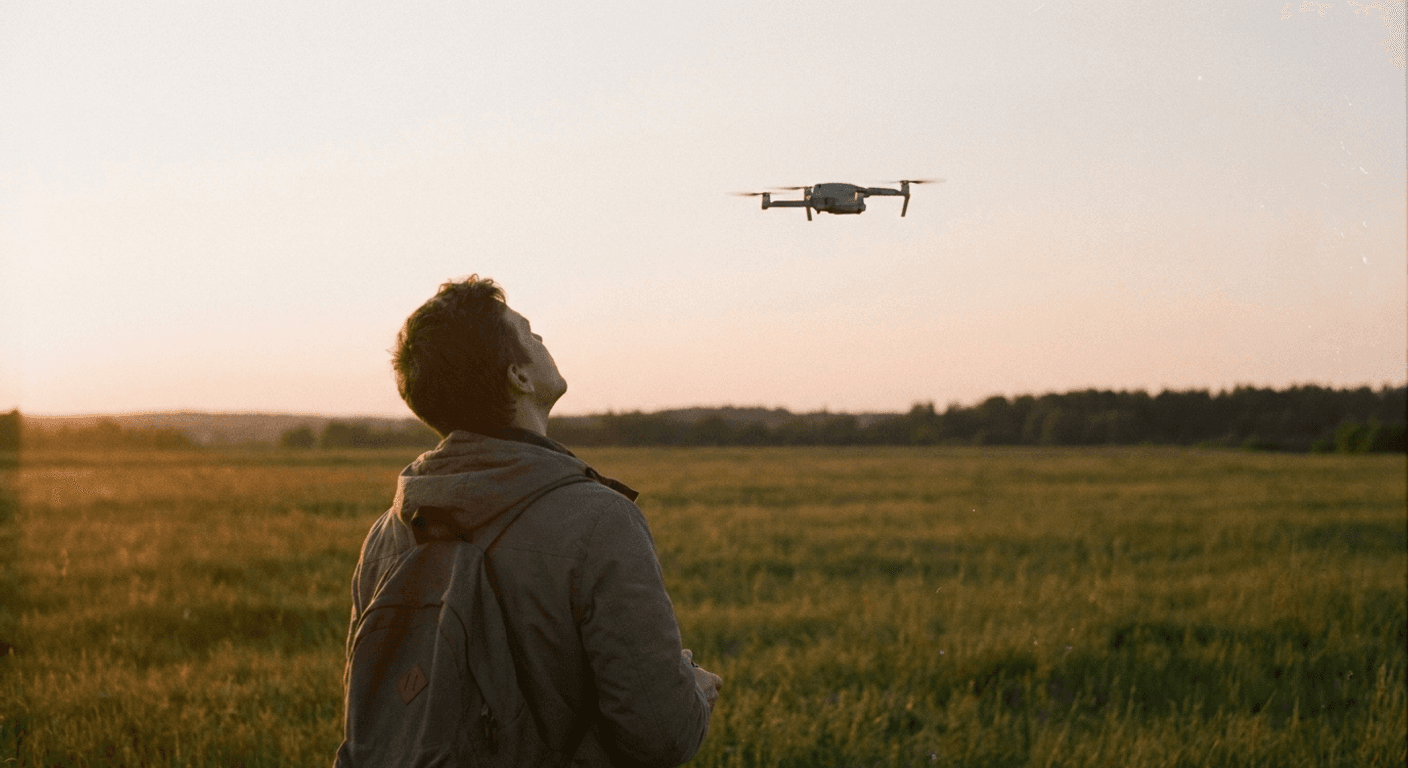
North Dakota law makes information a law enforcement agency gathers with a drone inadmissible in a criminal prosecution unless the agency obtained it under a search warrant or under a recognized exception to the warrant requirement, under N.D. Cent. Code Chapter 29-29.4. The same chapter bars arming police drones with lethal weapons, but, unusually, still allows less-than-lethal ones.
This guide is part of our Drone Laws by State series; for the broader rules on recording people and property in North Dakota, see our surveillance camera laws guide.
Information last verified on 2026-08-31. This article has not yet been reviewed by a licensed lawyer.
Jurisdiction scope: This article addresses North Dakota law on law-enforcement drone use under N.D. Cent. Code Chapter 29-29.4, general civilian drone conduct, and the federal shoot-down law. It does not cover FAA flight-operation rules, which apply the same way nationwide.
How federal and North Dakota law divide drone authority
The FAA controls the navigable airspace, which for drones extends down to the ground; every North Dakota operator must still register a qualifying drone, hold the applicable FAA credential, and broadcast Remote ID under the nationwide rules that took effect in 2023. None of that touches the question North Dakota's Legislature answered in 2015: what happens when a sheriff's department launches a drone over private land without asking a judge first. That is a state criminal-procedure question, and North Dakota legislated a direct answer largely in response to the Brossart standoff described below.

Does police need a warrant to fly a drone over my property in North Dakota?
Effectively yes, if the goal is evidence a prosecutor can use, but the mechanism is evidentiary rather than a ban on flying. N.D. Cent. Code Section 29-29.4-02 provides that information obtained from an unmanned aerial vehicle or robot is not admissible in a prosecution or proceeding within the state unless it was obtained under the authority of a search warrant, or in accordance with exceptions to the warrant requirement. The same section separately bars using that information in an affidavit of probable cause to obtain a search warrant, unless it came from a warrant, from a warrant exception, or through the monitoring of public lands or international borders.
Section 29-29.4-03 does not prohibit anything itself. It sets out what a drone surveillance warrant has to look like: it must satisfy the Constitution of North Dakota, and it must contain a data collection statement listing the persons that will have the power to authorize the use of the drone or robot, the locations in which it will operate, the maximum period it will operate on each flight or deployment, and whether it will collect information about individuals or groups, including the specific kinds of data, how long that data is kept, and whether and how it is destroyed. The first item is often described incorrectly. The statement identifies the officials who can authorize a deployment, not the personnel who will pilot the aircraft.
Section 29-29.4-04 is a savings clause listing four categories the chapter does not prohibit: patrol within twenty-five miles of a national border to prevent or deter illegal entry of individuals, illegal substances, or contraband; exigent circumstances, meaning the agency has reasonable suspicion that absent swift preventative action there is an imminent danger to life or bodily harm; an environmental or weather-related catastrophe, covering the assessment of environmental damage, erosion, flood, or contamination and the protection of public safety and property; and research, education, training, testing, or development undertaken by or with a school or institution of higher education, or with collaborators on those efforts.
Those four are not the full extent of when North Dakota police may fly without a warrant. Section 29-29.4-02 makes drone information admissible whenever it was obtained "in accordance with exceptions to the warrant requirement," which carries in the whole recognized body of Fourth Amendment and state warrant exceptions, including consent, plain view, and exigency, and the same section permits probable cause use of information obtained through the monitoring of public lands or international borders. A flight that fits none of Section 29-29.4-04's four categories can still produce admissible evidence on any of those grounds.
What the chapter does not do is make the flight itself illegal. Nothing in Chapter 29-29.4 creates a criminal offense, a civil penalty, or a private cause of action for a law enforcement drone flight conducted without a warrant. If a flight had neither a warrant nor an exception, the statutory consequence is that what it captured is inadmissible and cannot support a probable cause affidavit, not that an officer broke the law by flying.
Section 29-29.4-06 backs that regime with documentation requirements: agencies must log every surveillance flight's duration, path, and mission objective, have the flight information verified as accurate by the supervising authorized person, retain flight information for five years, cap retention of non-evidentiary imaging at 90 days, and let a criminal defendant obtain the underlying records through subpoena and discovery. It is one of the more detailed transparency requirements among states that regulate law enforcement drone use.
Can my neighbor legally fly a drone over my property in North Dakota?
North Dakota has no statute specifically barring one private citizen from using a drone to observe or photograph another. Chapter 29-29.4 governs law enforcement agencies, not civilians, so a dispute between neighbors falls back on general North Dakota law: civil trespass and nuisance theories, and the state's general privacy-tort and harassment statutes where the facts support them. A homeowner facing a persistent nuisance drone has a stronger claim through those doctrines, or through a direct complaint to the FAA if the operator can be identified, than through Chapter 29-29.4 itself.
North Dakota's law on arming police drones
Section 29-29.4-05 bars a law enforcement agency from authorizing the use of an unmanned aerial vehicle armed with any lethal weapon. The bill that became Chapter 29-29.4 originally would have banned weaponizing police drones entirely, but law enforcement groups lobbied against a blanket ban during the 2015 legislative process, and the amended version that passed left an opening for less-than-lethal payloads, such as tasers, rubber bullets, pepper spray, tear gas, and sound cannons, so long as the weapon is controlled remotely and cannot be activated autonomously. Multiple national news outlets described North Dakota at the time as the first state to explicitly authorize arming police drones with less-than-lethal weapons, a distinction civil-liberties groups criticized as an unintended result of law-enforcement-drafted amendments to what began as a privacy bill. The same section separately restricts a "robot's" deployment of a lethal weapon to narrow situations, requiring remote control rather than autonomous activation and limiting it to neutralizing an object at risk of exploding or posing an immediate threat, or preventing an imminent and substantial risk of serious injury or death where an officer's use of lethal force would already be legally justified.
The Rodney Brossart case: what actually happened
North Dakota's drone law is frequently discussed alongside the 2011 standoff at Rodney Brossart's farm near Lakota in Nelson County, one of the first publicized instances of a domestic law enforcement drone assisting an arrest, though the popular retelling overstates what the case decided. Six of a neighbor's cattle wandered onto Brossart's land in June 2011, and when deputies returned to retrieve them, Brossart's three armed sons refused to let them approach, triggering an armed standoff that stretched roughly 16 hours and drew a SWAT team from multiple counties. Nelson County Sheriff Kelly Janke arranged for a Predator B drone on loan from U.S. Customs and Border Protection to fly over the property; officers credited it with confirming it was safe to move in, and the sons were arrested without a shot fired.
Two points get lost in retellings. First, this happened four years before Chapter 29-29.4 existed, so no North Dakota warrant statute for drones could have been violated; the case is more accurately a catalyst for the 2015 law than a test of it. Second, the ruling on the drone issue came from a state court, not a federal one. Brossart's defense moved to dismiss the state charges on the ground that the drone surveillance was warrantless; in 2012, Northeast Central Judicial District Judge Joel D. Medd, a North Dakota state district judge, denied that motion, finding no improper use of the drone and that it had no bearing on the charges being contested. National coverage at the time frequently, and incorrectly, called Medd a "U.S. District Judge." A jury convicted Brossart of terrorizing law enforcement officers in January 2014, acquitting him of theft and criminal mischief; he was sentenced to three years with all but six months suspended, and his sons pleaded guilty to lesser menacing charges and received probation. No appellate court revisited the drone-warrant question, so the ruling carries no binding precedent beyond Brossart's own case.
| Question | North Dakota rule |
|---|---|
| Drone evidence in a prosecution | Inadmissible unless obtained under a search warrant or a warrant exception, N.D.C.C. Section 29-29.4-02 |
| What a drone warrant must contain | Data collection statement, including who may authorize the flight, Section 29-29.4-03 |
| Warrant exceptions | Any recognized exception to the warrant requirement, plus four categories the chapter does not prohibit in Section 29-29.4-04: border patrol (25 mi), exigent circumstances, environmental/weather catastrophe, research/education |
| Penalty for a warrantless police flight | None in the chapter; the consequence is that the evidence is suppressed |
| Lethal drone weapons | Banned, Section 29-29.4-05 |
| Less-than-lethal drone weapons | Allowed if remotely controlled, not autonomous |
| Flight data retention | 5 years (flight info); 90 days max (non-evidentiary imaging) |
| Civilian drone privacy statute | None; general trespass/nuisance law applies |
| Shooting down a drone | Federal felony regardless of location, 18 U.S.C. Section 32 |
Watch out: Chapter 29-29.4 reaches law enforcement agencies gathering evidence, and its central consequence is that unwarranted drone evidence is inadmissible. It says nothing about a private citizen's drone hovering over your yard; that dispute runs through ordinary trespass and nuisance law, not this chapter.
Is it legal to shoot down a drone over my property in North Dakota?
No. Federal law makes it a serious felony to damage, destroy, or disable any drone, including one hovering low over the shooter's own yard. 18 U.S.C. Section 32, the Aircraft Sabotage Act, criminalizes willfully damaging an "aircraft," a category the FAA has applied to drones since 2012. A conviction carries up to 20 years in federal prison, a fine of up to $250,000, and the permanent loss of firearm rights that follows any federal felony. The FAA has stated publicly that it, not the landowner, controls the airspace, so owning the ground below a drone does not create a right to fire on what is above it.
Publicized cases where a shooter faced only reduced or dismissed state charges elsewhere are not evidence that this conduct is safe in North Dakota. A Kentucky man's 2015 shoot-down of a neighbor's drone led a local judge to dismiss state criminal-mischief charges, but the drone owner's federal lawsuit, Boggs v. Merideth, was dismissed in 2017 for lack of federal jurisdiction, without any court ever deciding whether the shoot-down itself was lawful. No North Dakota statute, and no federal one, gives a landowner a right to disable a drone.
Disclaimer
This article provides general legal information about North Dakota drone law as verified on 2026-08-31. It does not constitute legal advice and does not create an attorney-client relationship. Readers with a specific drone incident should consult a lawyer licensed in North Dakota.
Related articles
- Drone Laws by State: the complete hub
- North Dakota Surveillance Camera Laws
- North Dakota Recording Laws
Last updated: 2026-08-31. Statutes cited reflect their in-force version as of 2026-08-31.
More North Dakota Laws
- North Dakota Data Privacy Laws
- North Dakota GPS Tracking Laws
- North Dakota Police Bodycam Laws
- North Dakota Recording Laws
- North Dakota Smart Glasses Recording Laws
Frequently Asked Questions
Does North Dakota require a warrant for police drone surveillance?
In practice yes for evidence a prosecutor wants to use, but the statute works through admissibility rather than a flight ban. N.D.C.C. Section 29-29.4-02 makes information from a drone or robot inadmissible in a prosecution unless it was obtained under a search warrant or in accordance with exceptions to the warrant requirement. Section 29-29.4-04 separately names four categories the chapter does not prohibit: border patrol within 25 miles of a national border, exigent circumstances involving imminent danger to life, an environmental or weather-related catastrophe, and research or education with a school. Those four are not the full extent of warrantless use, because the general warrant exceptions apply as well.
Is it illegal in North Dakota for police to fly a drone over my property without a warrant?
No North Dakota statute makes the flight itself an offense. Chapter 29-29.4 creates no crime, penalty, or private cause of action for a warrantless law enforcement drone flight. Its consequence under Section 29-29.4-02 is evidentiary: what the drone captured is inadmissible in a prosecution and cannot be used in a probable cause affidavit, unless a warrant or an exception applied.
What does a North Dakota drone warrant have to say?
Under Section 29-29.4-03 the warrant must satisfy the North Dakota Constitution and include a data collection statement identifying the persons who will have the power to authorize the use of the drone or robot, the locations where it will operate, the maximum period per flight or deployment, and whether it will collect information about individuals, including what kinds of data and how long it is retained or when it is destroyed. The statement names the officials who authorize the flight, not the operators who fly it.
Can my neighbor legally fly a drone over my yard in North Dakota?
North Dakota has no drone-specific civilian privacy statute. Chapter 29-29.4 governs law enforcement only, so a dispute with a neighbor's drone runs through general trespass, nuisance, and privacy law instead.
Are police drones allowed to carry weapons in North Dakota?
Lethal weapons are banned under Section 29-29.4-05. Less-than-lethal weapons, such as tasers, rubber bullets, pepper spray, and tear gas, are allowed if remotely controlled and not capable of autonomous activation, making North Dakota an outlier nationally.
Did the Rodney Brossart case involve North Dakota's drone warrant law?
No. The 2011 standoff and 2012 ruling predate Chapter 29-29.4, which was not enacted until 2015. A state district judge, often misreported as a federal judge, denied a motion to dismiss based on the warrantless drone use, but the case is more accurately seen as a catalyst for the later law than a test of it.
How long can North Dakota police keep drone flight data?
Section 29-29.4-06 requires flight information, meaning duration, path, and mission objective, to be retained for five years. Non-evidentiary imaging may not be retained for more than 90 days.
Is it legal to shoot down a drone flying over my house in North Dakota?
No. Destroying a drone is a federal felony under 18 U.S.C. Section 32 regardless of location, punishable by up to 20 years in federal prison. No North Dakota law creates an exception for a landowner.
Updates
Corrected which section of N.D.C.C. ch. 29-29.4 carries the drone warrant rule (Section 29-29.4-02, not -03), clarified that the statute makes unwarranted drone evidence inadmissible rather than making the flight itself illegal, corrected the claim that Section 29-29.4-04 lists the only exceptions, and fixed the description of what the warrant data collection statement must identify.
Independently fact-checked against the cited primary sources; governing law re-checked for recent changes
Reviewed and approved by an editor
The Law Behind This Article
This article rests on the statutory provisions below, held in our own legal record and retrieved from the official source. Tap a section to read the operative text.
North Dakota Century Code
§ 29-29.4-02Limitations on use of unmanned aerial vehicle systems and robotsIn force
Information obtained from an unmanned aerial vehicle or robot is not admissible in a prosecution or proceeding within the state unless the information was obtained: Pursuant to the authority of a search warrant; or In accordance with exceptions to the warrant requirement. Information obtained from the operation of an unmanned aerial vehicle or robot may not be used in an affidavit of probable cause in an effort to obtain a search warrant, unless the information was obtained under the circumstances described in subdivision a or b of subsection 1 or was obtained through the monitoring of public lands or international borders.
Official text (excerpt) · last checked 2026-08-31 · Read the full text in our law library · Verify at ndlegis.gov
§ 29-29.4-03Warrant requirementsIn force
A warrant for the use of an unmanned aerial vehicle or robot for the purpose of surveillance must satisfy the requirements of the Constitution of North Dakota. In addition, the warrant must contain a data collection statement that includes: The persons that will have the power to authorize the use of the unmanned aerial vehicle or robot; The locations in which the unmanned aerial vehicle system or robot will operate; The maximum period for which the unmanned aerial vehicle system will operate in each flight or deployment; and Whether the unmanned aerial vehicle system or robot will collect information or data about individuals or groups of individuals, and if so: The circumstances under which the unmanned aerial vehicle system or robot will be used; and The specific kinds of information or data the unmanned aerial vehicle system or robot will collect about individuals and how that information or data, as well as conclusions drawn from that information or data, will be used, disclosed, and otherwise handled, including: The period for which the information or data will be retained; and Whether the information or data will be destroyed, and if so, when and how the information…
Official text (excerpt) · last checked 2026-07-30 · Read the full text in our law library · Verify at ndlegis.gov
§ 29-29.4-04ExceptionsIn force
This chapter does not prohibit any use of an unmanned aerial vehicle or robot for surveillance during the course of: Patrol of national borders. The use of an unmanned aerial vehicle or robot to patrol within twenty-five miles [40.23 kilometers] of a national border, for purposes of policing that border to prevent or deter the illegal entry of any individual, illegal substance, or contraband. Exigent circumstances. The use of an unmanned aerial vehicle or robot by a law enforcement agency is permitted when exigent circumstances exist. For the purposes of this subsection, exigent circumstances exist when a law enforcement agency possesses reasonable suspicion that absent swift preventative action, there is an imminent danger to life or bodily harm. An environmental or weather-related catastrophe. The use of an unmanned aerial vehicle or robot by state or local authorities to preserve public safety, protect property, survey environmental damage to determine if a state of emergency should be declared, or conduct surveillance for the assessment and evaluation of environmental or weather-related damage, erosion, flood, or contamination.
Official text (excerpt) · last checked 2026-07-30 · Read the full text in our law library · Verify at ndlegis.gov
§ 29-29.4-05Prohibited use - ExceptionsIn force
A law enforcement agency may not authorize the use of, including granting a permit to use, an unmanned aerial vehicle armed with any lethal weapons. This chapter prohibits any use of an unmanned aerial vehicle or robot for: Domestic use in private surveillance. A law enforcement agency may not authorize the use of, including granting a permit to use, an unmanned aerial vehicle or robot to permit any private person to conduct surveillance on any other private person without the express, informed consent of that other person or the owner of any real property on which that other private person is present. Surveillance of the lawful exercise of constitutional rights, unless the surveillance is otherwise allowed under this chapter.
Official text (excerpt) · last checked 2026-07-30 · Read the full text in our law library · Verify at ndlegis.gov
§ 29-29.4-06Documentation of unmanned aerial vehicle or robot useIn force
The person authorized to conduct the surveillance under this chapter shall document all use of an unmanned aerial vehicle or robot for surveillance. The person shall document all surveillance flights as to duration, flight path, and mission objectives. The flight information must be verified as accurate and complete by the supervising person authorized by a court to conduct the surveillance. The flight information required under this section must be retained for five years. Any imaging or any other forms of data lawfully obtained under this chapter which are not accompanied by a reasonable and articulable suspicion that the images or data contain evidence of a crime, or are relevant to an ongoing investigation or trial, may not be retained for more than ninety days.
Official text (excerpt) · last checked 2026-07-30 · Read the full text in our law library · Verify at ndlegis.gov
United States Code Title 18
§ 32Destruction of aircraft or aircraft facilitiesIn forcecited in 51 of our articles
Whoever willfully— sets fire to, damages, destroys, disables, or wrecks any aircraft in the special aircraft jurisdiction of the United States or any civil aircraft used, operated, or employed in interstate, overseas, or foreign air commerce; places or causes to be placed a destructive device or substance in, upon, or in proximity to, or otherwise makes or causes to be made unworkable or unusable or hazardous to work or use, any such aircraft, or any part or other materials used or intended to be used in connection with the operation of such aircraft, if such placing or causing to be placed or such making or causing to be made is likely to endanger the safety of any such aircraft; sets fire to, damages, destroys, or disables any air navigation facility, or interferes by force or violence with the operation of such facility, if such fire, damaging, destroying, disabling, or interfering is likely to endanger the safety of any such aircraft in flight; with the intent to damage, destroy, or disable any such aircraft, sets fire to, damages, destroys, or disables or places a destructive device or substance in, upon, or in proximity to, any appliance or structure, ramp, landing area,…
Official text (excerpt) · last checked 2026-07-28 · Read the full text in our law library · Verify at uscode.house.gov
Cited in 168 court opinions in our collectionLatest citing opinion in our collection: 2026
In the courts (editorial summary, independently checked):United States v. Yousef (2003) applied 18 U.S.C. 32 to an overseas airline bombing plot, holding Section 32(a) reaches conduct abroad because US-flag aircraft in flight are within the special aircraft jurisdiction, and that a defendant brought here involuntarily is still found in the United States under Section 32(b).
Opinions citing this section in our collection:
- Perez v. United States (Supreme Court of the United States 1971, 402 U.S. 146)“…commerce, as, for example, the destruction of an aircraft ( 18 U. S. C. § 32 ), or persons or things in commerce, as…”
- Stanford v. Kentucky (Supreme Court of the United States 1989, 492 U.S. 361)“…r by persons subject to Uniform Code of Military Justice); 18 U. S. C. §§ 32 , 33, and 34 (1982 ed. and Supp. V) (de…”
- United States v. Yousef (Court of Appeals for the Second Circuit 2003, 327 F.3d 56)✓Yousef bombed a Philippine airliner and plotted to bomb twelve US flag airliners on Asian routes; the court held Section 32(a) reaches attacks on US flag aircraft worldwide, and that Yousef, brought here involuntarily, was found in the United States under Section 32(b).
Identified automatically from the court opinions citing this section — not a ranking of which case controls.
Also relied on in: Indiana Drone Laws (2026): Police Warrants, Voyeurism, Hunting, Iowa Drone Laws: Homestead, Farmstead & Warrant Rules, Kansas Drone Laws: Stalking Act & Privacy Rules Explained
Explore the law
This article also draws on these acts and chapters (opening at their first section): North Dakota Century Code § 29-29.4-01 (Definitions)
Related law for further reading — not part of this article’s citations.
Search our full record of US law — 2.1 million sections, every state + federal →
Sources and References
- N.D. Cent. Code Chapter 29-29.4, Surveillance by Unmanned Aerial Vehicle(ndlegis.gov).gov
- North Dakota Legislative Branch, Century Code Chapter 29-29.4 section index(ndlegis.gov).gov
- North Dakota Court System, Judge Joel D. Medd judicial profile (Northeast Central Judicial District)(ndcourts.gov).gov
- Forbes, "Predator Drone Sends North Dakota Man To Jail" (Jan. 27, 2014)(forbes.com)
- 18 U.S.C. Section 32, Destruction of Aircraft or Aircraft Facilities(law.cornell.edu)
- Boggs v. Merideth, No. 3:16-cv-00006 (W.D. Ky.), case docket(courtlistener.com)