
Nevada
Nevada Drone Laws: Trespass, Warrants & Critical Facilities
Independently fact-checked against primary sources (last audited August 17, 2026). · Reviewed by the RecordingLaw editorial team. · Law checked current as of August 17, 2026. · 2 primary sources cited on this page. How we verify our legal content

Nevada regulates drones more thoroughly than most states. A civil trespass law lets a property owner sue over repeated low overflights, NRS 493.112 requires police to get a warrant before using a drone to gather evidence at a place someone has a reasonable expectation of privacy, and separate statutes ban weaponized drones and set no-fly buffers around critical facilities and airports.
This guide is part of our Drone Laws by State series; for the broader rules on recording people and property in Nevada, see our surveillance camera laws guide.
Jurisdiction scope: This article addresses Nevada law governing private and law-enforcement drone use under NRS 493.103, 493.106, 493.109, and 493.112. It does not address FAA registration, Remote ID, or Part 107 pilot certification, which apply the same way nationwide regardless of state law.
How Federal and Nevada Law Divide Drone Authority
The FAA regulates where a drone may fly. Under 49 U.S.C. section 40102, it treats any unmanned aircraft as an "aircraft," which pulls it into the national airspace system regardless of size. A commercial or government flight generally needs a Remote Pilot Certificate under 14 C.F.R. Part 107, while a hobbyist flight falls under the separate statutory exception at 49 U.S.C. section 44809. Most registrable drones must also broadcast Remote ID.
None of that answers what a Nevada drone operator may do with a camera, or when Nevada police need a warrant. Those are state trespass, privacy, and criminal-procedure questions, and Nevada has built one of the more detailed state-level drone codes in the country into NRS Chapter 493, first enacted in 2015 under Assembly Bill 239.
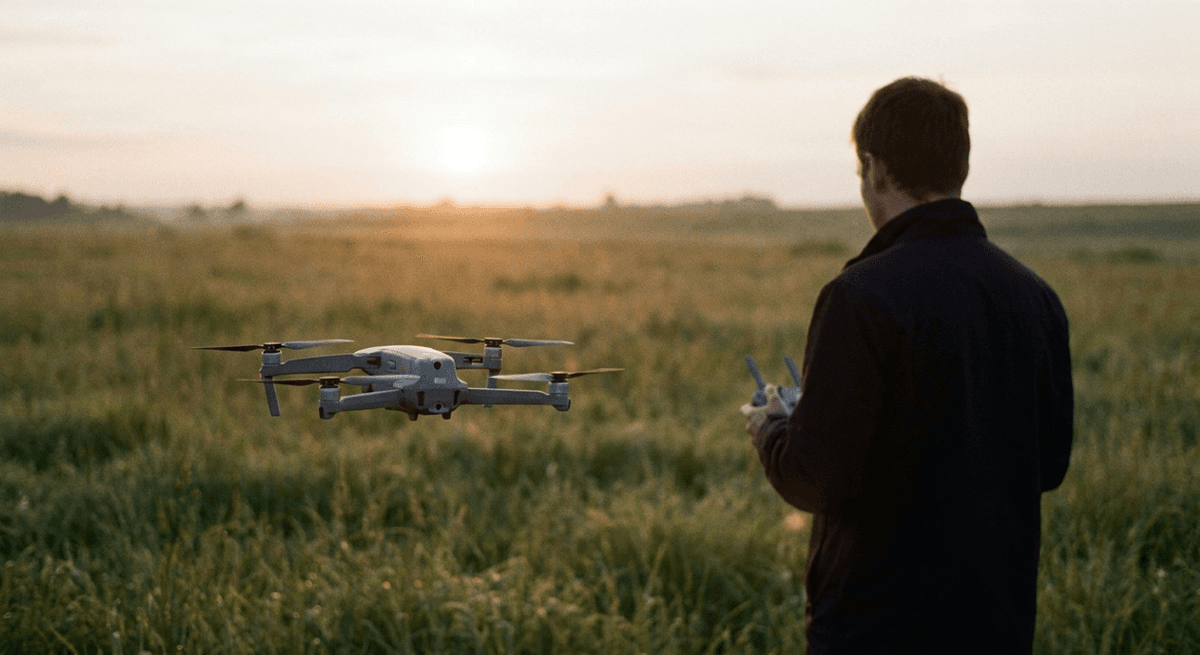
Can a Private Citizen Legally Fly a Drone Over My Property in Nevada?
Generally yes, on a single pass. Nevada does not ban a drone from briefly transiting the airspace above private land. What NRS 493.103 punishes is a repeat, unauthorized, low-altitude overflight after the owner has objected. Specifically, a property owner or lawful occupant can sue a drone owner or operator for trespass if the drone flew below 250 feet over the property, the operator had already flown at that altitude over the property on a prior occasion, and the owner gave the operator notice, in a manner recognized under NRS 207.200, that the flight was not authorized.
A plaintiff who wins recovers treble damages for the trespass, plus possible attorney's fees, costs, and an injunction. Subsection 2 lists the flights that cannot be sued over: a drone lawfully in the flight path for landing at an airport, airfield, or runway; a drone in the process of taking off or landing; a drone under the lawful operation of a law enforcement agency acting in accordance with NRS 493.112 or of another public agency acting in accordance with NRS 493.115; and a drone under the lawful operation of a business registered in this State, or of a land surveyor, where the operator is licensed or otherwise approved to fly it by the FAA, the flight is within the scope of the lawful activities of that business or surveyor, and it does not unreasonably interfere with the property's existing use. Note what the last exemption does and does not require: Nevada issues no drone-operator license of its own, so the state-side condition is business registration in Nevada, and the pilot credential comes from the FAA.
Separately, Nevada's general voyeurism statute, NRS 200.604, bars knowingly capturing an image of someone's private area without consent where they have a reasonable expectation of privacy, a gross misdemeanor on a first offense and a category E felony on a later one. It does not mention drones specifically, but its definition of "capture" (to videotape, photograph, film, record by any means, or broadcast) is broad enough to reach a drone-mounted camera used the same way a hidden camera would be.
Does Police Need a Warrant to Fly a Drone Over My Property in Nevada?
Yes, as the default rule. NRS 493.112 bars a law enforcement agency from operating a drone to gather evidence or other information within the curtilage of a residence, or at any other location in Nevada where a person has a reasonable expectation of privacy, unless the agency first obtains a warrant from a court of competent jurisdiction authorizing that specific use. A warrant issued under the statute is limited to 10 days, though it can be renewed. Information gathered in violation of the section is not admissible in a judicial, administrative, or other adjudicatory proceeding, and cannot be used to establish reasonable suspicion or probable cause for anything else, a rule that applies equally to other government entities that obtain drone data unlawfully.
The warrant requirement gives way in several defined circumstances: probable cause to believe that a person has committed a crime, is committing a crime, or is about to commit a crime combined with exigent circumstances that make it unreasonable for the agency to obtain a warrant; written consent that specifies the information to be gathered and the time, place, and manner of gathering it; search-and-rescue operations; an imminent threat to life or public safety (which requires a sworn statement filed within two business days); and a gubernatorial state-of-emergency or disaster declaration, limited to the declared area.
That first exception is now the center of a live dispute in Nevada. The Las Vegas Metropolitan Police Department's Drone as First Responder program, branded Blue Sky, grew from about 345 deployments in May 2025 to roughly 2,270 in April 2026, and the department flew more than 10,000 drone missions in 2025, reportedly the most of any police agency in the country. Because Metro treats routine 911 dispatches as emergencies, it argues most of those flights qualify without an individual warrant. The statutory test is narrower than that framing suggests: NRS 493.112(3)(a) requires probable cause of a specific crime as well as exigency, not merely an urgent-sounding call. The ACLU of Nevada and the Electronic Frontier Foundation have criticized Metro's approach as turning a narrow emergency exception into standing surveillance, particularly as the drones carry cameras that can resolve detail from roughly 2,000 feet away.
Critical Facilities, Airport Buffers, and Weaponized Drones
Beyond the trespass and warrant rules, Nevada restricts where a drone may fly near sensitive sites. NRS 493.109 bars operating a drone within 500 feet horizontally or 250 feet vertically of a "critical facility," unless the owner consents in writing. NRS 493.020, the chapter's general definitions section, defines "critical facility" to include a refinery, a chemical or petroleum production, transportation, storage, or processing facility, a pipeline, a water or wastewater treatment plant, a mine, a power plant or substation, certain electric transmission lines, and a jail, prison, or Department of Corrections facility. NRS 493.109 also bars flying within 5 miles of an airport unless the operator has the consent of the airport authority or the airport's operator, or has obtained a waiver, exemption, or other FAA authorization, and it requires the operator to carry documentation of that consent or authorization at all times during the flight. Violating NRS 493.109 is a misdemeanor.
NRS 493.106 goes further for armed drones: it is a category D felony to equip a drone with a weapon or to operate one that is already weaponized, and the offense escalates to a category C felony if the weaponized drone is actually discharged.
Outside Chapter 493, Nevada's wildlife code regulates drones by name. NRS 503.010 makes it unlawful to harass any game mammals or game birds with a manned or unmanned aircraft, to shoot at game with a weapon from a manned or unmanned aircraft, or to spot or locate game with any kind of manned or unmanned aircraft and communicate that location to a person on the ground within 24 hours for the purpose of hunting or trapping. Subsection 9 defines "aircraft" to include any unmanned aerial vehicle as defined in NRS 493.020, so a camera drone is squarely covered. A violation is a misdemeanor under NRS 501.385, punishable by a fine of $50 to $500, up to 6 months in county jail, or both, and NRS 501.3857 subjects an aircraft used to locate big game that way to forfeiture. NRS 503.005 separately makes it a misdemeanor to kill or attempt to kill birds or animals while flying in an aircraft.
| Question | Nevada rule |
|---|---|
| Civil trespass for low overflights | NRS 493.103: below 250 ft, repeat flight, prior notice required; treble damages |
| Law enforcement warrant requirement | NRS 493.112: warrant required for curtilage/privacy-expectation areas, capped at 10 days |
| Critical facility buffer | NRS 493.109: 500 ft horizontal / 250 ft vertical without written consent; misdemeanor |
| Airport buffer | NRS 493.109: 5 miles without consent or FAA authorization; misdemeanor |
| Weaponized drone | NRS 493.106: category D felony, category C if discharged |
| Drone use in hunting | NRS 503.010: unlawful to harass, shoot at, or spot game with a manned or unmanned aircraft; misdemeanor under NRS 501.385 |
| Shooting down a drone | Federal felony regardless of location, 18 U.S.C. section 32 |
Watch out: NRS 493.103's trespass action is narrower than it first appears. A single low flyover is not enough; the statute requires a prior unauthorized flight plus notice to the operator before a second flight becomes actionable. A one-time overflight may still support a nuisance or NRS 200.604 privacy claim, but not a claim under 493.103 itself.
Can I Shoot Down a Drone Over My Nevada Property?
No. Federal law makes it a serious crime to damage, destroy, or disable any drone, including one hovering low over your own yard. 18 U.S.C. section 32, the Aircraft Sabotage Act, criminalizes willfully damaging an "aircraft," a category the FAA has applied to drones since 2012. A conviction carries up to 20 years in federal prison, a fine up to $250,000, and the permanent loss of Second Amendment rights that follows any federal felony. The FAA's position, echoed in its own public guidance, is that it controls the national airspace, not the landowner below, so owning the ground does not create a right to fire on what is above it. No Nevada statute, including the trespass and privacy provisions in NRS Chapter 493, authorizes a landowner to disable or shoot down a drone as a matter of right.
More Nevada Laws
- Nevada Data Privacy Laws
- Nevada GPS Tracking Laws
- Nevada Police Bodycam Laws
- Nevada Recording Laws
- Nevada Smart Glasses Recording Laws
Frequently Asked Questions
Does Nevada require a warrant for police drone surveillance?
Yes, as the default rule. NRS 493.112 requires a warrant before a law enforcement agency uses a drone to gather evidence within a residence's curtilage or anywhere else a person has a reasonable expectation of privacy, subject to exceptions that include probable cause plus exigent circumstances, written consent, and search and rescue.
Can my neighbor legally fly a drone over my yard in Nevada?
A single flight is not itself a crime, but NRS 493.103 lets you sue for trespass, with treble damages, if the drone flies below 250 feet over your property on a repeat occasion after you have given the operator notice the flight is unauthorized.
What is NRS 493.112?
Nevada's law enforcement drone warrant statute. It bars police from using a drone to gather evidence at a location where someone has a reasonable expectation of privacy without a warrant, and makes evidence gathered in violation inadmissible.
Why can Las Vegas police fly drones without a warrant for every call?
NRS 493.112(3)(a) allows a warrantless flight only where the agency has probable cause to believe a person has committed, is committing, or is about to commit a crime and exigent circumstances make obtaining a warrant unreasonable. LVMPD's Drone as First Responder program treats most 911 dispatches as qualifying emergencies, which civil liberties groups argue stretches an exception that on its face requires probable cause of a specific crime.
How close can a drone fly to a jail, power plant, or refinery in Nevada?
Not within 500 feet horizontally or 250 feet vertically without the owner's written consent. NRS 493.109 sets that buffer and makes a violation a misdemeanor; the term 'critical facility' is defined in NRS 493.020, and it covers jails, prisons, refineries, power plants and substations, pipelines, mines, and water and wastewater treatment facilities.
Is it legal to fly a weaponized drone in Nevada?
No. NRS 493.106 makes equipping or operating a weaponized drone a category D felony, and a category C felony if the weapon is actually discharged.
Is it legal to shoot down a drone over my property in Nevada?
No. Federal law, 18 U.S.C. section 32, makes destroying any aircraft, including a drone, a felony regardless of where it is flying or whose property is below it. No Nevada statute creates an exception.
Does Nevada have a drone hunting law?
Yes, though it sits in the wildlife code rather than in NRS Chapter 493. NRS 503.010 makes it unlawful to harass game mammals or game birds with a manned or unmanned aircraft, to shoot at game with a weapon from one, or to spot game from one and relay that location to a person on the ground within 24 hours for hunting or trapping. The section's definition of 'aircraft' expressly includes unmanned aerial vehicles, and a violation is a misdemeanor under NRS 501.385.
Updates
Corrected the page to state that NRS 503.010 does regulate drone use in hunting and game harassment, named NRS 493.109 (not NRS 493.020) as the source of the 5-mile airport rule, attributed the "critical facility" definition to NRS 493.020 in the FAQ, restated the NRS 493.103 exemptions to match the statute (business registration in Nevada plus FAA approval, not a Nevada operator license), and corrected the NRS 493.112 warrantless-flight standard to probable cause plus exigent circumstances.
Independently fact-checked against the cited primary sources; governing law re-checked for recent changes
Corrected the source of Nevada's 'critical facility' definition: it is defined in NRS 493.020, the chapter's general definitions section, not within NRS 493.109 itself (which only defines 'airport').
Governing law re-checked for recent changes
Reviewed and approved by an editor
The Law Behind This Article
This article rests on the statutory provisions below, held in our own legal record and retrieved from the official source. Tap a section to read the operative text.
Nevada Revised Statutes, Chapter 493: GENERAL PROVISIONS
§ 493.103Unmanned aerial vehicles: Action for trespass against owner or operator; exceptions; award of treble damages for injury to person or property; award of attorney’s fees and costs and injunctive relief.In forcecited in 2 of our articles
1. Except as otherwise provided in subsection 2, a person who owns or lawfully occupies real property in this State may bring an action for trespass against the owner or operator of an unmanned aerial vehicle that is flown at a height of less than 250 feet over the property if: (a) The owner or operator of the unmanned aerial vehicle has flown the unmanned aerial vehicle over the property at a height of less than 250 feet on at least one previous occasion; and (b) The person who owns or occupies the real property notified the owner or operator of the unmanned aerial vehicle that the person did not authorize the flight of the unmanned aerial vehicle over the property at a height of less than 250 feet. For the purposes of this paragraph, a person may place the owner or operator of an unmanned aerial vehicle on notice in the manner prescribed in subsection 2 of NRS 207.200. 2. A person may not bring an action pursuant to subsection 1 if: (a) The unmanned aerial vehicle is lawfully in the flight path for landing at an airport, airfield or runway. (b) The unmanned aerial vehicle is in the process of taking off or landing.
Official text (excerpt) · last checked 2026-07-29 · Read the full text in our law library · Verify at leg.state.nv.us
Also relied on in: Nevada Laws on Recording in Public: Rights and Restrictions (2026)
§ 493.112Unmanned aerial vehicles: Operation by law enforcement agency; warrant required under certain circumstances; information acquired in violation of section inadmissible and may not be used to establish reasonable suspicion or probable cause.In force
1. Except as otherwise provided in this section, nothing in this section shall be deemed to otherwise prohibit the operation of an unmanned aerial vehicle by a law enforcement agency for any lawful purpose in this State. 2. Except as otherwise provided in subsection 3, a law enforcement agency shall not operate an unmanned aerial vehicle for the purpose of gathering evidence or other information within the curtilage of a residence or at any other location or upon any property in this State at which a person has a reasonable expectation of privacy, unless the law enforcement agency first obtains a warrant from a court of competent jurisdiction authorizing the use of the unmanned aerial vehicle for that purpose. A warrant authorizing the use of an unmanned aerial vehicle must specify the period for which operation of the unmanned aerial vehicle is authorized. A warrant must not authorize the use of an unmanned aerial vehicle for a period of more than 10 days. Upon motion and a showing of probable cause, a court may renew a warrant after the expiration of the period for which the warrant was initially issued.
Official text (excerpt) · last checked 2026-07-29 · Read the full text in our law library · Verify at leg.state.nv.us
§ 493.109Unmanned aerial vehicles: Operation near critical facility or within 5 miles of airport prohibited; exceptions; penalty.In force
1. A person shall not operate an unmanned aerial vehicle within: (a) A horizontal distance of 500 feet or a vertical distance of 250 feet from a critical facility without the written consent of the owner of the critical facility. (b) Except as otherwise provided in subsection 2, 5 miles of an airport. 2. A person may operate an unmanned aerial vehicle within 5 miles of an airport only if the person obtains the consent of the airport authority or the operator of the airport, or if the person has otherwise obtained a waiver, exemption or other authorization for such operation pursuant to any rule or regulation of the Federal Aviation Administration. A person who is authorized to operate an unmanned aerial vehicle within 5 miles of an airport pursuant to this subsection shall, at all times during such operation, maintain on his or her person documentation of any waiver, exemption, authorization or consent permitting such operation. 3. A person who violates this section is guilty of a misdemeanor.
Official text (excerpt) · last checked 2026-07-29 · Read the full text in our law library · Verify at leg.state.nv.us
§ 493.106Unmanned aerial vehicles: Weaponization prohibited; penalties.In force
1. A person shall not weaponize an unmanned aerial vehicle or operate a weaponized unmanned aerial vehicle. A person who violates this section is guilty of a category D felony and shall be punished as provided in NRS 193.130. 2. A person who weaponizes an unmanned aerial vehicle in violation of subsection 1 and who discharges the weapon is guilty of a category C felony and shall be punished as provided in NRS 193.130.
Official text (excerpt) · last checked 2026-07-29 · Read the full text in our law library · Verify at leg.state.nv.us
§ 493.115Unmanned aerial vehicles: Operation by public agency; requirements; prohibited uses; information acquired in violation of section inadmissible and may not be used to establish reasonable suspicion or probable cause.In force
1. A public agency: (a) May operate an unmanned aerial vehicle only if: (1) Before the operation of the unmanned aerial vehicle, the public agency registers the unmanned aerial vehicle with the Department pursuant to subsection 2 of NRS 493.118. (2) The public agency operates the unmanned aerial vehicle in accordance with the regulations adopted by the Department pursuant to subsection 4 of NRS 493.118. (b) Must not operate an unmanned aerial vehicle for the purposes of assisting a law enforcement agency with law enforcement or conducting a criminal prosecution. 2. Any photograph, image, recording or other information that is acquired by a public agency through the operation of an unmanned aerial vehicle in violation of this section, and any evidence that is derived therefrom: (a) Is not admissible in, and must not be disclosed in, a judicial, administrative or other adjudicatory proceeding; and (b) May not be used to establish reasonable suspicion or probable cause as the basis for investigating or prosecuting a crime or offense.
Official text (excerpt) · last checked 2026-07-29 · Read the full text in our law library · Verify at leg.state.nv.us
§ 493.020Definitions.In force
As used in NRS 493.010 to 493.120, inclusive, unless the context otherwise requires: 1. “Aircraft” includes a balloon, airplane, hydroplane, unmanned aerial vehicle and any other vehicle used for navigation through the air. A hydroplane, while at rest on water and while being operated on or immediately above water, is governed by the rules regarding water navigation. A hydroplane while being operated through the air other than immediately above water, is an aircraft. 2. “Critical facility” means a petroleum refinery, a petroleum or chemical production, transportation, storage or processing facility, a chemical manufacturing facility, a pipeline and any appurtenance thereto, a wastewater treatment facility, a water treatment facility, a mine as that term is defined in NRS 512.006, a power generating station, plant or substation and any appurtenances thereto, any transmission line that is owned in whole or in part by an electric utility as that term is defined in subsection 6 of NRS 704.187 or owned, operated, inspected, maintained or repaired in whole or in part by the Colorado River Commission of Nevada pursuant to NRS 538.161 or 538.166, a county, city or town…
Official text (excerpt) · last checked 2026-07-29 · Read the full text in our law library · Verify at leg.state.nv.us
Nevada Revised Statutes, Chapter 200: CRIMES AGAINST THE PERSON
§ 200.604Capturing image of private area of another person; distributing, disclosing, displaying, transmitting or publishing image of private area of another person; penalties; exceptions; confidentiality of image.In forcecited in 15 of our articles
1. Except as otherwise provided in subsection 4, a person shall not knowingly and intentionally capture an image of the private area of another person: (a) Without the consent of the other person; and (b) Under circumstances in which the other person has a reasonable expectation of privacy. 2. Except as otherwise provided in subsection 4, a person shall not distribute, disclose, display, transmit or publish an image that the person knows or has reason to know was made in violation of subsection 1. 3. Unless a greater penalty is provided pursuant to NRS 200.780 or 212.188, a person who violates this section: (a) For a first offense, is guilty of a gross misdemeanor. (b) For a second or subsequent offense, is guilty of a category E felony and shall be punished as provided in NRS 193.130. 4. This section does not prohibit any lawful law enforcement or correctional activity, including, without limitation, capturing, distributing, disclosing, displaying, transmitting or publishing an image for the purpose of investigating or prosecuting a violation of this section.
Official text (excerpt) · last checked 2026-07-29 · Read the full text in our law library · Verify at leg.state.nv.us
Cited in 4 court opinions in our collectionLatest citing opinion in our collection: 2018
Opinions citing this section in our collection:
- Coleman v. State (Nevada Supreme Court 2018, 416 P.3d 238)“…By the Court, PICKERING, J.: NRS 200.604 prohibits a person from knowingly and i…”
- COLEMAN (SOLOMON) VS. STATE (Nevada Supreme Court 2018, 2018 NV 28)“…y the Court, PICKERING, J.: NRS 200.604 prohibits a person from knowingly and…”
- Brian Olsen v. City of Henderson (Court of Appeals for the Ninth Circuit 2016, 648 F. App'x 628)“…amily. Nichols reasonably believed that Olsen had violated Nev. Rev. Stat. § 200.604 by capturing and publishing to his per…”
Identified automatically from the court opinions citing this section — not a ranking of which case controls.
Also relied on in: Nevada Smart Glasses Recording Laws 2026, Nevada Landlord-Tenant Recording Laws: Rights for Renters and Property Owners (2026), Nevada Medical Recording Laws: Patient Rights and Healthcare Privacy (2026)
United States Code Title 18
§ 32Destruction of aircraft or aircraft facilitiesIn forcecited in 51 of our articles
Whoever willfully— sets fire to, damages, destroys, disables, or wrecks any aircraft in the special aircraft jurisdiction of the United States or any civil aircraft used, operated, or employed in interstate, overseas, or foreign air commerce; places or causes to be placed a destructive device or substance in, upon, or in proximity to, or otherwise makes or causes to be made unworkable or unusable or hazardous to work or use, any such aircraft, or any part or other materials used or intended to be used in connection with the operation of such aircraft, if such placing or causing to be placed or such making or causing to be made is likely to endanger the safety of any such aircraft; sets fire to, damages, destroys, or disables any air navigation facility, or interferes by force or violence with the operation of such facility, if such fire, damaging, destroying, disabling, or interfering is likely to endanger the safety of any such aircraft in flight; with the intent to damage, destroy, or disable any such aircraft, sets fire to, damages, destroys, or disables or places a destructive device or substance in, upon, or in proximity to, any appliance or structure, ramp, landing area,…
Official text (excerpt) · last checked 2026-07-28 · Read the full text in our law library · Verify at uscode.house.gov
Cited in 168 court opinions in our collectionLatest citing opinion in our collection: 2026
In the courts (editorial summary, independently checked):United States v. Yousef (2003) applied 18 U.S.C. 32 to an overseas airline bombing plot, holding Section 32(a) reaches conduct abroad because US-flag aircraft in flight are within the special aircraft jurisdiction, and that a defendant brought here involuntarily is still found in the United States under Section 32(b).
Opinions citing this section in our collection:
- Perez v. United States (Supreme Court of the United States 1971, 402 U.S. 146)“…commerce, as, for example, the destruction of an aircraft ( 18 U. S. C. § 32 ), or persons or things in commerce, as…”
- Stanford v. Kentucky (Supreme Court of the United States 1989, 492 U.S. 361)“…r by persons subject to Uniform Code of Military Justice); 18 U. S. C. §§ 32 , 33, and 34 (1982 ed. and Supp. V) (de…”
- United States v. Yousef (Court of Appeals for the Second Circuit 2003, 327 F.3d 56)✓Yousef bombed a Philippine airliner and plotted to bomb twelve US flag airliners on Asian routes; the court held Section 32(a) reaches attacks on US flag aircraft worldwide, and that Yousef, brought here involuntarily, was found in the United States under Section 32(b).
Identified automatically from the court opinions citing this section — not a ranking of which case controls.
Also relied on in: Indiana Drone Laws (2026): Police Warrants, Voyeurism, Hunting, Iowa Drone Laws: Homestead, Farmstead & Warrant Rules, Kansas Drone Laws: Stalking Act & Privacy Rules Explained
Nevada Revised Statutes, Chapter 207: MISCELLANEOUS CRIMES
§ 207.200Unlawful trespass upon land; warning against trespassing.In forcecited in 2 of our articles
1. Unless a greater penalty is provided pursuant to NRS 200.603, any person who, under circumstances not amounting to a burglary: (a) Goes upon the land or into any building of another with intent to vex or annoy the owner or occupant thereof, or to commit any unlawful act; or (b) Willfully goes or remains upon any land or in any building after having been warned during the previous 36 months by the owner or occupant thereof not to trespass, Ê is guilty of a misdemeanor. The meaning of this subsection is not limited by subsections 2 and 4.
Official text (excerpt) · last checked 2026-07-29 · Read the full text in our law library · Verify at leg.state.nv.us
Cited in 28 court opinions in our collectionLatest citing opinion in our collection: 2026
Opinions citing this section in our collection:
- Jordan v. State Ex Rel. Department of Motor Vehicles & Public Safety (Nevada Supreme Court 2005, 121 Nev. 44)“…building for trespassing on state property in violation of NRS 207.200(l)(b), which prohibits people from will…”
- Scott v. Justice's Court of Tahoe Township (Nevada Supreme Court 1968, 84 Nev. 9)“…ndents. The main issue concerns the Nevada trespass statute NRS 207.200. Subordinate issues involve the filing…”
- STATE, OFFICE OF THE ATTORNEY GEN. VS. JUSTICE CT. (ESCALANTE) (Nevada Supreme Court 2017, 2017 NV 12)“…with one count of trespass in violation of NRS 207.200(1)(a). Escalante moved to dismiss…”
Identified automatically from the court opinions citing this section — not a ranking of which case controls.
Nevada Revised Statutes, Chapter 501: ADMINISTRATION AND ENFORCEMENT
§ 501.385Unlawful acts; criminal penalties.In force
Except as otherwise provided by specific statute: 1. Any person who: (a) Performs an act or attempts to perform an act made unlawful or prohibited by a provision of this title; (b) Willfully fails to perform an act required of the person by a provision of this title; (c) Obstructs, hinders, delays or otherwise interferes with any officer, employee or agent of the Department: (1) In the performance of any duty while enforcing or attempting to enforce any provision of this title or any regulation adopted pursuant thereto; or (2) While lawfully obtaining or attempting to obtain biological samples of wildlife, hunting, fishing or trapping data, or any other biological data or information relating to wildlife; (d) Violates any order issued or regulation adopted by the Commission under the provisions of this title; or (e) Having been granted a privilege or been licensed or permitted to do any act under the provisions of this title, exercises the grant, license or permit in a manner other than as specified, Ê is guilty of a misdemeanor.
Official text (excerpt) · last checked 2026-07-29 · Read the full text in our law library · Verify at leg.state.nv.us
Cited in 1 court opinions in our collectionLatest citing opinion in our collection: 2018
Opinions citing this section in our collection:
- In Re: Discipline of Hy Forgeron (Nevada Supreme Court 2018)“…t that attorney Hy Forgeron has been convicted of violating NRS 501.385, a misdemeanor offense. Because Forgero…”
Identified automatically from the court opinions citing this section — not a ranking of which case controls.
§ 501.3857Forfeitures.In force
Any gun, ammunition, trap, snare, vessel, vehicle, aircraft or other device or equipment used, or intended for use: 1. To facilitate the unlawful and intentional killing or possession of any big game mammal; 2. To hunt or kill a big game mammal by using information obtained as a result of the commission of an act prohibited by NRS 503.010 or a regulation of the Commission which prohibits the location of big game mammals for the purpose of hunting or killing by the use of: (a) A manned or unmanned aircraft, including, without limitation, any unmanned aerial vehicle, as defined in NRS 493.020, or any other device that is used for navigation of, or flight in, the air; (b) A hot air balloon or any other device that is lighter than air; or (c) A satellite or any other device that orbits the earth and is equipped to produce images, or other similar devices; or 3. Knowingly to transport, sell, receive, acquire or purchase any big game mammal which is unlawfully killed or possessed, Ê is subject to forfeiture pursuant to NRS 179.1156 to 179.1205, inclusive.
Official text (excerpt) · last checked 2026-07-29 · Read the full text in our law library · Verify at leg.state.nv.us
Nevada Revised Statutes, Chapter 503: HUNTING, FISHING AND TRAPPING; MISCELLANEOUS PROTECTIVE MEASURES
§ 503.005Manner of hunting: Killing bird or animal while flying in aircraft prohibited; exceptions; penalty.In force
1. Except as otherwise provided in subsection 2, a person shall not kill or attempt to kill any birds or animals while flying in an aircraft. 2. The Commission may promulgate rules and regulations whereby the Department may issue permits authorizing the hunting, killing or nonlethal control of coyotes, bobcats or ravens from an aircraft. 3. Every person who willfully violates the provisions of subsection 1 is guilty of a misdemeanor.
Official text (excerpt) · last checked 2026-07-29 · Read the full text in our law library · Verify at leg.state.nv.us
§ 503.010Manner of hunting or trapping: Unlawful use of certain modes of transportation; information and equipment; exceptions.In force
1. Except as otherwise provided in this section or subsection 2 of NRS 503.005, it is unlawful to harass any game mammals or game birds by any means, including, without limitation, with a manned or unmanned aircraft, firearm, helicopter, horse, power-driven vessel, motor-driven vehicle, noisemaker or sailboat. 2. Except as otherwise provided in this subsection, it is unlawful to shoot at any game mammals or game birds with a weapon from a manned or unmanned aircraft, helicopter or motor-driven vehicle. A person who is a paraplegic, has had one or both legs amputated or has suffered a paralysis of one or both legs which severely impedes the person’s walking may shoot from a stopped motor vehicle which is not parked on the traveled portion of a public highway, but the person may not shoot from, over or across a highway or road specified in NRS 503.175.
Official text (excerpt) · last checked 2026-07-29 · Read the full text in our law library · Verify at leg.state.nv.us
Explore the law
This article also draws on these acts and chapters (opening at their first section): Nevada Revised Statutes, Chapter 493: GENERAL PROVISIONS § 493.010 (Short title.)
Related law for further reading — not part of this article’s citations.
Search our full record of US law — 2.1 million sections, every state + federal →
Sources and References
- NRS Chapter 493, General Provisions (unmanned aerial vehicles)(leg.state.nv.us).gov
- NRS 493.103, action for trespass against owner or operator of an unmanned aerial vehicle(nevada.public.law)
- NRS 493.109, operation of unmanned aerial vehicle near critical facility or within 5 miles of airport prohibited(leg.state.nv.us).gov
- NRS 493.112, operation of unmanned aerial vehicle by law enforcement agency; warrant required under certain circumstances(nevada.public.law)
- NRS 493.106, weaponized unmanned aerial vehicles prohibited(nevada.public.law)
- 18 U.S.C. section 32, destruction of aircraft or aircraft facilities(law.cornell.edu)
- The Nevada Independent, Vegas police are filling the sky with camera-equipped drones. Residents have little input.(thenevadaindependent.com)
- NRS 493.020, definitions (including "critical facility") for the Uniform State Law for Aeronautics, NRS 493.010 to 493.120(leg.state.nv.us)
- NRS 503.010, manner of hunting or trapping: unlawful use of certain modes of transportation, including manned or unmanned aircraft(leg.state.nv.us)
- NRS 501.385, unlawful acts under the wildlife title; misdemeanor penalties(leg.state.nv.us)