
Kentucky
Kentucky Drone Laws: KRS 500.130 Privacy Rules & Warrants
Independently fact-checked against primary sources (last audited August 17, 2026). · Reviewed by the RecordingLaw editorial team. · Law checked current as of August 17, 2026. · 5 primary sources cited on this page. How we verify our legal content

Kentucky requires a warrant before police fly a drone over private property, and since June 2025 also bars private operators from using a drone to surveil or publish images of someone's home without consent, under KRS 500.130(12) and a new civil damages statute, KRS 411.067.
This guide is part of our Drone Laws by State series; for the broader rules on recording people and property in Kentucky, see our surveillance camera laws guide.
Jurisdiction scope: This article addresses Kentucky law governing private and law-enforcement drone use under KRS 500.130, KRS 411.067, and 301 KAR 3:140. It does not address FAA registration, Remote ID, or Part 107 pilot certification, which apply the same way nationwide regardless of state law.
How federal and Kentucky law divide drone authority
The FAA regulates where a drone may fly. Under 49 U.S.C. section 40102, it treats any unmanned aircraft as an "aircraft," pulling it into the national airspace system regardless of size. A commercial or government flight generally needs a Remote Pilot Certificate under 14 C.F.R. Part 107; a hobbyist flight falls under the separate exception at 49 U.S.C. section 44809. Most registrable drones must also broadcast Remote ID since 2023.
None of that answers what a Kentucky drone operator may record, or when Kentucky police need a warrant. Those are state privacy, trespass, and criminal-procedure questions layered on top of the federal operating rules, and Kentucky is one of the more legislatively active states on this front after its 2025 privacy statute.
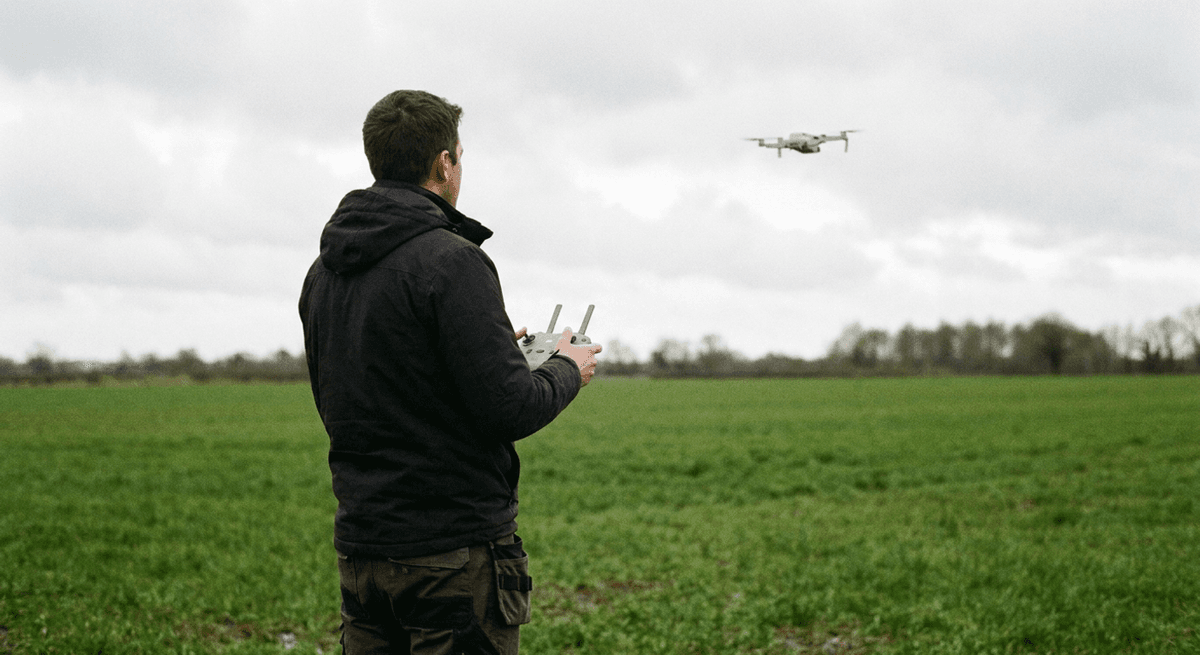
Can a private citizen legally fly a drone over my property in Kentucky?
Generally, yes; Kentucky has no statute barring a drone from merely passing through the airspace above private land. What it regulates is what the operator does with the flight. KRS 500.130(12) prohibits a person operating under the statute's business, recreational, or educational provisions from recording an image of privately owned real property, or of its owner, tenant, occupant, invitee, or licensee, with intent to conduct surveillance or publish an unauthorized image, where doing so violates a reasonable expectation of privacy.
The statute sets a specific test for that expectation: a person is presumed to have it on their own property if they cannot be seen by someone standing at ground level in a place that person has a legal right to be, regardless of whether a drone camera overhead could see them. A fence or hedge that blocks a neighbor's ground-level view can still support a privacy claim even though it does nothing to block an aerial camera.
Anyone surveilled or photographed in violation of subsection (12) can sue the operator, and any agency or political subdivision that violates it, under KRS 411.067, for injunctive relief, actual and punitive damages, court costs, and attorney's fees. KRS 411.067 itself sets no filing deadline; a separate section of the same 2025 act, KRS 413.2475, requires the action to be commenced within seven years after the cause of action accrued. Business, insurance, utility, mapping, agricultural, and educational drone use stays lawful under KRS 500.130(3) through (5) as long as it does not cross into the surveillance-with-intent conduct barred by subsection (12).
Does police need a warrant to fly a drone over my property in Kentucky?
Yes, in the core case. KRS 500.130(6) bars a law enforcement agency, or its agent, from using a drone to conduct a search unless authorized under the Fourth Amendment or Section 10 of the Kentucky Constitution, and any warrant relied on must specifically authorize drone use, not merely a physical search.
That rule has two limits. It only applies to a "search"; subsection (7) separately lets any government agency fly a drone for a legitimate governmental purpose outside a search, such as a crash scene or missing-person search. And when police rely on (6) or (7), subsection (8) requires minimizing data collection on non-suspects and bars disclosing it except by court order.
Evidence gathered outside these rules faces an exclusionary consequence: KRS 500.130(9) makes drone-derived evidence inadmissible in a Kentucky civil, criminal, or administrative proceeding unless collected under subsections (3) through (7), or offered against the drone's own owner to show misconduct. No agency is required to operate a drone at all, under subsection (10).
Kentucky's ban on drones for hunting and harassing wildlife
Kentucky Department of Fish and Wildlife Resources regulation 301 KAR 3:140, effective October 16, 2025, makes it unlawful to use aircraft or a drone to fish, hunt, or take wildlife, to drive or herd wildlife for those purposes, or to harass wildlife. It draws its authority from the broad definition of "take" in KRS 150.010(46), covering pursuing, shooting, wounding, or capturing wildlife.
The rule exempts department employees acting for safety, law enforcement, research, or management purposes, authorized landowners handling wildlife damage, and commercial fishers removing invasive carp. A hunter who uses a drone to scout or drive game outside those exceptions risks a citation independent of any privacy or trespass claim.
Can I shoot down a drone over my Kentucky property?
No. Federal law makes it a serious crime to damage, destroy, or disable any drone, including one hovering low over the shooter's own yard. 18 U.S.C. section 32, the Aircraft Sabotage Act, criminalizes willfully damaging an "aircraft," a category the FAA has applied to drones since 2012. A conviction carries up to 20 years in federal prison, a fine up to $250,000, and the permanent loss of Second Amendment rights that follows any federal felony. The FAA's position is that it, not the property owner, controls the airspace, so owning the ground below does not create a right to fire on what is above it.
Kentucky is the origin of the country's most widely known shoot-down story, but it is often misunderstood. In July 2015, William Merideth of Hillview shot down a drone he believed was filming his daughter; a local judge dismissed the state criminal-mischief and wanton-endangerment charges against him, reportedly calling it an invasion of privacy. That was one judge's charging decision, not a binding ruling that shooting down a drone is legal. The drone's owner, David Boggs, then sued Merideth in federal court seeking a declaration that the drone had been in protected federal airspace. The Western District of Kentucky dismissed that suit, Boggs v. Merideth, in March 2017 for lack of federal subject-matter jurisdiction, holding the claim was really a state-law property dispute. The court never reached whether flying a drone over someone's land is a federal airspace matter or a state trespass. No statute, state or federal, gives a landowner a right to shoot down a drone.
| Question | Kentucky rule |
|---|---|
| Civilian drone privacy statute | KRS 500.130(12), effective June 27, 2025 |
| Civil remedy for a privacy violation | KRS 411.067: injunction, actual and punitive damages, costs, fees |
| Statute of limitations on that claim | 7 years from accrual, KRS 413.2475 |
| Law enforcement warrant requirement | Yes, for a "search," under KRS 500.130(6) |
| Non-search government drone use | Allowed for a legitimate governmental purpose, KRS 500.130(7) |
| Drone hunting or wildlife harassment | Banned, 301 KAR 3:140 (effective Oct. 16, 2025) |
| Shooting down a drone | Federal felony regardless of location, 18 U.S.C. section 32 |
Watch out: Kentucky's warrant rule in KRS 500.130(6) only applies when police are conducting a "search." A department can still fly a drone over a public event, a search-and-rescue scene, or a traffic crash under the separate legitimate-governmental-purpose allowance in subsection (7), without a warrant.
More Kentucky Laws
- Kentucky Data Privacy Laws
- Kentucky GPS Tracking Laws
- Kentucky Police Bodycam Laws
- Kentucky Recording Laws
- Kentucky Smart Glasses Recording Laws
Frequently Asked Questions
Does Kentucky require a warrant for police drone surveillance?
Generally yes, when the flight amounts to a search. KRS 500.130(6) requires Fourth Amendment or Kentucky Constitution authorization, and any warrant relied on must specifically cover drone use. Outside a search, agencies may still fly drones for other legitimate governmental purposes.
Can my neighbor legally fly a drone over my yard in Kentucky?
Flying over alone is not itself illegal, but KRS 500.130(12) bars recording images of you or your property with intent to surveil or publish them without consent if that violates your reasonable expectation of privacy, and you can sue under KRS 411.067.
What is KRS 500.130?
Kentucky's central drone statute. It sets rules for business, recreational, educational, and government drone use, requires a warrant for law-enforcement drone searches, and, since June 2025, bars civilian surveillance of private property.
Did Boggs v. Merideth settle whether flying a drone over private land is trespassing in Kentucky?
No. The federal court dismissed the case in 2017 for lack of subject-matter jurisdiction and never reached that question. The dismissal was procedural, not a ruling on the merits.
Is it legal to shoot down a drone over my property in Kentucky?
No. Federal law, 18 U.S.C. section 32, makes destroying any aircraft, including a drone, a felony regardless of where it is flying. Favorable outcomes in past Kentucky cases involved dismissed state charges, not a recognized legal right.
Can I sue someone who used a drone to record me at home in Kentucky?
Yes, if the recording violated your reasonable expectation of privacy under KRS 500.130(12). KRS 411.067 lets you seek an injunction, actual and punitive damages, costs, and fees, and KRS 413.2475 gives you seven years after the claim accrued to file.
Can Kentucky police use a drone without a warrant at all?
Yes, outside a search. KRS 500.130(7) lets any government agency use a drone for a legitimate governmental purpose, such as a crash scene or search-and-rescue operation, subject to the data-minimization duty in subsection (8).
Is it legal to use a drone for hunting in Kentucky?
No. Regulation 301 KAR 3:140, effective October 16, 2025, bars using a drone to hunt, fish, take, herd, or harass wildlife, with narrow exceptions for agency and authorized landowner use.
Updates
Corrected the effective date of the drone hunting regulation 301 KAR 3:140 to October 16, 2025, and attributed the seven-year deadline for a drone privacy lawsuit to KRS 413.2475 rather than KRS 411.067.
Independently fact-checked against the cited primary sources; governing law re-checked for recent changes
Governing law re-checked for recent changes
Governing law re-checked for recent changes
Reviewed and approved by an editor
The Law Behind This Article
This article rests on the statutory provisions below, held in our own legal record and retrieved from the official source. Tap a section to read the operative text.
Kentucky Revised Statutes, Chapter 500: GENERAL PROVISIONS
§ 500.130Operation of unmanned aircraft system -- Definitions -- RestrictionsIn forcecited in 2 of our articles
(1) As used in this section: (a) "Communications service" means a cable, broadband, streaming, or telecommunications service; and (b) "Surveillance" means: 1. With respect to an owner, tenant, occupant, invitee, or licensee of privately owned real property, the observation of such persons with sufficient visual clarity to be able to obtain information about their identity, habits, conduct, movements, or location; or 2. With respect to privately owned real property, the observation of such property's physical improvements with sufficient visual clarity to be able to determine unique identifying features or its occupancy by one (1) or more persons. (2) Except for unmanned aircraft systems operated by the United States Army, Navy, Marine Corps, Air Force, Space Force, or Coast Guard, or a reserve component thereof, or by the Army National Guard or Air National Guard, unmanned aircraft systems may not be equipped with a lethal payload. (3) Except as provided in subsection (12) of this section, any business entity doing business lawfully within this state may use an unmanned aircraft system for business purposes, in compliance with 14 C.F.R. pt. 107.
Official text (excerpt) · last checked 2026-08-31 · Read the full text in our law library · Verify at apps.legislature.ky.gov
Also relied on in: Rhode Island Drone Laws: Privacy, Trespass, and Voyeurism Rules
Kentucky Revised Statutes, Chapter 411: RIGHTS OF ACTION AND SURVIVAL OF ACTIONS
§ 411.067Action against operator of unmanned aircraft systemIn force
The owner, tenant, occupant, invitee, or licensee of privately owned real property may initiate a civil action in a court of competent jurisdiction against any person, agency, or political subdivision that violates KRS 500.130(12) and may seek: (1) Appropriate injunctive relief; (2) Actual damages; (3) Punitive damages; (4) Court costs; and (5) Reasonable attorney's fees.
Official text (excerpt) · last checked 2026-07-29 · Read the full text in our law library · Verify at apps.legislature.ky.gov
United States Code Title 18
§ 32Destruction of aircraft or aircraft facilitiesIn forcecited in 51 of our articles
Whoever willfully— sets fire to, damages, destroys, disables, or wrecks any aircraft in the special aircraft jurisdiction of the United States or any civil aircraft used, operated, or employed in interstate, overseas, or foreign air commerce; places or causes to be placed a destructive device or substance in, upon, or in proximity to, or otherwise makes or causes to be made unworkable or unusable or hazardous to work or use, any such aircraft, or any part or other materials used or intended to be used in connection with the operation of such aircraft, if such placing or causing to be placed or such making or causing to be made is likely to endanger the safety of any such aircraft; sets fire to, damages, destroys, or disables any air navigation facility, or interferes by force or violence with the operation of such facility, if such fire, damaging, destroying, disabling, or interfering is likely to endanger the safety of any such aircraft in flight; with the intent to damage, destroy, or disable any such aircraft, sets fire to, damages, destroys, or disables or places a destructive device or substance in, upon, or in proximity to, any appliance or structure, ramp, landing area,…
Official text (excerpt) · last checked 2026-07-28 · Read the full text in our law library · Verify at uscode.house.gov
Cited in 168 court opinions in our collectionLatest citing opinion in our collection: 2026
In the courts (editorial summary, independently checked):United States v. Yousef (2003) applied 18 U.S.C. 32 to an overseas airline bombing plot, holding Section 32(a) reaches conduct abroad because US-flag aircraft in flight are within the special aircraft jurisdiction, and that a defendant brought here involuntarily is still found in the United States under Section 32(b).
Opinions citing this section in our collection:
- Perez v. United States (Supreme Court of the United States 1971, 402 U.S. 146)“…commerce, as, for example, the destruction of an aircraft ( 18 U. S. C. § 32 ), or persons or things in commerce, as…”
- Stanford v. Kentucky (Supreme Court of the United States 1989, 492 U.S. 361)“…r by persons subject to Uniform Code of Military Justice); 18 U. S. C. §§ 32 , 33, and 34 (1982 ed. and Supp. V) (de…”
- United States v. Yousef (Court of Appeals for the Second Circuit 2003, 327 F.3d 56)✓Yousef bombed a Philippine airliner and plotted to bomb twelve US flag airliners on Asian routes; the court held Section 32(a) reaches attacks on US flag aircraft worldwide, and that Yousef, brought here involuntarily, was found in the United States under Section 32(b).
Identified automatically from the court opinions citing this section — not a ranking of which case controls.
Also relied on in: Indiana Drone Laws (2026): Police Warrants, Voyeurism, Hunting, Iowa Drone Laws: Homestead, Farmstead & Warrant Rules, Kansas Drone Laws: Stalking Act & Privacy Rules Explained
Kentucky Revised Statutes, Chapter 150: FISH AND WILDLIFE RESOURCES
§ 150.010Definitions for chapterIn force
As used in this chapter, unless the context otherwise requires: (1) "Administrative regulation" means a written regulation promulgated, pursuant to KRS Chapter 13A, by the commissioner with the approval of the commission; (2) "Angling" means the taking or attempting to take fish by hook and line in hand, rod in hand, jugging, setline, or sport fishing trotline; (3) "Buy" includes offering to buy, acquiring, or possessing through purchase, barter, exchange, or trade; (4) "Cervid" means a hoofed mammal from the family Cervidae, including but not limited to white-tailed deer, mule deer, elk, moose, and caribou; (5) "Commercial trotline" means a line to which are attached more than fifty (50) single or multibarbed baited hooks, which shall not be placed closer than eighteen (18) inches; (6) "Commission" means the Department of Fish and Wildlife Resources Commission; (7) "Commissioner" means the commissioner of the Department of Fish and Wildlife Resources; (8) "Daylight hours" means the period from one-half (1/2) hour before sunrise to one- half (1/2) hour after sunset; (9) "Device" means any article, instrument, or equipment of whatever nature or kind which may be used to…
Official text (excerpt) · last checked 2026-07-29 · Read the full text in our law library · Verify at apps.legislature.ky.gov
Cited in 2 court opinions in our collectionLatest citing opinion in our collection: 2010
Opinions citing this section in our collection:
- City of Williamstown v. Ruby (Court of Appeals of Kentucky 1960, 336 S.W.2d 544)“…d benefit of the Department of Fish and Wildlife Resources. KRS 150.010 et seq. The Department, by a deed of as…”
- Sheffield v. City of Fort Thomas, Ky. (Court of Appeals for the Sixth Circuit 2010, 620 F.3d 596)“…trative regulations promulgated thereunder by the DFWR. See Ky. Rev. Stat §§ 150.010–150.999; 301 Ky. Admin. Regs. 1:010–6:0…”
Identified automatically from the court opinions citing this section — not a ranking of which case controls.
Kentucky Revised Statutes, Chapter 413: LIMITATION OF ACTIONS
§ 413.2475Action relating to operation of unmanned aircraft systemIn force
An action filed pursuant to KRS 411.067 shall be commenced within seven (7) years after the cause of action accrued.
Official text (excerpt) · last checked 2026-07-29 · Read the full text in our law library · Verify at apps.legislature.ky.gov
Search our full record of US law — 2.1 million sections, every state + federal →
Sources and References
- KRS 500.130, Operation of unmanned aircraft system, definitions, restrictions(apps.legislature.ky.gov).gov
- KRS 411.067, Action against operator of unmanned aircraft system(apps.legislature.ky.gov).gov
- 301 KAR 3:140, Use of aircraft to take wildlife prohibited(apps.legislature.ky.gov).gov
- Kentucky Legislature, 2025 Regular Session House Bill 19, privacy protection act(apps.legislature.ky.gov).gov
- Kentucky Department of Fish and Wildlife Resources, new regulation restricting drone use when hunting and fishing(fw.ky.gov).gov
- 18 U.S.C. section 32, destruction of aircraft or aircraft facilities(law.cornell.edu)
- Boggs v. Merideth, No. 3:16-cv-00006 (W.D. Ky.), case docket(courtlistener.com)
- KRS 413.2475, Action relating to operation of unmanned aircraft system, seven-year limitations period(apps.legislature.ky.gov)