
Indiana
Indiana Drone Laws (2026): Police Warrants, Voyeurism, Hunting
Independently fact-checked against primary sources (last audited August 17, 2026). · Reviewed by the RecordingLaw editorial team. · Law checked current as of August 17, 2026. · 4 primary sources cited on this page. How we verify our legal content
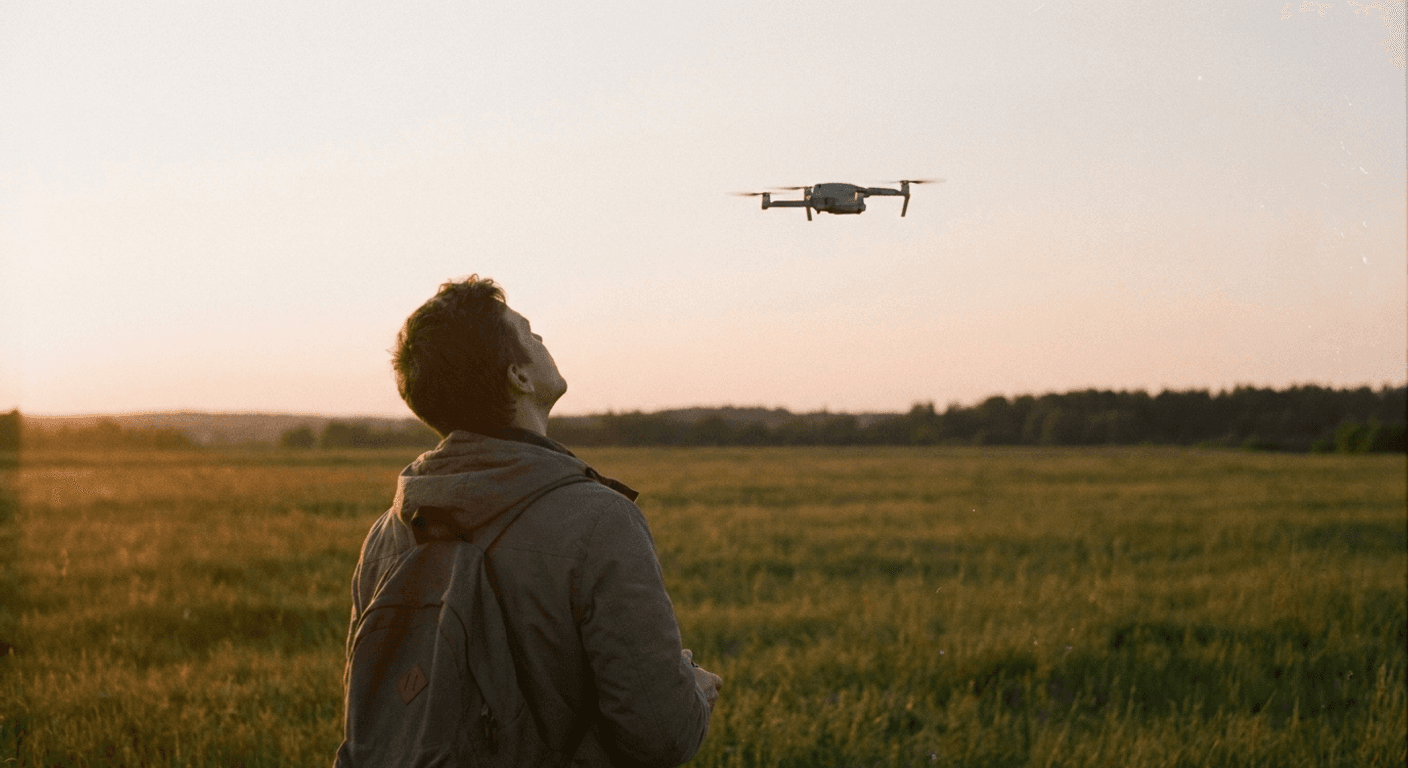
Indiana law enforcement must get a search warrant before using a drone on or over private property, or to search, surveil, or photograph it, under Indiana Code 35-33-5-9, resolving years of uncertainty. Separate statutes ban drone-aided deer poaching, "remote aerial voyeurism" of an occupied home and its secluded grounds, and "remote aerial harassment" of a neighbor's property.
Federal Airspace Rules vs. Indiana State Law
The FAA governs where a drone may fly nationwide: altitude limits, pilot certification under 14 CFR Part 107, the recreational-flyer exception at 49 U.S.C. 44809, and Remote ID broadcast requirements. None of that answers whether an Indiana police department can point a drone's camera at your backyard, or whether a neighbor can legally hover one outside your bedroom window. Indiana answers those questions through its own statutes, layered on top of the federal operating rules every drone must already follow.

Does Indiana Police Need a Warrant to Fly a Drone Over Your Property?
Yes, in most circumstances. Indiana Code 35-33-5-9 sets out two independent triggers. A law enforcement officer must obtain a search warrant to use an unmanned aerial vehicle "on or over private property," or to use one "to conduct a search, perform surveillance, obtain a photograph, or obtain video of private property or of individuals, items, or structures located on private property," in each case without the consent of the owner of the affected private property. The first prong is easy to overlook and it matters: a police drone does not escape the warrant rule simply because it was not actively searching or recording while it was up there.
The chapter's definitions bound how far that reaches. Indiana Code 35-33-5-0.5(7) defines "use of an unmanned aerial vehicle" as use by a law enforcement officer to obtain evidence relevant to the enforcement of statutes, rules, or regulations, and says the term includes both the interception of wire, electronic, or oral communications and the capture, collection, monitoring, or viewing of images. So the section governs evidence-gathering flights, and it closes off an argument that only video, and not audio interception, triggers the warrant rule.
This provision resolves what earlier secondary sources described only as a plausible, unconfirmed rule: Indiana's warrant requirement is written directly into the state's search-and-seizure code, Title 35, Article 33, Chapter 5, the same chapter that governs ordinary search warrants.
The rule tracks, rather than expands, ordinary Fourth Amendment doctrine. A warrant is not required for a drone search if a warrant would not be required for the same search conducted without a drone, meaning the traditional exceptions to the warrant requirement, such as plain view from a lawful vantage point or exigent circumstances, still apply. The statute's warrant requirement does not apply if the affected property owner has consented to the drone's use.
Indiana backs the warrant rule with an exclusionary remedy that many states without a comparable warrant statute lack. Indiana Code 35-33-5-10 provides that a communication or image obtained through drone use in violation of Section 9, and any evidence derived from it, is inadmissible in any proceeding.
Remote Aerial Voyeurism and Harassment: Indiana's Civilian Drone Privacy Laws
Indiana's most direct civilian-facing drone statute is not framed as a general privacy law but as a voyeurism offense. Indiana Code 35-45-4-5(g) makes it "remote aerial voyeurism," a Class A misdemeanor, to operate an unmanned aerial vehicle with the intent to peep, in a manner intended to cause the drone to enter the space above or surrounding another person's occupied dwelling, for the purpose of capturing images, photographs, video recordings, or audio recordings of that person.
The statute reaches two situations, not one. The person may be inside the occupied dwelling, or on the land or premises on which that dwelling is located, in a location that is not visible from an area open to the general public or where a member of the general public has the right to be. A drone that peeps at someone in a secluded backyard is therefore covered even though nothing was captured indoors. A Class A misdemeanor carries up to a year in jail and a fine of up to $5,000. The offense escalates to a Level 6 felony if the operator has a prior, unrelated conviction under the section, or if the operator publishes the captured material, makes it available on the internet, or transmits it to another person.
Indiana also has a dedicated drone-harassment statute, so a flight that captures nothing at all can still be a crime. Indiana Code 35-45-10-6 makes "remote aerial harassment" a Class A misdemeanor, and it reaches four separate acts: operating a drone in a manner intended to subject another person to harassment; operating a drone over another person's property without that person's consent and with intent to harass, disturb, or injure an individual or animal, or to damage or disturb a crop, on that property; knowingly or intentionally dispersing any substance from a drone onto another person's property without consent; and recklessly, knowingly, or intentionally operating a drone over another person's property without consent in a manner that interferes with or endangers another aircraft or drone. A prior unrelated conviction under the section raises the offense to a Level 6 felony. The statute supplies defenses where the prohibited act resulted from a mechanical or electronic failure or was necessary to avoid a greater harm, and, for the substance-dispersal prong, where the substance drifted over as unintentional overspray despite reasonable good faith precautions.
That combination matters for the most common complaint. A drone that repeatedly hovers over a fence line without ever recording inside a home is not left to trespass, harassment, or nuisance theories alone: if the operator meant to harass or disturb the people or animals below, Section 35-45-10-6 applies directly, and if the operator was peeping at someone in a secluded part of the property, Section 35-45-4-5(g)(2) applies as well. Local reporting on rural Hoosiers describes residents turning to these overlapping statutes, rather than to self-help, when drones repeatedly fly over chicken coops or livestock, or appear to track game for poachers.
Indiana's Drone Hunting Ban and the State's First Conviction
Indiana Code 14-22-6-16, in force since 2016, bars knowingly using an unmanned aerial vehicle to search for, scout, locate, or detect a wild animal as an aid to taking that animal, both during the animal's open hunting season and during the 14 days immediately before the season opens. A 2024 amendment narrowed an ambiguity in the original law: a drone, including one equipped with infrared, may be used to locate and recover an animal that has already been legally taken, though this does not authorize entering another person's property, or recovering the animal from another person's property, without the landowner's permission.
Section 14-22-6-16 carries no penalty clause of its own. The general penalty provision for the article, Indiana Code 14-22-38-1, makes a violation a Class C infraction, and a knowing or intentional violation a Class C misdemeanor. Under Indiana Code 35-50-3-4, a Class C misdemeanor carries up to 60 days in jail and a fine of up to $500. Related hunting counts are graded higher and should not be confused with drone scouting: actually taking a deer or a wild turkey in violation of the article is a Class B misdemeanor under Indiana Code 14-22-38-3.
Indiana's Department of Natural Resources brought its first prosecution under Section 14-22-6-16 in early 2026, after residents near a rural steel plant reported a drone repeatedly tracking a well-known, heavily antlered buck the community had nicknamed for months. Forensic analysis of the seized drone recovered hundreds of tracking photographs and GPS movement data showing the animal was being patterned around a baited area, with flights beginning September 14, 2025, 14 days before the October 1 season opened. The primary defendant took a plea deal in February 2026: 60 days of probation, a one-year revocation of hunting and fishing privileges, a $500 replacement fee, court costs, and surrender of the animal's hide and antlers; a second, less culpable suspect received pretrial diversion and probation. It is widely cited as the first conviction under Indiana's drone hunting statute since it took effect.
Can You Shoot Down a Drone Over Your Property in Indiana?
No. Every drone is legally an "aircraft" under federal law, and 18 U.S.C. 32, the Aircraft Sabotage Act, makes willfully damaging, destroying, or disabling one a federal felony carrying up to 20 years in prison, regardless of whose land it is flying over. Because the FAA, not the individual landowner, controls the national airspace, no state, including Indiana, can authorize a landowner to shoot down a drone as a matter of right. Indiana law enforcement officials quoted in coverage of the state's rural drone disputes have specifically advised frustrated residents that shooting one down is not a legal option, and have pointed them instead to Indiana Code 35-45-4-5's voyeurism protection, the remote aerial harassment offense in Indiana Code 35-45-10-6, the state's general trespass law, and the hunting-drone statute where poaching is suspected.
Penalties at a Glance
| Conduct | Indiana Statute | Type | Consequence |
|---|---|---|---|
| Law enforcement drone flown on or over private property, or used to search, surveil, or record it, without a warrant, consent, or an exception | Indiana Code 35-33-5-9 | Evidentiary | Image/communication and derivative evidence inadmissible (IC 35-33-5-10) |
| Remote aerial voyeurism of a person inside an occupied dwelling or on its secluded grounds | Indiana Code 35-45-4-5(g) | Class A misdemeanor (Level 6 felony if repeat or published/transmitted) | Up to 1 year jail, $5,000 fine (felony: harsher range) |
| Remote aerial harassment, including flying over another person's property without consent with intent to harass, disturb, or injure | Indiana Code 35-45-10-6 | Class A misdemeanor (Level 6 felony on a prior conviction under the section) | Up to 1 year jail, $5,000 fine |
| Using a drone to scout/locate game to aid hunting | Indiana Code 14-22-6-16 (penalty via IC 14-22-38-1) | Class C misdemeanor if knowing or intentional; otherwise Class C infraction | Up to 60 days jail, $500 fine |
| Shooting down any drone | 18 U.S.C. 32 (federal) | Felony | Up to 20 years in prison, fines up to $250,000 |
For general video surveillance rules outside the drone context, see Surveillance Camera Laws by State. For the full 51-state breakdown of drone law, see Drone Laws by State.
More Indiana Laws
- Indiana Data Privacy Laws
- Indiana GPS Tracking Laws
- Indiana Police Bodycam Laws
- Indiana Recording Laws
- Indiana Smart Glasses Recording Laws
Frequently Asked Questions
Does Indiana police need a warrant to fly a drone over my property?
Yes. Indiana Code 35-33-5-9 requires a law enforcement officer to get a search warrant on either of two independent grounds: to use an unmanned aerial vehicle on or over private property, or to use one to search, surveil, or photograph or video private property or the people, items, or structures on it. Either way, the warrant is required without the consent of the owner of the affected property. A warrant is not required if one would not be required for the same search without a drone, such as observation from a public vantage point.
What happens if Indiana police use a drone without a warrant?
Under Indiana Code 35-33-5-10, any image or communication obtained through a drone in violation of the warrant statute, and any evidence derived from it, is inadmissible in court.
Can my neighbor legally fly a drone over my house and film me in Indiana?
Two separate Indiana crimes can apply. Indiana Code 35-45-4-5(g) makes it a Class A misdemeanor, called remote aerial voyeurism, to fly a drone into the space above or surrounding your occupied home with intent to peep and capture images, video, or audio of you, and it covers you whether you are inside the house or on the surrounding land in a spot that is not visible from anywhere the public may be. Indiana Code 35-45-10-6 separately makes remote aerial harassment a Class A misdemeanor, which covers flying a drone over your property without your consent and with intent to harass, disturb, or injure you or an animal, as well as reckless operation over your property that interferes with or endangers another aircraft. A neighbor who repeatedly hovers a drone over your yard to bother you is facing a dedicated criminal statute, not only a civil trespass or nuisance theory.
What is remote aerial voyeurism in Indiana?
It is the offense in Indiana Code 35-45-4-5(g) of operating a drone with the intent to peep, causing it to enter the space above or surrounding a person's occupied dwelling to capture images, video, or audio of that person. The statute covers the person both inside the dwelling and on the land or premises where the dwelling sits, so long as that spot is not visible from an area open to the general public or where the public has a right to be. It is a Class A misdemeanor, punishable by up to a year in jail and a $5,000 fine, and becomes a Level 6 felony if the operator has a prior unrelated conviction under the section or publishes, posts, or transmits the material.
Can I use a drone to scout deer in Indiana before hunting season?
No. Indiana Code 14-22-6-16 bars using a drone to search for, scout, locate, or detect a wild animal to aid a hunt, both during the open season and for the 14 days immediately before it opens. That section carries no penalty of its own: under Indiana Code 14-22-38-1, a knowing or intentional violation of the hunting article is a Class C misdemeanor, which means up to 60 days in jail and a fine of up to $500, and a violation that is not knowing is a Class C infraction. A 2026 case in which a hunter used a drone to track a well-known trophy buck for weeks resulted in the state's first conviction under the statute.
Can I use a drone to recover a deer I already legally shot in Indiana?
Yes. A 2024 amendment to Indiana Code 14-22-6-16 allows a drone, including one equipped with infrared, to help locate and recover an animal that has already been legally taken, though it does not authorize entering another person's property, or recovering the animal from another person's property, without the landowner's permission.
Can I shoot down a drone flying over my property in Indiana?
No. Damaging or destroying any drone is a federal felony under 18 U.S.C. 32 regardless of Indiana law, because the FAA controls the national airspace rather than the individual landowner. Indiana law enforcement has advised rural residents frustrated by drones over their property that shooting one down is not a legal option.
Updates
Corrected Indiana's drone rules: restored the first prong of the police warrant statute (a warrant is required to fly on or over private property, not only to search or record it), added the remote aerial harassment offense at Indiana Code 35-45-10-6 that the page previously said did not exist, added the secluded-grounds prong of the remote aerial voyeurism statute, and fixed the drone-hunting penalty from a Class B misdemeanor to the Class C misdemeanor the hunting article's general penalty provision actually imposes.
Independently fact-checked against the cited primary sources; governing law re-checked for recent changes
Removed a fabricated 'motor vehicle accident scene' warrant exception from IC 35-33-5-9 (the statute has no such carve-out) and corrected IC 14-22-6-16's drone-recovery hunting exception, which actually turns on landowner permission and trespass rather than on whether the recovery party is carrying hunting implements.
Governing law re-checked for recent changes
Reviewed and approved by an editor
The Law Behind This Article
This article rests on the statutory provisions below, held in our own legal record and retrieved from the official source. Tap a section to read the operative text.
Indiana Code, TITLE 35. CRIMINAL LAW AND PROCEDURE
§ 35-33-5-9Unmanned aerial vehicles; search warrant; exceptionsIn forcecited in 2 of our articles
Sec. 9. A law enforcement officer must obtain a search warrant in order to use an unmanned aerial vehicle: (1) on or over private property; or (2) to conduct a search, perform surveillance, obtain a photograph, or obtain video of private property or of individuals, items, or structures located on private property; without the consent of the owner of the affected private property. However, a warrant is not required for a use of an unmanned aerial vehicle if a warrant would not be required for a search not using an unmanned aerial vehicle.
Official text (excerpt) · last checked 2026-07-29 · Read the full text in our law library · Verify at iga.in.gov
Cited in 1 court opinions in our collectionLatest citing opinion in our collection: 2018
Opinions citing this section in our collection:
- Amber Keith v. State of Indiana (Indiana Court of Appeals 2018, 91 N.E.3d 1029)“…the use of an unmanned aerial vehicle under IC 35-33-5-9. Ind. Code § 35-31.5-2-186 (20…”
Identified automatically from the court opinions citing this section — not a ranking of which case controls.
Also relied on in: Indiana Surveillance Camera Laws (2026 Guide)
§ 35-33-5-10Admissibility of evidence; unmanned aerial vehiclesIn force
Sec. 10. The following are not admissible as evidence in an administrative or judicial proceeding: (1) A communication or an image that is obtained through the use of an unmanned aerial vehicle in violation of section 9 of this chapter. (2) Evidence derived from a communication or an image described in subdivision (1).
Official text (excerpt) · last checked 2026-07-29 · Read the full text in our law library · Verify at iga.in.gov
Cited in 1 court opinions in our collectionLatest citing opinion in our collection: 2019
Opinions citing this section in our collection:
- City of Hammond v. John Rostankovski (Indiana Court of Appeals 2019, 119 N.E.3d 113)“…t, the 1 In its Order, the Superior Court referred to I.C. § 35-33-5-10. However, we assume the Superior Court…”
Identified automatically from the court opinions citing this section — not a ranking of which case controls.
§ 35-45-4-5Voyeurism; public voyeurism; aerial voyeurismIn forcecited in 16 of our articles
Sec. 5. (a) The following definitions apply throughout this section: (1) "Camera" means a camera, a video camera, a device that captures a digital image, or any other type of video recording device. (2) "Peep" means: (A) any looking of a clandestine, surreptitious, prying, or secretive nature; or (B) using a concealed camera with the intent of capturing an intimate image (as defined by IC 34-21.5-2-1). (3) "Private area" means the naked or undergarment clad genitals, pubic area, or buttocks of an individual. (b) A person: (1) who knowingly or intentionally: (A) peeps; or (B) goes upon the land of another with the intent to peep; into an occupied dwelling of another person; or (2) who knowingly or intentionally peeps in or into an area where an occupant of the area reasonably can be expected to disrobe or is actually expected to disrobe, including: (A) restrooms; (B) baths; (C) showers; and (D) dressing rooms; without the consent of the other person, commits voyeurism, a Class B misdemeanor.
Official text (excerpt) · last checked 2026-07-29 · Read the full text in our law library · Verify at iga.in.gov
Cited in 19 court opinions in our collectionLatest citing opinion in our collection: 2026
In the courts (editorial summary, independently checked):Casady v. State (2010) held restrooms and showers are areas where occupants reasonably can be expected to disrobe under 35-45-4-5, whether or not they actually did. Steven M. Sandleben v. State of Indiana (2014) read the public voyeurism definition of private area disjunctively, covering undergarment-clad or naked areas.
Opinions citing this section in our collection:
- Casady v. State (Indiana Court of Appeals 2010, 934 N.E.2d 1181)✓A man videotaped men at urinals and in a shower while hiding in a stall and a doorway; the court affirmed his voyeurism convictions, holding the filming was a clandestine peep and that restrooms are listed places where occupants can reasonably be expected to disrobe.
- Steven M. Sandleben v. State of Indiana (Indiana Court of Appeals 2014, 22 N.E.3d 782)✓A man put a camera under a four-year-old's skort in a store and filmed two girls underwater at a pool; the court upheld his public voyeurism convictions, holding the statute reaches naked or undergarment clad areas and was not vague as applied to him.
- David Delagrange v. State of Indiana (Indiana Court of Appeals 2013, 981 N.E.2d 1227)“…e other person, commits voyeurism, a Class B misdemeanor. Ind.Code § 35-45-4-5(a) (2005). After Delagrange committed t…”
Identified automatically from the court opinions citing this section — not a ranking of which case controls.
Also relied on in: Indiana Smart Glasses Recording Laws 2025, Indiana Audio Recording Laws: One-Party Consent Rules and Penalties, Indiana Landlord-Tenant Recording Laws: Rights for Renters and Property Owners
§ 35-45-10-6Remote aerial harassmentIn force
Sec. 6. (a) A person who: (1) operates an unmanned aerial vehicle in a manner that is intended to subject another person to harassment; (2) operates an unmanned aerial vehicle over the property of another person: (A) without the consent of the other person; and (B) with the intent to: (i) harass, disturb, or injure an individual or animal; or (ii) damage or disturb a crop; on the other person's property; (3) knowingly or intentionally disperses any substance from an unmanned aerial vehicle onto the property of another person without the consent of the other person; or (4) recklessly, knowingly, or intentionally operates an unmanned aerial vehicle: (A) over the property of another person; and (B) without the consent of the other person; in a manner that interferes with or endangers another aircraft or unmanned aerial vehicle; commits remote aerial harassment, a Class A misdemeanor. However, the offense is a Level 6 felony if the person has a prior unrelated conviction under this section.
Official text (excerpt) · last checked 2026-07-29 · Read the full text in our law library · Verify at iga.in.gov
Cited in 1 court opinions in our collectionLatest citing opinion in our collection: 2024
Opinions citing this section in our collection:
- Jeffery Dean Scheel v. State of Indiana (Indiana Court of Appeals 2024)“…catur County, approximately 400 yards 1 Ind. Code § 35-45-10-6. 2 As part of our civic-e…”
Identified automatically from the court opinions citing this section — not a ranking of which case controls.
§ 35-50-3-4Class C misdemeanorIn force
Sec. 4. A person who commits a Class C misdemeanor shall be imprisoned for a fixed term of not more than sixty (60) days; in addition, he may be fined not more than five hundred dollars ($500).
Official text (excerpt) · last checked 2026-07-29 · Read the full text in our law library · Verify at iga.in.gov
Cited in 20 court opinions in our collectionLatest citing opinion in our collection: 2026
Opinions citing this section in our collection:
- Snyder v. King (Indiana Supreme Court 2011, 958 N.E.2d 764)“…to an executed term of incarceration (no matter how short), I.C. § 35-50-3-4 (person convicted of Class C misdemeano…”
- Joey Jennings v. State of Indiana (Indiana Supreme Court 2013, 982 N.E.2d 1003)“…or a Class C misdemeanor is imprisonment for up to 60 days. Ind. Code § 35-50-3-4 (2008). 2 Namely, Indiana Code § 35-5…”
- Gressel v. State (Indiana Court of Appeals 1995, 653 N.E.2d 139)“…to sixty days imprisonment and/or a fine of up to $500.00. I.C. § 35-50-3-4. Thus, a court is not authorized to ord…”
Identified automatically from the court opinions citing this section — not a ranking of which case controls.
Indiana Code, TITLE 14. NATURAL AND CULTURAL RESOURCES
§ 14-22-6-16Use of unmanned aerial vehicles to aid huntingIn force
Sec. 16. (a) This section does not apply to the following: (1) The department or the department's designee. (2) Employees or agents of a governmental entity while performing official duties. (3) Employees or agents of an educational or research institution acting for bona fide educational or scientific purposes. (4) Use of an unmanned aerial vehicle to assist, provide care for, or provide veterinary treatment to a specific wild animal. (5) Use of an unmanned aerial vehicle to monitor areas of agricultural production or to monitor nuisance wild animals. (b) As used in this section, "take" means to: (1) kill, shoot, spear, harm, catch for the purpose of killing, trap for the purpose of killing, or pursue for the purpose of killing a wild animal; or (2) attempt to engage in conduct under subdivision (1).
Official text (excerpt) · last checked 2026-07-29 · Read the full text in our law library · Verify at iga.in.gov
§ 14-22-38-1Violations generallyIn force
Sec. 1. (a) Except as otherwise provided in this article and subject to subsection (b), a person who violates this article commits a Class C infraction. (b) Except as otherwise provided in this article, a person who knowingly or intentionally violates this article commits a Class C misdemeanor. (c) A person may not be charged with both: (1) a Class C misdemeanor; and (2) a Class C infraction; under this section for the same act or omission. [Pre-1995 Recodification Citation: 14-2-3-8(b).]
Official text (excerpt) · last checked 2026-07-29 · Read the full text in our law library · Verify at iga.in.gov
Cited in 3 court opinions in our collectionLatest citing opinion in our collection: 2014
Opinions citing this section in our collection:
- A.J.R. v. State (Indiana Court of Appeals 2014, 24 N.E.3d 1000)“…1-1 through 14-22-41-12; see also Ind.Code § 14-22-34-5; Ind.Code § 14-22-38-1 to -5 (specifically dealing with violat…”
- A.J.R. v. State of Indiana (Indiana Court of Appeals 2014, 3 N.E.3d 1000)“…1-1 through 14-22-41-12; see also Ind. Code § 14-22-34-5; Ind. Code § 14-22-38-1 to -5 (specifically dealing with violat…”
- Jeremy Schath v. State of Indiana (Indiana Court of Appeals 2014, 2 N.E.3d 136)“…iana Code section 14-22-10-1 commits a Class C misdemeanor. Ind. Code § 14-22-38-1. In the instant matter, the und…”
Identified automatically from the court opinions citing this section — not a ranking of which case controls.
United States Code Title 18
§ 32Destruction of aircraft or aircraft facilitiesIn forcecited in 51 of our articles
Whoever willfully— sets fire to, damages, destroys, disables, or wrecks any aircraft in the special aircraft jurisdiction of the United States or any civil aircraft used, operated, or employed in interstate, overseas, or foreign air commerce; places or causes to be placed a destructive device or substance in, upon, or in proximity to, or otherwise makes or causes to be made unworkable or unusable or hazardous to work or use, any such aircraft, or any part or other materials used or intended to be used in connection with the operation of such aircraft, if such placing or causing to be placed or such making or causing to be made is likely to endanger the safety of any such aircraft; sets fire to, damages, destroys, or disables any air navigation facility, or interferes by force or violence with the operation of such facility, if such fire, damaging, destroying, disabling, or interfering is likely to endanger the safety of any such aircraft in flight; with the intent to damage, destroy, or disable any such aircraft, sets fire to, damages, destroys, or disables or places a destructive device or substance in, upon, or in proximity to, any appliance or structure, ramp, landing area,…
Official text (excerpt) · last checked 2026-07-28 · Read the full text in our law library · Verify at uscode.house.gov
Cited in 168 court opinions in our collectionLatest citing opinion in our collection: 2026
In the courts (editorial summary, independently checked):United States v. Yousef (2003) applied 18 U.S.C. 32 to an overseas airline bombing plot, holding Section 32(a) reaches conduct abroad because US-flag aircraft in flight are within the special aircraft jurisdiction, and that a defendant brought here involuntarily is still found in the United States under Section 32(b).
Opinions citing this section in our collection:
- Perez v. United States (Supreme Court of the United States 1971, 402 U.S. 146)“…commerce, as, for example, the destruction of an aircraft ( 18 U. S. C. § 32 ), or persons or things in commerce, as…”
- Stanford v. Kentucky (Supreme Court of the United States 1989, 492 U.S. 361)“…r by persons subject to Uniform Code of Military Justice); 18 U. S. C. §§ 32 , 33, and 34 (1982 ed. and Supp. V) (de…”
- United States v. Yousef (Court of Appeals for the Second Circuit 2003, 327 F.3d 56)✓Yousef bombed a Philippine airliner and plotted to bomb twelve US flag airliners on Asian routes; the court held Section 32(a) reaches attacks on US flag aircraft worldwide, and that Yousef, brought here involuntarily, was found in the United States under Section 32(b).
Identified automatically from the court opinions citing this section — not a ranking of which case controls.
Also relied on in: Iowa Drone Laws: Homestead, Farmstead & Warrant Rules, Kansas Drone Laws: Stalking Act & Privacy Rules Explained, California Drone Laws (2026): Privacy, Fires & Shoot-Down Rules
United States Code Title 49
§ 44809Exception for limited recreational operations of unmanned aircraftIn forcecited in 13 of our articles
Except as provided in subsection (e), and notwithstanding chapter 447 of title 49, United States Code, a person may operate a small unmanned aircraft without specific certification or operating authority from the Federal Aviation Administration if the operation adheres to all of the following limitations: The aircraft is flown strictly for recreational purposes. The aircraft is operated in accordance with or within the programming of a community-based organization’s set of safety guidelines that are developed in coordination with the Federal Aviation Administration. The aircraft is flown within the visual line of sight of the person operating the aircraft or a visual observer co-located and in direct communication with the operator. The aircraft is operated in a manner that does not interfere with and gives way to any manned aircraft. In Class B, Class C, or Class D airspace or within the lateral boundaries of the surface area of Class E airspace designated for an airport, the operator obtains prior authorization from the Administrator or designee before operating and complies with all airspace restrictions and prohibitions.
Official text (excerpt) · last checked 2026-07-28 · Read the full text in our law library · Verify at uscode.house.gov
Cited in 1 court opinions in our collectionLatest citing opinion in our collection: 2022
Opinions citing this section in our collection:
- Tyler Brennan v. Stephen Dickson (Court of Appeals for the D.C. Circuit 2022, 45 F.4th 48)“…Reauthorization Act, § 349(a), (b), (f), 132 Stat. at 3297; 49 U.S.C. § 44809(f); see Final Rule, 86 Fed. Reg. at 440…”
Identified automatically from the court opinions citing this section — not a ranking of which case controls.
Also relied on in: Illinois Drone Laws (2026): Police Warrants, Privacy, and Hunting, Florida Drone Laws 2026: Privacy, Warrants & Penalties, Idaho Drone Laws (2026): Privacy, Police Warrants, and Hunting Rules
Search our full record of US law — 2.1 million sections, every state + federal →
Sources and References
- Indiana Code 35-33-5-9 (Unmanned aerial vehicles; search warrant; exceptions). Requires a search warrant before law enforcement uses a drone to search, surveil, or photograph private property or persons/items/structures on it without consent, subject to listed exceptions.(iga.in.gov).gov
- Indiana Code 35-33-5-10 (Admissibility of evidence; unmanned aerial vehicles). Makes any image, communication, or derivative evidence obtained in violation of the Section 9 warrant requirement inadmissible.(iga.in.gov).gov
- Indiana Code 35-45-4-5 (Voyeurism; public voyeurism; remote aerial voyeurism). Makes it a Class A misdemeanor to operate a drone with intent to peep, entering airspace above an occupied dwelling to capture images, video, or audio of the occupant; Level 6 felony for repeat offenders or if published/transmitted.(iga.in.gov).gov
- Indiana Code 14-22-6-16 (Use of unmanned aerial vehicles to aid hunting). Bars knowingly using a drone to search for, scout, locate, or detect a wild animal to aid taking it, during the open season and 14 days before; Class B misdemeanor; 2024 amendment permits post-kill recovery use.(iga.in.gov).gov
- 18 U.S.C. 32 (Aircraft Sabotage Act). Makes willfully damaging, destroying, or disabling any aircraft, including a drone, a federal felony punishable by up to 20 years in prison.(law.cornell.edu)
- Indiana Capital Chronicle, 'Rural Hoosiers lean on the law to fight drones' (April 27, 2026). Reports on rural residents' use of Indiana's warrant, voyeurism, and hunting statutes in response to drone disputes, and law enforcement guidance against shooting drones down.(indianacapitalchronicle.com)
- WBIW, 'Indiana DNR files first prosecution in illegal drone scouting case' (March 2, 2026). Details the drone-assisted deer-poaching case and seized-drone forensic evidence that led to Indiana's first conviction under IC 14-22-6-16.(wbiw.com)
- Indiana Code 35-45-10-6 (Remote aerial harassment). Makes it a Class A misdemeanor to operate a drone intending to harass another person; to operate one over another person's property without consent with intent to harass, disturb, or injure an individual or animal or damage or disturb a crop; to disperse a substance from a drone onto another's property without consent; or to recklessly, knowingly, or intentionally operate one over another's property without consent so as to interfere with or endanger another aircraft. Level 6 felony on a prior unrelated conviction under the section.(iga.in.gov)
- Indiana Code 14-22-38-1 (Violations generally). Supplies the penalty for IC 14-22-6-16, which has none of its own: a violation of the article is a Class C infraction, and a knowing or intentional violation is a Class C misdemeanor.(iga.in.gov)
- Indiana Code 35-50-3-4 (Class C misdemeanor). Fixes the Class C misdemeanor penalty at not more than 60 days imprisonment and a fine of not more than $500.(iga.in.gov)
- Indiana Code 14-22-38-3 (Unlawful taking of deer or wild turkey). Makes taking a deer or wild turkey in violation of the article a Class B misdemeanor, a separate offense from drone scouting under IC 14-22-6-16.(iga.in.gov)
- Indiana Code 35-33-5-0.5 (Definitions). Subsection (7) defines 'use of an unmanned aerial vehicle' as use by a law enforcement officer to obtain evidence relevant to enforcement of statutes, rules, or regulations, including interception of wire, electronic, or oral communications and the capture, collection, monitoring, or viewing of images. This bounds the scope of the IC 35-33-5-9 warrant requirement.(iga.in.gov)