
Alabama
Alabama Drone Laws (2026): Privacy, Prisons & Police Warrants
Independently fact-checked against primary sources (last audited August 17, 2026). · Reviewed by the RecordingLaw editorial team. · Law checked current as of August 17, 2026. · 6 primary sources cited on this page. How we verify our legal content
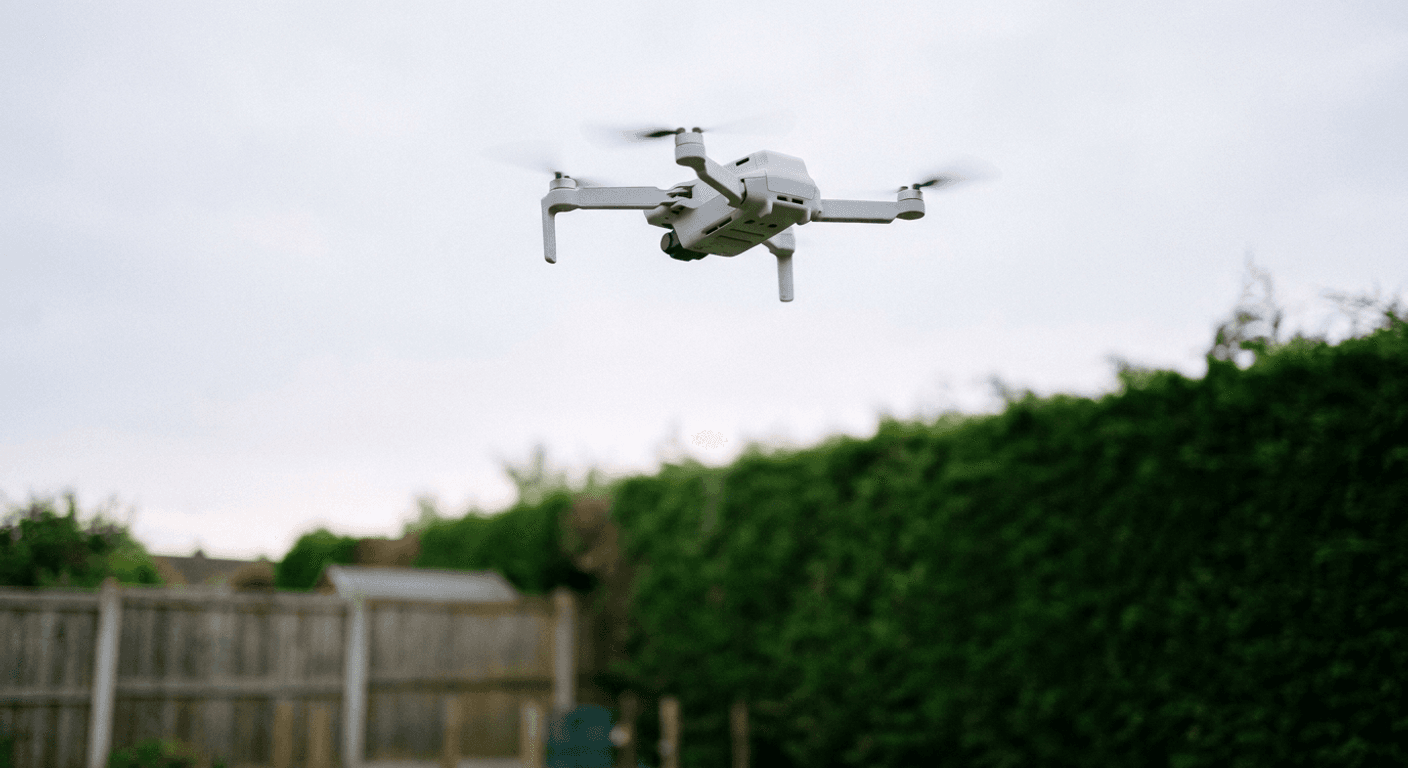
Alabama has no drone-specific privacy statute and no law requiring police to obtain a warrant before flying a drone over private property. Civilian drone spying is analyzed under general criminal surveillance and trespass law, while flying near a state prison, the Capitol complex in Montgomery, or a ticketed entertainment event triggers separate, more serious restrictions.
Information last verified on 2026-07-09. This article has not yet been reviewed by a licensed lawyer.
Scope: This page covers Alabama law on civilian and law-enforcement drone use, prison, Capitol-area and event no-fly rules, and the federal shoot-down law. It does not cover FAA flight-operation rules like registration and Remote ID. For a related surveillance topic, see Alabama Surveillance Camera Laws.
Does the FAA or Alabama control where a drone can fly?
The Federal Aviation Administration has exclusive authority over the navigable airspace, which for drones extends down to the ground. Anyone flying a drone in Alabama must register the aircraft with the FAA, keep it below 400 feet, and stay within visual line of sight unless a waiver applies; recreational flyers pass the FAA's free TRUST test, while commercial and government operators need a Remote Pilot Certificate under 14 CFR Part 107. Since 2023, most drones must also broadcast Remote ID, a digital signal showing location and control-station data. None of that decides whether a neighbor can legally point a camera drone at your backyard, or whether an Alabama police department needs a judge's signature first. Those questions turn on state law, layered on top of the federal operating rules, and the FAA's own guidance draws the line: it controls aviation safety and airspace, while states keep their police power over conduct, including privacy, trespass, and law-enforcement use. Alabama has used that authority narrowly so far, focusing on prisons, the state Capitol complex, and ticketed events, rather than a general civilian privacy law.
Does Alabama have a drone privacy law?
Alabama does not have a law written specifically for drone surveillance. Lawmakers came close in 2025 with House Bill 201, which would have made it a crime to fly a drone to record a public school or to observe a person with a reasonable expectation of privacy, but the bill died in the House Judiciary Committee on May 14, 2025, and no standalone replacement had passed as of this writing. Until the Legislature enacts something similar, a person harmed by a nosy drone has to rely on laws that were not written with drones in mind.
Ala. Code Section 13A-11-32 makes it a Class B misdemeanor to intentionally engage in surveillance while trespassing in a private place. "Private place" is defined in Section 13A-11-30(2) as a place where one may reasonably expect to be safe from casual or hostile intrusion or surveillance, but not a place to which the public or a substantial group of the public has access. The trespassing element is the practical problem for drone cases: the definition of a private place expressly contemplates being free from surveillance, but the offense itself still requires the operator to be trespassing, so a drone hovering above a fenced backyard, without the operator ever setting foot on the property, sits in a legal gray area the statute's drafters did not anticipate. No published Alabama appellate decision has yet addressed whether that kind of airspace-only intrusion satisfies Section 13A-11-32.
A separate provision, Ala. Code Section 13A-11-32.1, makes aggravated criminal surveillance a Class C felony where a person intentionally surveils an individual in a place where that individual has a reasonable expectation of privacy, without consent, for the purpose of sexual gratification. That section has no trespass element, so it is the more plausible hook for a voyeuristic drone flight, though it reaches only conduct done for sexual gratification and not ordinary snooping.
Does Alabama police need a warrant to fly a drone over my property?
Alabama has no statute specifically requiring a search warrant before a law enforcement agency uses a drone, unlike Florida, Illinois, or Virginia. Absent a state statute setting a higher bar, the ordinary Fourth Amendment standard applies: police generally need a warrant to use a drone to gather evidence from a constitutionally protected area, such as a home's curtilage, unless a recognized exception like consent, exigent circumstances, or plain view applies. That is federal constitutional law, not an Alabama statutory floor, and it leaves more discretion to individual departments than a dedicated warrant statute would.
A legislative Unmanned Aircraft System Study Commission examined gaps in Alabama's drone framework, including law-enforcement use, and delivered a final report to the Legislature in 2026. As of this writing, that process had not yet produced an enacted warrant statute, so readers should watch future sessions rather than assume Alabama has adopted a warrant requirement.
How does general trespass and nuisance law apply to a drone in Alabama?
Alabama's general trespass statute, Ala. Code Section 13A-7-4, makes it a violation, the state's lowest criminal classification, to knowingly enter or remain unlawfully on someone's property, including a fenced yard. As with the surveillance statute above, this language was drafted for people who physically enter land, not for a camera-equipped aircraft passing overhead. A homeowner's most realistic options against a persistent nuisance drone are often a civil claim for trespass to land or intrusion upon seclusion, a harassment complaint if the conduct is repeated and targeted, or a report to the FAA for careless operation.
What other Alabama-specific drone restrictions apply?
Several Alabama statutes carry far higher stakes than the general privacy gap described above. Ala. Code Sections 13A-7-91 through 13A-7-93 make it a Class C felony, with a mandatory minimum 30-day jail sentence that cannot be suspended and at least a $2,500 fine, to fly a drone within 500 feet horizontally or 200 feet vertically of a Department of Corrections facility, to use a drone to surveil or photograph one, or to introduce contraband or drone parts into one. "Facility" is defined broadly to include any real property the Department owns or leases, out to the outermost physical barrier, plus any public road within 100 yards of it.
A second set of felony restrictions covers the state Capitol complex. Ala. Code Sections 41-27-80 through 41-27-86 define a "Capitol area" to include the downtown Capitol complex in Montgomery, the Governor's Mansion, any official residence of the Governor, and any location designated by the Secretary of the Alabama State Law Enforcement Agency where the Legislature or the state appellate courts convene. Two offenses there are Class C felonies: intentionally using a drone to conduct surveillance of, or photograph or otherwise record images of, a Capitol area for the purpose of committing a criminal offense (Section 41-27-81), and intentionally or knowingly using one in the "vicinity" of a Capitol area in a manner that interferes with its operations or causes a disturbance (Section 41-27-82). "Vicinity" means within 500 horizontal feet and 250 vertical feet of the perimeter. Flying within 250 horizontal feet and 250 vertical feet of a state construction or improvement site inside a Capitol area, without written permission from the ALEA secretary, is a Class C misdemeanor and a Class B misdemeanor on a repeat offense (Section 41-27-83). Beginning January 1, 2027, Section 41-27-84 converts that same vicinity into a flat no-fly zone for anyone without written permission or a permit, exempting federal and state operators, people acting on their behalf, and emergency law-enforcement and fire responders. Section 41-27-85 authorizes ALEA to jam, hack, physically capture, or otherwise neutralize a drone operating in violation of the article, and to seize the aircraft and anything attached to or dropped from it.
Separately, starting October 1, 2026, a 2026 law (House Bill 429) makes it unlawful to operate a drone within 400 feet of a "ticketed entertainment event," a gated concert, sporting event, or performing-arts event, without consent from someone with legal authority over it. A first offense draws a $500 fine, repeat violations become a Class A misdemeanor, and federally authorized operators are exempt.
Alabama has no drone-specific hunting ban comparable to Alaska's. It does have a critical-infrastructure statute, Ala. Code Section 13A-7-4.3, which enumerates refineries, electrical power generating facilities and substations, pipelines, LNG terminals and storage facilities, regulated dams, and any portion of a public water system or public wastewater treatment system, and whose subsection (e) makes unauthorized entry of such a facility while possessing or operating a drone with an attached weapon, firearm, explosive, destructive device, or ammunition a Class C felony. That same section supplies the definition of "unmanned aircraft system" that both Alabama drone articles incorporate by reference. What Alabama lacks is a prohibition on merely flying a drone above critical infrastructure, the way some states bar overflight outright: Section 13A-7-4.3 is an unauthorized-entry offense, so the drone provision reaches an armed drone carried into the facility rather than a camera drone passing overhead.
Is it legal to shoot down a drone over my property in Alabama?
No. Federal law, 18 U.S.C. Section 32, makes it a felony to willfully damage, destroy, or disable an aircraft, and the FAA has classified drones as aircraft within the National Airspace System since 2012. Shooting down a drone is therefore a federal crime regardless of where it is flying, including directly over the shooter's own property, because the FAA, not the landowner, controls the airspace. A conviction carries up to 20 years in federal prison, a fine of up to $250,000, and permanent loss of firearm rights as a convicted felon. Alabama has not enacted, and could not lawfully enact, a statute authorizing a landowner to shoot down a drone as a matter of right.
Publicized cases where a drone shooter faced only reduced or dismissed state charges are not evidence that this conduct is safe. The best-known example, Kentucky resident William Merideth's 2015 shoot-down of a neighbor's drone, resulted in a local judge dismissing state criminal-mischief charges, but the drone owner's related federal lawsuit, Boggs v. Merideth, was dismissed in 2017 for lack of federal jurisdiction, without any court deciding whether the shoot-down itself was lawful. No reported Alabama case has tested a drone shoot-down, but the same federal exposure applies here as anywhere else.
Disclaimer
This article provides general legal information about Alabama drone law as verified on 2026-07-09. It does not constitute legal advice and does not create an attorney-client relationship. Readers with a specific drone incident, or a question about a pending Alabama bill, should consult a lawyer licensed in Alabama.
Related articles
Last updated: 2026-07-09. Statutes cited reflect their in-force or enacted version as of 2026-07-09.
More Alabama Laws
- Alabama Data Privacy Laws
- Alabama GPS Tracking Laws
- Alabama Police Bodycam Laws
- Alabama Recording Laws
- Alabama Smart Glasses Recording Laws
Frequently Asked Questions
Is it illegal to fly a drone over my neighbor's house in Alabama?
Not by itself. Alabama has no drone-specific privacy law, and merely flying over a property is not criminal trespass under Ala. Code Section 13A-7-4, which requires entering or remaining on land. If the flight amounts to targeted surveillance, harassment, or a nuisance, other general laws or a civil claim may apply.
Does Alabama require a warrant for police drone surveillance?
No. Alabama has no statute setting a specific warrant requirement for law enforcement drone use. Ordinary Fourth Amendment protections apply, meaning police generally need a warrant to search a constitutionally protected area like a home's curtilage, subject to standard exceptions such as consent or exigent circumstances.
Can I fly my drone near an Alabama prison?
No. Ala. Code Section 13A-7-91 makes it a Class C felony, with a mandatory 30-day minimum sentence, to fly a drone within 500 feet horizontally or 200 feet vertically of a Department of Corrections facility, or to use a drone to photograph or surveil one.
Can I fly a drone near the Alabama State House or the Governor's Mansion?
Not without serious risk. Under Ala. Code Sections 41-27-81 and 41-27-82 it is a Class C felony to use a drone to record a Capitol area for the purpose of committing a crime, or to fly one within 500 horizontal feet and 250 vertical feet of a Capitol area in a way that interferes with its operations or causes a disturbance. A Capitol area includes the downtown Capitol complex in Montgomery and the Governor's Mansion. Beginning January 1, 2027, Section 41-27-84 bars any unpermitted drone use in that same zone outright.
Can I fly a drone at an Alabama football game or concert?
Starting October 1, 2026, not without consent. A 2026 law makes it unlawful to fly a drone within 400 feet of a ticketed, gated entertainment event without permission from someone with authority over the venue, with escalating penalties for repeat violations.
Is it legal to shoot down a drone flying over my house in Alabama?
No. Destroying a drone is a federal felony under 18 U.S.C. Section 32 regardless of where it is flying, including over your own property, punishable by up to 20 years in federal prison. Alabama has no law authorizing self-help against a drone.
Does Alabama restrict drone use for hunting?
No. Unlike Alaska, Colorado, and Wyoming, Alabama has not enacted a statute restricting the use of drones to locate or pursue game.
What happened to Alabama's 2025 drone privacy bill?
House Bill 201 would have banned using a drone to record someone with a reasonable expectation of privacy or to film a public school. It died in the House Judiciary Committee on May 14, 2025, and Alabama still has no dedicated civilian drone-privacy statute.
Updates
Added Alabama's Capitol-area drone offenses (Ala. Code Sections 41-27-80 through 41-27-86), corrected the "private place" definition to its actual source at Section 13A-11-30(2) and restored the omitted "or surveillance" language, and replaced an inaccurate statement that Alabama has no critical-infrastructure statute with its actual scope under Section 13A-7-4.3.
Independently fact-checked against the cited primary sources; governing law re-checked for recent changes
Governing law re-checked for recent changes
Reviewed and approved by an editor
The Law Behind This Article
This article rests on the statutory provisions below, held in our own legal record and retrieved from the official source. Tap a section to read the operative text.
Code of Alabama 1975, Title 13A: Criminal Code.
§ 13A-7-91Operation of Unmanned Aircraft System Over a Department of Corrections Facility Prohibited in Certain Circumstances; Exceptions.In forcecited in 2 of our articles
(a) Except as provided in subsection (b), a person may not: (1) Operate an unmanned aircraft system within a horizontal distance of 500 feet or a vertical distance of 200 feet from a facility; or (2) Operate an unmanned aircraft system to conduct surveillance of or photograph or otherwise record images of a facility. (b) Subsection (a) does not apply to the use of an unmanned aircraft system by: (1) The Alabama Department of Corrections; (2) A person authorized by federal regulations to operate an unmanned aircraft system and who is operating the system in a lawful manner and consistent with federal regulations; (3) The Armed Forces of the United States of America; (4) The Alabama National Guard; or (5) Any of the following with prior written permission from the Commissioner of the Department of Corrections: a. A contractor working on behalf of the Department of Corrections; b. Any state or federal law enforcement agency or public safety agency responding to an emergency; c. A person engaged in official emergency functions or emergency management; or d. Any state or federal public utility.
Official text (excerpt) · last checked 2026-08-31 · Read the full text in our law library · Verify at alison.legislature.state.al.us
Also relied on in: Alabama Surveillance Camera Laws (2026 Guide)
§ 13A-7-93Introduction of Pieces of an Unmanned Aircraft System into a Facility.In force
(a) A person may not introduce or attempt to introduce any individual piece of an unmanned aircraft system into a facility. (b) A violation of this section is a Class C felony and a person violating this section shall be fined not less than two thousand five hundred dollars ($2,500). The sentence shall include a mandatory sentence, which is not subject to suspension or probation, of imprisonment in the Department of Corrections or a county jail for not less than 30 days.
Official text (excerpt) · last checked 2026-07-29 · Read the full text in our law library · Verify at alison.legislature.state.al.us
§ 13A-11-32Criminal Surveillance.In forcecited in 14 of our articles
(a) A person commits the crime of criminal surveillance if he intentionally engages in surveillance while trespassing in a private place. (b) Criminal surveillance is a Class B misdemeanor.
Official text (excerpt) · last checked 2026-08-31 · Read the full text in our law library · Verify at alison.legislature.state.al.us
Cited in 2 court opinions in our collectionLatest citing opinion in our collection: 2026
Opinions citing this section in our collection:
- Ages Group, LP v. Raytheon Aircraft Co., Inc. (District Court, M.D. Alabama 1998, 22 F. Supp. 2d 1310)“…rvation from a public street” does not violate the statute. Ala.Code § 13A-11-32, Commentary. However, AGES argues that…”
- United States v. Watkins (Court of Appeals for the Tenth Circuit 2026)“…ohibit the conduct in this case are noted in bold. Ala. Code § 13A-11-32;1 Ala. Code § 13A-11-32.1;2 Ariz. Rev.…”
Identified automatically from the court opinions citing this section — not a ranking of which case controls.
Also relied on in: Alabama Recording Laws (2026): One-Party Consent Rules, Alabama Landlord-Tenant Recording Laws: Rights for Renters and Property Owners, Alabama Voyeurism Laws: Hidden Cameras, Penalties, and Victim Rights
§ 13A-7-4Criminal Trespass in the Third Degree.In force
(a) A person is guilty of criminal trespass in the third degree when he knowingly enters or remains unlawfully in or upon premises. (b) Criminal trespass in the third degree is a violation.
Official text (excerpt) · last checked 2026-07-29 · Read the full text in our law library · Verify at alison.legislature.state.al.us
Cited in 4 court opinions in our collectionLatest citing opinion in our collection: 2025
Opinions citing this section in our collection:
- Freeman (District Court, N.D. Alabama 2025)“…owingly enters or remains unlawfully in or upon premises.” Ala. Code § 13A-7-4(a). Because Mr. Freeman pleaded the do…”
- George D. Metz, II v. D. Bridges (Court of Appeals for the Eleventh Circuit 2024)“…enters or remains unlawfully in or upon premises.” Ala. Code § 13A-7-4(a). Alabama also has a “stop and…”
- Bobby Edgar v. Marion Brunson (Court of Appeals for the Eleventh Circuit 2024)“…Opinion of the Court 24-10412 Ala. Code § 13A-7-4(a) (“A person is guilty of criminal tre…”
Identified automatically from the court opinions citing this section — not a ranking of which case controls.
§ 13A-11-30Definitions.In forcecited in 22 of our articles
The following definitions apply to this article: (1) EAVESDROP. To overhear, record, amplify or transmit any part of the private communication of others without the consent of at least one of the persons engaged in the communication, except as otherwise provided by law. (2) PRIVATE PLACE. A place where one may reasonably expect to be safe from casual or hostile intrusion or surveillance, but such term does not include a place to which the public or a substantial group of the public has access. (3) SURVEILLANCE. Secret observation of the activities of another person for the purpose of spying upon and invading the privacy of the person observed.
Official text (excerpt) · last checked 2026-07-29 · Read the full text in our law library · Verify at alison.legislature.state.al.us
Cited in 5 court opinions in our collectionLatest citing opinion in our collection: 2024
Opinions citing this section in our collection:
- Stinson v. Larson (Court of Civil Appeals of Alabama 2004, 893 So. 2d 462)“…ons Privacy Act of 1986, 18 U.S.C. §§ 2510 et seq., and Ala. Code 1975, §§ 13A-11-30 and 13A-11-31 (a). We note that the f…”
- Ages Group, LP v. Raytheon Aircraft Co., Inc. (District Court, M.D. Alabama 1998, 22 F. Supp. 2d 1310)“…f at least one of the persons engaged in the communication. Ala. Code § 13A-11-30 (1994). Alabama Code § 13A-11-32, prohi…”
- Bartnicki v. Vopper (Supreme Court of the United States 2001, 532 U.S. 514)“…[1] See 18 U. S. C. § 2511 (1) (1994 ed. and Supp. V); Ala. Code § 13A-11-30 et seq. (1994); Alaska Stat. Ann. §…”
Identified automatically from the court opinions citing this section — not a ranking of which case controls.
Also relied on in: One-Party Consent States: Complete 2026 Guide, Alabama Audio Recording Laws: Consent Rules and Penalties, Alabama Dashcam Laws: Legality, Mounting Rules, and Evidence Use
§ 13A-7-4.3Unauthorized Entry of a Critical Infrastructure Facility.In force
(a) For the purposes of this section, the following terms have the following meanings: (1) CRITICAL INFRASTRUCTURE. A system or asset, whether physical or virtual, so vital to the United States that the incapacity or destruction of the system or asset would have a debilitating impact on security, national economic security, national public health, or national public safety. (2) CRITICAL INFRASTRUCTURE FACILITY. The term includes, but is not limited to, any of the following, including any critical infrastructure located on or in any of the following types of facilities: a. A chemical, polymer, or rubber manufacturing facility. b. A pipeline. c. A refinery. d. An electrical power generating facility. e. The area surrounding an electrical power generating facility. f. An electrical transmission tower. g. An electrical substation or distribution substation. h. An electric utility control center. i. Electrical communication equipment. j. An electrical switching station. k. Electric power lines, power storage equipment, or other utility equipment. l. Any portion of a public water system or public wastewater treatment system. m.
Official text (excerpt) · last checked 2026-07-29 · Read the full text in our law library · Verify at alison.legislature.state.al.us
United States Code Title 18
§ 32Destruction of aircraft or aircraft facilitiesIn forcecited in 51 of our articles
Whoever willfully— sets fire to, damages, destroys, disables, or wrecks any aircraft in the special aircraft jurisdiction of the United States or any civil aircraft used, operated, or employed in interstate, overseas, or foreign air commerce; places or causes to be placed a destructive device or substance in, upon, or in proximity to, or otherwise makes or causes to be made unworkable or unusable or hazardous to work or use, any such aircraft, or any part or other materials used or intended to be used in connection with the operation of such aircraft, if such placing or causing to be placed or such making or causing to be made is likely to endanger the safety of any such aircraft; sets fire to, damages, destroys, or disables any air navigation facility, or interferes by force or violence with the operation of such facility, if such fire, damaging, destroying, disabling, or interfering is likely to endanger the safety of any such aircraft in flight; with the intent to damage, destroy, or disable any such aircraft, sets fire to, damages, destroys, or disables or places a destructive device or substance in, upon, or in proximity to, any appliance or structure, ramp, landing area,…
Official text (excerpt) · last checked 2026-07-28 · Read the full text in our law library · Verify at uscode.house.gov
Cited in 168 court opinions in our collectionLatest citing opinion in our collection: 2026
In the courts (editorial summary, independently checked):United States v. Yousef (2003) applied 18 U.S.C. 32 to an overseas airline bombing plot, holding Section 32(a) reaches conduct abroad because US-flag aircraft in flight are within the special aircraft jurisdiction, and that a defendant brought here involuntarily is still found in the United States under Section 32(b).
Opinions citing this section in our collection:
- Perez v. United States (Supreme Court of the United States 1971, 402 U.S. 146)“…commerce, as, for example, the destruction of an aircraft ( 18 U. S. C. § 32 ), or persons or things in commerce, as…”
- Stanford v. Kentucky (Supreme Court of the United States 1989, 492 U.S. 361)“…r by persons subject to Uniform Code of Military Justice); 18 U. S. C. §§ 32 , 33, and 34 (1982 ed. and Supp. V) (de…”
- United States v. Yousef (Court of Appeals for the Second Circuit 2003, 327 F.3d 56)✓Yousef bombed a Philippine airliner and plotted to bomb twelve US flag airliners on Asian routes; the court held Section 32(a) reaches attacks on US flag aircraft worldwide, and that Yousef, brought here involuntarily, was found in the United States under Section 32(b).
Identified automatically from the court opinions citing this section — not a ranking of which case controls.
Also relied on in: Indiana Drone Laws (2026): Police Warrants, Voyeurism, Hunting, Iowa Drone Laws: Homestead, Farmstead & Warrant Rules, Kansas Drone Laws: Stalking Act & Privacy Rules Explained
Search our full record of US law — 2.1 million sections, every state + federal →
Sources and References
- Ala. Code Section 13A-11-32 (Criminal Surveillance) and Section 13A-11-32.1 (Aggravated Criminal Surveillance)(alison.legislature.state.al.us).gov
- Ala. Code Section 13A-7-4 (Criminal Trespass in the Third Degree)(alison.legislature.state.al.us).gov
- Ala. Code Sections 13A-7-91 to 13A-7-93 (Operation of Unmanned Aircraft System Over a Department of Corrections Facility)(alison.legislature.state.al.us).gov
- Alabama House Bill 429 (2026 Regular Session), ticketed entertainment event drone restrictions, enrolled act(alison.legislature.state.al.us).gov
- Alabama House Bill 201 (2025 Regular Session), proposed drone privacy statute, introduced version (died in committee May 14, 2025)(alison.legislature.state.al.us).gov
- 18 U.S.C. Section 32 (Destruction of Aircraft or Aircraft Facilities)(law.cornell.edu)
- FAA, "State and Local Regulation of Unmanned Aircraft Systems (UAS)" Fact Sheet (July 2023)(faa.gov).gov
- WBRC, "Drone restriction bill for ticketed events advances in Alabama Legislature" (Mar. 12, 2026)(wbrc.com)
- Ala. Code Section 13A-11-30(2) (definition of "private place" for the criminal surveillance article)(alison.legislature.state.al.us)
- Ala. Code Section 13A-7-4.3 (Unauthorized Entry of a Critical Infrastructure Facility; subsection (e) armed-drone Class C felony)(alison.legislature.state.al.us)
- Alabama Senate Bill 231 (2026 Regular Session), Capitol-area unmanned aircraft system offenses, enrolled act(alison.legislature.state.al.us)
- Ala. Code Sections 41-27-80 to 41-27-86 (unlawful use of unmanned aircraft systems within the Capitol complex)(alison.legislature.state.al.us)