
United Kingdom
UK Knife Laws: Carrying, Good Reason and the Banned Blades
Independently fact-checked against primary sources (last audited September 28, 2026). · Law checked current as of September 28, 2026. · 12 primary sources cited on this page. How we verify our legal content
Carrying a knife in public in England and Wales is a criminal offence unless you have a good reason for it, and the list of knives you cannot even possess at home has grown twice since September 2024. A further round of tougher penalties has been passed by Parliament but, as of this guide, has not yet come into force. Getting the timeline right matters as much as getting the rules right.
The Basic Offence: Carrying a Blade in Public
The core offence sits in the Criminal Justice Act 1988, s.139: having an article with a blade or a sharp point in a public place, without good reason or lawful authority. It applies to essentially any bladed or pointed article, not only knives sold as weapons; kitchen knives, craft blades and tools all fall within it once they leave a home or workplace and enter a public place without a good reason for being carried.
The burden under s.139(4) falls on the person carrying the article to show good reason or lawful authority, rather than on the prosecution to disprove it.
The Folding Pocket Knife Exemption, and Why Locking Knives Don't Qualify
Section 139(1) carves out one specific exception: an ordinary folding pocket knife. To qualify, the cutting edge of the blade must be 3 inches (7.62cm) or less.
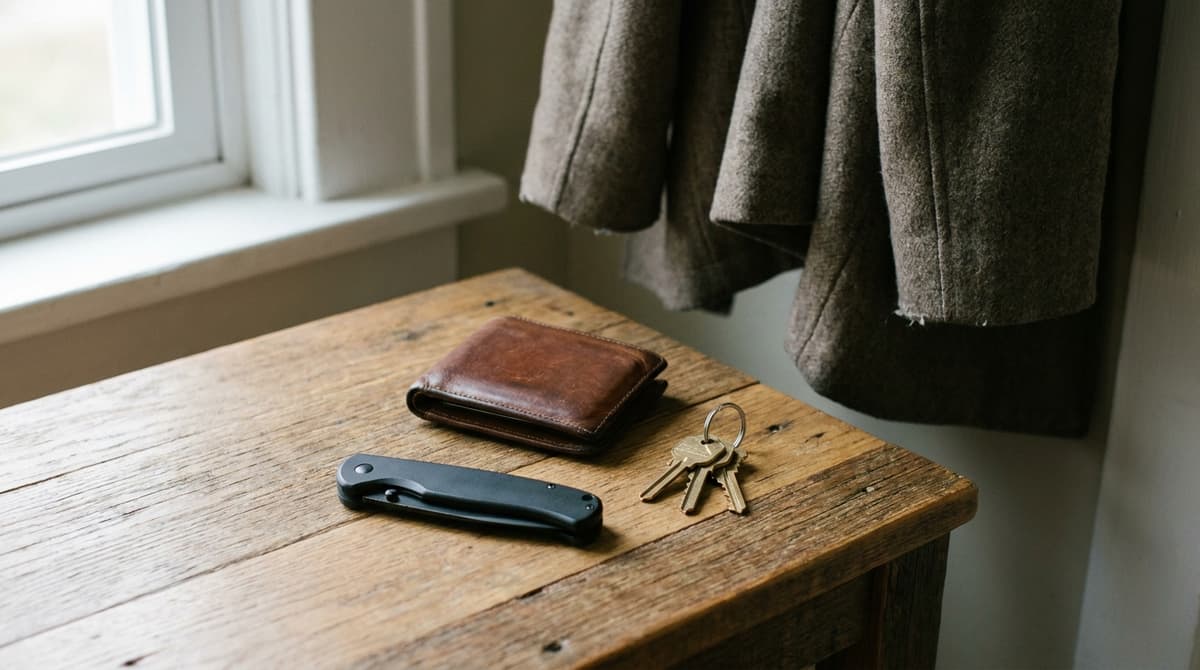
This exemption is narrower than it looks. In Harris v DPP [1993] 1 WLR 82 and R v Deegan [1998], the courts held that a knife which locks open, even briefly, is not a "folding" knife for the purposes of the exemption, because it is not readily and immediately foldable back down. A locking pocket knife with a 2.5-inch blade is therefore not automatically exempt just because of its length; the locking mechanism removes the exemption regardless of blade size. gov.uk's own consumer guidance confirms this in plain terms: a folding knife only counts as exempt if it does not have "a button, spring or catch that you have to use to fold the knife."
What Counts as a 'Good Reason'
"Good reason" and "lawful authority" are assessed on the facts of the individual case, not from a fixed checklist, but s.139(5) and gov.uk guidance both give recognised examples:
- carrying a knife for work (a tradesperson's tools, for instance);
- carrying a knife for religious reasons, such as a kirpan carried by some Sikhs;
- carrying a knife as part of a national costume.
None of these categories is automatic. A knife carried "for work" still has to be a genuine, proportionate tool for that work, carried in circumstances consistent with that reason. Simply asserting a reason after the fact does not guarantee a defence will succeed.
Offensive Weapons More Broadly: the 1953 and 1959 Acts
Two older statutes sit alongside s.139. The Prevention of Crime Act 1953, s.1 makes it an offence to have an offensive weapon in a public place without lawful authority or reasonable excuse, where an offensive weapon is one made or adapted to cause injury, or carried by the person with the intention of using it to cause injury. This covers weapons beyond bladed articles, such as knuckledusters or coshes, as well as knives carried with the wrong intent.
The Restriction of Offensive Weapons Act 1959, s.1 separately bans the manufacture, sale, hire, and importation of flick knives (blades that spring open under pressure from a button or similar device) and gravity knives (blades released by gravity or centrifugal force). Since 14 July 2021 in England and Wales, and 27 March 2023 in Scotland, simply possessing one, even at home, is also an offence. Unlike the 2024 and 2025 bans below, this restriction extends to England, Wales and Scotland.
The 2024 Ban: Zombie-Style Knives and Machetes
From 24 September 2024, possessing a "zombie-style knife" or "zombie-style machete" became a criminal offence in England and Wales. This was introduced through a statutory instrument made under the order-making power in the Criminal Justice Act 1988, s.141, which lets the Secretary of State add specific weapon descriptions to the list of prohibited items. The banned description covers blades over 8 inches with features such as serrations, multiple holes in the blade, or spikes, subject to narrow exceptions (for example, for antiques and certain registered collections).

The 2025 Ban: Ninja Swords ("Ronan's Law")
From 1 August 2025, possessing a "ninja sword" also became a criminal offence in England and Wales. This ban, sometimes referred to informally as "Ronan's Law," was made through its own standalone statutory instrument, separate from and earlier than the Crime and Policing Act 2026 described below. It targets swords with a blade of 14 to 24 inches, a primary and a secondary straight cutting edge, a blunt spine, and a tanto or reverse-tanto style point, along with a surrender-and-compensation scheme for people who lawfully owned one before the ban took effect.
The Crime and Policing Act 2026: Enacted, But Not Yet in Force
The Crime and Policing Act 2026 received Royal Assent, and it does contain further knife measures: an increase in the maximum penalty for private possession, importation, manufacture, sale or supply of a prohibited weapon from 6 months to 2 years' imprisonment, a new offence of possessing a bladed or pointed article, or an offensive weapon, with intent to use unlawful violence, to make someone believe unlawful violence will be used, or to cause serious unlawful damage to property (up to 7 years on indictment), and new online-sale rules requiring photographic age verification and reporting of bulk purchases.
None of these knife provisions have been brought into force. The commencement regulations made so far have activated a range of other measures in the Act, covering areas such as anti-social behaviour, firearms and public order, but the knife, crossbow and online-sale measures were not among them. Until a further commencement order specifically brings these sections into force, the current maximum penalty for private possession of a banned weapon remains 6 months, and the new possession-with-intent offence and online-sale verification rules are not yet law. Treat any claim that the 2-year penalty or the new offence is already in effect with caution, and check the current commencement position before relying on it.
Per-Nation Differences
The specific 2024 zombie-knife/machete and 2025 ninja-sword possession bans are England and Wales measures, made under the England and Wales version of the s.141 order-making power. The underlying carrying offence in s.139 itself extends to England, Wales and Northern Ireland (only its sentencing provisions differ by nation). Scotland has its own separate carrying offence, the Criminal Law (Consolidation) (Scotland) Act 1995, s.49, which has a similar 3-inch folding-knife exemption, plus its own devolved version of the s.141-style banning power. Neither Scotland nor Northern Ireland should be assumed to automatically pick up an England and Wales weapon-possession ban the moment it takes effect. The 1959 Act's flick-knife and gravity-knife restrictions extend to Scotland as well as England and Wales.
This guide explains the carrying offence, the pocket-knife exemption and the current state of the knife bans in general terms. It is not legal advice on a specific item or situation, and commencement dates for further reforms can change. Anyone facing a specific knife-related charge or question should get advice from a solicitor. For related rights, see our guides to self-defence and reasonable force and citizen's arrest in the UK, or the wider UK Criminal Law hub.
Frequently Asked Questions
Is it illegal to carry a knife in public in the UK?
In England and Wales, carrying a bladed or pointed article in a public place without good reason or lawful authority is an offence under the Criminal Justice Act 1988, s.139. A good reason, such as carrying it for work, can be a defence, but there is no general right to carry a knife just in case.
Can I carry a small folding pocket knife?
A folding pocket knife with a cutting edge of 3 inches or less is generally exempt from the s.139 offence. That exemption does not apply if the knife locks open, regardless of how short the blade is, following Harris v DPP and R v Deegan.
What counts as a 'good reason' to carry a knife?
Recognised examples include carrying a knife for work, for religious reasons such as a kirpan, or as part of a national costume. Whether a specific reason succeeds as a defence depends on the facts of the individual case, not a fixed list.
Are zombie knives and machetes banned in the UK?
Possessing a zombie-style knife or machete has been illegal in England and Wales since 24 September 2024, under a statutory instrument made under the Criminal Justice Act 1988, s.141.
Are ninja swords banned in the UK?
Possessing a ninja sword has been illegal in England and Wales since 1 August 2025. This ban came from its own standalone statutory instrument, not from the Crime and Policing Act 2026.
Has the Crime and Policing Act 2026 already increased knife possession penalties to 2 years?
No. The Act received Royal Assent and includes a planned increase from 6 months to 2 years, plus a new possession-with-intent offence, but these knife provisions had not been commenced as of this page's last check. The current maximum for private possession of a banned weapon remains 6 months.
Do the zombie-knife and ninja-sword bans apply in Scotland and Northern Ireland?
No. Those bans are England and Wales measures. Scotland and Northern Ireland have their own separate offensive-weapons laws, which should not be assumed to mirror an England and Wales ban.
Updates
Corrected the description of the banned ninja sword to include both straight cutting edges, described the Crime and Policing Act 2026 possession-with-intent offence as the statute defines it, clarified that the Act has made but not yet commenced the knife penalty changes, and added that possessing a flick knife or gravity knife is itself an offence.
Independently fact-checked against the cited primary sources; governing law re-checked for recent changes
The Crime and Policing Act 2026 received Royal Assent, including a planned increase in the private-possession penalty and a new possession-with-intent offence. These knife provisions had not been brought into force as of this page's last check.
Possession of ninja swords became a criminal offence in England and Wales under a standalone statutory instrument, separate from the Crime and Policing Act 2026.
Possession of zombie-style knives and machetes became a criminal offence in England and Wales.
The Law Behind This Article
This article rests on the statutory provisions below, held in our own legal record and retrieved from the official source. Tap a section to read the operative text.
Prevention of Crime Act 1953
s. 1Prohibition of the carrying of offensive weapons without lawful authority or reasonable excuse.In force
(1) Any person who without lawful authority or reasonable excuse, the proof whereof shall lie on him, has with him in any public place any offensive weapon shall be guilty of an offence, and shall be liable— (a) on summary conviction, to imprisonment for a term not exceeding six months or a fine not exceeding £200 , or both; (b) on conviction on indictment, to imprisonment for a term not exceeding four years or a fine not exceeding one hundred pounds, or both. (2) Where any person is convicted of an offence under subsection (1) of this section the court may make an order for the forfeiture or disposal of any weapon in respect of which the offence was committed. (2ZA) See section 315 of the Sentencing Code for provision about the sentence which the court may be required to impose where a person aged 16 or over who has a previous relevant conviction (within the meaning of that section) is convicted of an offence under this section. (2A) . . . . . . . . . . . . . . . . . . . . . . . . . . . . . . . . (2B) . . . . . . . . . . . . . . . . . . . . . . . . . . . . . . . . (2C) . . . . . . . . . . . . . . . . . . . . . . . . . . . . . . . . (2D) . . . . . . . . . . . . . . . . . . . . . .
Official text (excerpt) · last checked 2026-08-14 · Read the full text in our law library · Verify at legislation.gov.uk
Restriction of Offensive Weapons Act 1959
s. 1Penalties for offences in connection with dangerous weapons.In force
(1) Any person who manufactures, sells or hires or offers for sale or hire, or exposes or has in his possession for the purpose of sale or hire or lends or gives to any other person— (a) any knife which has a blade which opens automatically— (i) from the closed position to the fully opened position, or (ii) from a partially opened position to the fully opened position, by manual pressure applied to a button, spring or other device in or attached to the knife, and which is sometimes known as a “flick knife” or “flick gun”; or (b) any knife which has a blade which is released from the handle or sheath thereof by the force of gravity or the application of centrifugal force and which, when released, is locked in place by means of a button, spring, lever, or other device, sometimes known as a “gravity knife”, shall be guilty of an offence and shall be liable on summary conviction to imprisonment for a term not exceeding six months or to a fine not exceeding level 4 on the standard scale or to both such imprisonment and fine . (1A) Any person who possesses any knife of a kind described in subsection (1) is guilty of an offence.
Official text (excerpt) · last checked 2026-08-14 · Read the full text in our law library · Verify at legislation.gov.uk
Criminal Justice Act 1988
s. 139Offence of having article with blade or point in public place.In force
(1) Subject to subsections (4) and (5) below, any person who has an article to which this section applies with him in a public place shall be guilty of an offence. (2) Subject to subsection (3) below, this section applies to any article which has a blade or is sharply pointed except a folding pocketknife. (3) This section applies to a folding pocketknife if the cutting edge of its blade exceeds 3 inches. (4) It shall be a defence for a person charged with an offence under this section to prove that he had good reason or lawful authority for having the article with him in a public place. (5) Without prejudice to the generality of subsection (4) above, it shall be a defence for a person charged with an offence under this section to prove that he had the article with him— (a) for use at work; (b) for religious reasons; or (c) as part of any national costume. (6) A person guilty of an offence under subsection (1) above shall be liable- (a) on summary conviction, to imprisonment for a term not exceeding six months, or a fine not exceeding the statutory maximum, or both; (b) on conviction on indictment, to imprisonment for a term not exceeding four years, or a fine, or both.
Official text (excerpt) · last checked 2026-08-14 · Read the full text in our law library · Verify at legislation.gov.uk
s. 141Offensive weapons.In force
(1) Any person who manufactures, sells or hires or offers for sale or hire, exposes or has in his possession for the purpose of sale or hire, or lends or gives to any other person, a weapon to which this section applies shall be guilty of an offence and liable on summary conviction to imprisonment for a term not exceeding six months or to a fine not exceeding level 5 on the standard scale or both. (1A) Any person who possesses a weapon to which this section applies in private is guilty of an offence and liable— (a) on summary conviction in England and Wales, to imprisonment for a term not exceeding 51 weeks, to a fine or to both; (b) on summary conviction in Scotland, to imprisonment for a term not exceeding 6 months, to a fine not exceeding level 5 on the standard scale or to both; (c) on summary conviction in Northern Ireland, to imprisonment for a term not exceeding 12 months, to a fine not exceeding the statutory maximum or to both; (d) on conviction on indictment in Northern Ireland, to imprisonment for a term not exceeding 4 years, to a fine or to both.
Official text (excerpt) · last checked 2026-08-14 · Read the full text in our law library · Verify at legislation.gov.uk
Criminal Law (Consolidation) (Scotland) Act 1995
s. 49Offence of having in public place article with blade or point.In force
(1) Subject to subsections (4) and (5) below, any person who has an article to which this section applies with him in a public place shall be guilty of an offence and liable— (a) on summary conviction, to imprisonment for a term not exceeding twelve months or a fine not exceeding the statutory maximum or both; and (b) on conviction on indictment, to imprisonment for a term not exceeding 5 years or a fine or both. (2) Subject to subsection (3) below, this section applies to any article which has a blade or is sharply pointed. (3) This section does not apply to a folding pocketknife if the cutting edge of its blade does not exceed three inches (7.62 centimetres). (4) It shall be a defence for a person charged with an offence under subsection (1) above to show that the person had a reasonable excuse or lawful authority for having the article with him in the public place. (5) Without prejudice to the generality of subsection (4) above, it shall be a defence for a person charged with an offence under subsection (1) above to show that he had the article with him— (a) for use at work; (b) for religious reasons; or (c) as part of any national costume.
Official text (excerpt) · last checked 2026-08-14 · Read the full text in our law library · Verify at legislation.gov.uk
Search our record of UK legislation — retrieved from legislation.gov.uk →
Sources and References
- Criminal Justice Act 1988, s.139 (having an article with a blade or point in a public place)(legislation.gov.uk).gov
- Criminal Justice Act 1988, s.141 (offensive weapons: manufacture etc., and order-making power)(legislation.gov.uk).gov
- Criminal Law (Consolidation) (Scotland) Act 1995, s.49 (Scotland's bladed-article carrying offence)(legislation.gov.uk).gov
- Prevention of Crime Act 1953, s.1 (prohibition of the carrying of offensive weapons)(legislation.gov.uk).gov
- Restriction of Offensive Weapons Act 1959, s.1 (restriction of manufacture, sale etc. of flick knives and gravity knives)(legislation.gov.uk).gov
- The Criminal Justice Act 1988 (Offensive Weapons) (Amendment, Surrender and Compensation) Order 2024 (SI 2024/583)(legislation.gov.uk).gov
- The Criminal Justice Act 1988 (Offensive Weapons) (Amendment, Surrender and Compensation) (England and Wales) Order 2025 (SI 2025/681)(legislation.gov.uk).gov
- GOV.UK: Buying, carrying and selling knives, swords and other bladed products(gov.uk).gov
- GOV.UK: Crime and Policing Act 2026, knife crime and crossbows factsheet(gov.uk).gov
- The Crime and Policing Act 2026 (Commencement No. 1 and Saving Provision) Regulations 2026 (SI 2026/689)(legislation.gov.uk).gov
- Crime and Policing Act 2026, section 28 (new s.139AB Criminal Justice Act 1988: possession with intent to use unlawful violence), not yet in force(legislation.gov.uk).gov
- Crime and Policing Act 2026, section 29 (maximum penalty for offences relating to offensive weapons), not yet in force(legislation.gov.uk).gov