
Utah
Utah Drone Laws (2026): Police Warrants, Prisons & Privacy
Independently fact-checked against primary sources (last audited August 17, 2026). · Reviewed by the RecordingLaw editorial team. · Law checked current as of August 17, 2026. · 4 primary sources cited on this page. How we verify our legal content
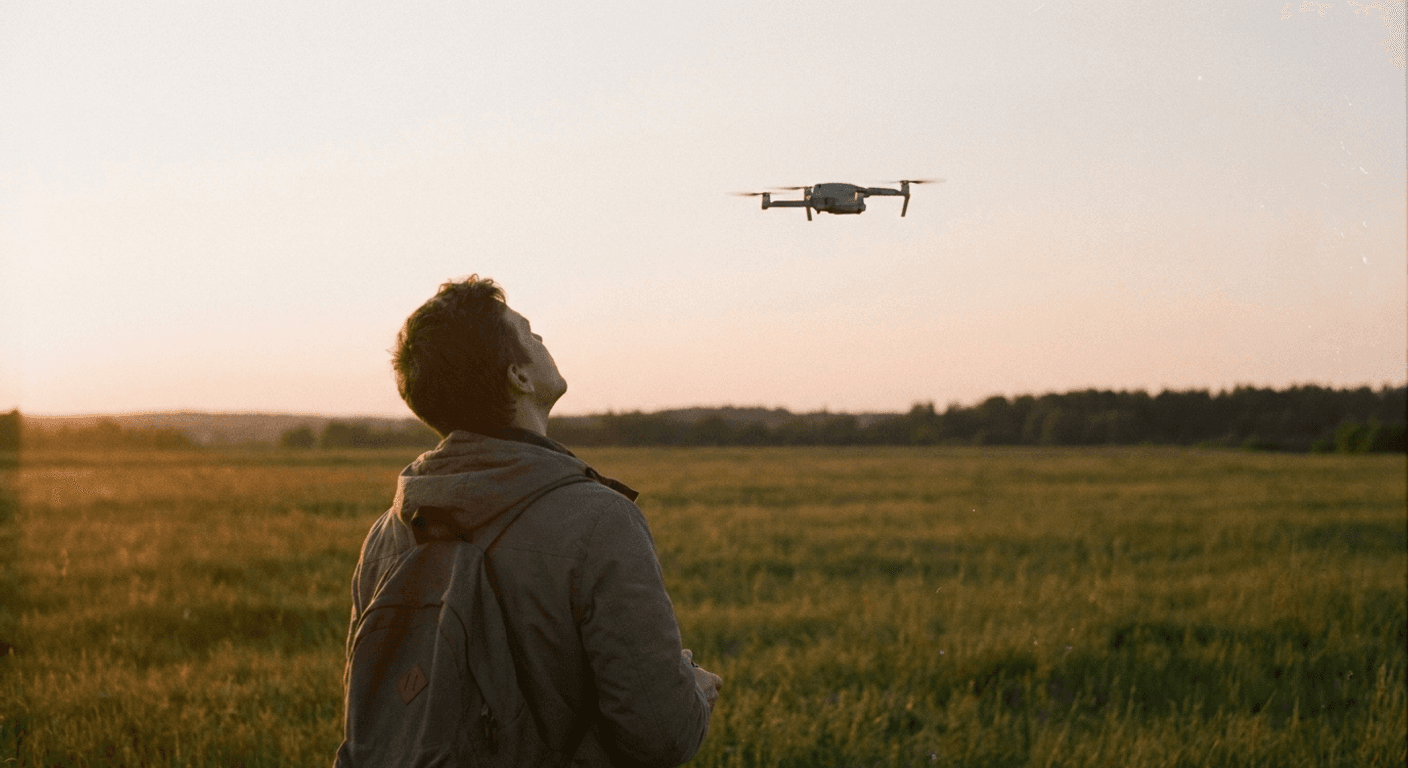
Utah gives a homeowner more than one route against an intrusive drone: Section 76-12-302 creates an express private cause of action for an unlawful privacy violation, and Utah's criminal trespass statute was written to reach a drone that enters and remains over private property. Utah Code Section 72-10-802 separately bars a Utah law enforcement agency from using drone-collected data unless it comes from a warrant, a recognized warrant exception, or one of a short list of other authorized sources.
This guide is part of our Drone Laws by State series, which also covers how state drone law intersects with surveillance camera laws more broadly.
Jurisdiction scope: This article addresses Utah state law on law enforcement drone use under Utah Code Sections 72-10-801 through 72-10-804, the civilian flight rules in Section 72-10-1002, Utah's privacy, trespass and criminal law as applied to private drone operators, and the federal baseline that applies in every state. It does not address a civilian's right to record police in public, which is covered separately in our guide to recording laws.
Does the FAA or Utah control where a drone can fly?
Both do, and that is the part most Utah summaries get wrong. The Federal Aviation Administration is the primary regulator of the airspace itself, in Utah as in every state. A commercial or otherwise non-recreational drone operator must hold a Remote Pilot Certificate under 14 CFR Part 107, register the aircraft, fly at or below 400 feet, and stay within visual line of sight; recreational flyers register separately under 49 U.S.C. Section 44809. Since September 16, 2023, most registered drones must also broadcast a Remote ID signal identifying the aircraft and its control station.
Utah has not left the flight rules entirely to the FAA. Utah Code Section 72-10-1002, Safe operation of unmanned aircraft, amended by Chapter 446 of the 2024 General Session and effective May 1, 2024, directs an individual who operates a drone for recreational purposes to comply with either that section or 49 U.S.C. Section 44809, and then writes a state set of flight rules of its own:
- Subsection (2) requires the operator, personally or through a visual observer, to maintain visual line of sight sufficient to know the aircraft's location, determine its attitude, altitude and direction, scan the airspace for hazards, and confirm it is not endangering anyone.
- Subsection (3) bars operation in Class B, Class C, or Class D airspace, or in the surface area of Class E airspace, without air traffic control authorization.
- Subsection (4) bars interference with operations and traffic patterns at any airport, heliport, or seaplane base.
- Subsection (5) bars operating from a transit rail platform or station, or within 50 feet of a fixed guideway directly beneath overhead electric lines, with carve-outs for large public transit district employees performing safety inspections and for law enforcement acting under Section 72-10-802.
- Subsection (6) bars flying over a surface critical infrastructure facility without that facility's authorization, excepting first responders and state or federal agencies with regulatory authority over the facility.
- Subsection (7) bars violating a notice to airmen described in 14 CFR Section 107.47.
- Subsection (8) sets a state altitude ceiling of 400 feet above ground level, except that an aircraft flown within a 400-foot radius of a structure may go up to 400 feet above that structure's immediate uppermost limit, absent an FAA waiver.
Subsection (9) sets the consequences. A law enforcement officer issues a written warning for a first violation, a second violation is an infraction, and a further violation after a prior infraction or misdemeanor conviction is a class B misdemeanor. Subsection (9)(a) also makes an individual who violates the section liable for any damages that result, which is a second statutory civil hook alongside Section 76-12-302.
How much of Section 72-10-1002 would survive a federal preemption challenge is an open question, and not one Utah appellate courts have answered. A federal district court struck down several provisions of a Massachusetts city's drone ordinance on a preemption theory in Singer v. City of Newton, 284 F. Supp. 3d 125 (D. Mass. 2017). But Section 72-10-1002 is on the books and enforced as written, so a Utah recreational flyer should plan around it rather than assume federal law displaces it.
Does police need a warrant to fly a drone over my property in Utah?
Yes. Utah Code Section 72-10-802 states that a law enforcement agency or officer may not obtain, receive, or use data acquired through an unmanned aircraft system unless the data is obtained in accordance with a search warrant, in accordance with a judicially recognized exception to the warrant requirement, subject to further limits, from a person who is a nongovernment actor, to locate a lost or missing individual in an area where the individual has no reasonable expectation of privacy, or in a manner that does not violate a reasonable expectation of privacy. Where data comes from a nongovernment source, Subsection (2) further limits an agency to using it for law enforcement purposes only if the data appears to pertain to the commission of a crime, or the agency believes in good faith that the data pertains to an imminent or ongoing emergency involving danger of death or serious bodily injury and that disclosing it would help remedy the emergency.
The current version of Section 72-10-802 took effect May 6, 2026, after amendment by Chapter 118 of the 2026 General Session, which narrowed the prior catch-all exception from data obtained "for purposes unrelated to a criminal investigation" to the current, tighter standard of data obtained "in a manner that does not violate a reasonable expectation of privacy." Under Section 72-10-804, titled Reporting, an agency that operates a drone on duty, or that obtains or receives data under Section 72-10-802, must document the presence and use of the drone, any data acquired, and where applicable the person from whom the data was received, in the official report of the law enforcement encounter. That section imposes no destruction duty; the destruction duty is in Section 72-10-802(3), which requires an agency to destroy drone-acquired data as soon as reasonably possible, subject to the retention schedules in Utah's Government Records Access and Management Act or other applicable law. Section 72-10-802(4) extends the same framework to an imaging surveillance device used with a drone, but that phrase is a defined statutory term borrowed from Section 77-23d-102, not a catch-all for every camera an agency might attach.
A separate section protects people who were never the point of the flight. Section 72-10-803, Data retention, bars an agency at Subsection (1)(a) from using, copying, or disclosing data an unmanned aircraft system collected on a person, structure, or area that is not a target, and at Subsection (1)(b) requires that non-target data be destroyed as soon as reasonably possible. The protection is not absolute. Subsection (2) lists exceptions for data that cannot be deleted without also deleting target data needed for the operation to succeed, data a court order requires the agency to release or preserve, data received from a nongovernment actor, data collected inadvertently that appears to pertain to the commission of a crime, data the agency reasonably determines pertains to an emergency where disclosure would help remedy it, and, broadest of all, data collected by drone over public lands outside municipal boundaries.
These provisions sit in Part 8 of Title 72, Chapter 10 (Sections 72-10-801 to 72-10-804), which the Utah Legislature renumbered in 2023 from the former Title 72, Chapter 14, without changing the underlying substance; a reader who finds an older citation to "Section 72-14-203" is looking at the predecessor to the current Section 72-10-802.
Can a neighbor or business legally fly a drone over my property in Utah?
Utah has no single drone-specific civilian privacy act on the model of California's anti-paparazzi law or Texas's image-capture statute. That is not the same as having no remedy. Three Utah statutes reach the intrusive-neighbor scenario, and two of them name unmanned aircraft on their face.
Unlawful privacy violation, Section 76-12-302. Subsection (2)(c) reaches an actor who installs or uses, outside of a private place, a device for observing, photographing, hearing, recording, amplifying, or broadcasting sounds or events originating in the private place that would not ordinarily be audible or visible outside it. That is the drone-at-the-window fact pattern, and it is a class B misdemeanor. Subsection (5) confirms the section reaches drones by carving out only the operator flying for legitimate commercial or educational purposes consistent with FAA rules whose intrusion is solely incidental. Most importantly for a homeowner, Subsection (8) creates an express private cause of action: a person injured by a violation, or the heirs of a deceased person, may sue the actor, and a court may order injunctive relief, the removal or destruction of the data collected, actual damages, reasonable attorney fees, and exemplary damages for a malicious violation.
Criminal trespass, Section 76-6-206. Utah's trespass statute is not ordinary trespass law where drones are concerned. It defines "enter" as the intrusion of the entire body or the entire unmanned aircraft, and it separately defines when an unmanned aircraft remains unlawfully, namely when it stays on or over private property that is not open to the public and the operator is not authorized to fly there. Subsections (2)(a) and (2)(b) make it an offense to cause an unmanned aircraft to enter and remain unlawfully over the property either with intent to annoy, injure, damage, or commit a crime, or recklessly as to causing fear for another's safety, or knowingly after notice by personal communication, fencing, or posted signs. The offense is a class B misdemeanor, and a class A misdemeanor if committed in a dwelling.
Recorded or photographed voyeurism, Section 76-12-307. This section makes it a class A misdemeanor, rising to a third degree felony for an aggravating factor such as a victim under 14, to intentionally use any type of technology to secretly or surreptitiously record an individual for the purpose of viewing a part of their body they have a reasonable expectation of privacy in, without their knowledge or consent, under circumstances where that expectation of privacy exists.
That last statute is what Orem police used in one of the first publicized drone-privacy arrests in the country. In December 2016, an Orem man noticed an unattended drone hovering outside his bathroom window, followed it, and captured it in a nearby parking lot; footage on the device reportedly showed multiple individuals filmed through their windows at different residences. Police traced the drone's owner through vehicle license plate records to Aaron Foote, who had a prior 2008 voyeurism conviction, and Foote and a second person, Terisha Lee Norviel, were arrested and charged with voyeurism under the law's earlier numbering. The charge available then was a general peeping statute focused on viewing someone's body in a place they expected privacy. Utah law has moved since, and a homeowner facing the same drone today would also have Section 76-12-302's private cause of action and the drone-specific trespass definitions in Section 76-6-206 available.
Weaponized drones and correctional facility offenses in Utah
Utah Code Section 72-10-902 makes it a class B misdemeanor to fly a drone that carries a weapon or to which a weapon is attached, unless the operator has a Federal Aviation Administration certificate of authorization or other written FAA approval for that specific use, a contract with the state or federal government permitting it, or is operating in airspace controlled by the United States Department of Defense with DOD's permission.
A related offense targets Utah's persistent problem with drones delivering contraband into prisons. Section 72-10-903 makes it a third degree felony to operate a drone to carry or drop an item to or inside the property of a correctional facility, or to remove an item from inside one, and a class B misdemeanor to operate a drone in a manner that interferes with a correctional facility's operations or security. The statute carves out an exception for an employee or contractor of a mosquito abatement district acting within the course and scope of their employment, a narrow but real limitation worth knowing if a drone-based pest-control operation flies near a Utah facility.
Wildlife and livestock protections
Utah restricts drone use around animals in two distinct ways. Utah Code Section 76-13-214 makes it a misdemeanor, a class B misdemeanor for a first offense and a class A misdemeanor for a subsequent offense or if livestock is seriously injured, killed, or damage exceeds $1,000, to intentionally, knowingly, or recklessly chase or actively disturb livestock using a motorized vehicle, a dog, or an unmanned aircraft system. Separately, Utah Administrative Code R657-5-14, a Division of Wildlife Resources rule rather than a statute passed by the legislature, restricts using an aircraft, drone, or other airborne device to locate or attempt to observe protected wildlife between July 31 and January 31 each year, a period covering most of Utah's big game hunting seasons.
The federal shoot-down rule
A persistent misconception is that a landowner may legally shoot down a drone hovering over their own property. Federal law says otherwise. The FAA classifies drones as aircraft within the National Airspace System, so 18 U.S.C. Section 32, the federal Aircraft Sabotage Act, applies to them: willfully damaging, destroying, or disabling a drone is a federal felony carrying up to 20 years in prison, regardless of whose property the drone is over, because the federal government, not the landowner, controls the airspace. No Utah statute authorizes a landowner to disable a drone over their own land, and a local prosecutor declining to pursue state charges in a sympathetic case does not establish a legal right to shoot one down.
More Utah Laws
- Utah Data Privacy Laws
- Utah GPS Tracking Laws
- Utah Police Bodycam Laws
- Utah Recording Laws
- Utah Smart Glasses Recording Laws
Frequently Asked Questions
Does Utah law require police to get a warrant before flying a drone over my property?
Yes. Utah Code Section 72-10-802 bars a Utah law enforcement agency from obtaining, receiving, or using drone-acquired data unless it comes through a search warrant, a judicially recognized exception to the warrant requirement, a limited nongovernment source, a missing-person search where there is no reasonable expectation of privacy, or a manner that does not violate a reasonable expectation of privacy.
Is it illegal for a neighbor to fly a drone over my house in Utah?
It can be. Utah Code Section 76-6-206 defines criminal trespass to include causing an unmanned aircraft to enter and remain unlawfully over private property, either with intent to annoy, injure, damage, or commit a crime or knowingly after notice, which is a class B misdemeanor and a class A misdemeanor in a dwelling. Section 76-12-302 separately makes it a class B misdemeanor to use a device outside a private place to observe or record events originating inside it, and Subsection (8) lets the injured person sue. Section 76-12-307's recorded voyeurism offense applies where a person's body was secretly recorded.
Can I sue someone in Utah for flying a drone over my property?
Yes, in the right circumstances. Utah Code Section 76-12-302(8) creates an express private cause of action for an unlawful privacy violation, and a court may award injunctive relief, removal or destruction of the data collected, actual damages, reasonable attorney fees, and exemplary damages for a malicious violation. Section 72-10-1002(9)(a) separately makes an individual who violates Utah's safe-operation rules liable for any damages that result. Ordinary trespass and nuisance claims remain available as well.
How high can I fly a drone in Utah?
Federal Part 107 caps most non-recreational flights at 400 feet, and Utah Code Section 72-10-1002(8) sets a matching state ceiling of 400 feet above ground level for recreational operation, except that an aircraft flown within a 400-foot radius of a structure may go up to 400 feet above that structure's immediate uppermost limit. Section 72-10-1002 also requires visual line of sight, air traffic control authorization in Class B, C, and D airspace, and facility authorization before flying over surface critical infrastructure.
What happens to drone footage Utah police collect of someone who was not the target?
Utah Code Section 72-10-803(1) bars a law enforcement agency from using, copying, or disclosing data a drone collected on a person, structure, or area that is not a target, and requires that data be destroyed as soon as reasonably possible. Subsection (2) lists exceptions, including a court order, data received from a nongovernment actor, inadvertently collected data that appears to pertain to a crime, an emergency, and data collected over public lands outside municipal boundaries.
What happened to the Utah couple accused of using a drone to spy on neighbors in Orem?
In December 2016, Orem police arrested Aaron Foote and Terisha Lee Norviel and charged them with voyeurism after a resident captured their drone hovering near a bathroom window; footage on the device reportedly showed several residences filmed through windows. The charge relied on Utah's general voyeurism statute rather than a drone-specific law.
Can I fly an armed or weaponized drone in Utah?
Not without authorization. Utah Code Section 72-10-902 makes flying a drone that carries or has a weapon attached a class B misdemeanor, unless the operator has FAA authorization, a government contract permitting it, or is operating in Department of Defense-controlled airspace with DOD's permission.
What happens if someone flies a drone into a Utah prison?
Utah Code Section 72-10-903 makes it a third degree felony to use a drone to carry or drop an item to or inside a correctional facility's property, or to remove an item from one, and a class B misdemeanor to interfere with a facility's operations or security by drone.
Can I shoot down a drone flying over my property in Utah?
No. Destroying, damaging, or disabling any drone is a federal felony under 18 U.S.C. Section 32, the Aircraft Sabotage Act, because the FAA controls the airspace regardless of who owns the land beneath it. No Utah law authorizes a landowner to disable a drone.
Does Utah restrict using drones to hunt or find wildlife?
Yes. Utah Administrative Code R657-5-14 restricts using an aircraft or drone to locate or observe protected wildlife between July 31 and January 31, and Utah Code Section 76-13-214 separately makes it a misdemeanor to chase or disturb livestock using a drone.
Updates
Corrected the description of Singer v. City of Newton to identify Newton as a city, as the court does.
Corrected a miscitation that attributed the drone-data destruction duty to Section 72-10-804 rather than Section 72-10-802(3), and added Utah's civilian flight rules (Section 72-10-1002), non-target data retention limits (Section 72-10-803), the drone-specific criminal trespass definitions (Section 76-6-206), and the private cause of action for unlawful privacy violation (Section 76-12-302), replacing the page's incorrect statements that Utah has no state flight rules and no civil remedy against an intrusive drone.
Updated the livestock-harassment-by-drone citation from the now-dead Section 76-9-308 to its current location, Section 76-13-214, following Utah's 2025 criminal-code recodification; the described penalty structure was already accurate.
Independently fact-checked against the cited primary sources; governing law re-checked for recent changes
Governing law re-checked for recent changes
Reviewed and approved by an editor
The Law Behind This Article
This article rests on the statutory provisions below, held in our own legal record and retrieved from the official source. Tap a section to read the operative text.
Utah Code, Title 72: Transportation Code
§ 72-10-802Unmanned aircraft system use requirements -- Exceptions.In force
(1) A law enforcement agency or officer may not obtain, receive, or use data acquired through an unmanned aircraft system unless the data is obtained: (a) in accordance with a search warrant; (b) in accordance with judicially recognized exceptions to warrant requirements; (c) subject to Subsection (2), from a person who is a nongovernment actor; (d) to locate a lost or missing individual in an area in which an individual has no reasonable expectation of privacy; or (e) in a manner that does not violate a reasonable expectation of privacy. (2) A law enforcement officer or agency may only use for law enforcement purposes data obtained from a nongovernment actor if: (a) the data appears to pertain to the commission of a crime; or (b) the law enforcement agency or officer believes, in good faith, that: (i) the data pertains to an imminent or ongoing emergency involving danger of death or serious bodily injury to an individual; and (ii) disclosing the data would assist in remedying the emergency.
Official text (excerpt) · last checked 2026-08-31 · Read the full text in our law library · Verify at le.utah.gov
§ 72-10-804Reporting.In force
(1) As used in this section, "law enforcement encounter" means the same as that term is defined in Section 77-7a-103. (2) A law enforcement officer or agency that operates an unmanned aircraft system while on duty or acting in the law enforcement officer's or agency's official capacity, or obtains or receives data in accordance with Section 72-10-802, shall document the following in any report or other official record of the law enforcement encounter: (a) the presence and use of the unmanned aircraft; (b) any data acquired; and (c) if applicable, the person from whom data was received in accordance with Subsection 72-10-802(2).
Official text (excerpt) · last checked 2026-07-29 · Read the full text in our law library · Verify at le.utah.gov
§ 72-10-903Unlawful operation of an unmanned aircraft near a correctional facility.In force
(1) An individual may not operate an unmanned aircraft system: (a) to carry or drop any item to or inside the property of a correctional facility; (b) in a manner that interferes with the operations or security of a correctional facility; or (c) to remove any item from inside the property of a correctional facility. (2) (a) A violation of Subsection (1)(a) or (c) is a third degree felony. (b) A violation of Subsection (1)(b) is a class B misdemeanor. (3) An operator of an unmanned aircraft system does not violate Subsection (1) if the operator is: (a) an employee or contractor working on behalf of a mosquito abatement district created pursuant to Title 17B, Limited Purpose Local Government Entities - Special Districts, or Title 17D, Limited Purpose Local Government Entities - Other Entities; and (b) acting in the course and scope of the operator's employment.
Official text (excerpt) · last checked 2026-07-29 · Read the full text in our law library · Verify at le.utah.gov
§ 72-10-902Weapon attached to unmanned aircraft -- Penalties.In force
(1) (a) Except as provided in Subsection (2), a person may not fly an unmanned aircraft that carries a weapon or to which a weapon is attached. (b) A person that violates Subsection (1)(a) is guilty of a class B misdemeanor. (2) A person may fly an unmanned aircraft that carries a weapon or to which a weapon is attached if the person: (a) (i) obtains a certificate of authorization, or other written approval, from the Federal Aviation Administration authorizing the person to fly the unmanned aircraft that carries the weapon or to which the weapon is attached; and (ii) operates the unmanned aircraft in accordance with the certificate of authorization or other written approval; (b) (i) obtains a contract with the state or the federal government permitting the person to fly the unmanned aircraft that carries the weapon or to which the weapon is attached; and (ii) operates the unmanned aircraft in accordance with the contract; or (c) operates the unmanned aircraft that carries the weapon or to which the weapon is attached in airspace controlled by the United States Department of Defense, with the permission of the United States Department of Defense.
Official text (excerpt) · last checked 2026-07-29 · Read the full text in our law library · Verify at le.utah.gov
§ 72-10-803Data retention.In force
(1) Except as provided in this section, a law enforcement agency: (a) may not use, copy, or disclose data collected by an unmanned aircraft system on a person, structure, or area that is not a target; and (b) in accordance with applicable federal, state, and local laws, shall ensure that data described in Subsection (1)(a) is destroyed as soon as reasonably possible after the law enforcement agency collects or receives the data. (2) A law enforcement agency is not required to comply with Subsection (1) if: (a) deleting the data would also require the deletion of data that: (i) relates to the target of the operation; and (ii) is requisite for the success of the operation; (b) the law enforcement agency receives the data: (i) through a court order that: (A) requires a person to release the data to the law enforcement agency; or (B) prohibits the destruction of the data; or (ii) from a person who is a nongovernment actor; (c) (i) the data was collected inadvertently; and (ii) the data appears to pertain to the commission of a crime; (d) (i) the law enforcement agency reasonably determines that the data pertains to an emergency situation; and (ii) using or disclosing…
Official text (excerpt) · last checked 2026-07-29 · Read the full text in our law library · Verify at le.utah.gov
§ 72-10-1002Safe operation of unmanned aircraft.In force
(1) An individual who operates an unmanned aircraft system to fly an unmanned aircraft for recreational purposes shall comply with this section or 49 U.S.C. Sec. 44809. (2) An individual operating an unmanned aircraft shall: (a) maintain visual line of sight of the unmanned aircraft in order to: (i) know the location of the unmanned aircraft; (ii) determine the attitude, altitude, and direction of flight; (iii) observe the airspace for other air traffic or hazards; and (iv) determine that the unmanned aircraft does not endanger the life or property of another person; and (b) ensure that the ability described in Subsection (2)(a)(i) is exercised by either: (i) the operator of the unmanned aircraft; or (ii) a visual observer. (3) An individual may not operate an unmanned aircraft in Class B, Class C, or Class D airspace or within the lateral boundaries of the surface area of Class E airspace designated for an airport unless the operator of the unmanned aircraft has prior authorization from air traffic control. (4) An individual may not operate an unmanned aircraft in a manner that interferes with operations and traffic patterns at any airport, heliport, or seaplane base.
Official text (excerpt) · last checked 2026-07-29 · Read the full text in our law library · Verify at le.utah.gov
Utah Code, Title 76: Criminal Offenses
§ 76-12-307Recorded or photographed voyeurism.In forcecited in 14 of our articles
(1) (a) As used in this section, "sex-designated privacy space" means the same as that term is defined in Section 76-12-309. (b) Terms defined in Sections 76-1-101.5, 76-12-101, and 76-12-301 apply to this section. (2) An actor commits recorded or photographed voyeurism if the actor intentionally uses any type of technology to secretly or surreptitiously record, by video, photograph, or other means, an individual: (a) for the purpose of viewing any portion of the individual's body regarding which the individual has a reasonable expectation of privacy, whether or not that portion of the body is covered with clothing; (b) without the knowledge or consent of the individual; and (c) under circumstances in which the individual has a reasonable expectation of privacy. (3) (a) Except as provided in Subsection(3)(b), a violation of Subsection (2) is a class A misdemeanor.
Official text (excerpt) · last checked 2026-07-29 · Read the full text in our law library · Verify at le.utah.gov
Also relied on in: Utah Smart Glasses Recording Laws (2026), Utah Employee Monitoring Laws: Workplace Surveillance and Social Media (2026), Utah Recording Laws (2026): One-Party Consent Rules
§ 76-13-214Harassment of livestock.In force
(1) (a) As used in this section: (i) "Livestock" means the same as that term is defined in Section 76-13-202. (ii) "Unmanned aircraft system" means the same as that term is defined in Section 72-10-102. (b) Terms defined in Sections 76-1-101.5, 76-13-101, and 76-13-201 apply to this section. (2) Except as provided in Subsection (4), an actor commits harassment of livestock if the actor intentionally, knowingly, or recklessly chases, with the intent of causing distress, or harms livestock through the use of: (a) a motorized vehicle or all-terrain vehicle; (b) a dog; or (c) an unmanned aircraft system. (3) (a) Except as provided in Subsection (3)(b), a violation of Subsection (2) is a class B misdemeanor if: (i) no livestock is seriously injured or killed as a result of the actor's actions; or (ii) the actor's actions cause the livestock to be displaced onto property where the livestock is not legally entitled to be.
Official text (excerpt) · last checked 2026-07-29 · Read the full text in our law library · Verify at le.utah.gov
§ 76-12-302Unlawful privacy violation.In forcecited in 4 of our articles
(1) (a) For purposes of this section, "expectation of privacy" means a property owner's expectation of privacy described in Subsection (6). (b) Terms defined in Sections 76-1-101.5, 76-12-101, and 76-12-301 apply to this section. (2) An actor commits unlawful privacy violation if, except as authorized by law, the actor: (a) trespasses on property with intent to subject anyone to eavesdropping or other surveillance in a private place; (b) installs, or uses after unauthorized installation in a private place, without the consent of the person or persons entitled to privacy in the private place, a device for observing, photographing, hearing, recording, amplifying, or broadcasting sounds or events in the private place; (c) installs or uses outside of a private place a device for observing, photographing, hearing, recording, amplifying, or broadcasting sounds or events originating in the private place that would not ordinarily be audible, visible, or comprehensible outside the private place, without the consent of the person or persons entitled to privacy in the private place; or (d) uses ground-penetrating technology, without the consent of the property owner, to detect,…
Official text (excerpt) · last checked 2026-08-31 · Read the full text in our law library · Verify at le.utah.gov
Cited in 1 court opinions in our collectionLatest citing opinion in our collection: 2026
Opinions citing this section in our collection:
- United States v. Watkins (Court of Appeals for the Tenth Circuit 2026)“…x. Penal Code Ann. § 21.17;2 Tex. Penal Code Ann. § 42.01;2 Utah Code Ann. § 76-12-302;3 Utah Code Ann. § 76-12-306;2 Vt. Stat…”
Identified automatically from the court opinions citing this section — not a ranking of which case controls.
Also relied on in: Utah Surveillance Camera Laws (2026 Guide), Utah Ring Doorbell Laws: What You Need to Know in 2026
§ 76-6-206Criminal trespass.In forcecited in 3 of our articles
(1) (a) As used in this section: (i) "Enter" means intrusion of the entire body or the entire unmanned aircraft. (ii) "Graffiti" means the same as that term is defined in Section 76-6-101. (iii) "Remain unlawfully," as that term relates to an unmanned aircraft, means remaining on or over private property when: (A) the private property or any portion of the private property is not open to the public; and (B) the person operating the unmanned aircraft is not otherwise authorized to fly the unmanned aircraft over the private property or any portion of the private property. (b) Terms defined in Sections 76-1-101.5 and 76-6-201 apply to this section.
Official text (excerpt) · last checked 2026-07-29 · Read the full text in our law library · Verify at le.utah.gov
Cited in 21 court opinions in our collectionLatest citing opinion in our collection: 2024
Opinions citing this section in our collection:
- Salt Lake City v. Grotepas (Court of Appeals of Utah 1994, 238 Utah Adv. Rep. 13)“…raised the statutory defense to criminal trespass found at Utah Code Ann. § 76-6-206 (4) (1990) [2] nor introduced any evid…”
- State v. Hamilton (Utah Supreme Court 2003, 473 Utah Adv. Rep. 18)“…oyance or injury to any person or damage to any property." Utah Code Ann. § 76-6-206 (@2)(a) (1999). 10 Under t…”
- State v. Kitches (Court of Appeals of Utah 2021, 484 P.3d 415)“…presence [would] cause fear for the safety of another.” Utah Code Ann. § 76-6-206(2)(a); see also id. § 76-2-103(2) (“A p…”
Identified automatically from the court opinions citing this section — not a ranking of which case controls.
Also relied on in: Utah Dog Bite Laws: Liability and Victim Rights, Utah Squatters Rights and Adverse Possession Laws (2026)
United States Code Title 18
§ 32Destruction of aircraft or aircraft facilitiesIn forcecited in 51 of our articles
Whoever willfully— sets fire to, damages, destroys, disables, or wrecks any aircraft in the special aircraft jurisdiction of the United States or any civil aircraft used, operated, or employed in interstate, overseas, or foreign air commerce; places or causes to be placed a destructive device or substance in, upon, or in proximity to, or otherwise makes or causes to be made unworkable or unusable or hazardous to work or use, any such aircraft, or any part or other materials used or intended to be used in connection with the operation of such aircraft, if such placing or causing to be placed or such making or causing to be made is likely to endanger the safety of any such aircraft; sets fire to, damages, destroys, or disables any air navigation facility, or interferes by force or violence with the operation of such facility, if such fire, damaging, destroying, disabling, or interfering is likely to endanger the safety of any such aircraft in flight; with the intent to damage, destroy, or disable any such aircraft, sets fire to, damages, destroys, or disables or places a destructive device or substance in, upon, or in proximity to, any appliance or structure, ramp, landing area,…
Official text (excerpt) · last checked 2026-07-28 · Read the full text in our law library · Verify at uscode.house.gov
Cited in 168 court opinions in our collectionLatest citing opinion in our collection: 2026
In the courts (editorial summary, independently checked):United States v. Yousef (2003) applied 18 U.S.C. 32 to an overseas airline bombing plot, holding Section 32(a) reaches conduct abroad because US-flag aircraft in flight are within the special aircraft jurisdiction, and that a defendant brought here involuntarily is still found in the United States under Section 32(b).
Opinions citing this section in our collection:
- Perez v. United States (Supreme Court of the United States 1971, 402 U.S. 146)“…commerce, as, for example, the destruction of an aircraft ( 18 U. S. C. § 32 ), or persons or things in commerce, as…”
- Stanford v. Kentucky (Supreme Court of the United States 1989, 492 U.S. 361)“…r by persons subject to Uniform Code of Military Justice); 18 U. S. C. §§ 32 , 33, and 34 (1982 ed. and Supp. V) (de…”
- United States v. Yousef (Court of Appeals for the Second Circuit 2003, 327 F.3d 56)✓Yousef bombed a Philippine airliner and plotted to bomb twelve US flag airliners on Asian routes; the court held Section 32(a) reaches attacks on US flag aircraft worldwide, and that Yousef, brought here involuntarily, was found in the United States under Section 32(b).
Identified automatically from the court opinions citing this section — not a ranking of which case controls.
Also relied on in: Indiana Drone Laws (2026): Police Warrants, Voyeurism, Hunting, Iowa Drone Laws: Homestead, Farmstead & Warrant Rules, Kansas Drone Laws: Stalking Act & Privacy Rules Explained
United States Code Title 49
§ 44809Exception for limited recreational operations of unmanned aircraftIn forcecited in 13 of our articles
Except as provided in subsection (e), and notwithstanding chapter 447 of title 49, United States Code, a person may operate a small unmanned aircraft without specific certification or operating authority from the Federal Aviation Administration if the operation adheres to all of the following limitations: The aircraft is flown strictly for recreational purposes. The aircraft is operated in accordance with or within the programming of a community-based organization’s set of safety guidelines that are developed in coordination with the Federal Aviation Administration. The aircraft is flown within the visual line of sight of the person operating the aircraft or a visual observer co-located and in direct communication with the operator. The aircraft is operated in a manner that does not interfere with and gives way to any manned aircraft. In Class B, Class C, or Class D airspace or within the lateral boundaries of the surface area of Class E airspace designated for an airport, the operator obtains prior authorization from the Administrator or designee before operating and complies with all airspace restrictions and prohibitions.
Official text (excerpt) · last checked 2026-07-28 · Read the full text in our law library · Verify at uscode.house.gov
Cited in 1 court opinions in our collectionLatest citing opinion in our collection: 2022
Opinions citing this section in our collection:
- Tyler Brennan v. Stephen Dickson (Court of Appeals for the D.C. Circuit 2022, 45 F.4th 48)“…Reauthorization Act, § 349(a), (b), (f), 132 Stat. at 3297; 49 U.S.C. § 44809(f); see Final Rule, 86 Fed. Reg. at 440…”
Identified automatically from the court opinions citing this section — not a ranking of which case controls.
Also relied on in: Illinois Drone Laws (2026): Police Warrants, Privacy, and Hunting, Florida Drone Laws 2026: Privacy, Warrants & Penalties, Idaho Drone Laws (2026): Privacy, Police Warrants, and Hunting Rules
Search our full record of US law — 2.1 million sections, every state + federal →
Sources and References
- Utah Code Section 72-10-802, Unmanned aircraft system use requirements, exceptions, as amended by Chapter 118, 2026 General Session, effective May 6, 2026(le.utah.gov).gov
- Utah Code Section 72-10-804, Reporting requirement for law enforcement drone use(le.utah.gov).gov
- Utah Code Section 72-10-903, Unlawful operation of an unmanned aircraft near a correctional facility(le.utah.gov).gov
- Utah Code Section 76-12-307, Recorded or photographed voyeurism (renumbered from Section 76-9-702.7 by Chapter 173, 2025 General Session)(le.utah.gov).gov
- Fox News, "Utah couple arrested for allegedly peering into neighbors' windows with drone" (Dec. 2016)(foxnews.com)
- 18 U.S.C. Section 32, Aircraft Sabotage Act, federal prohibition on destroying or damaging an aircraft including drones(law.cornell.edu)
- Utah Code Section 72-10-1002, Safe operation of unmanned aircraft (amended by Chapter 446, 2024 General Session, effective May 1, 2024)(le.utah.gov)
- Utah Code Section 72-10-803, Data retention, limits on use and destruction of drone-collected non-target data(le.utah.gov)
- Utah Code Section 76-12-302, Unlawful privacy violation, including the private cause of action in Subsection (8)(le.utah.gov)
- Utah Code Section 76-6-206, Criminal trespass, defining entry and unlawful remaining by an unmanned aircraft over private property(le.utah.gov)