
Texas
Texas Drone Laws (2026): Chapter 423, Privacy & McCraw
Independently fact-checked against primary sources (last audited August 17, 2026). · Reviewed by the RecordingLaw editorial team. · Law checked current as of August 17, 2026. · 3 primary sources cited on this page. How we verify our legal content
Texas has the most litigated drone privacy law in the country. Texas Government Code Chapter 423 makes it a crime to fly a drone to capture an image of a person or private property with intent to surveil, and in a decision issued in January 2024 (superseding a 2023 opinion the panel later withdrew), the Fifth Circuit rejected a sweeping First Amendment and federal preemption challenge to the law in National Press Photographers Association v. McCraw.
This guide is part of our Drone Laws by State series, which also covers how state drone law intersects with surveillance camera laws more broadly.
Information last verified on 2026-07-09. This article has not yet been reviewed by a licensed lawyer.
Jurisdiction scope: This article addresses Texas state law on private and law enforcement drone image capture under Government Code Chapter 423 and the federal baseline that applies in every state. It does not address a civilian's right to record police in public, which is covered separately in our guide to recording laws.
Does the FAA or Texas control where a drone can fly?
The Federal Aviation Administration is the exclusive regulator of the airspace itself, in Texas as in every state. A commercial or otherwise non-recreational drone operator must hold a Remote Pilot Certificate under 14 CFR Part 107, register the aircraft, fly at or below 400 feet, and stay within visual line of sight; recreational flyers register separately under 49 U.S.C. Section 44809. Since September 16, 2023, most registered drones must also broadcast a Remote ID signal identifying the aircraft and its control station. A Texas city or county cannot add its own altitude ceiling or flight-path rule on top of that federal scheme; a federal district court struck down several provisions of a Massachusetts town's drone ordinance on exactly that theory in Singer v. City of Newton, 284 F. Supp. 3d 125 (D. Mass. 2017). What Texas regulates instead is conduct: what a person does with a drone-mounted camera once it is airborne over Texas soil, which is exactly what Chapter 423 targets.
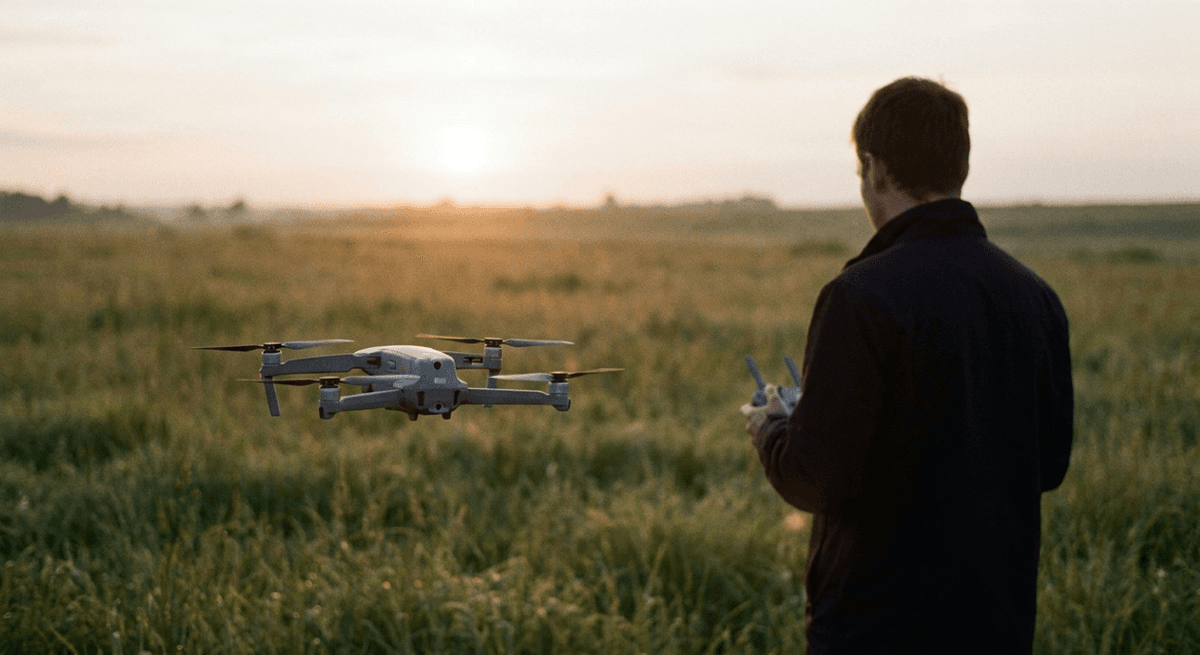
Illegal use of a drone to capture an image: Section 423.003
Section 423.003(a) makes it an offense to use a drone to capture an image of an individual or privately owned real property in Texas with the intent to conduct surveillance on the individual or property shown, and Subsection (b) sets the penalty at a Class C misdemeanor. "Intent" carries the meaning given in Penal Code Section 6.03, and Subsection (c) provides a defense if the operator destroyed the image immediately upon learning it was captured unlawfully and never shared, exhibited, or provided it to anyone else. The offense turns on intent to surveil, not on the mere fact that a drone happened to fly over private land.
Chapter 423 also lists a long set of lawful purposes under Section 423.002 that fall entirely outside the surveillance offense, including capturing an image with the consent of the property owner, under a valid search or arrest warrant, for academic research at a Texas institution, for utility, pipeline, or telecommunications inspection, for real estate marketing that does not show identifiable individuals, for professional surveying or engineering work, and for military operations. A drone operator who fits one of these categories does not need to separately prove they lacked surveillance intent.
Possessing or sharing an unlawfully captured image: Section 423.004
Once an image is captured in violation of Section 423.003, Section 423.004 separately criminalizes what happens to it next. Possessing the image is a Class C misdemeanor. Disclosing, displaying, distributing, or otherwise using the image is a Class B misdemeanor, a meaningfully higher-stakes offense. Each individual image a person possesses, discloses, displays, distributes, or uses in violation of the statute counts as a separate offense, so a single drone flight that captures and shares multiple images can generate multiple charges. As with Section 423.003, a defense is available if the person destroyed the image or stopped the disclosure immediately after learning it was unlawfully captured.
Civil lawsuit and damages under Section 423.006
Beyond the criminal penalties, an owner or tenant of privately owned Texas real property can bring a civil action under Section 423.006 to enjoin a violation or imminent violation of Section 423.003 or 423.004. A prevailing plaintiff can recover $5,000 for all images captured in a single episode in violation of Section 423.003, or $10,000 for the disclosure, display, distribution, or other use of any images captured in a single episode in violation of Section 423.004, and actual damages if the disclosure was made with malice as defined in Civil Practice and Remedies Code Section 41.001. The court must award court costs and reasonable attorney's fees to the prevailing party. Multiple owners or tenants of the same property are treated as a single party for purposes of the statutory penalty, and a suit must generally be filed within two years of the date the image was captured or disclosed.
Critical infrastructure, correctional facilities, and sports venues
Separate from the surveillance-image offense, Chapter 423 restricts low-altitude drone flights near sensitive facilities regardless of intent. Section 423.0045 makes it a Class B misdemeanor, escalating to a Class A misdemeanor on a repeat offense, to operate a drone over a defined critical infrastructure facility, such as a refinery, power generation site, water treatment plant, or oil and gas pipeline or wellhead, when the drone is not higher than 400 feet above ground level. The statute measures that threshold above the ground beneath the aircraft rather than as an absolute ceiling, and it reaches a drone flying at exactly 400 feet AGL, not only one below that line. Section 423.0046 applies the same altitude threshold and penalty structure to a sports venue, defined as an arena, stadium, coliseum, or similar facility with a seating capacity of 30,000 or more. A correctional, detention, or juvenile facility is protected by a different code altogether: Penal Code Section 38.115 uses the same not-higher-than-400-feet-above-ground-level threshold and makes flying a drone over one a Class B misdemeanor, rising to a Class A misdemeanor on a repeat offense, and to a state jail felony if the drone is used to deliver or otherwise introduce contraband into the facility. The two Chapter 423 sections exempt the facility's own owner or operator, government entities, law enforcement, and FAA-compliant commercial operators; Section 38.115 carries its own separate exceptions.
Even before the Fifth Circuit ended the district court's injunction, Texas newsrooms reported real friction over Chapter 423 in the field. In one widely reported incident, a Texas photojournalist flying a drone to cover a fire was warned by an officer that continuing to do so could violate Chapter 423, illustrating how the statute's critical infrastructure and general surveillance provisions can chill routine newsgathering even absent a prosecution.
National Press Photographers Association v. McCraw: what the Fifth Circuit actually decided
The National Press Photographers Association and the Texas Press Association sued Texas officials, including Department of Public Safety Director Steve McCraw, in September 2019 in the U.S. District Court for the Western District of Texas, arguing that Chapter 423's surveillance-image provisions violated the First Amendment on their face, and that its critical-infrastructure provisions violated the First Amendment and were preempted by federal aviation law. In March 2022, U.S. District Judge Robert Pitman granted summary judgment for the plaintiffs, held the challenged provisions unconstitutional, and enjoined their enforcement statewide.
The Fifth Circuit first ruled in 2023, then withdrew that opinion and issued a superseding decision on January 10, 2024, reported at 90 F.4th 770. The court affirmed dismissal of the preemption claim, and vacated and remanded the First Amendment and due-process claims against the state officials for dismissal on standing and sovereign-immunity grounds, a jurisdictional ruling rather than a merits holding; it reversed only as to the Hays County District Attorney, directing entry of judgment against the plaintiffs as to him. No part of the district court's injunction against Chapter 423 survived this ruling. Critically, the panel did not hold that Chapter 423 can never be challenged. It expressly left open the possibility of narrower as-applied First Amendment challenges brought by a specific person prosecuted under a specific set of facts. The opinion also noted that no plaintiff in the case had ever been arrested or prosecuted under Chapter 423, and that the one known prosecution, brought by the Hays County District Attorney's office, ended in a deferred disposition and did not involve a member of the press. In short, McCraw validates Chapter 423 as written, but it does not guarantee that every future prosecution under it will survive a challenge.
Does police need a warrant to fly a drone over my property in Texas?
Texas has not enacted a standalone statute requiring a warrant before every law enforcement drone flight, unlike states such as Illinois, Minnesota, or neighboring Utah. A Texas resident's claim that police unlawfully surveilled them by drone instead rests on ordinary Fourth Amendment analysis. The U.S. Supreme Court has held that aerial observation of a yard from public airspace by a manned aircraft, without a warrant, generally does not violate the Fourth Amendment. See California v. Ciraolo, 476 U.S. 207 (1986), and Florida v. Riley, 488 U.S. 445 (1989). Neither case involved a drone, and no Texas appellate decision has squarely extended that reasoning to a small drone hovering much closer to a home, so the outcome of a specific Texas case can turn heavily on altitude, duration, and what the drone actually observed.
The federal shoot-down rule
A persistent misconception is that a landowner may legally shoot down a drone hovering over their own property. Federal law says otherwise. The FAA classifies drones as aircraft within the National Airspace System, so 18 U.S.C. Section 32, the federal Aircraft Sabotage Act, applies to them: willfully damaging, destroying, or disabling a drone is a federal felony carrying up to 20 years in prison, regardless of whose property the drone is over, because the federal government, not the landowner, controls the airspace. No Texas statute authorizes a landowner to disable a drone over their own land, and a local prosecutor declining to pursue state charges in a sympathetic case does not establish a legal right to shoot one down.
Disclaimer
This article provides general legal information about Texas drone law as verified on 2026-07-09. It does not constitute legal advice and does not create an attorney-client relationship. Readers with a specific drone incident, or a question about a pending Texas bill, should consult a lawyer licensed in Texas.
Related articles
Last updated: 2026-07-09. Statutes cited reflect their in-force or enacted version as of 2026-07-09.
More Texas Laws
- Texas Data Privacy Laws
- Texas GPS Tracking Laws
- Texas Police Bodycam Laws
- Texas Recording Laws
- Texas Smart Glasses Recording Laws
Frequently Asked Questions
Is it illegal to fly a drone over someone's house in Texas?
It depends on intent. Texas Government Code Section 423.003 makes it a Class C misdemeanor to use a drone to capture an image of a person or privately owned real property with the intent to conduct surveillance, but flights for a listed lawful purpose under Section 423.002, such as owner consent or utility inspection, are not covered.
Can I be charged for taking pictures of my neighbor's yard with a drone in Texas?
You can be if the image was captured with intent to conduct surveillance and you possess, disclose, or share it. Section 423.003 covers the initial capture, and Section 423.004 separately criminalizes possessing, disclosing, displaying, or distributing an unlawfully captured image, with each image treated as a separate offense.
What did the Fifth Circuit decide in National Press Photographers Association v. McCraw?
In a decision reported at 90 F.4th 770 (5th Cir. 2024), superseding a 2023 opinion the panel later withdrew, the Fifth Circuit affirmed dismissal of the preemption claim and vacated the First Amendment claims against state officials for dismissal on jurisdictional grounds, reversing only as to the Hays County District Attorney. No part of the district court's injunction against Chapter 423 survived this ruling, and the panel left open the possibility of narrower as-applied challenges in future specific prosecutions.
Can I fly a drone near a Texas prison or power plant?
Not at or below 400 feet above ground level without authorization. Government Code Sections 423.0045 and 423.0046 make it a Class B misdemeanor, escalating to a Class A misdemeanor on a repeat offense, to fly a drone over a critical infrastructure facility or a large sports venue when the drone is not higher than 400 feet above ground level, which reaches a drone at exactly 400 feet AGL. A correctional or detention facility is covered instead by Penal Code Section 38.115, which uses the same 400-foot above-ground-level threshold and carries the same misdemeanor tiers and escalates to a state jail felony if the drone delivers or introduces contraband into the facility. Exemptions apply for the facility's own operators, government entities, and law enforcement.
Does Texas law require police to get a warrant before flying a drone over my property?
Texas has no standalone drone-warrant statute. A dispute over a law enforcement drone flight in Texas is analyzed under ordinary Fourth Amendment case law rather than a dedicated state statute.
How much can I sue for if someone drones my property in Texas?
Section 423.006 lets an owner or tenant of the property recover $5,000 for all images captured in a single episode in violation of Section 423.003, or $10,000 for the disclosure or use of images from a single episode in violation of Section 423.004, plus actual damages if malice is shown and attorney's fees and costs.
Can I shoot down a drone flying over my property in Texas?
No. Destroying, damaging, or disabling any drone is a federal felony under 18 U.S.C. Section 32, the Aircraft Sabotage Act, because the FAA controls the airspace regardless of who owns the land beneath it. No Texas law authorizes a landowner to disable a drone.
Updates
Corrected the description of National Press Photographers Association v. McCraw to match the Fifth Circuit's opinion, including which provisions faced the preemption claim and what the ruling did to the district court's injunction.
Corrected the 400-foot drone altitude threshold for Texas critical infrastructure, sports venues, and correctional facilities: the statutes reach a drone that is not higher than 400 feet above ground level, which includes a drone at exactly 400 feet, rather than only one below that line.
Corrected a fabricated citation, Government Code Section 423.0047, for the correctional-facility drone offense; the real law is Penal Code Section 38.115, which also carries a state-jail-felony tier for using a drone to deliver contraband into a facility that the article had omitted. Also corrected the $5,000 civil-damages figure, which the statute caps per single episode of image capture rather than per individual image, and replaced a citation to a Fifth Circuit opinion that was later withdrawn with the controlling January 2024 opinion.
Independently fact-checked against the cited primary sources; governing law re-checked for recent changes
Corrected the Fifth Circuit citation in National Press Photographers Association v. McCraw: the October 23, 2023 opinion at 84 F.4th 632 was withdrawn on rehearing and superseded by a January 10, 2024 opinion at 90 F.4th 770, which affirmed dismissal of the preemption claim but vacated (rather than rejected on the merits) the First Amendment claims against state officials for lack of standing/sovereign immunity, reversing only as to the Hays County DA; SCOTUS denied certiorari October 7, 2024.
Governing law re-checked for recent changes
Reviewed and approved by an editor
The Law Behind This Article
This article rests on the statutory provisions below, held in our own legal record and retrieved from the official source. Tap a section to read the operative text.
Texas Government Code
§ 423.003OFFENSE: ILLEGAL USE OF UNMANNED AIRCRAFT TO CAPTURE IMAGEIn force
(a) A person commits an offense if the person uses an unmanned aircraft to capture an image of an individual or privately owned real property in this state with the intent to conduct surveillance on the individual or property captured in the image. (b) An offense under this section is a Class C misdemeanor. (c) It is a defense to prosecution under this section that the person destroyed the image: (1) as soon as the person had knowledge that the image was captured in violation of this section; and (2) without disclosing, displaying, or distributing the image to a third party. (d) In this section, "intent" has the meaning assigned by Section 6.03, Penal Code.
Official text (excerpt) · last checked 2026-08-31 · Read the full text in our law library · Verify at statutes.capitol.texas.gov
§ 423.004OFFENSE: POSSESSION, DISCLOSURE, DISPLAY, DISTRIBUTION, OR USE OF IMAGEIn force
(a) A person commits an offense if the person: (1) captures an image in violation of Section 423.003; and (2) possesses, discloses, displays, distributes, or otherwise uses that image. (b) An offense under this section for the possession of an image is a Class C misdemeanor. An offense under this section for the disclosure, display, distribution, or other use of an image is a Class B misdemeanor. (c) Each image a person possesses, discloses, displays, distributes, or otherwise uses in violation of this section is a separate offense. (d) It is a defense to prosecution under this section for the possession of an image that the person destroyed the image as soon as the person had knowledge that the image was captured in violation of Section 423.003. (e) It is a defense to prosecution under this section for the disclosure, display, distribution, or other use of an image that the person stopped disclosing, displaying, distributing, or otherwise using the image as soon as the person had knowledge that the image was captured in violation of Section 423.003.
Official text (excerpt) · last checked 2026-07-28 · Read the full text in our law library · Verify at statutes.capitol.texas.gov
§ 423.006CIVIL ACTIONIn force
(a) An owner or tenant of privately owned real property located in this state may bring against a person who, in violation of Section 423.003, captured an image of the property or the owner or tenant while on the property an action to: (1) enjoin a violation or imminent violation of Section 423.003 or 423.004; (2) recover a civil penalty of: (A) $5,000 for all images captured in a single episode in violation of Section 423.003; or (B) $10,000 for disclosure, display, distribution, or other use of any images captured in a single episode in violation of Section 423.004; or (3) recover actual damages if the person who captured the image in violation of Section 423.003 discloses, displays, or distributes the image with malice. (b) For purposes of recovering the civil penalty or actual damages under Subsection (a), all owners of a parcel of real property are considered to be a single owner and all tenants of a parcel of real property are considered to be a single tenant. (c) In this section, "malice" has the meaning assigned by Section 41.001, Civil Practice and Remedies Code.
Official text (excerpt) · last checked 2026-07-28 · Read the full text in our law library · Verify at statutes.capitol.texas.gov
§ 423.0045OFFENSE: OPERATION OF UNMANNED AIRCRAFT OVER CRITICAL INFRASTRUCTURE FACILITYIn force
(a) In this section: (1) Repealed by Acts 2023, 88th Leg., R.S., Ch. 591 (H.B. 3075), Sec. 4, eff. September 1, 2023. (1-a) "Critical infrastructure facility" means: (A) one of the following, if completely enclosed by a fence or other physical barrier that is obviously designed to exclude intruders, or if clearly marked with a sign or signs that are posted on the property, are reasonably likely to come to the attention of intruders, and indicate that entry is forbidden: (i) a petroleum or alumina refinery; (ii) an electrical power generating facility, substation, switching station, or electrical control center; (iii) a chemical, polymer, or rubber manufacturing facility; (iv) a water intake structure, water treatment facility, wastewater treatment plant, or pump station; (v) a natural gas compressor station; (vi) a liquid natural gas terminal or storage facility; (vii) a telecommunications central switching office or any structure used as part of a system to provide wired or wireless telecommunications services; (viii) a port, a railroad switching yard, a trucking terminal, or any other freight transportation facility; (ix) a gas processing plant, including a plant…
Official text (excerpt) · last checked 2026-07-28 · Read the full text in our law library · Verify at statutes.capitol.texas.gov
Cited in 1 court opinions in our collectionLatest citing opinion in our collection: 2022
Opinions citing this section in our collection:
- National Press Photographers Association v. McCraw (District Court, W.D. Texas 2022)“…d. at 11). Texas Government Code Sections 423.0045 and 423.0046 (together “No-Fly Provisio…”
Identified automatically from the court opinions citing this section — not a ranking of which case controls.
§ 423.0046OFFENSE: OPERATION OF UNMANNED AIRCRAFT OVER SPORTS VENUEIn force
(a) In this section, "sports venue" means an arena, automobile racetrack, coliseum, stadium, or other type of area or facility that: (1) has a seating capacity of 30,000 or more people; and (2) is primarily used for one or more professional or amateur sports or athletics events. (b) A person commits an offense if the person intentionally or knowingly operates an unmanned aircraft over a sports venue and the unmanned aircraft is not higher than 400 feet above ground level. (c) This section does not apply to conduct described by Subsection (b) that is committed by: (1) the federal government, the state, or a governmental entity; (2) a person under contract with or otherwise acting under the direction or on behalf of the federal government, the state, or a governmental entity; (3) a law enforcement agency; (4) a person under contract with or otherwise acting under the direction or on behalf of a law enforcement agency; (5) an operator of an unmanned aircraft that is being used for a commercial purpose, if the operation is conducted in compliance with: (A) each applicable Federal Aviation Administration rule, restriction, or exemption; and (B) all required Federal Aviation…
Official text (excerpt) · last checked 2026-07-28 · Read the full text in our law library · Verify at statutes.capitol.texas.gov
§ 423.002NONAPPLICABILITYIn force
(a) It is lawful to capture an image using an unmanned aircraft in this state: (1) for the purpose of professional or scholarly research and development or for another academic purpose by a person acting on behalf of an institution of higher education or a private or independent institution of higher education, as those terms are defined by Section 61.003, Education Code, including a person who: (A) is a professor, employee, or student of the institution; or (B) is under contract with or otherwise acting under the direction or on behalf of the institution; (2) in airspace designated as a test site or range authorized by the Federal Aviation Administration for the purpose of integrating unmanned aircraft systems into the national airspace; (3) as part of an operation, exercise, or mission of any branch of: (A) the United States military; or (B) the Texas military forces as defined by Section 437.001; (4) if the image is captured by a satellite for the purposes of mapping; (5) if the image is captured by or for an electric or natural gas utility or a telecommunications provider: (A) for operations and maintenance of utility or telecommunications facilities for the purpose…
Official text (excerpt) · last checked 2026-07-28 · Read the full text in our law library · Verify at statutes.capitol.texas.gov
Cited in 2 court opinions in our collectionLatest citing opinion in our collection: 2022
Opinions citing this section in our collection:
- National Press Photographers Association v. McCraw (District Court, W.D. Texas 2022)“…tain newsgathering activities. (Id.). Texas Government Code Sections 423.002, 423.003, 423.004, and 423.006 (togethe…”
Identified automatically from the court opinions citing this section — not a ranking of which case controls.
Texas Penal Code
§ 38.115OPERATION OF UNMANNED AIRCRAFT OVER CORRECTIONAL FACILITY OR DETENTION FACILITYIn force
(a) In this section: (1) "Contraband" means any item not provided by or authorized by the operator of a correctional facility or detention facility. (2) "Correctional facility" means: (A) a confinement facility operated by or under contract with any division of the Texas Department of Criminal Justice; (B) a municipal or county jail; (C) a confinement facility operated by or under contract with the Federal Bureau of Prisons; or (D) a secure correctional facility or secure detention facility, as defined by Section 51.02, Family Code. (3) "Detention facility" means a facility operated by or under contract with United States Immigration and Customs Enforcement for the purpose of detaining aliens and placing them in removal proceedings.
Official text (excerpt) · last checked 2026-07-28 · Read the full text in our law library · Verify at statutes.capitol.texas.gov
Cited in 2 court opinions in our collectionLatest citing opinion in our collection: 2024
Opinions citing this section in our collection:
- National Press v. McCraw (Court of Appeals for the Fifth Circuit 2024, 90 F.4th 770)“…Id. § 423.0045(a)(1-a). 11 Tex. Penal Code § 38.115(b). The No-Fly provisions relating to c…”
Identified automatically from the court opinions citing this section — not a ranking of which case controls.
United States Code Title 18
§ 32Destruction of aircraft or aircraft facilitiesIn forcecited in 51 of our articles
Whoever willfully— sets fire to, damages, destroys, disables, or wrecks any aircraft in the special aircraft jurisdiction of the United States or any civil aircraft used, operated, or employed in interstate, overseas, or foreign air commerce; places or causes to be placed a destructive device or substance in, upon, or in proximity to, or otherwise makes or causes to be made unworkable or unusable or hazardous to work or use, any such aircraft, or any part or other materials used or intended to be used in connection with the operation of such aircraft, if such placing or causing to be placed or such making or causing to be made is likely to endanger the safety of any such aircraft; sets fire to, damages, destroys, or disables any air navigation facility, or interferes by force or violence with the operation of such facility, if such fire, damaging, destroying, disabling, or interfering is likely to endanger the safety of any such aircraft in flight; with the intent to damage, destroy, or disable any such aircraft, sets fire to, damages, destroys, or disables or places a destructive device or substance in, upon, or in proximity to, any appliance or structure, ramp, landing area,…
Official text (excerpt) · last checked 2026-07-28 · Read the full text in our law library · Verify at uscode.house.gov
Cited in 168 court opinions in our collectionLatest citing opinion in our collection: 2026
In the courts (editorial summary, independently checked):United States v. Yousef (2003) applied 18 U.S.C. 32 to an overseas airline bombing plot, holding Section 32(a) reaches conduct abroad because US-flag aircraft in flight are within the special aircraft jurisdiction, and that a defendant brought here involuntarily is still found in the United States under Section 32(b).
Opinions citing this section in our collection:
- Perez v. United States (Supreme Court of the United States 1971, 402 U.S. 146)“…commerce, as, for example, the destruction of an aircraft ( 18 U. S. C. § 32 ), or persons or things in commerce, as…”
- Stanford v. Kentucky (Supreme Court of the United States 1989, 492 U.S. 361)“…r by persons subject to Uniform Code of Military Justice); 18 U. S. C. §§ 32 , 33, and 34 (1982 ed. and Supp. V) (de…”
- United States v. Yousef (Court of Appeals for the Second Circuit 2003, 327 F.3d 56)✓Yousef bombed a Philippine airliner and plotted to bomb twelve US flag airliners on Asian routes; the court held Section 32(a) reaches attacks on US flag aircraft worldwide, and that Yousef, brought here involuntarily, was found in the United States under Section 32(b).
Identified automatically from the court opinions citing this section — not a ranking of which case controls.
Also relied on in: Indiana Drone Laws (2026): Police Warrants, Voyeurism, Hunting, Iowa Drone Laws: Homestead, Farmstead & Warrant Rules, Kansas Drone Laws: Stalking Act & Privacy Rules Explained
Search our full record of US law — 2.1 million sections, every state + federal →
Sources and References
- Tex. Gov't Code Chapter 423, Use of Unmanned Aircraft, Sections 423.002-423.006(statutes.capitol.texas.gov).gov
- Tex. Gov't Code Sections 423.0045-423.0046, critical infrastructure and sports venue drone restrictions(statutes.capitol.texas.gov).gov
- National Press Photographers Ass'n v. McCraw, 90 F.4th 770 (5th Cir. 2024) (superseding a withdrawn October 2023 opinion on rehearing), rejecting facial First Amendment and preemption challenges to Chapter 423(caselaw.findlaw.com)
- Reporters Committee for Freedom of the Press docket summary and Fifth Circuit opinion, Nat'l Press Photographers Ass'n v. McCraw, No. 22-50337(courtlistener.com)
- California v. Ciraolo, 476 U.S. 207 (1986) and Florida v. Riley, 488 U.S. 445 (1989), aerial-observation Fourth Amendment precedent(law.cornell.edu)
- 18 U.S.C. Section 32, Aircraft Sabotage Act, federal prohibition on destroying or damaging an aircraft including drones(law.cornell.edu)
- Tex. Penal Code Section 38.115 - contraband and drone offenses at correctional and detention facilities(statutes.capitol.texas.gov).gov