
Illinois
Illinois Drone Laws (2026): Police Warrants, Privacy, and Hunting
Independently fact-checked against primary sources (last audited August 17, 2026). · Reviewed by the RecordingLaw editorial team. · Law checked current as of August 17, 2026. · 5 primary sources cited on this page. How we verify our legal content

Illinois has no law stopping a neighbor from flying a drone over your yard, but its Freedom from Drone Surveillance Act limits when police can use one to a warrant or one of several other listed exceptions, including 911-dispatched emergency response and notice-based event monitoring, and separate statutes ban drones for hunting, wildlife harassment, and secretly filming someone in a bedroom or bathroom.
Federal Airspace Rules vs. Illinois State Law
The FAA controls where a drone may fly: altitude limits, pilot certification under 14 CFR Part 107 for commercial and government operators, the recreational exception at 49 U.S.C. 44809, and Remote ID broadcast requirements. That federal framework does not answer what happens to the footage once it is captured, or where a drone may be used against wildlife or a private citizen. Illinois regulates that separate layer through a mix of a dedicated law enforcement statute, general criminal recording law, and its Wildlife Code. A flight that is fully legal under FAA rules can still expose the operator to Illinois criminal or civil liability depending on what is recorded and why.
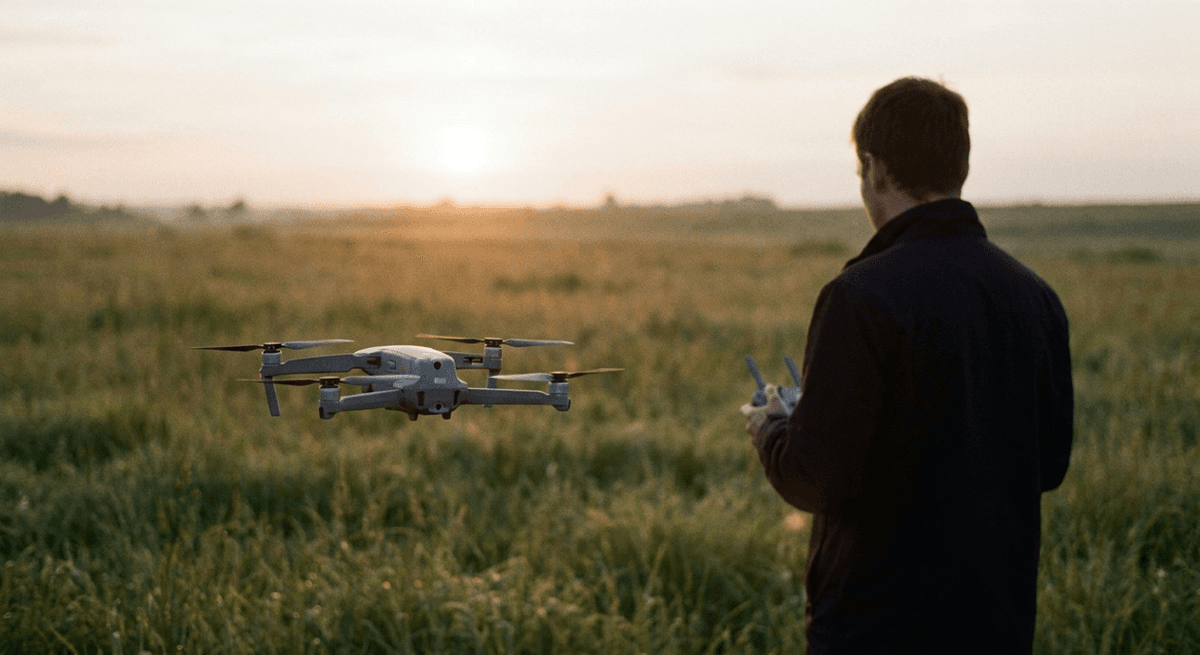
Illinois's Freedom from Drone Surveillance Act: When Can Police Use a Drone?
The Freedom from Drone Surveillance Act, 725 ILCS 167, sets a default ban: a law enforcement agency may not use a drone to gather information unless the use fits one of ten statutory exceptions in Section 15. The most common lawful basis is a search warrant, issued on a probable-cause showing under 725 ILCS 5/108-3 of the Code of Criminal Procedure, and capped at 45 days, renewable only if the agency makes a fresh showing of good cause to the issuing judge. Several other exceptions are narrow: a credible, specific terrorism risk certified by the United States Secretary of Homeland Security; reasonable suspicion that swift drone use is needed to prevent imminent harm to life or to stop an imminent escape or destruction of evidence, capped at 48 hours and reported to the State's Attorney within 24 hours; locating a missing person or conducting search and rescue; crime scene or traffic crash scene photography that is geographically confined and time-limited, which dispenses with a warrant only over state or political-subdivision land, highways, and roadways, because 725 ILCS 167/15(5) states that drone use under that paragraph on private property still requires a search warrant under 725 ILCS 5/108-3 or lawful consent to search; drone use during a declared or suspected disaster or public health emergency, with no advance declaration required; inspecting a building or structure at the express request of local government; and demonstrating a drone's capabilities without collecting or recording data. A 2023 amendment, Public Act 103-0101 (the Drones as First Responders Act, effective June 16, 2023), added two significantly broader categories that let agencies use drones for routine, notice-based monitoring well outside the warrant process: responding to a 911 dispatch to locate a victim, assess a health or safety need, or coordinate responding units, and monitoring a parade, festival, or other routed or special event in real time, provided the agency posts advance public notice at least 24 hours before the event.
The Act also constrains what happens after the flight, and 725 ILCS 167/20(a) runs three separate clocks rather than one. Information gathered under paragraphs (1) through (6) and (9) of Section 15, which covers the warrant, terrorism, exigency, missing-person, crime scene, disaster, and demonstration exceptions, must be destroyed within 30 days. Information gathered under paragraph (10), the routed or special-event monitoring added in 2023, must be destroyed within 24 hours. Imagery from a paragraph (7) infrastructure inspection must be destroyed immediately after it is turned over to the local government that requested it. A supervisor may keep material past those deadlines only on one of the four grounds in 725 ILCS 167/20(b): reasonable suspicion that the information contains evidence of criminal activity; relevance to an ongoing investigation or pending criminal trial; use exclusively for training, provided the material carries no personally identifiable information; or that the information consists only of the drone's flight path data, metadata, or telemetry. Agencies may not sell or disclose drone-gathered information to unauthorized recipients, though records remain subject to the Freedom of Information Act (absent an applicable exemption) or a court order or subpoena tied to a criminal proceeding or crash investigation. Every agency that owns or uses a drone must file an annual report with the Illinois Criminal Justice Information Authority, which compiles and publishes a statewide summary.
The same 2023 amendment added two further limits on how a drone may be used once deployed. Section 17 bars a law enforcement agency from using onboard facial recognition during a flight, or applying facial recognition software to drone-gathered footage, except under the terrorism and imminent-harm exceptions above. Section 18 bars equipping or using a firearm, weaponized laser, kinetic impact projectile, chemical agent or irritant, or any other lethal or non-lethal weapon on a law enforcement drone.
Can a Private Citizen Fly a Drone Over Your Property in Illinois?
Illinois has no civilian drone-privacy statute comparable to Idaho's Code 21-213 or Florida's Freedom from Unwarranted Surveillance Act. A neighbor's drone flight over your yard, by itself, is not a distinct Illinois crime. Instead, several general statutes reach the conduct that actually causes harm. Criminal trespass to real property, 720 ILCS 5/21-3, still applies to landing or operating a drone on someone else's ground without permission, and persistent, low-altitude flight over a fenced yard can support a trespass theory consistent with the "immediate reaches" doctrine recognized in United States v. Causby, 328 U.S. 256 (1946).
Where the drone is used to record, Illinois's unauthorized video recording statute, 720 ILCS 5/26-4, applies regardless of the camera platform. It is unlawful to knowingly video record or transmit live video of another person, without consent, in a restroom, tanning bed or salon, locker room, changing room, hotel bedroom, or their own residence. A first violation is a Class 4 felony, and the offense rises to a Class 3 felony if the victim is under 18, the offender is required to register as a sex offender, or the recording is disseminated. Dissemination combined with either a victim under 18 or a registered-sex-offender defendant is a Class 2 felony, the statute's top tier. Property owners also retain the common-law tort of intrusion upon seclusion and can seek flight logs and registration information in litigation to identify a persistent drone operator.
Your city cannot fill that gap with a local ordinance. Section 42.1 of the Illinois Aeronautics Act, 620 ILCS 5/42.1, makes the regulation of unmanned aircraft systems "an exclusive power and function of the State" and provides that no unit of local government, "including home rule unit, may enact an ordinance or resolution to regulate unmanned aircraft systems." The section does not apply to municipalities of more than 1,000,000 inhabitants, which in practice means Chicago retains authority to legislate on drones and no other Illinois city does. One narrow window stays open elsewhere: under subsection (b-5), a unit of local government may adopt reasonable rules for private drone use in the airspace above publicly owned recreational property such as parks, playgrounds, aquatic facilities, and wildlife areas, so long as those rules do not conflict with state agency rules or federal law. So a village outside Chicago cannot ban drone flights over your neighborhood, but it can restrict them over the municipal park.
Separately, a bill introduced in the Illinois General Assembly in January 2026, House Bill 4332, would require registered sex offenders to disclose drone ownership, including make and model, to the Illinois State Police, in the same way they already report vehicles and internet accounts. As of this writing the bill remains pending and has not been enacted into law.
Hunting, Wildlife, and Illinois Drone Restrictions
Illinois criminalizes two distinct drone-and-wildlife scenarios, and both are Class A misdemeanors rather than minor fines.
Using a drone in a way that interferes with another person's lawful taking of wildlife or aquatic life is "hunter or fisherman interference" under 720 ILCS 5/48-3(b)(10), a criminal offense independent of any property or privacy claim. The first-offense Class B misdemeanor step-down in 720 ILCS 5/48-3(d) reaches only paragraphs (1) through (8), so a drone violation is a Class A misdemeanor from the first offense, punishable by a jail term of less than one year and a fine of up to $2,500. On conviction the court "shall revoke, for a period of one year to 5 years," the offender's Illinois hunting, fishing, or trapping license or privileges. Section 48-3(e) adds a civil layer for drone conduct: a court may enjoin it and must award costs and damages to the person interfered with, which may include punitive damages and the wasted cost of licenses, permits, travel, guides, and equipment.
Separately, the Wildlife Code, 520 ILCS 5/2.33(i), makes it unlawful to take, pursue, or intentionally harass or disturb any wild bird or mammal by use or aid of an unmanned aircraft, with an exception for a public utility or a mobile services provider inspecting a facility, tower, or structure. The Wildlife Code's penalty section, 520 ILCS 5/3.5, expressly excludes subsection (i) from its Class B misdemeanor list and instead provides that a person who violates subsection (i) of Section 2.33 "shall be guilty of a Class A misdemeanor and subject to a fine of no less than $500 and no more than $5,000 in addition to other statutory penalties." The $500 floor is mandatory, so this is not a fine a court can waive down to a ticket.
Can You Shoot Down a Drone Over Your Property in Illinois?
No. Every drone is legally an "aircraft," and 18 U.S.C. 32, the Aircraft Sabotage Act, makes willfully damaging, destroying, or disabling one a federal felony carrying up to 20 years in prison, regardless of whose property it is flying over. Illinois has not enacted, and could not enact, a state law authorizing a landowner to shoot down a drone, because the FAA, not the landowner, controls the airspace. A property owner who feels harassed by a persistent drone should document the flights and pursue the trespass, harassment, or recording claims described above rather than disable the aircraft.
Penalties at a Glance
| Conduct | Illinois Statute | Type | Consequence |
|---|---|---|---|
| Law enforcement drone use without a warrant or listed exception | 725 ILCS 167 | Evidentiary/administrative | Unauthorized data must be destroyed; agency subject to statutory reporting requirements |
| Recording a person without consent in a restroom, locker room, or residence | 720 ILCS 5/26-4 | Class 4 felony (Class 3 if minor, registered offender, or disseminated; Class 2 if disseminated and the victim is a minor or the offender is a registered sex offender) | 1-3 years prison (Class 4), 2-5 years (Class 3), 3-7 years (Class 2), fines up to $25,000 |
| Using a drone to interfere with another person's lawful taking of wildlife or aquatic life | 720 ILCS 5/48-3(b)(10), (d) | Class A misdemeanor (no first-offense step-down) | Jail term of less than one year, fine up to $2,500, and mandatory revocation of hunting, fishing, or trapping privileges for 1 to 5 years; injunction plus costs, damages, and possible punitive damages under 48-3(e) |
| Taking, pursuing, or intentionally harassing wild birds or mammals with a drone | 520 ILCS 5/2.33(i), penalty at 520 ILCS 5/3.5 | Class A misdemeanor | Jail term of less than one year and a mandatory fine of $500 to $5,000 |
| Local government enacting its own drone ordinance | 620 ILCS 5/42.1 | Preempted | Void as to any unit of local government, including home rule units, except municipalities over 1,000,000 inhabitants and reasonable rules over municipal recreational property |
| Shooting down any drone | 18 U.S.C. 32 (federal) | Felony | Up to 20 years in prison, fines up to $250,000 |
For general surveillance and security camera rules outside the drone context, see Surveillance Camera Laws by State. For the full 51-state breakdown of drone law, see Drone Laws by State.
More Illinois Laws
- Illinois Data Privacy Laws
- Illinois GPS Tracking Laws
- Illinois Police Bodycam Laws
- Illinois Recording Laws
- Illinois Smart Glasses Recording Laws
Frequently Asked Questions
Does my neighbor need my permission to fly a drone over my yard in Illinois?
No Illinois statute requires it. Illinois has no dedicated civilian drone privacy law comparable to Idaho's or Florida's. A neighbor's drone flight over your yard is governed by ordinary trespass, nuisance, and harassment law. Persistent, low-altitude flights over a fenced yard can support a trespass claim, and secretly filming you through a window or inside your home can trigger the state's unauthorized video recording statute.
Can my city or village ban drones in Illinois?
Almost certainly not. Section 42.1 of the Illinois Aeronautics Act, 620 ILCS 5/42.1, makes regulating unmanned aircraft systems an exclusive power and function of the State and bars every unit of local government, including home rule units, from enacting a drone ordinance or resolution. The section carves out municipalities of more than 1,000,000 inhabitants, so Chicago may regulate drones and no other Illinois city may. Everywhere else the only permitted local rules are reasonable restrictions on private drone use in the airspace above publicly owned recreational property such as parks, playgrounds, aquatic facilities, and wildlife areas, and those rules may not conflict with state agency rules or federal law.
Can Illinois police fly a drone over my house without a warrant?
Generally no. The Freedom from Drone Surveillance Act, 725 ILCS 167, bans law enforcement drone use to gather information unless one of ten listed exceptions applies. The most common path is a search warrant based on probable cause under 725 ILCS 5/108-3, capped at 45 days and renewable only on a fresh showing of good cause. Other exceptions exist for imminent danger, a certified terrorism risk, crime scene photography, disasters, and missing-person searches, and, since a 2023 amendment, for responding to a 911 dispatch or monitoring a parade or special event with 24-hour advance public notice. The crime scene exception is narrower than it sounds over private land: 725 ILCS 167/15(5) still requires a search warrant or lawful consent for crime scene and crash scene photography on private property, and waives the warrant only over state or political-subdivision land, highways, and roadways.
What happens to information Illinois police collect with a drone?
Under 725 ILCS 167/20 the deadline depends on why the drone flew. Information gathered under most of the Act's exceptions must be destroyed within 30 days, information gathered while monitoring a parade or other routed or special event must be destroyed within 24 hours, and imagery from an infrastructure inspection requested by a local government must be destroyed immediately after it is turned over. A supervisor may keep the material longer only if there is reasonable suspicion it contains evidence of criminal activity, it is relevant to an ongoing investigation or pending criminal trial, it will be used exclusively for training and carries no personally identifiable information, or it consists only of flight path data, metadata, or telemetry. Agencies must also file annual usage reports with the Illinois Criminal Justice Information Authority.
Is it illegal to use a drone to hunt or scout deer in Illinois?
Yes, and the exposure is larger than most people expect. Using a drone to take, pursue, or intentionally harass or disturb a wild bird or mammal violates the Wildlife Code, 520 ILCS 5/2.33(i), and 520 ILCS 5/3.5 makes that a Class A misdemeanor carrying a mandatory fine of no less than $500 and no more than $5,000 in addition to other statutory penalties. Using a drone to interfere with someone else's lawful taking of wildlife or aquatic life is a separate Class A misdemeanor under 720 ILCS 5/48-3, with no first-offense step-down, and a conviction requires the court to revoke your Illinois hunting, fishing, or trapping privileges for one to five years.
Can I be charged with a felony for filming someone with a drone in Illinois?
Yes, if the recording captures a person without consent in a restroom, locker room, changing room, tanning bed or salon, hotel bedroom, or their own residence. That conduct is a Class 4 felony under 720 ILCS 5/26-4, regardless of whether a drone or a handheld camera was used, and it rises to a Class 3 felony if the victim is under 18, the offender is a registered sex offender, or the images are disseminated. If the images are disseminated and the victim is under 18 or the offender is a registered sex offender, the offense is a Class 2 felony, the statute's most serious tier.
Can I shoot down a drone flying over my property in Illinois?
No. Damaging, destroying, or disabling any drone is a federal felony under 18 U.S.C. 32, the Aircraft Sabotage Act, no matter which state you are in or whether the drone is over your own land. Illinois has no law authorizing a landowner to shoot down a drone, and state law cannot override the federal prohibition.
Do registered sex offenders in Illinois have to register their drones?
Not yet. A bill introduced in the Illinois General Assembly in January 2026, House Bill 4332, would require registered sex offenders to disclose drone ownership, including make and model, to the Illinois State Police. As of this writing the bill has not been enacted into law.
Updates
Corrected the penalties for both Illinois drone-and-wildlife offenses, which are Class A misdemeanors rather than petty offenses, replaced the flat 30-day police retention rule with the three deadlines the statute actually sets, added the private-property warrant condition on the crime scene exception, and added the state law barring cities other than Chicago from passing their own drone ordinances.
Updated this page to reflect the Freedom from Drone Surveillance Act's 2023 expansion (911-dispatched emergency response, notice-based event monitoring, and new facial-recognition/weapons restrictions), added the Class 2 felony tier for disseminated unauthorized recordings involving a minor or registered sex offender, and fixed three dead ilga.gov citation links.
Independently fact-checked against the cited primary sources; governing law re-checked for recent changes
Governing law re-checked for recent changes
Reviewed and approved by an editor
The Law Behind This Article
This article rests on the statutory provisions below, held in our own legal record and retrieved from the official source. Tap a section to read the operative text.
Illinois Compiled Statutes Chapter 725, Act 167 (Freedom from Drone Surveillance Act)
§ 10Prohibited use of dronesIn forcecited in 2 of our articles
Except as provided in Section 15, a law enforcement agency may not use a drone to gather information.
Official text (excerpt) · last checked 2026-08-31 · Read the full text in our law library · Verify at ilga.gov
Also relied on in: Illinois Surveillance Camera Laws (2026 Guide)
§ 15ExceptionsIn force
This Act does not prohibit the use of a drone by a law enforcement agency: (1) To counter a high risk of a terrorist attack by a specific individual or organization if the United States Secretary of Homeland Security determines that credible intelligence indicates that there is that risk. (2) If a law enforcement agency first obtains a search warrant based on probable cause issued under Section 108-3 of the Code of Criminal Procedure of 1963. The warrant must be limited to a period of 45 days, renewable by the judge upon a showing of good cause for subsequent periods of 45 days. (3) If a law enforcement agency possesses reasonable suspicion that, under particular circumstances, swift action is needed to prevent imminent harm to life, or to forestall the imminent escape of a suspect or the destruction of evidence. The use of a drone under this paragraph (3) is limited to a period of 48 hours. Within 24 hours of the initiation of the use of a drone under this paragraph (3), the chief executive officer of the law enforcement agency must report in writing the use of a drone to the local State's Attorney.
Official text (excerpt) · last checked 2026-07-29 · Read the full text in our law library · Verify at ilga.gov
Illinois Compiled Statutes Chapter 720, Act 5 (Criminal Code of 2012)
§ 26-4Unauthorized video recording and live video transmissionIn forcecited in 9 of our articles
(a) It is unlawful for any person to knowingly make a video record or transmit live video of another person without that person's consent in a restroom, tanning bed, tanning salon, locker room, changing room, or hotel bedroom. (a-5) It is unlawful for any person to knowingly make a video record or transmit live video of another person in that other person's residence without that person's consent. (a-6) It is unlawful for any person to knowingly make a video record or transmit live video of another person in that other person's residence without that person's consent when the recording or transmission is made outside that person's residence by use of an audio or video device that records or transmits from a remote location. (a-10) It is unlawful for any person to knowingly make a video record or transmit live video of another person's intimate parts for the purpose of viewing the body of or the undergarments worn by that other person without that person's consent.
Official text (excerpt) · last checked 2026-08-31 · Read the full text in our law library · Verify at ilga.gov
Cited in 16 court opinions in our collectionLatest citing opinion in our collection: 2026
Opinions citing this section in our collection:
- People v. McCavitt (Illinois Supreme Court 2021, 452 Ill. Dec. 456)“…o Recording/Live Video Transmission in violation of 720 ILCS 5/26-4,” and the warrant authorized th…”
- People v. Van Syckle (Appellate Court of Illinois 2020, 2019 IL App (1st) 181410)“…in violation of section 26-4(a) of the Criminal Code (720 ILCS 5/26-4(a) (West 2014)). Defendant filed a…”
- People v. Maillet (Appellate Court of Illinois 2019, 2019 IL App (2d) 161114)“…of section 26-4(a-5) of the Criminal Code of 2012 (Code) (720 ILCS 5/26-4(a-5) (West 2012)). Count II alleged tha…”
Identified automatically from the court opinions citing this section — not a ranking of which case controls.
Also relied on in: Illinois Video Recording Laws: Consent, BIPA, and Surveillance Rules (2026), Illinois Voyeurism and Hidden Camera Laws: Penalties and BIPA Rules (2026), Illinois Employee Monitoring Laws (2026): BIPA, Recording & More
§ 48-3Hunter or fisherman interferenceIn force
(a) Definitions. As used in this Section: "Aquatic life" means all fish, reptiles, amphibians, crayfish, and mussels the taking of which is authorized by the Fish and Aquatic Life Code. "Interfere with" means to take any action that physically impedes, hinders, or obstructs the lawful taking of wildlife or aquatic life. "Taking" means the capture or killing of wildlife or aquatic life and includes travel, camping, and other acts preparatory to taking which occur on lands or waters upon which the affected person has the right or privilege to take such wildlife or aquatic life. "Wildlife" means any wildlife the taking of which is authorized by the Wildlife Code and includes those species that are lawfully released by properly licensed permittees of the Department of Natural Resources.
Official text (excerpt) · last checked 2026-07-29 · Read the full text in our law library · Verify at ilga.gov
§ 21-3Criminal trespass to real propertyIn force
(a) A person commits criminal trespass to real property when he or she: (1) knowingly and without lawful authority enters or remains within or on a building; (2) enters upon the land of another, after receiving, prior to the entry, notice from the owner or occupant that the entry is forbidden; (3) remains upon the land of another, after receiving notice from the owner or occupant to depart; (3.5) presents false documents or falsely represents his or her identity orally to the owner or occupant of a building or land in order to obtain permission from the owner or occupant to enter or remain in the building or on the land; (3.7) intentionally removes a notice posted on residential real estate as required by subsection (l) of Section 15-1505.8 of Article XV of the Code of Civil Procedure before the date and time set forth in the notice; or (4) enters a field used or capable of being used for growing crops, an enclosed area containing livestock, an agricultural building containing livestock, or an orchard in or on a motor vehicle (including an off-road vehicle, motorcycle, moped, or any other powered two-wheel vehicle) after receiving, prior to the entry, notice from the owner or…
Official text (excerpt) · last checked 2026-07-29 · Read the full text in our law library · Verify at ilga.gov
Cited in 67 court opinions in our collectionLatest citing opinion in our collection: 2026
Opinions citing this section in our collection:
- People v. Smith (Appellate Court of Illinois 2004, 346 Ill. App. 3d 146)“…rosecution under section 21-3 of the Criminal Code of 1961 (720 ILCS 5/21-3 (West 2000)). 92 Ill. Adm.Code § 2520.3…”
- People v. Chai (Appellate Court of Illinois 2014, 2014 IL App (2d) 121234)“…i with notice that he was not to return to the DMV) (720 ILCS 5/21-3 (West 2010)); (2) resisting a peace off…”
- People v. Lozano (Appellate Court of Illinois 2022, 462 Ill. Dec. 551)“…may have been trespassing by attempting to entering it. See 720 ILCS 5/21-3(a)(1) (West 2018). ¶ 37 Defendant a…”
Identified automatically from the court opinions citing this section — not a ranking of which case controls.
Illinois Compiled Statutes Chapter 520, Act 5 (Wildlife Code)
§ 2.33ProhibitionsIn force
(a) It is unlawful to carry or possess any gun in any State refuge unless otherwise permitted by administrative rule. (b) It is unlawful to use or possess any snare or snare-like device, deadfall, net, or pit trap to take any species, except that snares not powered by springs or other mechanical devices may be used to trap fur-bearing mammals, in water sets only, if at least one-half of the snare noose is located underwater at all times. (c) It is unlawful for any person at any time to take a wild mammal protected by this Act from its den by means of any mechanical device, spade, or digging device or to use smoke or other gases to dislodge or remove such mammal except as provided in Section 2.37. (d) It is unlawful to use a ferret or any other small mammal which is used in the same or similar manner for which ferrets are used for the purpose of frightening or driving any mammals from their dens or hiding places. (e) (Blank). (f) It is unlawful to use spears, gigs, hooks, or any like device to take any species protected by this Act. (g) It is unlawful to use poisons, chemicals, or explosives for the purpose of taking any species protected by this Act.
Official text (excerpt) · last checked 2026-07-29 · Read the full text in our law library · Verify at ilga.gov
Cited in 7 court opinions in our collectionLatest citing opinion in our collection: 2023
Opinions citing this section in our collection:
- People v. Winslow (Appellate Court of Illinois 2023, 2023 IL App (4th) 210246-U)“…and (3) unlawful waste and failure to destroy usable meat (520 ILCS 5/2.33(hh) (West 2018)) for wasting or failing…”
- United States v. Mark Burge (Court of Appeals for the Seventh Circuit 2012, 683 F.3d 829)“…ues such as the use of snares, deadfalls, or pit traps. See 520 ILCS 5/2.33(b). Also, it is a Class A misde- meanor…”
- Murawski v. Reid (District Court, E.D. Illinois 2019, 375 F. Supp. 3d 998)“…n ownership of or title to the submerged land"); see also 520 ILCS 5/2.33(t) ("It is unlawful for any person to t…”
Identified automatically from the court opinions citing this section — not a ranking of which case controls.
§ 3.5Penalties; probationIn force
(a) Any person who violates any of the provisions of Section 2.36a, including administrative rules, shall be guilty of a Class 3 felony, except as otherwise provided in subsection (b) of this Section and subsection (a) of Section 2.36a. (b) Whenever any person who has not previously been convicted of, or placed on probation or court supervision for, any offense under Section 1.22, 2.36, or 2.36a, operating without a permit as prescribed in subsection (b) of Section 2.37, or an offense under subsection (i) or (cc) of Section 2.33, the court may, without entering a judgment and with the person's consent, sentence the person to probation for a violation of Section 2.36a. (1) When a person is placed on probation, the court shall enter an order specifying a period of probation of 24 months and shall defer further proceedings in the case until the conclusion of the period or until the filing of a petition alleging violation of a term or condition of probation. (2) The conditions of probation shall be that the person: (A) Not violate any criminal statute of any jurisdiction.
Official text (excerpt) · last checked 2026-07-29 · Read the full text in our law library · Verify at ilga.gov
United States Code Title 18
§ 32Destruction of aircraft or aircraft facilitiesIn forcecited in 51 of our articles
Whoever willfully— sets fire to, damages, destroys, disables, or wrecks any aircraft in the special aircraft jurisdiction of the United States or any civil aircraft used, operated, or employed in interstate, overseas, or foreign air commerce; places or causes to be placed a destructive device or substance in, upon, or in proximity to, or otherwise makes or causes to be made unworkable or unusable or hazardous to work or use, any such aircraft, or any part or other materials used or intended to be used in connection with the operation of such aircraft, if such placing or causing to be placed or such making or causing to be made is likely to endanger the safety of any such aircraft; sets fire to, damages, destroys, or disables any air navigation facility, or interferes by force or violence with the operation of such facility, if such fire, damaging, destroying, disabling, or interfering is likely to endanger the safety of any such aircraft in flight; with the intent to damage, destroy, or disable any such aircraft, sets fire to, damages, destroys, or disables or places a destructive device or substance in, upon, or in proximity to, any appliance or structure, ramp, landing area,…
Official text (excerpt) · last checked 2026-07-28 · Read the full text in our law library · Verify at uscode.house.gov
Cited in 168 court opinions in our collectionLatest citing opinion in our collection: 2026
In the courts (editorial summary, independently checked):United States v. Yousef (2003) applied 18 U.S.C. 32 to an overseas airline bombing plot, holding Section 32(a) reaches conduct abroad because US-flag aircraft in flight are within the special aircraft jurisdiction, and that a defendant brought here involuntarily is still found in the United States under Section 32(b).
Opinions citing this section in our collection:
- Perez v. United States (Supreme Court of the United States 1971, 402 U.S. 146)“…commerce, as, for example, the destruction of an aircraft ( 18 U. S. C. § 32 ), or persons or things in commerce, as…”
- Stanford v. Kentucky (Supreme Court of the United States 1989, 492 U.S. 361)“…r by persons subject to Uniform Code of Military Justice); 18 U. S. C. §§ 32 , 33, and 34 (1982 ed. and Supp. V) (de…”
- United States v. Yousef (Court of Appeals for the Second Circuit 2003, 327 F.3d 56)✓Yousef bombed a Philippine airliner and plotted to bomb twelve US flag airliners on Asian routes; the court held Section 32(a) reaches attacks on US flag aircraft worldwide, and that Yousef, brought here involuntarily, was found in the United States under Section 32(b).
Identified automatically from the court opinions citing this section — not a ranking of which case controls.
Also relied on in: Indiana Drone Laws (2026): Police Warrants, Voyeurism, Hunting, Iowa Drone Laws: Homestead, Farmstead & Warrant Rules, Kansas Drone Laws: Stalking Act & Privacy Rules Explained
United States Code Title 49
§ 44809Exception for limited recreational operations of unmanned aircraftIn forcecited in 13 of our articles
Except as provided in subsection (e), and notwithstanding chapter 447 of title 49, United States Code, a person may operate a small unmanned aircraft without specific certification or operating authority from the Federal Aviation Administration if the operation adheres to all of the following limitations: The aircraft is flown strictly for recreational purposes. The aircraft is operated in accordance with or within the programming of a community-based organization’s set of safety guidelines that are developed in coordination with the Federal Aviation Administration. The aircraft is flown within the visual line of sight of the person operating the aircraft or a visual observer co-located and in direct communication with the operator. The aircraft is operated in a manner that does not interfere with and gives way to any manned aircraft. In Class B, Class C, or Class D airspace or within the lateral boundaries of the surface area of Class E airspace designated for an airport, the operator obtains prior authorization from the Administrator or designee before operating and complies with all airspace restrictions and prohibitions.
Official text (excerpt) · last checked 2026-07-28 · Read the full text in our law library · Verify at uscode.house.gov
Cited in 1 court opinions in our collectionLatest citing opinion in our collection: 2022
Opinions citing this section in our collection:
- Tyler Brennan v. Stephen Dickson (Court of Appeals for the D.C. Circuit 2022, 45 F.4th 48)“…Reauthorization Act, § 349(a), (b), (f), 132 Stat. at 3297; 49 U.S.C. § 44809(f); see Final Rule, 86 Fed. Reg. at 440…”
Identified automatically from the court opinions citing this section — not a ranking of which case controls.
Also relied on in: Florida Drone Laws 2026: Privacy, Warrants & Penalties, Idaho Drone Laws (2026): Privacy, Police Warrants, and Hunting Rules, Louisiana Drone Laws: Privacy, Critical Infrastructure & Shoot-Down Rules
Illinois Compiled Statutes Chapter 620, Act 5 (Illinois Aeronautics Act)
§ 42.1Regulation of unmanned aircraft systemsIn force
(a) As used in this Section: "Unmanned aircraft" means a device used or intended to be used for flight in the air that is operated without the possibility of direct human intervention within or on the device. "Unmanned aircraft system" means an unmanned aircraft and its associated elements, including communication links and the components that control the unmanned aircraft, that are required for the safe and efficient operation of the unmanned aircraft in the National Airspace System. (b) Except as otherwise provided in this Section, to the extent that State-level oversight does not conflict with federal laws, rules, or regulations, the regulation of an unmanned aircraft system is an exclusive power and function of the State. No unit of local government, including home rule unit, may enact an ordinance or resolution to regulate unmanned aircraft systems. This Section is a denial and limitation of home rule powers and functions under subsection (h) of Section 6 of Article VII of the Illinois Constitution. This Section does not apply to any local ordinance enacted by a municipality of more than 1,000,000 inhabitants.
Official text (excerpt) · last checked 2026-07-29 · Read the full text in our law library · Verify at ilga.gov
Illinois Compiled Statutes Chapter 725, Act 5 (Code of Criminal Procedure of 1963)
§ 108-3Grounds for search warrantIn force
(a) Except as provided in subsection (b), upon the written complaint of any person under oath or affirmation which states facts sufficient to show probable cause and which particularly describes the place or person, or both, to be searched and the things to be seized, any judge may issue a search warrant for the seizure of the following: (1) Any instruments, articles or things designed or intended for use or which are or have been used in the commission of, or which may constitute evidence of, the offense in connection with which the warrant is issued; or contraband, the fruits of crime, or things otherwise criminally possessed. (2) Any person who has been kidnaped in violation of the laws of this State, or who has been kidnaped in another jurisdiction and is now concealed within this State, or any human fetus or human corpse.
Official text (excerpt) · last checked 2026-07-29 · Read the full text in our law library · Verify at ilga.gov
Cited in 11 court opinions in our collectionLatest citing opinion in our collection: 2021
Opinions citing this section in our collection:
- People v. Carlson (Illinois Supreme Court 1999, 185 Ill. 2d 546)“…tion 108-3(a)(1) of the Code of Criminal Procedure of 1963 (725 ILCS 5/108-3(a)(1) (West 1992)) does not authorize i…”
- People v. Nwosu (Appellate Court of Illinois 1997)“…nguage of section 108-3 of the Code of Criminal Procedure. 725 ILCS 5/108-3 (West 1992). Section 108-3(a)(1) provi…”
- People v. Ross (Appellate Court of Illinois 2018, 2017 IL App (4th) 170121)“…r person to be searched and the things to be seized. 725 ILCS 5/108-3(a) (West 2014). “The purpose of this re…”
Identified automatically from the court opinions citing this section — not a ranking of which case controls.
Search our full record of US law — 2.1 million sections, every state + federal →
Sources and References
- 725 ILCS 167, Freedom from Drone Surveillance Act. Default ban on law enforcement drone use to gather information, lifted only by one of ten exceptions in Section 15: most commonly a warrant under 725 ILCS 5/108-3 (capped 45 days, renewable), plus a certified terrorism risk, exigent circumstances (48 hours), missing-person searches, crime/crash scene photography, a declared disaster, local-government-requested infrastructure inspection, public-relations demonstrations, and, since Public Act 103-0101 (eff. 6/16/2023), 911-dispatched emergency response and notice-based event monitoring. Requires destruction of gathered data within 30 days absent an evidentiary exception, annual reporting to ICJIA, and (added by the same 2023 amendment) bars onboard facial recognition (Sec. 17) and weaponizing drones (Sec. 18).(ilga.gov).gov
- 720 ILCS 5/26-4, Unauthorized Video Recording and Live Video Transmission. Bans recording a person without consent in a restroom, locker room, changing room, tanning bed/salon, hotel bedroom, or their residence. Class 4 felony, Class 3 felony for minor victims, registered-sex-offender defendants, or dissemination.(ilga.gov).gov
- 720 ILCS 5/48-3, Hunter or fisherman interference. Makes it a crime to use a drone to interfere with a person's lawful hunting, fishing, or trapping of animals.(ilga.gov).gov
- 520 ILCS 5/2.33, Wildlife Code prohibitions. Bans taking, pursuing, or intentionally harassing or disturbing a wild bird or mammal by use of a drone, with an exception for utility/mobile-facility inspection.(ilga.gov).gov
- 18 U.S.C. 32 (Aircraft Sabotage Act). Makes willfully damaging, destroying, or disabling any aircraft, including a drone, a federal felony punishable by up to 20 years in prison.(law.cornell.edu)
- Illinois Criminal Justice Information Authority, State Fiscal Year 2024 Freedom from Drone Surveillance Act Report. Official agency report on law enforcement drone usage, the annual reporting requirement, and data-handling practices under 725 ILCS 167.(icjia.illinois.gov).gov
- 520 ILCS 5/3.5, Wildlife Code penalties. Excludes subsection (i) of Section 2.33, the unmanned-aircraft provision, from the Class B misdemeanor list and makes a violation of subsection (i) a Class A misdemeanor subject to a fine of no less than $500 and no more than $5,000 in addition to other statutory penalties.(ilga.gov)
- 620 ILCS 5/42.1, Illinois Aeronautics Act, Regulation of unmanned aircraft systems. Makes UAS regulation an exclusive power and function of the State, bars any unit of local government including home rule units from enacting a drone ordinance, exempts municipalities over 1,000,000 inhabitants, and preserves reasonable local rules for drone use over publicly owned recreational property under subsection (b-5).(ilga.gov)
- 725 ILCS 167/20, Freedom from Drone Surveillance Act, Information retention. Sets three destruction clocks (30 days for Section 15 paragraphs (1)-(6) and (9), 24 hours for paragraph (10) event monitoring, immediate after turnover for paragraph (7) infrastructure inspection) and four retention grounds, including de-identified training use and flight path data, metadata or telemetry.(ilga.gov)
- 725 ILCS 167/15, Freedom from Drone Surveillance Act, Exceptions. Lists the ten exceptions to the default ban, including paragraph (5) crime scene and traffic crash scene photography, which on private property still requires a search warrant under 725 ILCS 5/108-3 or lawful consent to search.(ilga.gov)
- 730 ILCS 5/5-4.5-55, Class A misdemeanors. Imprisonment is a determinate sentence of less than one year; a fine not to exceed $2,500 for each offense, or the amount specified in the offense, whichever is greater, may be imposed.(ilga.gov)