
Georgia
Georgia Drone Laws 2026: Privacy, Prisons & Preemption
Independently fact-checked against primary sources (last audited August 17, 2026). · Reviewed by the RecordingLaw editorial team. · Law checked current as of August 17, 2026. · 4 primary sources cited on this page. How we verify our legal content
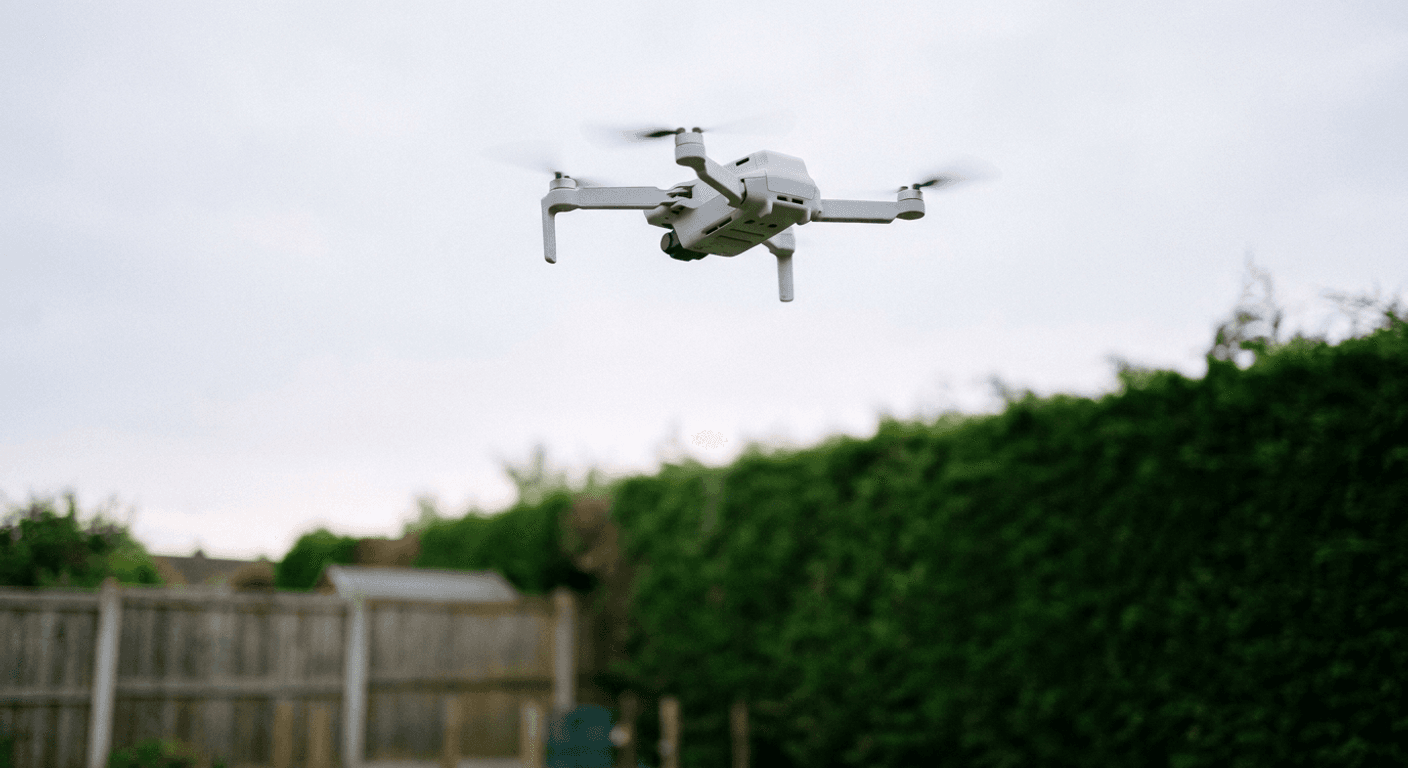
Georgia has no drone-specific civilian privacy statute. A drone operator who films into your bedroom window or lingers over your backyard is prosecuted the same way a Peeping Tom with a handheld camera would be, under Georgia's general invasion-of-privacy law, while a separate statute makes drone-delivered prison contraband a felony.
This page covers how Georgia's general privacy, trespass, local-preemption, ticketed-event, prison, and hunting laws apply to drones, plus the federal ban on shooting one down. It does not cover FAA flight-operation rules like registration or Remote ID, which apply the same way nationwide. For camera-based surveillance generally, see Recording Law's surveillance camera laws guide; for how other states handle drones, see the Drone Laws hub.
Who regulates drones in Georgia: the federal and state split
The FAA owns Georgia's airspace itself: altitude, registration, commercial pilot certification under 14 CFR Part 107, and Remote ID broadcast. A federal district court made that clear in Singer v. City of Newton, 284 F. Supp. 3d 125 (D. Mass. 2017), striking down a city's attempt to impose its own altitude and registration rules. States and their subdivisions retain authority over conduct instead: what a drone operator records, and where a drone may not go near people, prisons, or protected land. Georgia's answer to the conduct question is thinner than states like Florida or Texas that wrote dedicated drone-privacy statutes; Georgia largely routes drone disputes through general laws not written with drones in mind, a choice the Fifth Circuit's decision upholding Texas's drone statute in National Press Photographers Ass'n v. McCraw, 90 F.4th 770 (5th Cir. 2024), shows the legislature is free to revisit.

Can someone fly a drone over your property in Georgia and film you?
Georgia has no statute that mentions drones by name in this context. Instead, a drone operator who captures video of a person in a place where they have a reasonable expectation of privacy falls under O.C.G.A. § 16-11-62, Georgia's eavesdropping, surveillance, and invasion-of-privacy statute. That law makes it unlawful to go on or about the premises of another, or any private place, for the purpose of secretly observing or recording someone's activities, and separately bars using a camera to observe, photograph, or record another person's activities in a private place without the consent of everyone observed. Georgia courts have treated the video-recording clause as requiring consent from everyone shown, which is a stricter rule than the one-party consent standard that governs an audio recording of a conversation under the same statute.
A violation is a felony, punishable by one to five years in prison, a fine of up to $10,000, or both. Distributing a photograph, video, or recording of another person's private activities without consent is separately unlawful under the same statute. Because § 16-11-62 was not written with aerial cameras in mind, it does not have Florida-style presumptions about ground-level observability; a plaintiff or prosecutor instead has to show the location was genuinely a "private place" and that the recording captured private activity, the same showing required for a ground-based hidden camera.
Launching or landing a drone on someone else's property without consent is separately treated as ordinary trespass under Georgia's general trespass law, not as a drone-specific offense. A drone that merely transits over private land at altitude, without landing and without recording anyone's private activity, generally does not violate either statute.
Does Georgia let cities and counties pass their own drone rules?
No, with narrow exceptions. O.C.G.A. § 6-1-4(b), enacted by House Bill 481 in 2017, provides that any ordinance, resolution, regulation, or policy of a local government entity regulating the testing or operation of unmanned aircraft systems is preempted and is null, void, and of no force and effect. Three carve-outs survive. A local government may enforce an ordinance it adopted on or before April 1, 2017; it may adopt an ordinance that enforces Federal Aviation Administration restrictions; and it may adopt an ordinance providing for or prohibiting the launch or intentional landing of a drone from or on its own public property, except as to drones operated for commercial purposes. Outside those three, a county or city cannot write its own privacy, no-fly, or licensing rules for drones. Subsection (c) gives the state the same launch-and-landing authority over its own public property.
Can you fly a drone near a stadium, concert, or festival in Georgia?
Usually not. The same Code section that preempts local rules also creates one of Georgia's few general-application drone crimes. O.C.G.A. § 6-1-4(d)(1) makes it unlawful to operate an unmanned aircraft system within 400 feet of or above a ticketed entertainment event. A person who violates it is guilty of the unauthorized operation of an unmanned aircraft system and is punished as for a misdemeanor.
The statute defines a "ticketed entertainment event" as any music, sporting, or performing arts event held in a location with gated entries or barriers that prevent access to the general public, and for which a revocable license issued by the owner, operator, or lessee of the property is required for attendance. That definition captures a stadium game, a fenced-in music festival, and a ticketed theater performance. It does not reach a free, open-access public event in a park.
Five exceptions appear in subsection (d)(3). The prohibition does not apply to an operator who has obtained consent from any person with legal authority over the ticketed entertainment event; who is authorized by federal regulations to operate an unmanned aircraft system and is operating it in a lawful manner consistent with those regulations; who is an employee of the property where the event is held and is conducting official business; who is an employee of a water, sewer, electrical, telephone, cable, or other regulated utility service provider conducting official business within the scope of that employment; or who is a private property owner operating a drone he or she owns above that property, provided the flight is consistent with federal regulations and is not used for commercial purposes, to convey or communicate a message, or to record for purposes of commercial broadcasting or publication, monitor, or otherwise interfere in any way with the event.
Georgia treats the offense seriously enough to fingerprint the people charged with it. In an official opinion issued March 24, 2026, the Attorney General designated misdemeanor offenses arising under O.C.G.A. § 6-1-4(d) as offenses for which those charged are to be fingerprinted.
Does police need a warrant to fly a drone over your property in Georgia?
Georgia has not enacted a statute specifically requiring a warrant before a law enforcement agency uses a drone. That puts Georgia in the larger group of states where drone surveillance by police is governed by ordinary Fourth Amendment case law rather than a dedicated statutory floor: officers generally need a warrant to conduct a search where a person has a reasonable expectation of privacy, subject to the usual exceptions for exigent circumstances, plain view, and consent, but no Georgia statute sets drone-specific rules, deadlines for data deletion, or reporting requirements the way roughly a dozen other states now do.
Drones, Georgia prisons, and the federal authority gap
O.C.G.A. § 42-5-18 makes it a felony to intentionally photograph or record a "place of incarceration" using a drone for the purpose of committing a criminal offense, punishable by five to ten years in prison. A person may secure the warden's or superintendent's prior authorization to document a noncriminal purpose, but the statute expressly provides that failing to secure that authorization is not itself evidence of criminal intent. Using a drone to deliver or attempt to deliver contraband into a Georgia prison, jail, or detention facility is a separate felony under the same statute, punishable by one to ten years in prison. The Georgia Department of Corrections has documented an average of roughly 58 drone incidents a month at its facilities in recent reporting, part of a wave of drone-based contraband smuggling that led to "Operation Skyhawk," a 2024 joint state-federal investigation that resulted in about 150 arrests and the seizure of 87 drones along with drugs, cell phones, and weapons.
The felony penalty under § 42-5-18 addresses what happens after a drone drops contraband, but it does not let corrections officers disable a drone before it reaches the yard. In March 2026, Attorney General Chris Carr joined 20 other state attorneys general in formally asking the Trump administration to grant state and local law enforcement expanded authority to detect and disable unauthorized drones, noting that only a narrow set of federal agencies currently hold that authority. That gap mirrors the federal shoot-down rule discussed below: authority over the airspace, including the power to disable something flying in it, remains a federal question even when the underlying conduct on the ground is squarely a state crime.
Drones and hunting in Georgia
O.C.G.A. § 27-3-12(a) makes it unlawful to use electronic communications equipment for the purpose of facilitating pursuit of any wild animal, game bird, or game animal. The subsection does not name drones, but the category is written broadly enough to cover using one to spot, track, or steer a hunter toward game.
Georgia has no drone-specific hunter-harassment statute either. O.C.G.A. § 27-3-151, enacted in 1986, is the state's general hunter-harassment law, and its text contains no reference to drones or unmanned aircraft. It makes it unlawful to interfere with the lawful taking of wildlife by intentionally preventing or attempting to prevent another person from taking it, to disturb wildlife or engage in activity tending to disturb wildlife for that purpose, or to refuse a law enforcement officer's order to stop such conduct. Because the prohibition is written around the conduct rather than the tool, it reaches interference carried out with a drone the same way it reaches interference carried out on foot. The statute does not apply to law enforcement officers or Department of Natural Resources employees performing their duties.
Georgia carved out a narrow exception in 2026: House Bill 946, signed by Governor Brian Kemp, permits using a drone to locate, but not harvest, feral hogs on private land in response to roughly $150 million in annual crop damage.
Can you legally shoot down a drone over your Georgia property?
No. Federal law makes it a serious felony to shoot down, disable, or otherwise damage any drone, anywhere, including over the shooter's own property, because the FAA controls the national airspace rather than the landowner below it. 18 U.S.C. § 32, the Aircraft Sabotage Act, criminalizes willfully damaging or destroying an "aircraft," a category the FAA has treated drones as falling into since 2012, and a conviction carries up to 20 years in federal prison. Publicized incidents where local prosecutors dropped state charges after a neighbor shot down a drone are not evidence of a legal right to do so; no state, including Georgia, authorizes a property owner to disable a drone, and self-help remains legally risky.
This article provides general legal information about Georgia's drone-related laws as of mid-2026. It is not legal advice. For a specific dispute, consult a Georgia attorney or the appropriate law enforcement agency.
More Georgia Laws
- Georgia Data Privacy Laws
- Georgia GPS Tracking Laws
- Georgia Police Bodycam Laws
- Georgia Recording Laws
- Georgia Smart Glasses Recording Laws
Frequently Asked Questions
Does Georgia have a law specifically about drones spying on you?
No. Georgia has not enacted a drone-specific civilian privacy statute. A drone operator who records someone in a place where they have a reasonable expectation of privacy is instead prosecuted under O.C.G.A. § 16-11-62, Georgia's general eavesdropping and invasion-of-privacy law, which is a felony.
Can my city or county in Georgia pass its own drone ordinance?
Generally no. O.C.G.A. § 6-1-4(b) preempts local regulation of the testing or operation of drones statewide. A local government may still enforce an ordinance it adopted on or before April 1, 2017, adopt an ordinance enforcing FAA restrictions, or regulate the launch and intentional landing of drones on its own public property, except as to commercial operations.
Can you fly a drone over a concert or stadium in Georgia?
Not without an exception. O.C.G.A. § 6-1-4(d) makes it a misdemeanor to operate a drone within 400 feet of or above a ticketed entertainment event, meaning a music, sporting, or performing arts event held behind gates or barriers that require a ticket for entry. Five exceptions apply: consent from someone with legal authority over the event, operation authorized by and consistent with federal regulations, an on-site employee of the venue on official business, a regulated utility employee on official business, and a private property owner flying his or her own drone noncommercially above that property without interfering with the event.
Does Georgia police need a warrant to fly a drone over my property?
Georgia has no statute specifically requiring one. Law enforcement drone use is governed by ordinary Fourth Amendment case law, the same baseline that applies in most states that have not passed a dedicated drone-warrant statute.
What happens if you fly a drone over a Georgia prison?
Intentionally photographing or recording a place of incarceration by drone for the purpose of committing a criminal offense is a felony under O.C.G.A. § 42-5-18, punishable by five to ten years in prison; failing to get the warden's prior authorization is not by itself evidence of criminal intent. Using a drone to deliver contraband into the facility is a separate felony punishable by one to ten years in prison.
Can I use a drone to help me hunt in Georgia?
No, with one narrow exception. O.C.G.A. § 27-3-12 makes it unlawful to use electronic communications equipment to facilitate pursuit of game, which covers using a drone to spot or track game for a hunter. Georgia's general hunter-harassment law, O.C.G.A. § 27-3-151, does not mention drones anywhere in its text but reaches interference with another person's lawful taking of wildlife however it is done, including by drone. A 2026 law, HB 946, allows drones to locate, but not harvest, feral hogs on private land.
Can I shoot down a drone flying over my house in Georgia?
No. Shooting down any drone is a federal felony under 18 U.S.C. § 32 no matter whose property it is over, because federal law controls the national airspace. Georgia state charges, such as criminal mischief or discharging a firearm, can also apply.
Updates
Added Georgia’s 400-foot no-fly rule for ticketed concerts, games, and festivals under O.C.G.A. § 6-1-4(d) and its five exceptions, and corrected the hunting section to explain that Georgia’s hunter-harassment and pursuit statutes reach drones through general conduct language rather than any drone-specific statutory text.
Updated the NPPA v. McCraw citation to the controlling January 2024 Fifth Circuit opinion.
Independently fact-checked against the cited primary sources; governing law re-checked for recent changes
Corrected O.C.G.A. Section 42-5-18: unauthorized drone photography of a Georgia prison for a criminal purpose is a felony (five to ten years), not a misdemeanor, and the statute requires that criminal-purpose element rather than treating a missing warden authorization alone as the violation.
Governing law re-checked for recent changes
Reviewed and approved by an editor
The Law Behind This Article
This article rests on the statutory provisions below, held in our own legal record and retrieved from the official source. Tap a section to read the operative text.
Official Code of Georgia Annotated
§ 6-1-4Unmanned aircraft system defined; preemption for unmanned aircraft systems; operations.In force
(a) As used in this Code section, the term: (1) 'Ticketed entertainment event' means any music, sporting, or performing arts event held in a location with gated entries or barriers that prevent access to the general public and in which a revocable license that has been issued by an owner, opera
Official text (excerpt) · last checked 2026-08-31 · Read the full text in our law library · Verify at legis.ga.gov
§ 16-11-62Eavesdropping, surveillance, or intercepting communication which invades privacy of another; divulging private message.In forcecited in 25 of our articles
It shall be unlawful for: (1) Any person in a clandestine manner intentionally to overhear, transmit, or record or attempt to overhear, transmit, or record the private conversation of another which shall originate in any private place; (2) Any person, through the use of any device, without the
Official text (excerpt) · last checked 2026-08-31 · Read the full text in our law library · Verify at legis.ga.gov
Cited in 94 court opinions in our collectionLatest citing opinion in our collection: 2026
In the courts (editorial summary, independently checked):Kelley v. State (1998) held OCGA 16-11-62(2) reached a guardian who photographed a nude 16-year-old in the family bathroom, with no exception for family members. Burgeson v. State (1996) held a conversation recorded in a patrol car was not covered, because no reasonable expectation of privacy existed there.
Opinions citing this section in our collection:
- Burgeson v. State (Supreme Court of Georgia 1996, 267 Ga. 102)✓Police secretly recorded two arrestees talking in the back of a patrol car. The court held a police car is much like a jail cell, with no reasonable expectation of privacy, so intercepting that conversation did not offend OCGA 16-11-62 and the tape was admissible.
- Kelley v. State (Court of Appeals of Georgia 1998, 233 Ga. App. 244)✓A guardian photographed her 16-year-old niece nude and passed out in the family bathtub. The court held OCGA 16-11-62(2) reaches any person with no family exception, that the film need not be developed, and that a jury could find the bathroom a private place.
- Dobbins v. State (Supreme Court of Georgia 1992, 262 Ga. 161)“…th the consent of one of the parties to the conversation. OCGA § 16-11-62 (1) provides that: It shall be unlawf…”
Identified automatically from the court opinions citing this section — not a ranking of which case controls.
Also relied on in: Georgia Data Privacy Laws: Breach Notification & Consumer Rights (2026), Georgia Ring Doorbell Laws: What You Need to Know in 2026, Georgia Surveillance Camera Laws (2026 Guide)
§ 42-5-18Items prohibited for possession by inmates; warden's authorization; penalty; use of unmanned aircraft to accomplish violations.In force
(a) As used in this Code section, the term: (1) 'Inmate' means a prisoner, detainee, criminal suspect, immigration detainee, or other person held, incarcerated, or detained in a place of incarceration, whether or not such person is inside or outside of such place of incarceration. (2) 'Place
Official text (excerpt) · last checked 2026-08-04 · Read the full text in our law library · Verify at legis.ga.gov
Cited in 18 court opinions in our collectionLatest citing opinion in our collection: 2026
Opinions citing this section in our collection:
- Jonathan Henry v. State (Court of Appeals of Georgia 2025)“…s convicted of five counts of furnishing prohibited items (OCGA § 42-5-18 (b)), and one count of possession of t…”
- State v. Tonya Newberry (Court of Appeals of Georgia 2023)“…amine, marijuana, and tobacco to an inmate in violation of OCGA § 42-5-18 (b)1 and (b.1),2 and for crossing the…”
- Maria Terrell v. State (Court of Appeals of Georgia 2020)“…or three counts of furnishing prohibited items to inmates (OCGA § 42-5-18), Maria Terrell argues that the evidenc…”
Identified automatically from the court opinions citing this section — not a ranking of which case controls.
§ 27-3-12Unlawful substances and equipment; computer assisted remote hunting prohibited.In force
(a) It shall be unlawful to hunt any wild animal, game animal, or game bird by means of drugs, poisons, chemicals, smoke, gas, explosives, or recorded calls or sounds including, but not limited to, electronically imitated or amplified calls or sounds, except that bobcat and fox may be hunted u
Official text (excerpt) · last checked 2026-08-04 · Read the full text in our law library · Verify at legis.ga.gov
§ 27-3-151Activity prohibited.In force
(a) It shall be unlawful for any person to: (1) Interfere with the lawful taking of wildlife by another person by intentionally preventing or attempting to prevent such person from such lawful taking of wildlife; (2) Disturb or engage in activity tending to disturb wildlife for the purpose of…
Official text (excerpt) · last checked 2021-08-17 · Read the full text in our law library
United States Code Title 18
§ 32Destruction of aircraft or aircraft facilitiesIn forcecited in 51 of our articles
Whoever willfully— sets fire to, damages, destroys, disables, or wrecks any aircraft in the special aircraft jurisdiction of the United States or any civil aircraft used, operated, or employed in interstate, overseas, or foreign air commerce; places or causes to be placed a destructive device or substance in, upon, or in proximity to, or otherwise makes or causes to be made unworkable or unusable or hazardous to work or use, any such aircraft, or any part or other materials used or intended to be used in connection with the operation of such aircraft, if such placing or causing to be placed or such making or causing to be made is likely to endanger the safety of any such aircraft; sets fire to, damages, destroys, or disables any air navigation facility, or interferes by force or violence with the operation of such facility, if such fire, damaging, destroying, disabling, or interfering is likely to endanger the safety of any such aircraft in flight; with the intent to damage, destroy, or disable any such aircraft, sets fire to, damages, destroys, or disables or places a destructive device or substance in, upon, or in proximity to, any appliance or structure, ramp, landing area,…
Official text (excerpt) · last checked 2026-07-28 · Read the full text in our law library · Verify at uscode.house.gov
Cited in 168 court opinions in our collectionLatest citing opinion in our collection: 2026
In the courts (editorial summary, independently checked):United States v. Yousef (2003) applied 18 U.S.C. 32 to an overseas airline bombing plot, holding Section 32(a) reaches conduct abroad because US-flag aircraft in flight are within the special aircraft jurisdiction, and that a defendant brought here involuntarily is still found in the United States under Section 32(b).
Opinions citing this section in our collection:
- Perez v. United States (Supreme Court of the United States 1971, 402 U.S. 146)“…commerce, as, for example, the destruction of an aircraft ( 18 U. S. C. § 32 ), or persons or things in commerce, as…”
- Stanford v. Kentucky (Supreme Court of the United States 1989, 492 U.S. 361)“…r by persons subject to Uniform Code of Military Justice); 18 U. S. C. §§ 32 , 33, and 34 (1982 ed. and Supp. V) (de…”
- United States v. Yousef (Court of Appeals for the Second Circuit 2003, 327 F.3d 56)✓Yousef bombed a Philippine airliner and plotted to bomb twelve US flag airliners on Asian routes; the court held Section 32(a) reaches attacks on US flag aircraft worldwide, and that Yousef, brought here involuntarily, was found in the United States under Section 32(b).
Identified automatically from the court opinions citing this section — not a ranking of which case controls.
Also relied on in: Indiana Drone Laws (2026): Police Warrants, Voyeurism, Hunting, Iowa Drone Laws: Homestead, Farmstead & Warrant Rules, Kansas Drone Laws: Stalking Act & Privacy Rules Explained
United States Code Title 49
§ 44809Exception for limited recreational operations of unmanned aircraftIn forcecited in 13 of our articles
Except as provided in subsection (e), and notwithstanding chapter 447 of title 49, United States Code, a person may operate a small unmanned aircraft without specific certification or operating authority from the Federal Aviation Administration if the operation adheres to all of the following limitations: The aircraft is flown strictly for recreational purposes. The aircraft is operated in accordance with or within the programming of a community-based organization’s set of safety guidelines that are developed in coordination with the Federal Aviation Administration. The aircraft is flown within the visual line of sight of the person operating the aircraft or a visual observer co-located and in direct communication with the operator. The aircraft is operated in a manner that does not interfere with and gives way to any manned aircraft. In Class B, Class C, or Class D airspace or within the lateral boundaries of the surface area of Class E airspace designated for an airport, the operator obtains prior authorization from the Administrator or designee before operating and complies with all airspace restrictions and prohibitions.
Official text (excerpt) · last checked 2026-07-28 · Read the full text in our law library · Verify at uscode.house.gov
Cited in 1 court opinions in our collectionLatest citing opinion in our collection: 2022
Opinions citing this section in our collection:
- Tyler Brennan v. Stephen Dickson (Court of Appeals for the D.C. Circuit 2022, 45 F.4th 48)“…Reauthorization Act, § 349(a), (b), (f), 132 Stat. at 3297; 49 U.S.C. § 44809(f); see Final Rule, 86 Fed. Reg. at 440…”
Identified automatically from the court opinions citing this section — not a ranking of which case controls.
Also relied on in: Illinois Drone Laws (2026): Police Warrants, Privacy, and Hunting, Florida Drone Laws 2026: Privacy, Warrants & Penalties, Idaho Drone Laws (2026): Privacy, Police Warrants, and Hunting Rules
Search our full record of US law — 2.1 million sections, every state + federal →
Sources and References
- O.C.G.A. § 6-1-4, Unmanned aircraft system defined; preemption for unmanned aircraft systems; operations (enacted by 2017 HB 481)(legis.ga.gov).gov
- Georgia Department of Corrections, Contraband Arrests at GDC Facilities (drone-delivered contraband, felony under O.C.G.A. § 42-5-18)(gdc.georgia.gov).gov
- Office of the Georgia Attorney General, "Carr Pushes for State, Local Authority to Combat Illegal Drone Drops at Prisons" (March 30, 2026)(law.georgia.gov).gov
- Reporters Committee for Freedom of the Press, Georgia recording law guide (O.C.G.A. § 16-11-62 eavesdropping and invasion of privacy)(rcfp.org)
- NBC News, "150 arrested in bust of Georgia prison smuggling ring using drones"(nbcnews.com)
- 18 U.S.C. § 32, Destruction of aircraft or aircraft facilities (federal shoot-down prohibition)(law.cornell.edu)
- Singer v. City of Newton, 284 F. Supp. 3d 125 (D. Mass. 2017)(leagle.com)
- Georgia Attorney General, Official Opinion 2026-2 (March 24, 2026), designating misdemeanor offenses under O.C.G.A. § 6-1-4(d), unauthorized operation of an unmanned aircraft system within 400 feet of or above a ticketed entertainment event, as offenses for which those charged are fingerprinted(law.georgia.gov).gov