
California
California Drone Laws (2026): Privacy, Fires & Shoot-Down Rules
Independently fact-checked against primary sources (last audited August 17, 2026). · Reviewed by the RecordingLaw editorial team. · Law checked current as of August 17, 2026. · 4 primary sources cited on this page. How we verify our legal content
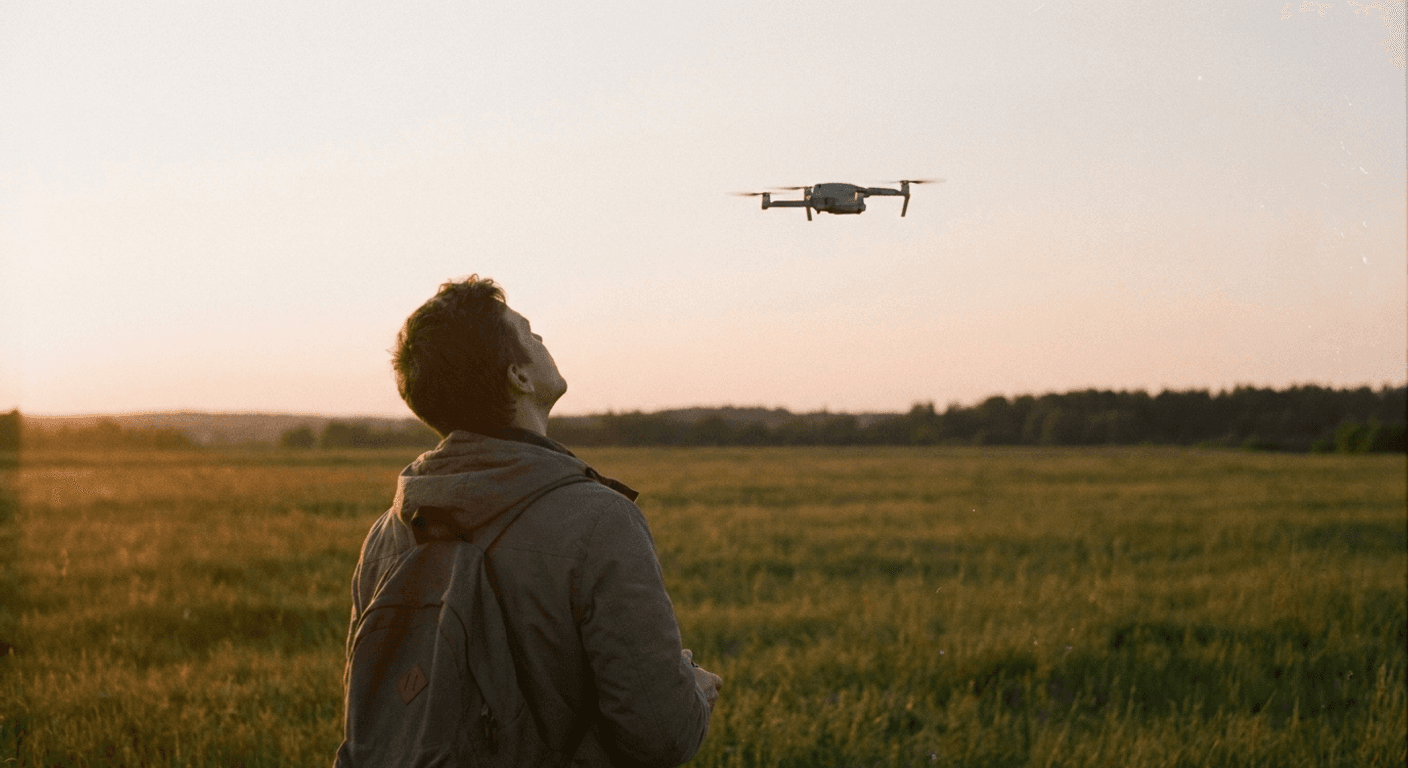
California does not regulate drone airspace, the FAA does that nationally, but it has one of the country's most litigated drone privacy statutes: Civil Code Section 1708.8, the anti-paparazzi law, which lets a person sue over a drone flown into the airspace above their land to capture a private moment.
This guide is part of our Drone Laws by State series, which also covers how state law intersects with surveillance camera laws more broadly.
Jurisdiction scope: This article addresses California state law on private drone surveillance, emergency-scene interference, and the federal baseline that applies in every state. It does not address a civilian's right to record police, which is covered separately in our guide to recording laws.
Does the FAA or California control where a drone can fly?
The Federal Aviation Administration is the exclusive regulator of the airspace itself. Under 14 CFR Part 107, a commercial or non-recreational drone operator must hold a Remote Pilot Certificate, register the aircraft, fly at or below 400 feet, and stay within visual line of sight; recreational flyers register and follow a similar, separate framework under 49 U.S.C. Section 44809. A California city or county cannot add its own drone-registration requirement or operating restrictions that conflict with that federal scheme; in Singer v. City of Newton, 284 F. Supp. 3d 125 (D. Mass. 2017), a federal district court held preempted a Massachusetts city's drone-registration requirement, its ban on flights below 400 feet over private property without the owner's permission, its visual-line-of-sight rule, and its ban on flights over city property without permission. What California can and does regulate is conduct: what a person does with a drone-mounted camera once it is airborne over California soil.

California's anti-paparazzi statute: Civil Code Section 1708.8
California's core drone privacy law is not a criminal statute at all. Civil Code Section 1708.8 creates civil liability for what it calls a physical invasion of privacy: a person is liable if they knowingly enter onto the land, or into the airspace above the land, of another person without permission, to capture a visual image, sound recording, or other physical impression of someone engaging in a private, personal, or familial activity, in a manner offensive to a reasonable person, according to the California Legislative Information site. Critically, the statute does not require the operator to physically cross the property line at ground level. Flying a drone up into the vertical column of airspace above someone's backyard to photograph them can itself satisfy the trespass element. A related "constructive invasion" provision reaches the same conduct even without a technical trespass, if the image could not have been captured without one but for the device used.
The airspace language was added by Assembly Bill 856, approved by the governor on October 6, 2015, and effective January 1, 2016. News coverage at the time tied the amendment directly to a wave of celebrity complaints about paparazzi drones, most visibly after Miley Cyrus posted an Instagram video in 2014 of a drone hovering over her backyard captioned "Drone Pap wtf," a moment reporters and legal commentators repeatedly cited as a catalyst for the bill.
The remedies split into two tracks, and it is worth keeping them apart. Under subdivision (d), a private plaintiff who wins can recover up to three times their general and special damages, punitive damages subject to the usual proof standard, and disgorgement of any profit if the images were captured for a commercial purpose. The statute also sets a civil fine of not less than $5,000 and not more than $50,000, but that fine is not part of a private recovery: subdivision (m) provides that a proceeding to collect it may be brought only by a county counsel or city attorney, and directs that one-half go to the prosecuting agency and one-half to the Arts and Entertainment Fund in the State Treasury. For a drone operator, the fine is real exposure in a public enforcement action; for a homeowner suing over a drone, it is not money they should expect to see.
Drones at emergency scenes and the firefighting problem
California treats a drone flown into an active emergency scene as its own category of problem, separate from privacy. Penal Code Section 402 makes it a misdemeanor to go to the scene of an emergency in a way that impedes police officers, firefighters, or emergency medical personnel; a 2016 amendment, Assembly Bill 1680, added language specifically covering "a person, regardless of his or her location, who operates or uses an unmanned aerial vehicle, remote piloted aircraft, or drone that is at the scene of an emergency," according to the California Legislative Information site. Cal Fire has enforced this aggressively during wildfire season, since even a single unauthorized drone incursion into a fire's airspace can force firefighting aircraft to ground themselves for safety.
California backs that rule up with an immunity provision. Government Code Section 853, added by Senate Bill 807 and effective January 1, 2017, protects a local public entity or its employees from civil liability for damage to a drone if that damage occurred while the entity was providing emergency medical, firefighting, or search-and-rescue services and the drone was interfering with that work, according to the California Legislative Information site. In practice, that means a firefighter or paramedic who disables a drone blocking an active rescue is shielded from a lawsuit by the drone's owner, a narrower and more specific carve-out than the general prohibitions on shooting at a drone described below.
Does police need a warrant to fly a drone over my property in California?
California has no standalone statute requiring a warrant before every police drone flight, unlike states such as Illinois or Minnesota. A California resident's claim that police unlawfully surveilled them by drone instead rests on ordinary Fourth Amendment analysis, together with California's own state constitutional right to privacy under Article I, Section 1. The U.S. Supreme Court has held that aerial observation of a yard from public airspace by a manned aircraft, without a warrant, generally does not violate the Fourth Amendment. See California v. Ciraolo, 476 U.S. 207 (1986) (fixed-wing flyover of a fenced backyard at 1,000 feet); Florida v. Riley, 488 U.S. 445 (1989) (helicopter at 400 feet). Neither case involved a drone, and no California appellate decision has squarely extended that reasoning to a small drone hovering much closer to a home.
Shooting down a drone: California Penal Code Section 247 and the federal rule
A persistent misconception is that a landowner may legally shoot down a drone hovering over their own property. Do not do it. Two separate bodies of law are in play, and the California one is the more certain of the two.
Start with state law, because it is the clearer hook. California Penal Code Section 247(a) provides that any person who willfully and maliciously discharges a firearm at an unoccupied aircraft is guilty of a felony, according to the California Legislative Information site. There is no interstate-commerce element to argue over and no need to reach federal law at all: firing a gun at a drone in California is charged as a felony under state law.
Federal law is the second exposure, and it is serious but less settled than it is usually described. The FAA classifies drones as aircraft within the National Airspace System, and the federal government's position is that 18 U.S.C. Section 32, the aircraft sabotage statute, therefore reaches them; willfully damaging, destroying, or disabling a covered aircraft carries up to 20 years in prison. That statute is not unqualified, though. Section 32(a)(1) reaches an aircraft in the special aircraft jurisdiction of the United States, or a civil aircraft used, operated, or employed in interstate, overseas, or foreign air commerce. Whether a small recreational drone that never leaves one state, hovering over a single backyard, satisfies either element has never been decided by a court. Treat federal charges as a real and untested risk rather than a settled certainty, and note that the state felony above does not depend on the answer.
The widely publicized 2015 "Kentucky Drone Slayer" case, in which a Hillview, Kentucky, man shot down a neighbor's drone and had state criminal-mischief charges dismissed by a local judge, is often cited as evidence that shooting down a drone is low-risk. It is not. The drone owner's related federal civil suit, Boggs v. Merideth, was dismissed in 2017 for lack of federal jurisdiction without any court ever ruling on whether the shoot-down itself was lawful, and no state, including California, has passed a law authorizing a landowner to disable a drone over their own property; California's Government Code Section 853 immunity described above applies only to public emergency responders, not to private landowners.
More California Laws
- California Data Privacy Laws
- California GPS Tracking Laws
- California Police Bodycam Laws
- California Recording Laws
- California Smart Glasses Recording Laws
Frequently Asked Questions
Is it illegal to fly a drone over someone's backyard in California?
It can be. California Civil Code Section 1708.8 makes it a civil wrong to knowingly enter the airspace above someone's land with a drone, without permission, to capture a private, personal, or familial activity in an offensive way, even if the drone never crosses the property line at ground level.
Can I sue a neighbor or paparazzi photographer for using a drone to spy on me in California?
Yes. Civil Code Section 1708.8 allows a lawsuit for physical invasion of privacy, and a winning plaintiff can recover up to three times their general and special damages, punitive damages, and disgorgement of any commercial profit. The statute's $5,000 to $50,000 civil fine is separate and does not go to you: subdivision (m) lets only a county counsel or city attorney bring a proceeding to collect it, and splits the money between the prosecuting agency and a state Arts and Entertainment Fund.
Why does California's drone privacy law mention paparazzi?
The airspace provisions were added to Civil Code Section 1708.8 by Assembly Bill 856 in 2015, after high-profile complaints from celebrities including Miley Cyrus about drones photographing them at home, which lawmakers and news coverage cited as the impetus for the amendment.
Is it illegal to fly a drone near a wildfire in California?
Yes. Penal Code Section 402 makes it a misdemeanor to operate a drone at the scene of an emergency, including a wildfire, in a way that impedes firefighters or other emergency personnel, and Cal Fire actively enforces this because an unauthorized drone can ground firefighting aircraft.
Can I legally shoot down a drone flying over my property in California?
No. California Penal Code Section 247(a) makes it a felony to willfully and maliciously discharge a firearm at an unoccupied aircraft, which is the most direct charge a California shooter faces. The federal government also treats destroying a drone as a violation of 18 U.S.C. Section 32, the aircraft sabotage statute, carrying up to 20 years, though that statute's jurisdictional element has never been tested in court against a purely local recreational drone. California's Government Code Section 853 immunity for damaging an interfering drone applies only to public emergency responders, not private landowners.
Does California require police to get a warrant before flying a drone over my property?
California has no standalone statute requiring a warrant for every police drone flight. Disputes generally fall back on ordinary Fourth Amendment analysis and California's state constitutional privacy right under Article I, Section 1 of the California Constitution.
What is the current citation for California's anti-paparazzi drone law?
California Civil Code Section 1708.8, as amended by Assembly Bill 856 (2015), effective January 1, 2016. The statute is officially titled a provision on physical and constructive invasion of privacy and is available on the California Legislative Information website.
Updates
Corrected the description of Singer v. City of Newton to the four Newton, Massachusetts ordinance provisions the court actually held preempted.
Corrected who collects the $5,000 to $50,000 civil fine under Civil Code 1708.8 (a city attorney or county counsel, not the private plaintiff), restated the federal shoot-down felony as an untested application of 18 U.S.C. 32 while adding California Penal Code 247(a), and fixed a mislabeled link to the California recording laws page.
Independently fact-checked against the cited primary sources; governing law re-checked for recent changes
Governing law re-checked for recent changes
Reviewed and approved by an editor
The Law Behind This Article
This article rests on the statutory provisions below, held in our own legal record and retrieved from the official source. Tap a section to read the operative text.
California Civil Code
§ 1708.8In forcecited in 9 of our articles
(a) A person is liable for physical invasion of privacy when the person knowingly enters onto the land or into the airspace above the land of another person without permission or otherwise commits a trespass in order to capture any type of visual image, sound recording, or other physical impression of the plaintiff engaging in a private, personal, or familial activity and the invasion occurs in a manner that is offensive to a reasonable person. (b) A person is liable for constructive invasion of privacy when the person attempts to capture, in a manner that is offensive to a reasonable person, any type of visual image, sound recording, or other physical impression of the plaintiff engaging in a private, personal, or familial activity, through the use of any device, regardless of whether there is a physical trespass, if this image, sound recording, or other physical impression could not have been achieved without a trespass unless the device was used. (c) An assault or false imprisonment committed with the intent to capture any type of visual image, sound recording, or other physical impression of the plaintiff is subject to subdivisions (d), (e), and (h).
Official text (excerpt) · last checked 2026-08-31 · Read the full text in our law library · Verify at leginfo.legislature.ca.gov
Cited in 17 court opinions in our collectionLatest citing opinion in our collection: 2026
In the courts (editorial summary, independently checked):Richardson-Tunnell v. Schools Insurance Program for Employees (2007) held Section 1708.8 creates no exception to Government Code 821.6 immunity for a public entity's investigatory surveillance. Simmons v. Bauer Media Group USA, LLC (2020) let a 1708.8(b) claim over a hidden tracker past an anti-SLAPP motion without reaching its elements.
Opinions citing this section in our collection:
- Hernandez v. Hillsides, Inc. (California Supreme Court 2009, 47 Cal. 4th 272)“…provisions is on the “intent to capture” a “visual image” (Civ. Code, § 1708.8, subd. (a)), or on the “attempt” to do…”
- Richardson-Tunnell v. Schools Insurance Program for Employees (California Court of Appeal 2007, 69 Cal. Rptr. 3d 176)✓Workers' compensation investigators secretly videotaped an injured teacher at her wedding and honeymoon; the court held Civil Code section 1708.8 creates no exception to the investigatory immunity of Government Code section 821.6, so her claim against the public entities failed.
- Raef v. Appellate Division of the Superior Court (California Court of Appeal 2015, 240 Cal. App. 4th 1112)“…Erwin Chemerinsky explained in relation to another statute (Civ. Code, § 1708.8, which, too, forms part of what is popu…”
Identified automatically from the court opinions citing this section — not a ranking of which case controls.
Also relied on in: California Security Camera and Surveillance Laws: Rules for Home and Business (2026), California Video Recording Laws: Filming, Surveillance, and Consent (2026), California Voyeurism and Hidden Camera Laws: Penalties and Protections (2026)
California Penal Code
§ 402In force
(a) (1) Every person who goes to the scene of an emergency, or stops at the scene of an emergency, for the purpose of viewing the scene or the activities of police officers, firefighters, emergency medical, or other emergency personnel, or military personnel coping with the emergency in the course of their duties during the time it is necessary for emergency vehicles or those personnel to be at the scene of the emergency or to be moving to or from the scene of the emergency for the purpose of protecting lives or property, unless it is part of the duties of that person’s employment to view that scene or those activities, and thereby impedes police officers, firefighters, emergency medical, or other emergency personnel or military personnel, in the performance of their duties in coping with the emergency, is guilty of a misdemeanor. (2) For purposes of this subdivision, a person shall include a person, regardless of his or her location, who operates or uses an unmanned aerial vehicle, remote piloted aircraft, or drone that is at the scene of an emergency.
Official text (excerpt) · last checked 2026-07-28 · Read the full text in our law library · Verify at leginfo.legislature.ca.gov
§ 247In force
(a) Any person who willfully and maliciously discharges a firearm at an unoccupied aircraft is guilty of a felony. (b) Any person who discharges a firearm at an unoccupied motor vehicle or an uninhabited building or dwelling house is guilty of a public offense punishable by imprisonment in the county jail for not more than one year or in the state prison. This subdivision does not apply to shooting at an abandoned vehicle, unoccupied vehicle, uninhabited building, or dwelling house with the permission of the owner. As used in this section and Section 246 “aircraft” means any contrivance intended for and capable of transporting persons through the airspace.
Official text (excerpt) · last checked 2026-07-28 · Read the full text in our law library · Verify at leginfo.legislature.ca.gov
Cited in 14 court opinions in our collectionLatest citing opinion in our collection: 2024
Opinions citing this section in our collection:
- Nguyen v. PROTON TECHNOLOGY CORP. (California Court of Appeal 1999, 81 Cal. Rptr. 2d 392)“…95, pled guilty to shooting a gun at an unoccupied vehicle (Pen. Code, § 247, subd. (b)) and vandalism (Pen. Code, §…”
- People v. White (California Court of Appeal 1992, 4 Cal. App. 4th 1299)“…the facts of the particular violation. (1c) We note that Penal Code section 247 makes punishable as a misdemeanor the…”
- People v. Mesce (California Court of Appeal 1997, 52 Cal. App. 4th 618)“…t an unoccupied aircraft, motor vehicle, or dwelling house (Pen. Code, § 247); exhibiting a deadly weapon or firearm…”
Identified automatically from the court opinions citing this section — not a ranking of which case controls.
California Government Code
§ 853In force
A local public entity or public employee of a local public entity shall not be liable for any damage to an unmanned aircraft or unmanned aircraft system, if the damage was caused while the local public entity or public employee of a local public entity was providing, and the unmanned aircraft or unmanned aircraft system was interfering with, the operation, support, or enabling of any of the following emergency services: (a) Emergency medical services or ambulance transport services, including, but not limited to, air ambulance services. (b) Firefighting or firefighting-related services, including, but not limited to, air services related to firefighting or firefighting-related services. (c) Search and rescue services, including, but not limited to, air search and rescue services.
Official text (excerpt) · last checked 2026-07-28 · Read the full text in our law library · Verify at leginfo.legislature.ca.gov
Cited in 1 court opinions in our collectionLatest citing opinion in our collection: 2025
Opinions citing this section in our collection:
- Doe v. Mount Pleasant Elementary School Dist. (California Court of Appeal 2025)“…re protection (Gov. Code, §§ 850–850.8), unmanned aircraft (Gov. Code, §§ 853–853.5), medical, hospital and public he…”
Identified automatically from the court opinions citing this section — not a ranking of which case controls.
United States Code Title 18
§ 32Destruction of aircraft or aircraft facilitiesIn forcecited in 51 of our articles
Whoever willfully— sets fire to, damages, destroys, disables, or wrecks any aircraft in the special aircraft jurisdiction of the United States or any civil aircraft used, operated, or employed in interstate, overseas, or foreign air commerce; places or causes to be placed a destructive device or substance in, upon, or in proximity to, or otherwise makes or causes to be made unworkable or unusable or hazardous to work or use, any such aircraft, or any part or other materials used or intended to be used in connection with the operation of such aircraft, if such placing or causing to be placed or such making or causing to be made is likely to endanger the safety of any such aircraft; sets fire to, damages, destroys, or disables any air navigation facility, or interferes by force or violence with the operation of such facility, if such fire, damaging, destroying, disabling, or interfering is likely to endanger the safety of any such aircraft in flight; with the intent to damage, destroy, or disable any such aircraft, sets fire to, damages, destroys, or disables or places a destructive device or substance in, upon, or in proximity to, any appliance or structure, ramp, landing area,…
Official text (excerpt) · last checked 2026-07-28 · Read the full text in our law library · Verify at uscode.house.gov
Cited in 168 court opinions in our collectionLatest citing opinion in our collection: 2026
In the courts (editorial summary, independently checked):United States v. Yousef (2003) applied 18 U.S.C. 32 to an overseas airline bombing plot, holding Section 32(a) reaches conduct abroad because US-flag aircraft in flight are within the special aircraft jurisdiction, and that a defendant brought here involuntarily is still found in the United States under Section 32(b).
Opinions citing this section in our collection:
- Perez v. United States (Supreme Court of the United States 1971, 402 U.S. 146)“…commerce, as, for example, the destruction of an aircraft ( 18 U. S. C. § 32 ), or persons or things in commerce, as…”
- Stanford v. Kentucky (Supreme Court of the United States 1989, 492 U.S. 361)“…r by persons subject to Uniform Code of Military Justice); 18 U. S. C. §§ 32 , 33, and 34 (1982 ed. and Supp. V) (de…”
- United States v. Yousef (Court of Appeals for the Second Circuit 2003, 327 F.3d 56)✓Yousef bombed a Philippine airliner and plotted to bomb twelve US flag airliners on Asian routes; the court held Section 32(a) reaches attacks on US flag aircraft worldwide, and that Yousef, brought here involuntarily, was found in the United States under Section 32(b).
Identified automatically from the court opinions citing this section — not a ranking of which case controls.
Also relied on in: Indiana Drone Laws (2026): Police Warrants, Voyeurism, Hunting, Iowa Drone Laws: Homestead, Farmstead & Warrant Rules, Kansas Drone Laws: Stalking Act & Privacy Rules Explained
Search our full record of US law — 2.1 million sections, every state + federal →
Sources and References
- Cal. Civil Code Section 1708.8, physical and constructive invasion of privacy, drone/airspace provisions(leginfo.legislature.ca.gov).gov
- Assembly Bill 856 (2015), amending Civil Code Section 1708.8 to add airspace/drone language, approved October 6, 2015(leginfo.legislature.ca.gov).gov
- Cal. Penal Code Section 402, emergency scene obstruction, drone-specific subsection added by AB 1680 (2016)(leginfo.legislature.ca.gov).gov
- Cal. Gov. Code Section 853, immunity for local emergency responders who damage an interfering unmanned aircraft, added by SB 807 (2016)(leginfo.legislature.ca.gov).gov
- 18 U.S.C. Section 32, Aircraft Sabotage Act, federal prohibition on destroying or damaging an aircraft including drones(law.cornell.edu)
- Washington Times, "California paparazzi no longer can use drones over private property under new law" (Oct. 2015), reporting on AB 856 and the celebrity-drone incidents behind it(washingtontimes.com)
- Cal. Penal Code Section 247(a), felony to willfully and maliciously discharge a firearm at an unoccupied aircraft(leginfo.legislature.ca.gov)