
Florida
Leyes sobre Mordeduras de Perro en Florida: Responsabilidad y Derechos de las Víctimas
Verificado de forma independiente contra fuentes primarias (última auditoría: 23 de agosto de 2026). · Revisado por el equipo editorial de RecordingLaw. · Ley verificada como vigente al 23 de agosto de 2026. · 12 fuentes primarias citadas en esta página. Cómo verificamos nuestro contenido legal
Florida impone responsabilidad objetiva a los dueños de perros según el Fla. Stat. § 767.04: si un perro muerde a alguien en un lugar público o en una propiedad donde la persona está legalmente presente, el dueño es responsable por los daños sin importar si el perro había mordido antes. Florida no es un estado de la regla de la primera mordida.
Calcule su reclamo: Use nuestra Calculadora de Indemnización por Mordedura de Perro en Florida gratuita para ver un rango aproximado de indemnización según los gastos médicos, el lugar de la mordedura, la edad de la víctima y la regla de responsabilidad de Florida.
Responsabilidad por Mordedura de Perro en Florida: El Estándar de Responsabilidad Objetiva
Florida sigue un estándar de responsabilidad objetiva para las lesiones por mordedura de perro. Según el Fla. Stat. § 767.04, el dueño de cualquier perro que muerda a una persona mientras esta se encuentra en un lugar público o legalmente en una propiedad privada es responsable por los daños. Esto se aplica incluso si el dueño no tenía conocimiento previo de que el perro era peligroso.
Esto significa que Florida no es un estado de "primera mordida gratis." Los dueños de perros no pueden evadir la responsabilidad argumentando que no sabían que el perro era capaz de morder.
Para establecer un reclamo bajo este estatuto, una víctima de mordedura debe probar tres cosas:
- Que el demandado era dueño del perro
- Que el perro mordió a la víctima
- Que la víctima se encontraba en un lugar público o legalmente en una propiedad privada al momento de la mordedura
La víctima no necesita probar que el dueño fue negligente, que el perro había mordido antes, o que el perro había mostrado previamente un comportamiento agresivo.
Lesiones sin Mordedura
La ley de Florida también aborda las lesiones causadas por perros que no involucran mordeduras. Según el Fla. Stat. § 767.01, los dueños de perros son responsables "por cualquier daño causado por el perro del dueño a una persona o a cualquier animal incluido en las definiciones de 'animal doméstico' y 'ganado'." Esta disposición cubre las lesiones a personas y a animales domésticos o ganado; no crea responsabilidad por daños a la propiedad. Los tribunales de Florida han interpretado esta disposición para imponer responsabilidad objetiva a los dueños también por lesiones sin mordedura, como cuando un perro derriba a alguien o hace que una persona se caiga.
La Defensa del Letrero de "Perro Bravo"
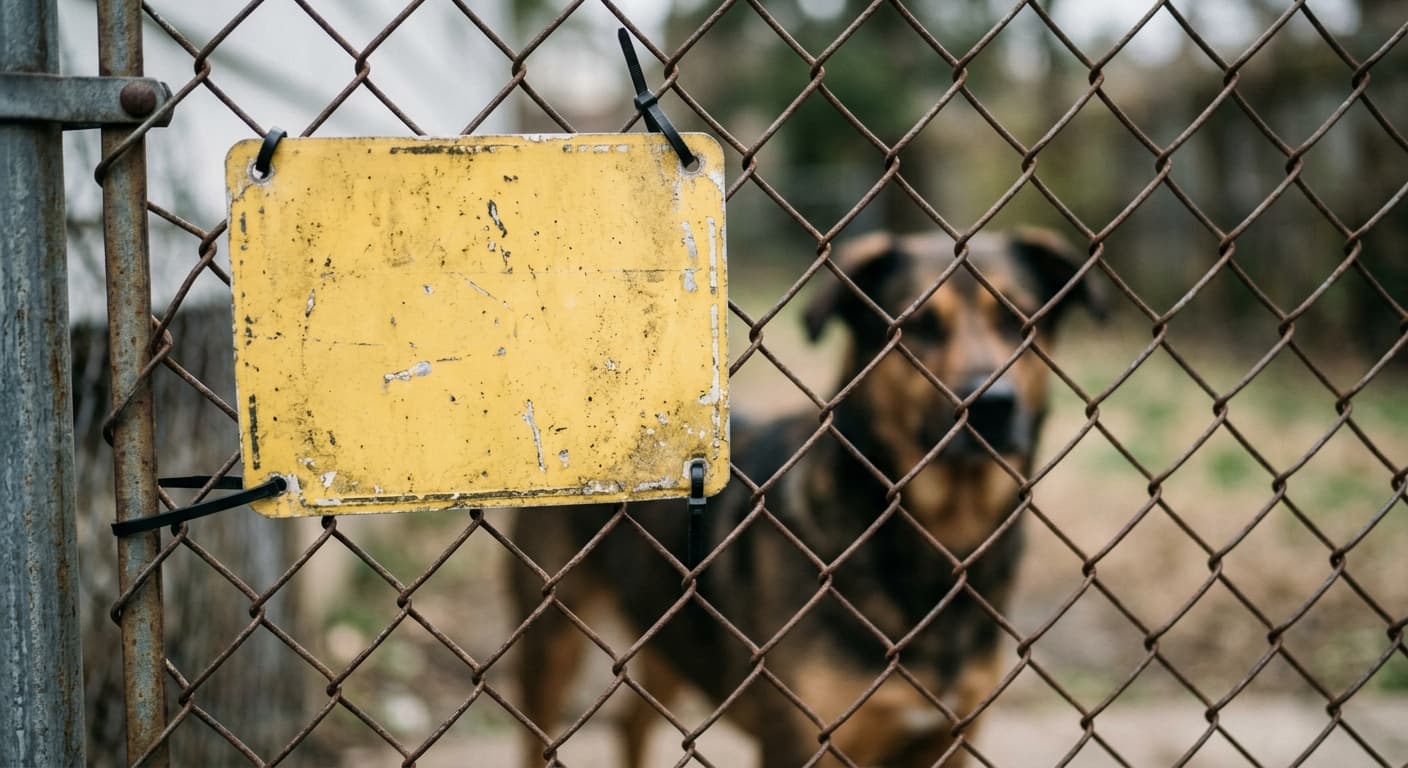
La ley de Florida ofrece una defensa única para los dueños de perros. Según el Fla. Stat. § 767.04, un dueño no es responsable por una mordedura de perro si, al momento de la lesión, había exhibido "en un lugar prominente de su propiedad un letrero fácil de leer que incluya las palabras 'Perro Bravo.'"

Sin embargo, esta defensa tiene dos excepciones importantes:
- No se aplica si la víctima es menor de 6 años
- No se aplica si la propia negligencia del dueño fue una causa próxima de la mordedura
El letrero debe ser claramente visible y legible. Los tribunales han examinado el tamaño, la ubicación y la visibilidad de los letreros de "Perro Bravo" al evaluar esta defensa.
Negligencia Comparativa en los Casos de Mordedura de Perro
El Fla. Stat. § 767.04 también incluye una disposición de negligencia comparativa. Si la propia negligencia de la víctima contribuyó a la mordedura, el tribunal reduce la responsabilidad del dueño según el porcentaje de responsabilidad atribuido a la víctima.
La Regla del Límite del 51% (HB 837)
En marzo de 2023, Florida promulgó la HB 837, una amplia ley de reforma de responsabilidad civil que cambió a Florida de un estado de negligencia comparativa pura a un estado de negligencia comparativa modificada. Bajo este nuevo marco:
| Responsabilidad de la Víctima | Indemnización |
|---|---|
| 0% a 50% | Indemnización total menos el porcentaje de responsabilidad de la víctima |
| 51% o más | Completamente impedida de recibir indemnización |
Este límite del 51% se aplica a los casos de mordedura de perro. Si un tribunal determina que la víctima tuvo más del 50% de responsabilidad por el incidente (por ejemplo, mediante una provocación grave), la víctima no recibe nada.
La única excepción son los reclamos por negligencia médica, que todavía operan bajo la negligencia comparativa pura.
Defensas Disponibles para los Dueños de Perros
Incluso bajo la responsabilidad objetiva, los dueños de perros en Florida tienen varias defensas potenciales:
Provocación
Si la víctima provocó al perro mediante burlas, tormentos, golpes u otro comportamiento agresivo, el dueño puede no ser responsable. La provocación debe ser lo suficientemente significativa como para causar que un perro normalmente tranquilo muerda.
Traspaso Ilegal
Debido a que el Fla. Stat. § 767.04 solo se aplica cuando una víctima está en un lugar público o "legalmente" en una propiedad privada, los traspasadores generalmente no pueden usar este estatuto de responsabilidad objetiva. Sin embargo, esta defensa puede no aplicarse a los niños pequeños que no comprenden los límites de la propiedad.
Asunción del Riesgo
Si la víctima aceptó a sabiendas el riesgo de ser mordida, esto puede limitar o impedir la indemnización. Los profesionales que trabajan con animales (veterinarios, peluqueros caninos, trabajadores de guarderías para perros) pueden enfrentar esta defensa.
Excepción Veterinaria o Profesional
Las personas cuyo trabajo implica manejar perros pueden tener una capacidad limitada para recibir indemnización bajo la responsabilidad objetiva, ya que el riesgo de una mordedura es inherente a su trabajo.
Plazo de Prescripción: 2 Años
Según el Fla. Stat. § 95.11(5)(a), el plazo de prescripción para los reclamos por lesiones personales en Florida es de 2 años a partir de la fecha de la mordedura. Este plazo se redujo de 4 a 2 años mediante la HB 837, vigente desde el 24 de marzo de 2023.
Consideraciones importantes para el plazo de presentación:
- El plazo comienza en la fecha en que ocurre la mordedura
- Los menores de edad pueden tener plazos extendidos (el plazo de prescripción se suspende durante la minoría de edad según el Fla. Stat. § 95.051)
- Los reclamos contra entidades gubernamentales a menudo tienen plazos de notificación más cortos
- No cumplir con el plazo normalmente pondrá fin al reclamo, porque el dueño puede alegar la prescripción como una defensa completa
Una advertencia que vale la pena plantear a un abogado: el § 95.11(3)(e) todavía establece un plazo de cuatro años para "una acción fundada en responsabilidad legal (estatutaria)", y un reclamo bajo el § 767.04 es una acción de responsabilidad objetiva estatutaria en la que la víctima no tiene que probar negligencia. Ningún tribunal de apelaciones de Florida ha resuelto si ese plazo de cuatro años sigue vigente para los reclamos por mordedura de perro después de la HB 837, y la práctica habitual es tratar los dos años como el plazo aplicable. Planifique en torno a los dos años, pero no asuma que un reclamo antiguo carece de valor sin antes consultar a un abogado.
Debido al plazo reducido, las víctimas deben consultar a un abogado con prontitud después de sufrir una lesión por mordedura de perro.
Derechos de las Víctimas e Indemnización
Las víctimas de mordedura de perro en Florida pueden recibir varias categorías de indemnización:
Daños Económicos
- Gastos médicos (atención de emergencia, cirugía, rehabilitación, procedimientos reconstructivos)
- Costos médicos futuros para tratamiento continuo
- Salarios perdidos y pérdida de capacidad de ingresos
- Daños a la propiedad
Daños No Económicos
- Dolor y sufrimiento
- Angustia emocional y trauma psicológico
- Cicatrices y desfiguración
- Pérdida del disfrute de la vida
Florida no impone un límite legal a los daños en los casos de mordedura de perro. Las víctimas generalmente pueden recibir tanto daños económicos como no económicos mediante un reclamo de responsabilidad objetiva.
Responsabilidades del Dueño del Perro Según la Ley de Florida
Los dueños de perros en Florida tienen varias obligaciones legales:
- Vacunación contra la rabia: el Fla. Stat. § 828.30 exige que todos los perros de 4 meses de edad o más estén vacunados contra la rabia
- Leyes de correa: muchos condados y municipios de Florida exigen que los perros estén con correa en áreas públicas (esto varía según la ordenanza local)
- Confinamiento: los perros deben estar confinados de manera segura en la propiedad del dueño
- Licencia: la mayoría de las jurisdicciones locales exigen que los perros tengan licencia y estén registrados
- Letreros de advertencia: los dueños de perros clasificados como peligrosos deben colocar letreros de advertencia y cumplir con requisitos adicionales
Violar estas responsabilidades puede fortalecer el caso de una víctima y puede resultar en sanciones adicionales.
Designaciones de Perro Peligroso
La ley de Florida establece un proceso formal para clasificar a los perros como "peligrosos" según los Fla. Stat. §§ 767.11-767.13.
Qué Hace que un Perro sea "Peligroso"
Según el Fla. Stat. § 767.11, un perro puede clasificarse como peligroso si ha:
- Mordido, atacado o puesto en peligro agresivamente a una persona en una propiedad pública o privada
- Infligido una lesión grave a un ser humano
- Lesionado gravemente o matado a un animal doméstico en más de una ocasión fuera de la propiedad del dueño
- Cuando, sin haber sido provocado, persiguió o se acercó a una persona en las calles, aceras o cualquier terreno público de manera amenazante o con una actitud aparente de ataque, hechos declarados bajo juramento por una o más personas e investigados por la autoridad correspondiente
Esa última categoría es importante: un perro puede clasificarse como peligroso bajo esta disposición sin haber mordido nunca a nadie. Un vecino al que un perro suelto embiste repetidamente de forma amenazante puede iniciar el proceso de clasificación con solo una declaración jurada.
"Lesión grave" según el estatuto significa una lesión física que resulta en huesos rotos, múltiples mordeduras, o laceraciones desfigurantes que requieren suturas o cirugía reconstructiva.
Requisitos para los Dueños de Perros Peligrosos
Los dueños de perros clasificados como peligrosos deben cumplir con requisitos estrictos según el Fla. Stat. § 767.12:
- Obtener un seguro de responsabilidad civil de al menos $100,000
- Implantar un microchip al perro
- Mantener al perro en un recinto seguro que cumpla con estándares específicos
- Usar bozal y correa cuando el perro esté fuera del recinto
- Colocar letreros de advertencia en la propiedad
- Registrar al perro como peligroso ante el control de animales
La Ley Pam Rock (2025)
En mayo de 2025, el gobernador DeSantis firmó la Ley Pam Rock (CS/HB 593, Cap. 2025-61), que entró en vigor el 1 de julio de 2025. El proyecto complementario del Senado, el SB 572, quedó archivado una vez que se aprobó el proyecto de la Cámara, por lo que el CS/HB 593 es el vehículo legislativo promulgado. Nombrada en honor a Pam Rock, una cartera del condado de Putnam que fue asesinada por cinco perros mientras repartía correo en agosto de 2022, esta ley introdujo cambios significativos:
| Cambio | Antes de la Ley Pam Rock | Después de la Ley Pam Rock |
|---|---|---|
| Sanción cuando un perro clasificado como peligroso causa una lesión grave o la muerte | Delito grave de tercer grado | Delito grave de segundo grado |
| Confiscación obligatoria durante la investigación | Solo para perros que causaron una lesión grave | Ampliada para incluir perros con una puntuación de 5 o más en la Escala de Mordidas de Dunbar |
| Remoción de microchip | No abordada específicamente | Delito grave de tercer grado remover intencionalmente el microchip de un perro peligroso |
| Multa máxima por infracciones de perro peligroso | Montos más bajos | Aumentada a $1,000 |
Un delito grave de segundo grado en Florida conlleva sanciones de hasta 15 años de prisión y una multa de $10,000.
Sanciones Penales para los Dueños de Perros
En casos graves, los dueños de perros pueden enfrentar cargos penales además de la responsabilidad civil:
Cargos por Delito Menor
Según el Fla. Stat. § 767.13, si un perro previamente clasificado como peligroso ataca o muerde a una persona o animal doméstico sin provocación, el dueño enfrenta un delito menor de primer grado, sancionable con hasta 1 año de cárcel y una multa de $1,000.
Cargos por Delito Grave
Si un perro clasificado como peligroso causa una lesión grave o la muerte de una persona, el dueño enfrenta un delito grave de segundo grado según la Ley Pam Rock (anteriormente un delito grave de tercer grado). Esto conlleva hasta 15 años de prisión.
Perros que Nunca Fueron Clasificados como Peligrosos
La mayoría de los perros que muerden nunca han pasado por un procedimiento de clasificación, por lo que el § 767.13 no los alcanza. La disposición que sí los alcanza es el Fla. Stat. § 767.136. Si un perro que no ha sido declarado peligroso ataca y causa una lesión grave o la muerte a una persona, y el dueño sabía de las tendencias peligrosas del perro pero mostró un desprecio imprudente hacia ellas, el dueño comete un delito menor de primer grado.
Por separado, el Fla. Stat. § 767.135 exige que un perro no clasificado que ataque y mate a una persona sea confiscado de inmediato por el control de animales, puesto en custodia, y retenido durante 10 días hábiles después de que el dueño reciba una notificación por escrito, para luego ser sacrificado. Esa disposición no es una sanción penal; es una disposición obligatoria sobre el animal.
También puede aplicarse responsabilidad penal cuando el dueño usó intencionalmente al perro como arma.
Legislación Específica por Raza en Florida
La ley de Florida generalmente prohíbe la legislación específica por raza (BSL) a nivel local. Según el Fla. Stat. § 767.14, ningún gobierno local puede promulgar ninguna ordenanza o regulación específica por raza.
El Fin de la Prohibición de Pit Bulls en Miami-Dade
Cuando Florida aprobó la ley de preferencia de BSL en 1990, incluyó una cláusula de exención que permitía que las prohibiciones locales de raza existentes permanecieran vigentes. Esto preservó la prohibición de pit bulls de 1989 del condado de Miami-Dade, que había prohibido la propiedad de perros tipo pit bull.
En 2023, la Legislatura de Florida aprobó la SB 942, que eliminó la cláusula de exención a partir del 1 de octubre de 2023. Este cambio:
- Puso fin a la prohibición de pit bulls de 34 años del condado de Miami-Dade
- Puso fin a la prohibición similar de la ciudad de Sunrise
- Amplió la prohibición para cubrir también las regulaciones basadas en el tamaño o peso del perro
- Aplicó las mismas reglas a las políticas de vivienda pública
A partir de 2026, ninguna jurisdicción de Florida puede regular a los perros según su raza, tamaño o peso. Todas las regulaciones sobre perros en Florida deben basarse en el comportamiento.
Responsabilidad del Arrendador por Mordeduras de Perro
Aunque el Fla. Stat. § 767.04 se aplica a los dueños de perros, los tribunales de Florida también han reconocido la responsabilidad del arrendador en ciertas situaciones. Un arrendador puede ser considerado responsable de la mordedura del perro de un inquilino cuando:
- El arrendador tenía conocimiento real de que el perro del inquilino era peligroso
- El arrendador mantenía control sobre la propiedad y podía hacer cumplir las disposiciones del contrato de arrendamiento
- El arrendador no tomó medidas razonables para proteger a otros del perro
El caso clave que estableció este principio es White v. Whitworth, en el que un tribunal de Florida determinó que un arrendador era responsable porque tenía conocimiento real de la naturaleza peligrosa del perro y no actuó.
Los arrendadores pueden reducir su riesgo mediante:
- La inclusión de políticas sobre mascotas en los contratos de arrendamiento
- Exigir que los inquilinos con perros tengan un seguro de inquilino con cobertura de responsabilidad civil
- Actuar con prontitud cuando se enteran de que el perro de un inquilino puede ser peligroso
- Documentar todas las quejas sobre animales agresivos en la propiedad
Cómo Presentar un Reclamo por Mordedura de Perro en Florida
Si le mordió un perro en Florida y no sabe qué puede hacer, estos pasos pueden proteger sus derechos legales:
- Busque atención médica de inmediato. Reciba tratamiento y conserve todos los registros médicos y facturas.
- Informe el incidente. Presente un informe ante el control de animales local y la policía. Esto crea un registro oficial.
- Documente la escena. Tome fotos de las lesiones, del lugar, del perro (si es seguro hacerlo) y de cualquier ropa rota.
- Reúna información. Obtenga el nombre, los datos de contacto y la información del seguro de vivienda o de inquilino del dueño.
- Identifique a los testigos. Reúna la información de contacto de cualquier persona que haya presenciado el ataque.
- Conserve las pruebas. Guarde la ropa rota, los vendajes ensangrentados y otras pruebas físicas.
- Contacte a un abogado dentro del plazo de 2 años. Debido a que la HB 837 acortó el plazo de prescripción, actuar rápidamente es esencial.
Más Leyes de Florida
- Leyes de Grabación de Reuniones con IA de Florida
- Leyes de Pensión Alimenticia de Florida
- Leyes de Empleo a Voluntad de Florida
- Leyes de Accidentes de Auto de Florida
- Leyes de Asientos de Auto de Florida
- Leyes de Custodia de Menores de Florida
- Leyes de Manutención Infantil de Florida
- Leyes de Matrimonio de Hecho de Florida
- Leyes de Privacidad de Datos de Florida
- Leyes sobre Deepfakes de Florida
- Leyes de Divorcio de Florida
- Leyes de Emancipación de Florida
- Leyes de Eliminación de Antecedentes de Florida
- Leyes de Choque y Fuga de Florida
- Leyes de Propietarios e Inquilinos de Florida
- Leyes del Limón de Florida
Preguntas frecuentes
¿Es Florida un estado de responsabilidad objetiva para las mordeduras de perro?
Sí. Según el Fla. Stat. § 767.04, los dueños de perros son objetivamente responsables por las lesiones de mordedura sin importar si sabían que el perro era peligroso. La víctima solo necesita probar que el demandado era dueño del perro, que el perro la mordió, y que estaba legalmente presente en el lugar.
¿Cuánto tiempo tengo para presentar una demanda por mordedura de perro en Florida?
Tiene 2 años a partir de la fecha de la mordedura según el Fla. Stat. § 95.11(5)(a). Este plazo se redujo de 4 a 2 años mediante la HB 837, vigente desde el 24 de marzo de 2023, y no cumplirlo normalmente pondrá fin a su reclamo porque el dueño puede alegar la prescripción como una defensa completa. Hay un punto sin resolver que vale la pena consultar con un abogado: el § 95.11(3)(e) todavía permite cuatro años para una acción fundada en responsabilidad legal (estatutaria), y un reclamo bajo el § 767.04 es una acción de responsabilidad objetiva estatutaria, pero ningún tribunal de apelaciones de Florida ha resuelto qué plazo rige. Planifique en torno a los dos años.
¿Puede un letrero de 'Perro Bravo' proteger a un dueño de perro de la responsabilidad en Florida?
Posiblemente, sí. Según el Fla. Stat. § 767.04, un dueño que exhiba un letrero prominente y legible con las palabras 'Perro Bravo' en su propiedad puede evitar la responsabilidad objetiva. Sin embargo, esta defensa no se aplica si la víctima es menor de 6 años o si la negligencia del dueño contribuyó a la mordedura.
¿Qué sucede si tuve parte de la culpa de la mordedura de perro?
Florida aplica la negligencia comparativa modificada. Si tuvo 50% o menos de responsabilidad, su indemnización se reduce según su porcentaje de responsabilidad. Si tuvo 51% o más de responsabilidad (por ejemplo, al provocar gravemente al perro), queda completamente impedido de recibir cualquier indemnización según la HB 837.
¿Qué es la Ley Pam Rock y cómo afecta a los dueños de perros peligrosos?
La Ley Pam Rock (CS/HB 593, Cap. 2025-61), firmada en mayo de 2025 y vigente desde el 1 de julio de 2025, aumentó las sanciones para los dueños de perros clasificados como peligrosos. Si un perro clasificado como peligroso causa una lesión grave o la muerte, el dueño ahora enfrenta un delito grave de segundo grado (hasta 15 años de prisión) en lugar de un delito grave de tercer grado. La ley también convierte en delito grave de tercer grado la remoción de un microchip de un perro peligroso.
Actualizaciones
Se agregó el tercer supuesto de perro peligroso bajo el Fla. Stat. 767.11(3)(c), que permite la clasificación sin que haya mordedura, se citaron los Fla. Stat. 767.136 y 767.135 para perros nunca declarados peligrosos, se corrigió la Ley Pam Rock a su vehículo legislativo promulgado CS/HB 593 (Cap. 2025-61) en lugar del SB 572 archivado, se corrigió la regla de vacunación antirrábica a partir de los 4 meses de edad, y se señaló el argumento no resuelto del plazo de cuatro años por responsabilidad estatutaria junto al plazo de presentación de dos años.
Verificado de forma independiente contra las fuentes primarias citadas; ley aplicable revisada en busca de cambios recientes
Ley aplicable revisada en busca de cambios recientes
Revisado y aprobado por un editor
La ley detrás de este artículo
Este artículo se apoya en las disposiciones legales a continuación, conservadas en nuestro propio registro jurídico y obtenidas de la fuente oficial. Toque una sección para leer el texto vigente.
Florida Statutes
§ 767.04Dog owner’s liability for damages to persons bitten.Vigentecitada en 2 de nuestros artículos
The owner of any dog that bites any person while such person is on or in a public place, or lawfully on or in a private place, including the property of the owner of the dog, is liable for damages suffered by persons bitten, regardless of the former viciousness of the dog or the owners’ knowledge of such viciousness. However, any negligence on the part of the person bitten that is a proximate cause of the biting incident reduces the liability of the owner of the dog by the percentage that the bitten person’s negligence contributed to the biting incident. A person is lawfully upon private property of such owner within the meaning of this act when the person is on such property in the performance of any duty imposed upon him or her by the laws of this state or by the laws or postal regulations of the United States, or when the person is on such property upon invitation, expressed or implied, of the owner.
Texto oficial (extracto) · verificado el 2026-08-28 · Lea el texto completo en nuestra biblioteca legal · Verifique en leg.state.fl.us
Citada en 40 resoluciones judiciales de nuestra colecciónResolución más reciente que la cita en nuestra colección: 2022
En los tribunales (resumen editorial, verificado de forma independiente):Belcher Yacht, Inc. v. Stickney (1984) sostuvo que la sección 767.04 alcanza solo al dueño del perro y no a un cuidador ajeno, y Carroll v. Moxley (1970) sostuvo que la defensa del letrero Bad Dog depende de si el letrero era prominente y fácil de leer. Huie v. Wipperfurth (1994) señaló que la reforma de 1993 hizo el remedio acumulativo con el derecho común.
Resoluciones que citan esta sección en nuestra colección:
- Carroll v. Moxley (Supreme Court of Florida 1970, 241 So. 2d 681)✓Una mujer fue mordida por un perro en la tienda de su madre, que tenía un letrero de advertencia; el tribunal sostuvo que la sección 767.04 desplaza el derecho común solo en las situaciones que cubre, y que si el letrero Bad Dog es prominente y legible es una cuestión de hecho, así que el juicio sumario fue un error.
- Belcher Yacht, Inc. v. Stickney (Supreme Court of Florida 1984, 450 So. 2d 1111)✓El dueño de un yate fue mordido por el perro guardián de una marina que tenía un letrero de advertencia; el tribunal sostuvo que la sección 767.04 es el remedio exclusivo contra el dueño del perro, pero que la ley solo alcanza a los dueños, así que el guardia sí podía ser demandado por negligencia.
- Donner v. Arkwright-Boston Manufacturers Mutual Insurance (Supreme Court of Florida 1978, 358 So. 2d 21)✓Un invitado acarició a una dóberman nerviosa y fue mordido en el labio, y el jurado recibió una instrucción sobre asunción del riesgo; la Corte Suprema sostuvo que un dueño demandado bajo la sección 767.04 solo cuenta con las defensas que el propio texto legal fija, entonces provocación o un letrero Bad Dog colocado.
Identificado automáticamente a partir de las opiniones judiciales que citan esta sección; no es un ranking de qué caso prevalece.
§ 767.01Dog owner’s liability for damages to persons, domestic animals, or livestock.Vigente
(1) A dog owner is liable for any damage done by the owner’s dog to a person or to any animal included in the definitions of “domestic animal” and “livestock” as provided by s. 585.01. (2) If a dog owner has knowledge of the dog’s dangerous propensities, the owner must securely confine the dog in a proper enclosure as defined in s. 767.11.
Texto oficial (extracto) · verificado el 2026-07-28 · Lea el texto completo en nuestra biblioteca legal · Verifique en leg.state.fl.us
Citada en 22 resoluciones judiciales de nuestra colecciónResolución más reciente que la cita en nuestra colección: 2008
Resoluciones que citan esta sección en nuestra colección:
- Brandeis v. Felcher (District Court of Appeal of Florida 1968, 211 So. 2d 606)“…question to be determined on this appeal is whether, under Fla. Stat. § 767.01 , F.S.A., liability might be imposed up…”
- Mapoles v. Mapoles (District Court of Appeal of Florida 1977, 350 So. 2d 1137)“…Mapoles was entered by the trial court upon the theory that Section 767.01, Florida Statutes, imposed strict liability upon the dog…”
- Smith v. Allison (District Court of Appeal of Florida 1976, 332 So. 2d 631)“…intiff relies for affirmance on several cases interpreting Fla. Stat. § 767.01 , the "Damage [Done] by Dogs" statute,…”
Identificado automáticamente a partir de las opiniones judiciales que citan esta sección; no es un ranking de qué caso prevalece.
§ 767.11Definitions.Vigente
As used in this part, unless the context clearly requires otherwise:(1) “Animal control authority” means an entity acting alone or in concert with other local governmental units and authorized by them to enforce the animal control laws of the city, county, or state. In those areas not served by an animal control authority, the sheriff shall carry out the duties of the animal control authority under this part. (2) “Animal control officer” means any individual employed, contracted with, or appointed by the animal control authority for the purpose of aiding in the enforcement of this part or any other law or ordinance relating to the licensure of animals, control of animals, or seizure and impoundment of animals and includes any state or local law enforcement officer or other employee whose duties in whole or in part include assignments that involve the seizure and impoundment of an animal.
Texto oficial (extracto) · verificado el 2026-07-28 · Lea el texto completo en nuestra biblioteca legal · Verifique en leg.state.fl.us
Citada en 1 resoluciones judiciales de nuestra colecciónResolución más reciente que la cita en nuestra colección: 2008
Resoluciones que citan esta sección en nuestra colección:
- Trammell v. Thomason (District Court, M.D. Florida 2008, 559 F. Supp. 2d 1281)“…rous *1290 dogs” as that term in defined in Fla. Stat. § 767.11 (1) and not to address police work dogs…”
Identificado automáticamente a partir de las opiniones judiciales que citan esta sección; no es un ranking de qué caso prevalece.
§ 767.12Classification of dogs as dangerous; owner requirements; penalty.Vigente
(1) An animal control authority shall investigate reported incidents involving any dog that may be dangerous and, if possible, shall interview the owner and require a sworn affidavit from any person, including any animal control officer or enforcement officer, desiring to have a dog classified as dangerous.(a) An animal that is the subject of a dangerous dog investigation and that has killed a human being or has bitten a human being and left a bite mark that scores 5 or higher on the Dunbar bite scale must be immediately confiscated by an animal control authority; placed in quarantine, if necessary, for the proper length of time; impounded; and held. The animal must be held pending the outcome of the investigation and any hearings or appeals related to the dangerous dog classification or any penalty imposed under this section. If the dog is to be destroyed, the dog may not be destroyed while an appeal is pending. The owner is responsible for payment of all boarding costs and other fees as may be required to humanely and safely keep the animal pending any hearing or appeal.
Texto oficial (extracto) · verificado el 2026-07-28 · Lea el texto completo en nuestra biblioteca legal · Verifique en leg.state.fl.us
Citada en 3 resoluciones judiciales de nuestra colecciónResolución más reciente que la cita en nuestra colección: 2007
Resoluciones que citan esta sección en nuestra colección:
- County of Pasco v. Riehl (Supreme Court of Florida 1994, 19 Fla. L. Weekly Supp. 183)“…Justice, concurring. I concur, but hasten to note that section 767.12, Florida Statutes (1991), was amended in 1993 and the pre…”
- Marion County v. Grunnah (District Court of Appeal of Florida 2007, 962 So. 2d 931)“…determination that her dogs are "dangerous," as defined by section 767.12, Florida Statutes (2006). The threshold question we must…”
Identificado automáticamente a partir de las opiniones judiciales que citan esta sección; no es un ranking de qué caso prevalece.
§ 767.13Attack or bite by dangerous dog; penalties; confiscation; destruction.Vigente
(1) If a dog that has previously been declared dangerous attacks or bites a person or a domestic animal without provocation, the owner commits a misdemeanor of the first degree, punishable as provided in s. 775.082 or s. 775.083. The dangerous dog must be immediately confiscated by an animal control authority; placed in quarantine, if necessary, for the proper length of time; impounded; and held for 10 business days after the owner is given written notification under s. 767.12, and thereafter destroyed in an expeditious and humane manner. The owner may request a hearing under s. 767.12 during the 10 business days after such notification. The owner is responsible for payment of all boarding costs and other fees as may be required to humanely and safely keep the animal during any appeal procedure. (2) If a dog that has previously been declared dangerous attacks and causes severe injury to or death of any human, the owner commits a felony of the second degree, punishable as provided in s. 775.082, s. 775.083, or s. 775.084.
Texto oficial (extracto) · verificado el 2026-07-28 · Lea el texto completo en nuestra biblioteca legal · Verifique en leg.state.fl.us
Citada en 2 resoluciones judiciales de nuestra colecciónResolución más reciente que la cita en nuestra colección: 2010
Resoluciones que citan esta sección en nuestra colección:
- State v. Nowlin (District Court of Appeal of Florida 2010, 50 So. 3d 79)“…viously bitten a small child, she could not be liable under section 767.13, Florida Statutes, for the acts of her dangerous dog sinc…”
- City of Ocala v. Green (District Court of Appeal of Florida 2008, 988 So. 2d 114)“…convicted criminally for violating Florida's dog bite law, section 767.13, Florida Statutes (2007). The city now seeks review of th…”
Identificado automáticamente a partir de las opiniones judiciales que citan esta sección; no es un ranking de qué caso prevalece.
§ 767.14Additional local restrictions authorized.Vigente
This act does not limit any local government or public housing authority from adopting an ordinance or a policy, respectively, to address the safety and welfare concerns caused by attacks on persons or domestic animals; placing further restrictions or additional requirements on owners of dogs that have bitten or attacked persons or domestic animals; or developing procedures and criteria for the implementation of this act, provided that no such regulation is specific to breed, weight, or size and that the provisions of this act are not lessened by such additional regulations or requirements.
Texto oficial (extracto) · verificado el 2026-07-28 · Lea el texto completo en nuestra biblioteca legal · Verifique en leg.state.fl.us
Citada en 1 resoluciones judiciales de nuestra colecciónResolución más reciente que la cita en nuestra colección: 2011
Resoluciones que citan esta sección en nuestra colección:
- Hoesch v. Broward County (District Court of Appeal of Florida 2011, 53 So. 3d 1177)“…ttempts to avoid this suggestion of conflict by pointing to section 767.14, Florida Statutes (2010). Bro-ward argues that no conflic…”
Identificado automáticamente a partir de las opiniones judiciales que citan esta sección; no es un ranking de qué caso prevalece.
§ 95.11Limitations other than for the recovery of real property.Vigentecitada en 16 de nuestros artículos
Actions other than for recovery of real property shall be commenced as follows:(1) WITHIN TWENTY YEARS.—An action on a judgment or decree of a court of record in this state. (2) WITHIN FIVE YEARS.—(a) An action on a judgment or decree of any court, not of record, of this state or any court of the United States, any other state or territory in the United States, or a foreign country. (b) A legal or equitable action on a contract, obligation, or liability founded on a written instrument, except for an action to enforce a claim against a payment bond, which shall be governed by the applicable provisions of paragraph (6)(e), s. 255.05(10), s. 337.18(1), or s. 713.23(1)(e), and except for an action for a deficiency judgment governed by paragraph (6)(g). (c) An action to foreclose a mortgage. (d) An action alleging a willful violation of s. 448.110. (e) Notwithstanding paragraph (b), an action for breach of a property insurance contract, with the period running from the date of loss. (3) WITHIN FOUR YEARS.—(a) An action relating to the determination of paternity, with the time running from the date the child reaches the age of majority.
Texto oficial (extracto) · verificado el 2026-09-08 · Lea el texto completo en nuestra biblioteca legal · Verifique en leg.state.fl.us
Citada en 698 resoluciones judiciales de nuestra colecciónResolución más reciente que la cita en nuestra colección: 2026
En los tribunales (resumen editorial, verificado de forma independiente):Merkle v. Robinson (1999) sostuvo que la prueba de relación significativa rige los conflictos de leyes sobre la sección 95.11, de modo que una demanda prescrita en Florida puede proceder bajo el plazo de otro estado. Foley v. Morris (1976) aplicó un plazo acortado de la 95.11 a una demanda preexistente cuando el demandante aún tuvo el nuevo plazo completo.
Resoluciones que citan esta sección en nuestra colección:
- Merkle v. Robinson (Supreme Court of Florida 1999, 737 So. 2d 540)✓Una paciente de West Virginia demandó a la sucesión de un médico en Florida, donde él se había jubilado; su reclamo era extemporáneo bajo la ley de Florida pero no bajo la de West Virginia. La corte sostuvo que la prueba de relación significativa rige los conflictos sobre section 95.11, y aplicó el plazo de West Virginia.
- Foley v. Morris (District Court of Appeal of Florida 1976, 325 So. 2d 37)✓Un cirujano dejó un drenaje de goma dentro de un paciente en 1971; la demanda se presentó en 1974, después de que Florida reemplazara el plazo de cuatro años por el de dos años para negligencia médica en section 95.11(6). La corte aplicó el nuevo plazo desde su fecha de vigencia y confirmó la desestimación.
- State ex rel. Gerstein v. Hialeah Race Course, Inc. (Supreme Court of Florida 1971, 245 So. 2d 53)✓Un fiscal estatal demandó a operadores de hipódromos por contribuciones políticas. Al declarar inconstitucional, en su aplicación, el plazo de cuatro años de la ley de campañas, la corte determinó que regía el límite general de un año de section 95.11(7)(a), por lo que la demanda tardía fue desestimada correctamente.
Identificado automáticamente a partir de las opiniones judiciales que citan esta sección; no es un ranking de qué caso prevalece.
§ 95.051When limitations tolled.Vigentecitada en 2 de nuestros artículos
(1) The running of the time under any statute of limitations except ss. 95.281, 95.35, and 95.36 is tolled by:(a) Absence from the state of the person to be sued. (b) Use by the person to be sued of a false name that is unknown to the person entitled to sue so that process cannot be served on the person to be sued. (c) Concealment in the state of the person to be sued so that process cannot be served on him or her. (d) The adjudicated incapacity, before the cause of action accrued, of the person entitled to sue. In any event, the action must be begun within 7 years after the act, event, or occurrence giving rise to the cause of action. (e) Voluntary payments by the alleged father of the child in paternity actions during the time of the payments. (f) The payment of any part of the principal or interest of any obligation or liability founded on a written instrument. (g) The pendency of any arbitral proceeding pertaining to a dispute that is the subject of the action. (h) The period of an intervening bankruptcy tolls the expiration period of a tax certificate under s. 197.482 and any proceeding or process under chapter 197.
Texto oficial (extracto) · verificado el 2026-07-28 · Lea el texto completo en nuestra biblioteca legal · Verifique en leg.state.fl.us
Citada en 75 resoluciones judiciales de nuestra colecciónResolución más reciente que la cita en nuestra colección: 2026
Resoluciones que citan esta sección en nuestra colección:
- Major League Baseball v. Morsani (Supreme Court of Florida 2001, 26 Fla. L. Weekly Supp. 465)“…the district court certified the following question: Does section 95.051, Florida Statutes (1993), prohibit the application of the…”
- Landers v. Milton (Supreme Court of Florida 1979, 370 So. 2d 368)“…of proving the inapplicability of the tolling provisions of section 95.051, Florida Statutes (1977). They argue that once it appears…”
- Totura & Co., Inc. v. Williams (Supreme Court of Florida 2000, 754 So. 2d 671)“…nter does not suggest that any of the tolling provisions in section 95.051, Florida Statutes (1991), pertain to this case and we fin…”
Identificado automáticamente a partir de las opiniones judiciales que citan esta sección; no es un ranking de qué caso prevalece.
§ 828.30Rabies vaccination of dogs, cats, and ferrets.Vigente
(1)(a) All dogs, cats, and ferrets 4 months of age or older must be vaccinated by a licensed veterinarian or a person authorized under paragraph (b) against rabies with a vaccine that is licensed by the United States Department of Agriculture for use in those species. (b) Acting under the indirect supervision of a veterinarian, an employee, an agent, or a contractor of a county or municipal animal control authority or sheriff may vaccinate against rabies dogs, cats, and ferrets that are in the custody of an animal control authority or a sheriff and which will be transferred, rescued, fostered, adopted, or reclaimed by the owner. The supervising veterinarian assumes responsibility for any person vaccinating animals at his or her direction or under his or her direct or indirect supervision. As used in this paragraph, the term “indirect supervision” means that the supervising veterinarian is required to be available for consultation through telecommunications but is not required to be physically present during such consultation. (c) The owner of every dog, cat, and ferret shall have the animal revaccinated 12 months after the initial vaccination.
Texto oficial (extracto) · verificado el 2026-07-28 · Lea el texto completo en nuestra biblioteca legal · Verifique en leg.state.fl.us
Citada en 1 resoluciones judiciales de nuestra colecciónResolución más reciente que la cita en nuestra colección: 2015
Resoluciones que citan esta sección en nuestra colección:
- Alboniga v. School Board of Broward County Florida (District Court, S.D. Florida 2015, 87 F. Supp. 3d 1319)“…d to the regulation of animals permitted in schools, see Fla. Stat. § 828.30 , Fla. Admin. Code 6A-2.0040. ■ By Au…”
Identificado automáticamente a partir de las opiniones judiciales que citan esta sección; no es un ranking de qué caso prevalece.
§ 767.135Attack or bite by unclassified dog that causes death; confiscation; destruction.Vigente
If a dog that has not been declared dangerous attacks and causes the death of a human, the dog must be immediately confiscated by an animal control authority; placed in quarantine, if necessary, for the proper length of time; impounded; and held for 10 business days after the owner is given written notification under s. 767.12, and thereafter destroyed in an expeditious and humane manner. The owner may request a hearing under s. 767.12 during the 10 business days after such notification. If the owner files a written appeal under s. 767.12 or this section, the dog must be held and may not be destroyed while the appeal is pending. The owner is responsible for payment of all boarding costs and other fees as may be required to humanely and safely keep the animal during any appeal procedure.
Texto oficial (extracto) · verificado el 2026-07-28 · Lea el texto completo en nuestra biblioteca legal · Verifique en leg.state.fl.us
§ 767.136Attack or bite by unclassified dog that causes severe injury or death; penalties.Vigente
(1) If a dog that has not been declared dangerous attacks and causes severe injury to, or the death of, a human, and the owner of the dog had knowledge of the dog’s dangerous propensities, yet demonstrated a reckless disregard for such propensities under the circumstances, the owner of the dog commits a misdemeanor of the first degree, punishable as provided in s. 775.082 or s. 775.083. (2) If the dog attacks or bites a person who is engaged in or attempting to engage in a criminal activity at the time of the attack, the owner of the dog is not guilty of any crime under this section.
Texto oficial (extracto) · verificado el 2026-07-28 · Lea el texto completo en nuestra biblioteca legal · Verifique en leg.state.fl.us
Fuentes y referencias
- Fla. Stat. § 767.04 - Responsabilidad del dueño del perro por daños a personas mordidas(leg.state.fl.us).gov
- Fla. Stat. § 767.01 - Daños causados por perros; responsabilidad del dueño(leg.state.fl.us).gov
- Fla. Stat. § 767.11 - Definiciones (Perros Peligrosos)(leg.state.fl.us).gov
- Fla. Stat. § 767.12 - Clasificación de perros como peligrosos(leg.state.fl.us).gov
- Fla. Stat. § 767.13 - Ataque o mordedura de un perro peligroso; sanciones(leg.state.fl.us).gov
- Fla. Stat. § 767.14 - Preferencia estatal sobre la regulación local de perros(leg.state.fl.us).gov
- Fla. Stat. § 95.11 - Plazo de prescripción para lesiones personales(leg.state.fl.us).gov
- HB 837 (2023) - Ley de Reforma de Responsabilidad Civil de Florida(flsenate.gov).gov
- SB 572 / Ley Pam Rock (2025) - Perros Peligrosos(flsenate.gov).gov
- SB 942 (2023) - Derogación de la legislación específica por raza(flsenate.gov).gov
- Fla. Stat. § 828.30 - Requisito de vacunación contra la rabia(leg.state.fl.us).gov
- Fla. Stat. Capítulo 767 - Daños Causados por Perros; Perros Peligrosos (capítulo completo)(leg.state.fl.us).gov
- Fla. Stat. § 767.136 - Ataque o mordedura de un perro no clasificado que causa lesión grave o muerte; sanciones(leg.state.fl.us)
- Fla. Stat. § 767.135 - Ataque o mordedura de un perro no clasificado que causa la muerte; confiscación; sacrificio(leg.state.fl.us)
- CS/HB 593 (2025), Cap. 2025-61 - Ley Pam Rock (Perros Peligrosos), aprobada por el Gobernador en mayo de 2025(flsenate.gov)
Referencia pagada a abogados. RecordingLaw puede recibir compensación cuando usted usa un enlace de ayuda legal. RecordingLaw no es un bufete de abogados. Enviar una solicitud no garantiza que un abogado acepte su caso y no crea una relación abogado-cliente.