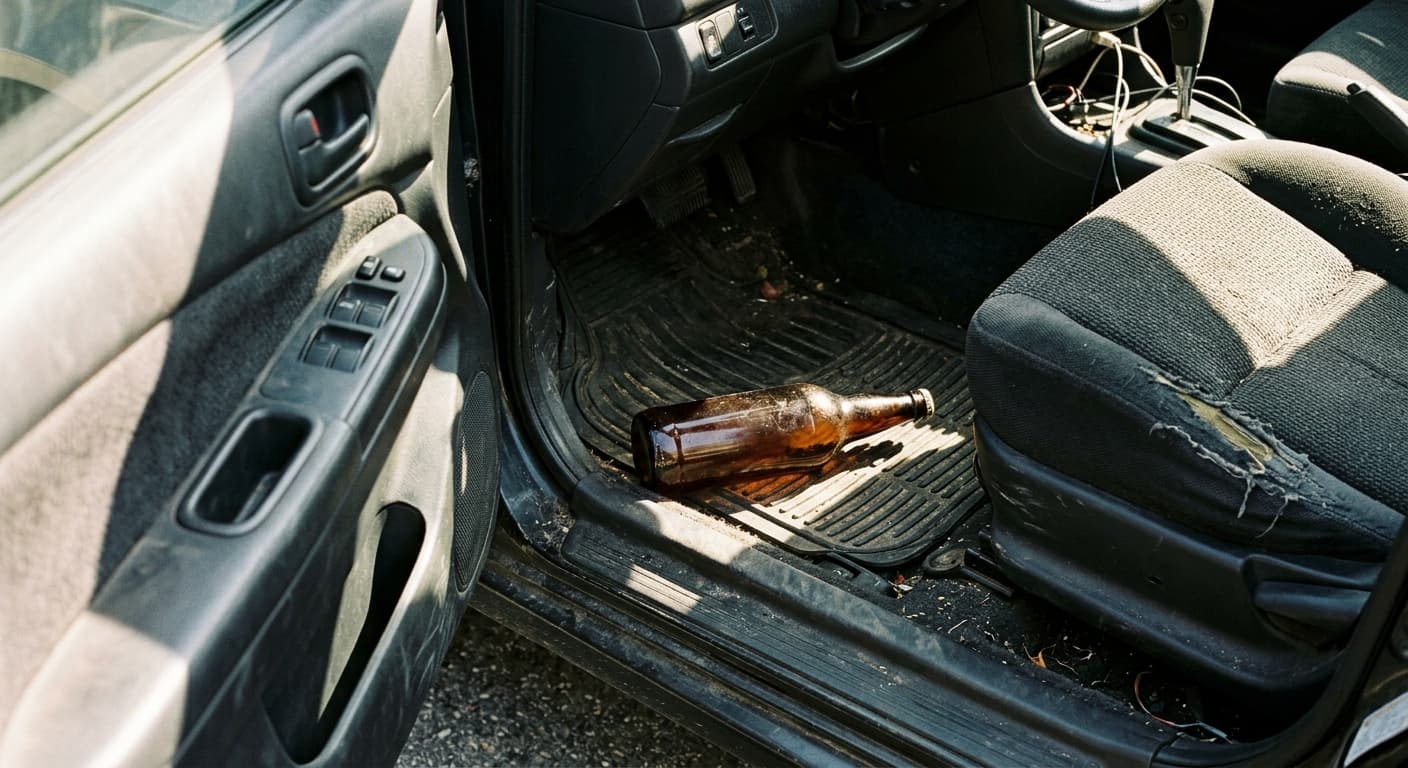
Alabama Open Container Law (2026): The $25 Fine and No-Points Rule
Alabama bans open alcohol containers for drivers and passengers under Ala. Code 32-5A-330. The maximum fine is $25, and it is not a moving violation.
3 min read
52 articles
Alabama bans open alcohol containers for drivers and passengers under Ala. Code 32-5A-330. The maximum fine is $25, and it is not a moving violation.
Alaska bans driving with an open alcohol container in the passenger compartment under AS 28.35.029. It's a driving offense, not a passenger-possession ban.
Arizona bans possessing or drinking alcohol in a vehicle's passenger area for drivers and passengers under A.R.S. 4-251, with exceptions for taxis and RVs.
Arkansas bans an open alcohol container in the passenger area of a vehicle under Ark. Code 5-71-218, covering both drivers and passengers.
California bans driver and passenger drinking and open containers under Veh. Code Sections 23221, 23222, 23223, 23225, 23226 and 23229. Rules and penalty.
Colorado bans open containers and drinking for drivers and passengers under C.R.S. 42-4-1305. Read the verbatim text, exemptions, and $66 penalty.
Connecticut has no open-container possession law. Conn. Gen. Stat. 53a-213 only bans driver drinking. See the penalty and federal non-conformance.
DC has no dedicated vehicle open-container law; D.C. Code § 25-1001 bans drinking in cars on public streets instead. Penalties and exemptions explained.
Delaware has no open-container possession law. 21 Del. C. 4177J only bans officer-witnessed driver drinking. HB119's 2023 fate, penalty, and FHWA status.
Florida bans open-container possession and drinking for drivers and passengers, even parked. Exemptions, local rules, and penalties under Fla. Stat. § 316.1936.
Georgia bans open-container possession and drinking for driver and passengers; a solo driver is deemed to possess any open container in reach. Penalties inside.
Hawaii's open-container rule spans four statutes covering driver, passenger, and storage, and the glove compartment isn't a safe harbor. Penalties and FHWA status.
Idaho bans drivers and passengers from possessing or drinking an open alcohol container in a vehicle under Idaho Code § 23-505. Exemptions and penalties explained.
Illinois bans unsealed alcohol containers for drivers and passengers under 625 ILCS 5/11-502, with a driver's-area rule that applies even in exempt vehicles.
Indiana bans possessing an opened alcohol container in the passenger compartment under Ind. Code § 9-30-15-3, a Class C infraction. Exemptions explained.
Iowa bans unsealed alcohol and, since 2025, THC-beverage containers under Iowa Code §§ 321.284 and 321.284A. Glove compartment counts. Penalties explained.
Kansas bans transporting open alcohol unless it fits a safe-harbor exemption under K.S.A. 8-1599. Read the exemptions, penalties, and repeat-offense rules.
Kentucky bans open containers for drivers and passengers under KRS 189.530(2). Read the locked glove-box exemption, fine range, and for-hire carve-out.
Louisiana bans open containers under La. R.S. 32:300, with 8 exemptions and a parish-population local-variation rule. Read the daiquiri-shop mechanism.
Maine puts the operator in violation under 29-A M.R.S. 2112-A when the operator or a passenger has an open container or drinks. Read the exemptions and penalty.
Maryland bans open containers for every occupant, and drinking for passengers only, under Criminal Law Section 10-125. Read the rule, exemptions, and penalty.
Massachusetts bans open containers in the passenger area under Gen. Laws ch. 90, Section 24I, with a stricter driver bar. Fine is $100 to $500.
Michigan bans transporting or possessing an open container in the passenger area under MCL 257.624a. Read the rule, exemptions, and misdemeanor penalty.
Minnesota's Open Bottle Law bans open containers and drinking for drivers and passengers under Minn. Stat. 169A.35. Read the rule, exemptions, penalty.
Research could not confirm a Mississippi open-container statute. See why, what the DUI law still covers, and the federal non-conforming listing.
Missouri bans only driver drinking while moving under RSMo 577.017, not possession. See the penalty and why Missouri is federally non-conforming.
Montana bans possessing an open container in a vehicle's passenger area for drivers and passengers under MCA 61-8-1026, capped at a $100 fine.
Nebraska bans open-container possession and drinking for drivers and passengers under Neb. Rev. Stat. 60-6,211.08, even in public parking areas.
Nevada bans drinking and open containers for drivers and passengers under NRS 484B.150. Read the exemptions, penalty, and what counts as a passenger area.
New Hampshire restricts passengers, not just the driver, from carrying unsealed alcohol under RSA 265-A:44. Read the sealed-container rule and $150 penalty.
New Jersey bans open containers for drivers and passengers under N.J.S.A. 39:4-51b and bans drinking while driving under 39:4-51a.
New Mexico bans drinking and open containers for drivers and passengers under NMSA 66-8-138. Read the exemptions, glove compartment rule, and penalties.
New York bans open containers and drinking for drivers and passengers under VTL Section 1227. Exemptions, penalty, and a sourcing note explained.
North Carolina has two open container offenses: a driver-only misdemeanor and a separate passenger infraction, under N.C.G.S. Section 20-138.7. Full breakdown.
North Dakota bans open containers in vehicles and public parking lots, and excludes the glove box, under N.D.C.C. Section 39-08-18. Penalty and exemptions.
Ohio bans open containers for drivers and passengers in parked and moving vehicles under R.C. 4301.62. Minor misdemeanor penalty, exemptions, and FHWA status.
Oklahoma bans open-container possession in a moving vehicle under 21 Okla. Stat. Section 1220. See the moving-vehicle limit, exemptions, and penalty.
Open container laws by state: who's covered, passenger rules, exemptions, penalties, and the 12 states FHWA flags as non-conforming for FY2026. Full 51-row table.
Oregon bans drinking and open-container possession for drivers and passengers under ORS 811.170. See exemptions, the glove-box rule, and penalty.
Pennsylvania bans open-container possession and alcohol consumption for drivers and passengers under 75 Pa.C.S. Section 3809. Read the exact text.
Rhode Island bans unsealed containers in the passenger section under R.I. Gen. Laws Section 31-22-21.1, an operator-framed rule. See penalties.
South Carolina bans open beer/wine and opened liquor in vehicles under two statutes, Section 61-4-110 and Section 61-6-4020(A). Rules, exemptions, penalty.
South Dakota bans drinking or possessing an open container in a vehicle for any occupant under SDCL 35-1-9.1. Read the rule, exemptions, and penalty class.
Tennessee's open container law bans only the driver, not passengers, under Tenn. Code Section 55-10-416. See the driver-only rule, local option, and penalty.
Texas bans open containers for drivers and passengers under Penal Code 49.031, moving, stopped, or parked. Read the rule, exemptions, and Class C penalty.
Utah bans drinking while operating or riding in a covered vehicle and open containers under Code 41-6a-526, covering golf carts, scooters, and e-bikes.
Vermont bans operator and passenger drinking plus open containers under 23 V.S.A. 1134 and 1134a. See the for-hire/motor-home exemption and civil penalties.
Virginia has no open-container possession law. Code 18.2-323.1 bans only driver drinking, using containers as a rebuttable presumption. See the penalty.
Washington's open container law, RCW 46.61.519, is a civil traffic infraction covering drinking, possession, and the vehicle owner's duty. See exemptions.
West Virginia bans open containers for the operator and passengers under W. Va. Code Section 17C-5D-3. Read the text, exemptions, and $50-$100 fine.
Wisconsin bans drinking and possessing an open alcohol container on your person in vehicles under Wis. Stat. 346.935. Read the storage rule, exemptions, and penalty.
Wyoming bars open containers for any occupant while a vehicle is moving under Wyo. Stat. 31-5-235. Read the local ordinance opt-out and penalties.