
Wyoming
Wyoming Open Container Law (2026): Statute and Penalty
Independently fact-checked against primary sources (last audited September 17, 2026). · 3 primary sources cited on this page. How we verify our legal content
Wyoming bans any occupant of a motor vehicle, not just the driver, from consuming, transporting, or possessing an open alcoholic beverage while the vehicle is in motion on a public street or highway, under Wyo. Stat. Ann. Section 31-5-235. As of September 2026, the operative text was confirmed against the state's official code site, and it carries two real wrinkles most peer states do not share: the ban only reaches a moving vehicle, and a city or town with its own competing ordinance can displace the state law entirely within its limits.
Jurisdiction scope: This article addresses Wyoming's state open container law, covering possession, consumption, and transport by any vehicle occupant, under Wyo. Stat. Ann. Section 31-5-235. It does not address DUI charges, or a specific municipality's local ordinance text. For Wyoming's separate DUI penalties, see Wyoming DUI laws.
A Caption That Doesn't Match the Text
Wyoming's statute is captioned "Consumption and possession of alcoholic beverages in opened containers by operator of vehicle prohibited; definitions; penalty," which reads as if the law targets only the driver. The operative subsection does not say that. It reads:

"No person shall consume, transport or possess any alcoholic beverage in a motor vehicle while the motor vehicle is in motion on a public street or public highway unless the beverage is:"
Wyo. Stat. Ann. Section 31-5-235(b)
"No person" is broader than "operator," and it means the ban reaches every occupant of the vehicle, driver and passengers alike. Do not rely on the caption alone; the enforceable text controls, and it does not limit the offense to the person driving.
Only While the Vehicle Is Moving
Unlike most states in this dataset, Wyoming's ban is written to apply only "while the motor vehicle is in motion." A parked vehicle on a public street or highway is not covered by this section's plain language. That is a genuine gap compared with peer states, most of which ban possession and consumption whether the vehicle is moving or stopped. It is also the most likely explanation, on the statute's own text, for why Wyoming is on the federal government's list of non-conforming states (see Federal Compliance below), though the specific reasoning behind that federal determination was not separately confirmed.
Exemptions
Subsection (b) prohibits consuming, transporting, or possessing any alcoholic beverage in a motor vehicle while it is in motion on a public street or highway, unless the beverage is:
- In its original unopened container with an unbroken seal. Notwithstanding that requirement, W.S. 12-4-410(e) creates a narrow carve-out for a resealed bottle of wine, but only if every one of its conditions is met: the bottle came from a restaurant liquor licensee; the patron purchased a full-course meal and consumed part of the bottle with that meal on the premises; the licensee (or the licensee's agent) resealed the bottle; the licensee placed it in a tamper-proof, transparent bag that is itself securely sealed; and the licensee provided a dated receipt.
- In the trunk, or another outside compartment of the vehicle not readily accessible to any occupant while the vehicle is moving.
- In the bed of a pickup truck, if the truck is unoccupied there and the bed is out of the driver's reach.
- In an unoccupied rear compartment, for a vehicle with no trunk or other outside compartment, that is not readily accessible to the driver and not normally occupied by passengers while the vehicle is in motion.
- In a secured recreational-vehicle cabinet or compartment not accessible to the driver while the vehicle is moving, and inaccessible to both the driver and passengers while in motion.
For-Hire Vehicle Passengers Are Exempt
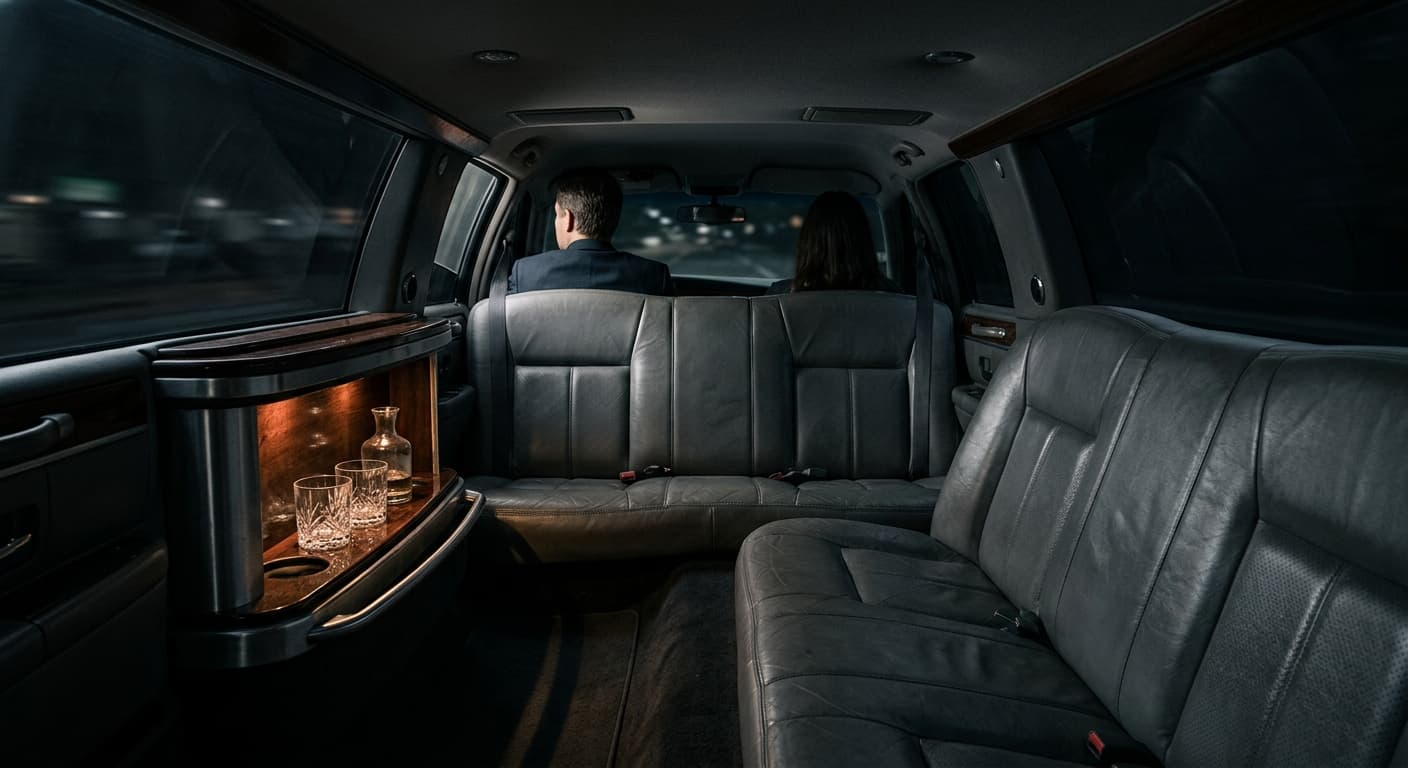
Subsection (d) is a separate, categorical exemption from the whole section, not one of the subsection (b) safe harbors above: "This section shall not apply to any passenger in the passenger area of a motor vehicle designed, maintained or used primarily for the transportation of passengers for compensation." A passenger in a taxi, limousine, or similar for-hire vehicle may have an alcoholic beverage. The driver of that vehicle remains barred from consuming or having an alcoholic beverage within what the statute treats as the driver's zone of control.
Municipalities Can Displace the State Law
Wyoming's local-option structure runs the opposite direction from a state that lets cities add stricter rules on top of its own law. Under this statute, a city or town that has adopted its own ordinance prohibiting open containers is not governed by this state section at all; its own ordinance controls instead, within its boundaries. The state statute applies outside incorporated municipalities, and inside any municipality that has not adopted a competing ordinance of its own. A driver or passenger should check the specific municipality's own ordinance, rather than assume the state statute above applies inside city limits, since a local ordinance's terms, including whether it reaches a parked vehicle, can differ from the state law it replaces.
Penalty
A violation carries a fine, and for repeat convictions, potential jail time, escalating with the number of prior convictions:
- A first conviction, or a subsequent conviction not occurring within one year after the first conviction: a fine of up to $200.
- A second conviction occurring within one year after the first conviction: a fine of up to $300, or up to 30 days imprisonment, or both.
- A third or subsequent conviction occurring within one year after the first conviction: a fine of up to $500, or up to six months imprisonment, or both.
Federal Compliance
Federal law, 23 U.S.C. Section 154, conditions a share of a state's highway funding on having an open container law that bans both possession and consumption, covers the whole passenger area, reaches every occupant, and is primarily enforced. States that fall short have 2.5 percent of certain federal highway apportionments reserved and redirected to highway safety programs, under FHWA's annual apportionment notice. Wyoming is on FHWA's list of non-conforming states for fiscal year 2026 (FHWA Notice N4510.905, dated October 1, 2025). The statute's in-motion-only scope and its municipal-ordinance opt-out are plausible reasons the law does not meet the federal standard, but FHWA's notice does not itself explain which specific element it found lacking, so neither should be treated as the confirmed, sole cause.
For how this rule compares with every other state, see the open container laws by state comparison.
Disclaimer: This article provides general legal information about open container laws in the United States as of September 2026. It is not legal advice. Open container statutes, exemptions, and penalties change, and a municipality's own ordinance may impose different rules than the state law described here; verify the current text of the law that applies where you are before relying on it, and consult a lawyer licensed in Wyoming for advice about a specific situation.
Statutes cited reflect their in-force version as of 2026-09-16. Last updated: 2026-09-16.
Frequently Asked Questions
Does Wyoming's open container law apply to passengers, or just the driver?
It applies to any occupant. The statute's caption mentions the "operator," but the operative subsection uses "no person," which covers passengers as well as the driver.
Is an open container illegal in a parked car in Wyoming?
On the statute's plain text, no. The ban applies only while the vehicle is in motion on a public street or highway; a parked vehicle is not covered by this section.
Can a Wyoming city have a different open container rule than the state?
Yes, and it works differently than in most states. A city or town that has adopted its own open container ordinance is governed by that ordinance instead of the state statute, entirely within its boundaries.
What is the penalty for an open container violation in Wyoming?
It escalates with prior convictions: up to $200 for a first conviction, or for a later conviction that does not occur within one year after the first conviction; up to $300 or 30 days for a second conviction occurring within that one-year window; and up to $500 or six months for a third or later conviction occurring within it.
Updates
Independently fact-checked against the cited primary sources
Sources and References
- Wyo. Stat. Ann. § 31-5-235 - Consumption and possession of alcoholic beverages in opened containers by operator of vehicle prohibited; definitions; penalty(wyoleg.gov).gov
- W.S. § 12-4-410(e) - resealed-wine-bottle transport carve-out referenced by 31-5-235(b)(i)(wyoleg.gov).gov
- 23 U.S.C. § 154(a) - Open container requirements(law.cornell.edu)
- FHWA Notice N4510.905 - FY2026 Apportionment of Federal-Aid Highway Program Funds (open container non-conforming states list)(highways.dot.gov).gov