Canada
Car Seat and Booster Seat Laws in Yukon, the Northwest Territories, and Nunavut
Independently fact-checked against primary sources (last audited August 14, 2026). · 14 primary sources cited on this page. How we verify our legal content
Yukon requires a three-stage car seat and booster system under its Motor Vehicles Act, while the Northwest Territories and Nunavut's child-restraint regulations stop at a rear-facing infant seat and a forward-facing toddler seat, with no booster-seat class written into either territory's law.
Yukon: A Three-Stage Law, With a New Act Not Yet Fully in Force
Yukon's child restraint rules currently live in the Motor Vehicles Act, RSY 2002, c.153, sections 194 through 197. Section 194 makes it an offence to operate a motor vehicle on a highway with a child passenger unless the vehicle has a prescribed child restraint system, the system is properly installed, and the child is properly secured in it. For section 194 purposes, the Act's own definition of "child" is a person under the age of 6.
The specific weight and size brackets for each restraint type are set separately, by regulation under section 196, not spelled out in the Act itself. Yukon's own government guidance page describes the practical result as three stages: an infant stage under 10 kilograms (22 pounds) that is rear-facing, a stage from 10 to 22 kilograms (22 to 48 pounds) that is forward-facing, and a third stage that is a booster seat. The exact upper weight, height, or age cutoff where the booster stage ends could not be independently confirmed against the underlying regulation text for this article, so parents should confirm the current figure with Yukon's Child Car Seat Safety Program rather than assume a specific number. It is also worth noting that the Act's "under 6" definition of "child" governs who must be in a prescribed system under section 194, while the practical three-stage guidance above appears to extend by weight into a booster stage that would often apply to children older than 6; how the regulation itself reconciles those two things was not confirmed in the research behind this article.
Yukon also has a second, newer statute in play. The Traffic Safety Act, SY 2024, c.10, received assent on October 29, 2024, but is not yet fully in force. Its own transitional provisions allow the government to bring certain fine and penalty provisions into early effect while offences are still defined under "the existing Act," meaning the Motor Vehicles Act described above continues to govern child restraints today. A search of the new Act's own text for the words "restraint," "booster," and "child seating" turned up no matches, which suggests the new Act defers its child-passenger-safety rules to regulations that have not yet been made public. Until those regulations appear, this page describes the law currently in force under the Motor Vehicles Act; readers relying on this page for travel well into the future should check whether Yukon's framework has changed by then.
Yukon's stages
| Stage | Threshold | Requirement |
|---|---|---|
| Stage 1 | Under 10 kg (22 lb) | Rear-facing restraint |
| Stage 2 | 10 kg to 22 kg (22 to 48 lb) | Forward-facing restraint |
| Stage 3 | Above roughly 22 kg, exact upper cutoff not independently confirmed | Booster seat |
Who is liable, and who is exempt
Section 194(2) is written as a duty on the driver: "No person shall operate...a motor vehicle in which a child is a passenger unless..." the restraint requirements are met. Liability sits with the person operating the vehicle, not with the child or a third party.
Section 197 exempts several categories of vehicle entirely from sections 194 and 195: motor vehicles manufactured before 1965, taxis, school buses, transit buses, motor coaches, emergency vehicles, and motorhomes. Section 194(3) also allows a medical exemption where a physician or nurse practitioner certifies the child cannot be secured for medical reasons or because of a physical characteristic.
Penalties
Section 195 sets a fine of not more than $100 for a violation of section 194(2). A judge may waive the penalty if the person satisfies the court at sentencing that the vehicle has since been properly equipped, and no further proceedings are taken at all if the investigating officer is satisfied, within 15 days of the offence, that the vehicle has been equipped. That $100 figure is what is printed in the Act's current consolidated text; whether a 2025 regulation changed the amount could not be confirmed for this article, so treat $100 as current-until-verified rather than a settled figure.
Enforcement in practice
No Yukon-specific news release about a car-seat enforcement campaign or blitz was found for this article. What is confirmed is that the Yukon government runs a standing Child Car Seat Safety Program, reachable by phone or email, that offers certified technician assessments, help choosing an appropriate seat, recall and safety-alert information, and community information sessions. That is genuine evidence of an active safety and education program, though it is not evidence of active ticketing enforcement, and readers should not assume one from the other.
Northwest Territories: No Booster Requirement, By the Regulation's Own Definitions
The Northwest Territories' child restraint rules come from the Motor Vehicles Act, R.S.N.W.T. 1988, c.M-16, section 146, together with the Seat Belt Assembly and Child Restraint System Regulations, R.R.N.W.T. 1990, c.M-35, as amended in 2019.

The regulation defines exactly two restraint classes and stops there. It defines "infant" as a person whose weight is less than 9 kilograms, and "toddler" as a person whose weight is 9 kilograms or more but less than 18 kilograms. An infant must be secured in a rearward-facing system meeting the federal CMVSS 213.1 standard, or CMVSS 213.5 for an infant with special needs as defined federally. A toddler must be secured in a system meeting CMVSS 213 or the federal Motor Vehicle Safety Regulations' section 213.4, or CMVSS 213.3 if the child is a disabled person as defined federally.
There is no third weight class in the regulation, and no reference anywhere in its text to a booster-cushion standard. Once a child passes 18 kilograms, roughly 40 pounds, they fall outside the regulation's "prescribed child restraint system" entirely. What governs instead is the parent Act's section 146(4)(a), which simply requires a passenger under 15 to wear a complete seat belt assembly. That is an affirmative, text-based confirmation that the Northwest Territories has no booster-seat law, drawn from reading where the regulation's own defined terms stop, not from failing to find a booster rule elsewhere.
The Northwest Territories' classes
| Class | Weight | Requirement |
|---|---|---|
| Infant | Less than 9 kg | Rearward-facing restraint, CMVSS 213.1 (or 213.5 for special needs) |
| Toddler | 9 kg up to 18 kg | Restraint meeting CMVSS 213 or MVSR s.213.4 (or 213.3 for a disabled person) |
| 18 kg and above, under 15 years old | No restraint type prescribed | Ordinary seat belt, under MVA s.146(4)(a) |
Who is liable, and who is exempt
Section 146 frames the child-restraint duty as a duty on "the operator," the same driver-liability pattern as Yukon. Taxis are exempt separately for each class: the infant section does not apply to a taxi operator transporting an infant for compensation, and the toddler section carries the identical exemption. The regulations also exempt correctional and police transport of persons in custody where restraints have been removed to facilitate lawful transport, and exempt ambulance patients and attendants where wearing a seat belt is impracticable.
Penalties and demerit points
The Act itself does not print a specific dollar fine for a section 146 child-restraint violation. Instead, section 338 sets a general ceiling that applies to any offence under the Act or its regulations: a fine not exceeding $5,000, imprisonment for up to six months, or both. No public schedule showing the actual dollar amount issued for a specific child-restraint ticket was located for this article, so the real-world amount should be confirmed with Northwest Territories courts or the RCMP rather than assumed from the statutory ceiling.
The territory's Driver's Licence Demerit Point Regulations do assign points for this violation: 2 demerit points for operating a motor vehicle in which a child is not properly secured in a prescribed child restraint system. The regulation's schedule lists this item against section 146(4)(b) of the Motor Vehicles Act, the same provision that sets the child-restraint duty.
Enforcement in practice
The Northwest Territories' Department of Infrastructure appears to maintain a page describing a child car seat safety program, though its current content could not be independently verified for this article. No Northwest Territories-specific RCMP news release about a car-seat enforcement campaign was located. As with Yukon, this points to a thin public enforcement-communications record rather than to any conclusion about how often the law is actually enforced.
Nunavut: The Same Textual Gap, With an Open Currency Question
Nunavut's Traffic Safety Act is, textually, the same 1988 Northwest Territories Motor Vehicles Act that Nunavut inherited at division on April 1, 1999, later renamed. Its child restraint regulation, the Seat Belt Assembly and Child Restraint System Regulations, R.R.N.W.T. (Nu) 1990, c.M-35, shares the same citation lineage as the Northwest Territories' regulation described above, but Nunavut's copy has not received the 2019 amendments that updated the Northwest Territories' version.
This matters for a reason beyond the child-restraint rules themselves. Nunavut's official consolidation is stamped, on the document itself, "Current to: 2019-12-06." The government's own website separately displays a banner stating that the consolidation is not up to date, and lists five amending statutes passed since then, in 2020, twice in 2021, in 2025, and in 2026, that are not reflected in the text. Whether any of those amendments touched the seat belt or child-restraint provisions was not established for this article. Treat everything below as an accurate reading of the currently published consolidation, with that open question attached: it is possible, not confirmed, that something has changed since 2019 that the published text does not yet show.
With that caveat stated, Nunavut's regulation defines the same two classes as the Northwest Territories' regulation: an infant under 9 kilograms in a rearward-facing system, and a toddler from 9 kilograms up to 18 kilograms in a forward-facing system. There is no booster class here either. Two differences from the Northwest Territories' current version are worth noting as real, sourced facts rather than errors: Nunavut's older text has no special-needs or disabled-persons carve-outs at all, since those provisions were only added to the Northwest Territories' regulation in 2019. And Nunavut's toddler rule includes an ownership-based exception the Northwest Territories' current version does not: in a vehicle that is not owned, leased, or regularly used by the child's own parent or guardian, such as a friend's or rental car, a toddler may be secured with an ordinary seat belt lap strap alone instead of a child restraint system.
Nunavut's classes
| Class | Weight | Requirement |
|---|---|---|
| Infant | Less than 9 kg | Rearward-facing restraint |
| Toddler, parent's own vehicle | 9 kg up to 18 kg | Restraint system |
| Toddler, a vehicle not owned or regularly used by a parent or guardian | 9 kg up to 18 kg | Restraint system, or an ordinary seat belt lap strap |
Who is liable, and who is exempt
Liability again sits with the person operating the vehicle. Taxi operators are exempt when transporting an infant or toddler for compensation, under the regulation's own terms.
A genuinely open question the research behind this article could not resolve: whether the Act applies uniformly across Nunavut's communities, all 25 of which are reachable only by air or sealift and have no road connection to the rest of Canada or to each other. No provision was found that either limits or confirms application by community or by road-network connectivity; the Act's text simply applies wherever there is a "highway" as defined, and individual Nunavut communities do have local road networks even without inter-community connections. This should not be stated either way without further confirmation.
Penalties and demerit points
Nunavut's general penalty structure mirrors the Northwest Territories', since both derive from the same source Act: a fine not exceeding $5,000, imprisonment for up to six months, or both, for an offence under the Act or its regulations. No Nunavut-specific dollar figure for a child-restraint ticket was located.
Nunavut has its own Driver's Licence Demerit Point Regulations, and its schedule assigns 2 demerit points for failing to secure a child in a child restraint system, listed against section 146(6). In Nunavut's consolidated Act, section 146(6) is the child-restraint provision. The currency caveat above applies here too: the published consolidations may not reflect every later amendment.
Enforcement in practice
No Nunavut-specific news release about a car-seat enforcement campaign was located. Policing in Nunavut falls under the RCMP's V Division. As with the other two territories, this points to a thin public enforcement-communications record, not to a conclusion about how the law is actually applied.
Beyond the Legal Minimum: Why a Booster Still Matters Where the Law Doesn't Require One
The Northwest Territories' and Nunavut's regulations stop prescribing a restraint type once a child passes about 18 kilograms, meaning the law allows an ordinary lap-and-shoulder seat belt from that point on, even though that belt is sized and positioned for an adult body. That is a description of what the law requires. It is not a description of what is safest, and meeting it is a floor, not a safety endorsement.
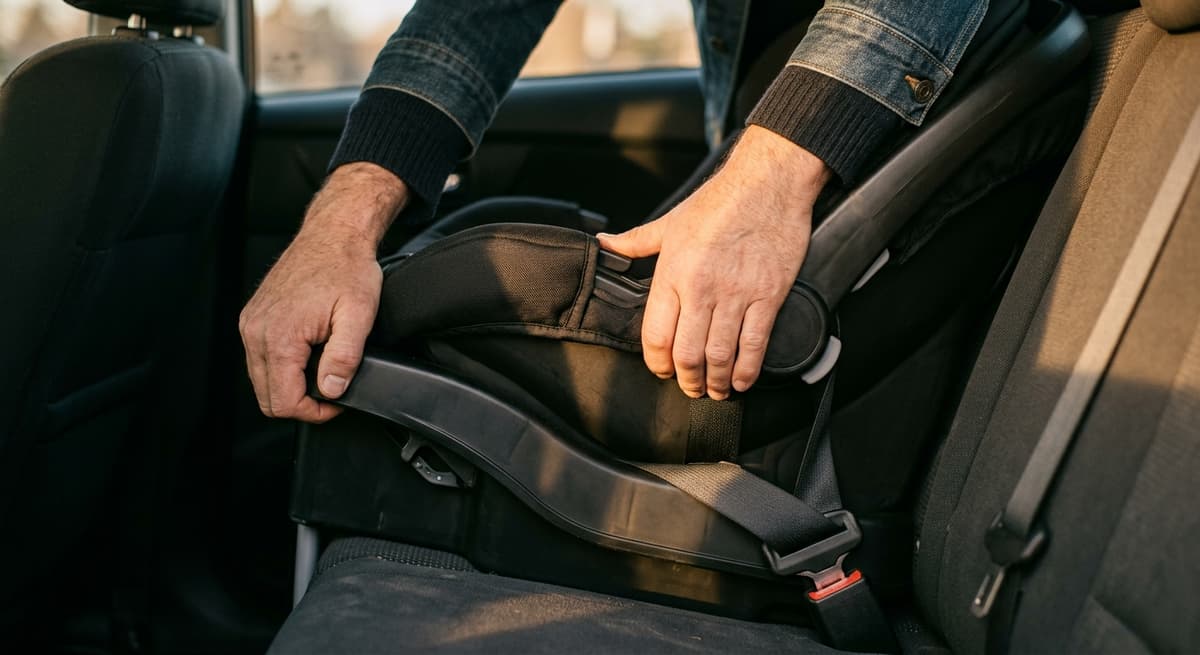
Transport Canada's own certification framework already treats booster cushions as part of the same regulated safety-equipment family as car seats, not as an optional extra. The regulations Transport Canada administers for child restraints cover child car seats and booster cushions together, with booster cushions governed by their own federal safety standard under the same Motor Vehicle Restraint Systems and Booster Seats Safety Regulations framework that certifies infant and toddler seats. In other words, a booster cushion sold in Canada must meet a real federal safety standard even in a territory where using one is not yet a legal requirement.
Yukon's own government has, for its part, already built a booster stage into its official three-stage guidance, the same progression, rear-facing infant seat, forward-facing toddler seat, then booster seat, that appears across Canadian car-seat guidance generally. A child who moves from the Northwest Territories or Nunavut into Yukon, or into a province, would be expected to continue into a booster seat under that jurisdiction's own rules. The growth-based reasoning behind a booster does not stop applying at a territorial border just because a particular territory's current law does not yet require one.
For parents and caregivers in the Northwest Territories or Nunavut deciding when a child is actually ready to move from a booster into an adult seat belt alone, the more reliable guide is the seat manufacturer's own weight, height, and age instructions, together with Transport Canada's general recommendation to follow the manufacturer's instructions for the specific seat in use, rather than the absence of a territorial law.
The Canada Car Seat Checker shows which restraint applies for a child's exact age, weight and height in Yukon, the Northwest Territories or Nunavut, along with the rule and any penalty.
The Federal Layer: Manufacturing Standards, the National Safety Mark, and US-Bought Seats
Every one of the rules above is a territorial rule about how a car seat must be used on a specific trip. A separate, federal layer governs something different: what a car seat must be, and whether it may be sold, before it ever reaches a vehicle.
What CMVSS 213 actually governs
Transport Canada's own explainer states that the Motor Vehicle Safety Act requires products like child car seats and booster cushions manufactured for sale in Canada, or imported into Canada, to be certified and clearly labelled as complying with all applicable Canadian standards. That confirms the core division that runs through this whole page: CMVSS 213 and its related sub-standards regulate manufacture, certification, and import or sale. They do not regulate the act of using a particular seat on a particular trip. That use layer is entirely territorial or provincial, as described above.
The specific sub-standards, cross-confirmed by both territorial regulations read for this article, which cite these same numbers directly, are CMVSS 213 and 213.1 for the base infant and child restraint standard, 213.3 for restraint systems for disabled persons, 213.4 as an alternate compliance path referenced in the federal Motor Vehicle Safety Regulations, and 213.5 for restraint systems for infants with special needs. Booster cushions are covered by a distinct standard, commonly referenced as CMVSS 213.2, under the Motor Vehicle Restraint Systems and Booster Seats Safety Regulations; the full text of that regulation was located but not read section by section for this article, so specific booster-cushion provisions should be confirmed directly before being cited verbatim elsewhere.
The National Safety Mark, and why a US-bought seat is not legal here
Transport Canada's own cross-border shopping advisory states the position plainly: child, infant, and booster seats that do not comply with certain specifications of Canada's Motor Vehicle Restraint Systems and Booster Seat Safety Regulations must not be imported, advertised, or sold in Canada, and provincial and territorial legislation does not allow their use. Transport Canada adds that it is not advisable to buy a restraint system in the United States, Europe, or elsewhere and use it in Canada, because it does not meet the applicable CMVSS requirements, and "it cannot be used legally in any province or territory."
That last point has teeth specifically because of how the territorial rules above are written. Every child-restraint regulation read for this article, in all three territories, defines the legally required restraint by cross-referencing a specific CMVSS-certified standard number, not any country's standard generally. A seat certified only to United States standards fails that test on its face, even though the underlying vehicle-use law is territorial rather than federal.
A concrete, recent example makes this less abstract. In March 2026, Transport Canada issued a recall notice for certain Evenflo car seats, including the Pivot Xpand TS, Omni Ultra Travel System, and Revolve360 Extend Quartz models, that were manufactured and certified for the United States market but inadvertently shipped to Canada. Fifteen units were sold in Canada. Transport Canada's notice explained that Canadian and US requirements differ, including a requirement that Canadian labels and instructions appear in both official languages, which the US-certified units did not meet. Separately, in August 2026, Transport Canada issued a different recall for certain Evenflo REO car seats over a headrest that could shift position in forward-facing mode, affecting 6,223 units sold in Canada, a reminder that the recall system also catches ordinary mechanical defects unrelated to certification.
Expiry dates are a manufacturer decision, not a regulatory one
Transport Canada's own page on the subject states that although not required by regulation, most or all child car seats and booster seats sold in Canada carry an expiry date or useful life date, and that Transport Canada recommends parents and caregivers follow the manufacturer's instructions and warnings for the specific seat in use. An expiry date on a seat is a manufacturer's decision, not a federal or territorial statutory requirement, though following it is still the recommended practice.
Who regulates what
Transport Canada's own explainer states the division plainly: the federal government sets and enforces the safety standards required for new vehicles sold in Canada and for imported vehicles, while provincial and territorial highway traffic acts regulate drivers and vehicle use, including driver's licences, vehicle loading, winter tire use, and seat belt and child seat use. That is exactly the split visible in every regulation read for this article: the federal government controls what a seat must be to be sold in Canada, and each territory controls whether, and how, it must actually be used.
What This Means If Something Goes Wrong
The documented consequences differ by territory, and only what was actually verified is stated here. In Yukon, a violation carries a fine of not more than $100 under the Motor Vehicles Act, with a judge able to waive it if the vehicle is properly equipped by sentencing, and no further proceedings at all if it is equipped within 15 days of the offence. In the Northwest Territories and Nunavut, there is no seat-specific dollar figure printed in either Act; violations fall under the general offence provision, a fine of not more than $5,000, up to six months in jail, or both, though the actual amount issued on a specific ticket was not located for this article and should be confirmed with local courts or the RCMP. The Northwest Territories and Nunavut each also assign 2 demerit points to a child-restraint violation under their own demerit point regulations.
None of that changes what actually happens in a crash. A ticket, or the absence of one, has no bearing on whether a child's body is properly supported by a restraint sized for their weight rather than a seat belt sized for an adult. A low or unverified ticket count is not evidence that a particular restraint choice is safe; it is only evidence about how often, or how visibly, the rule has been enforced. The "Beyond the Legal Minimum" section above describes what should actually guide that decision, regardless of what a given territory's current law requires.
Related Resources
Frequently Asked Questions
Does Yukon require a booster seat by law?
Yukon's own government guidance describes a three-stage system ending in a booster seat as Stage 3. The exact upper weight, height, or age cutoff for that stage was not confirmed against the underlying regulation for this article, and a new Traffic Safety Act, assented in 2024 but not yet fully in force, could eventually change the framework.
Do the Northwest Territories or Nunavut require booster seats?
No. Both territories' child-restraint regulations define only an infant class, under 9 kg, and a toddler class, 9 kg up to 18 kg, with no third, booster-specific class. A child above roughly 18 kg is governed by the ordinary seat belt requirement instead.
If there's no booster law, is it still safer to use a booster seat?
Yes. The absence of a legal requirement is a statement about the law, not a safety opinion. Transport Canada's own certification framework already treats booster cushions as part of the same regulated safety-equipment family as car seats.
Can I use a car seat I bought in the United States in Yukon, the Northwest Territories, or Nunavut?
No. Transport Canada states that a seat certified only to US standards «cannot be used legally in any province or territory» in Canada, because every territorial and provincial law requires a restraint certified to Canada's own standards.
Are taxis exempt from car seat laws in these territories?
Yes, in all three. Yukon's Motor Vehicles Act exempts taxis outright, along with pre-1965 vehicles, school buses, transit buses, motor coaches, emergency vehicles, and motorhomes. The Northwest Territories and Nunavut both exempt a taxi operator specifically when transporting an infant or toddler for compensation.
Is Nunavut's car seat law up to date?
Not confirmed either way. Nunavut's consolidated Traffic Safety Act text is stamped current only to December 6, 2019, and the territorial government's own website flags five amending statutes since then that are not reflected in that text. Whether any of them changed the child-restraint rules was not established in the research behind this article.
What's the fine for a car seat violation in these territories?
In Yukon, up to $100 under the Motor Vehicles Act, waivable if the vehicle is properly equipped by sentencing. In the Northwest Territories and Nunavut, there is no seat-specific dollar figure in the Act; the general penalty is a fine of not more than $5,000, up to six months in jail, or both, and the actual amount for a specific ticket should be confirmed locally.
Do car seats expire in Canada?
Most do, but that is set by the manufacturer, not by federal or territorial regulation. Transport Canada recommends following the manufacturer's instructions and expiry date for the specific seat in use.
Updates
Corrected the Northwest Territories demerit points for a child-restraint offence from 3 to 2 (Motor Vehicles Act s.146(4)(b)) and removed an incorrect section cross-reference; added Nunavut's confirmed figure of 2 demerit points (s.146(6)).
Independently fact-checked against the cited primary sources
Sources and References
- Yukon Motor Vehicles Act, RSY 2002, c.153, ss.194-197 (child restraint systems)(laws.yukon.ca).gov
- Yukon Traffic Safety Act, SY 2024, c.10 (assented, not yet fully in force)(laws.yukon.ca).gov
- Government of Yukon, Child Car Seats guidance and Child Car Seat Safety Program(yukon.ca).gov
- Northwest Territories Motor Vehicles Act, R.S.N.W.T. 1988, c.M-16, s.146(justice.gov.nt.ca).gov
- NWT Seat Belt Assembly and Child Restraint System Regulations, R.R.N.W.T. 1990, c.M-35(justice.gov.nt.ca).gov
- NWT Driver's Licence Demerit Point Regulations, R-093-93(justice.gov.nt.ca).gov
- Nunavut Traffic Safety Act consolidation (current to 2019-12-06)(nunavutlegislation.ca).gov
- Nunavut Seat Belt Assembly and Child Restraint System Regulations, R.R.N.W.T. (Nu) 1990, c.M-35(nunavutlegislation.ca).gov
- Transport Canada, safety regulations and standards that apply to child car seats and booster cushions(tc.canada.ca).gov
- Transport Canada, child car seat cross-border shopping advisory(tc.canada.ca).gov
- Transport Canada recall notice, Evenflo US-certified seats incorrectly shipped to Canada (March 2026)(tc.canada.ca).gov
- Transport Canada recall notice, Evenflo REO car seats headrest defect (August 2026)(tc.canada.ca).gov
- Transport Canada, expiry dates on child car seats and booster seats(tc.canada.ca).gov
- Transport Canada, federal and provincial/territorial government responsibilities for vehicle safety(tc.canada.ca).gov