New Brunswick
New Brunswick Car Seat Laws: Age, Weight, and Height Rules
Independently fact-checked against primary sources (last audited August 14, 2026). · 6 primary sources cited on this page. How we verify our legal content

In New Brunswick, a child under 9 years old, weighing less than 36 kg, and standing less than 145 cm tall must ride in an approved child seating and restraint system, not just a seat belt, under New Brunswick Regulation 83-163.
What New Brunswick's Law Requires
New Brunswick's child restraint rule sits in Section 6 of New Brunswick Regulation 83-163, the Seat Belt Regulation, made under Section 200.1 of the Motor Vehicle Act, R.S.N.B. 1973, c. M-17. The current official text is consolidated to December 18, 2020.
The regulation places the duty on the driver: «A driver of a motor vehicle on a highway shall ensure that a passenger who meets all of the following criteria is occupying and is properly secured in a child seating and restraint system prescribed under section 7.»
Those criteria are joined by AND, not OR. The passenger must be under 9 years of age, and weigh less than 36 kg, and have a standing height of less than 145 cm. All three conditions have to hold at once for the requirement to apply. The moment any single one is exceeded, whether the child turns 9, reaches 36 kg, or reaches 145 cm, the child restraint mandate ends and an ordinary seat belt becomes the legal requirement, whichever of the three happens first.
One Combined Band, Not Three Staged Classes
This is a real structural difference from provinces like Nova Scotia and Prince Edward Island, which define separate legal classes for infants, toddlers, and older children directly in their own regulations. New Brunswick's regulation sets a single combined threshold band and leaves the choice of restraint type to Section 7: the device must be used «in accordance with the manufacturer's instructions and specifications as to weight and, where applicable, height of the child,» and it must conform to Canada Motor Vehicle Safety Standard (CMVSS) 213, 213.1, 213.2, or 213.4.
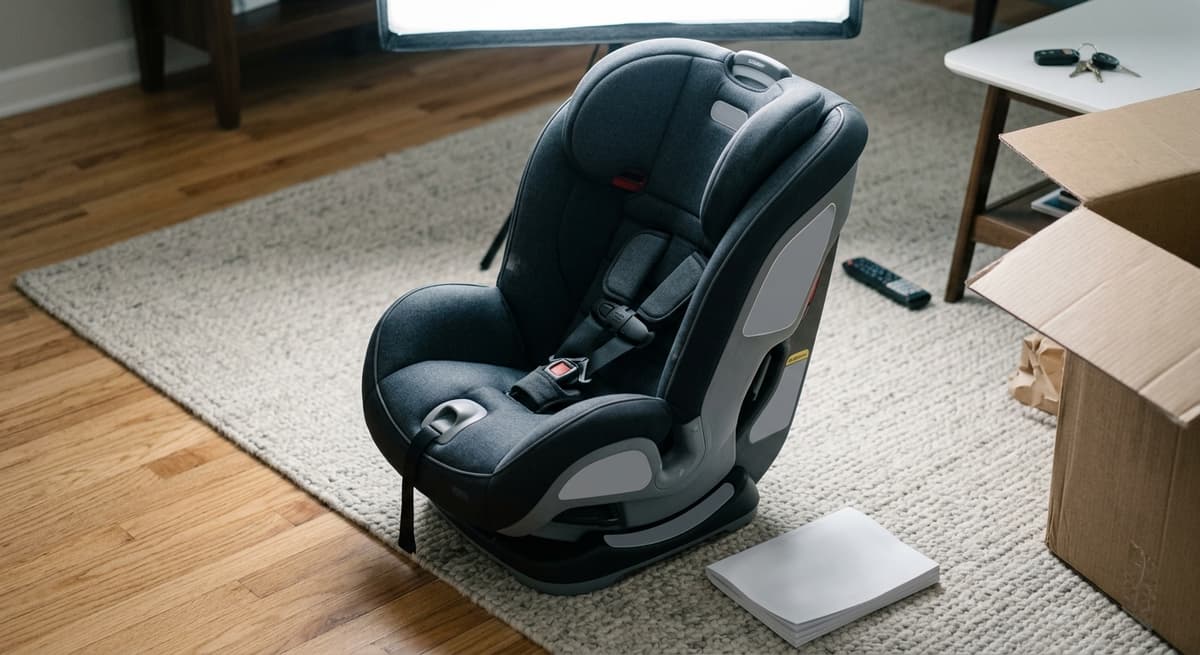
In practice, this still produces a staged progression, because a manufacturer's own instructions typically call for a rear-facing seat first, then a forward-facing seat, then a booster. New Brunswick's own government guidance describes that practical staging separately from the law itself; see «Beyond the legal minimum» below.
| Threshold (all three must apply) | Legal requirement |
|---|---|
| Under 9 years old, AND under 36 kg, AND standing height under 145 cm | Must occupy a child seating and restraint system meeting CMVSS 213, 213.1, 213.2, or 213.4, installed and used exactly per the manufacturer's instructions |
| Any one of the three limits is reached (age 9, or 36 kg, or 145 cm, whichever comes first) | An ordinary seat belt satisfies the law |
Who Must Comply, and Who Is Exempt
The duty runs to the driver, not the child or a third party. New Brunswick Regulation 83-163 sets out several specific exemptions:
- Taxicabs: a taxicab driver transporting a passenger under 16 for hire is exempt (s.4(a)).
- Rideshare, added in 2020: a driver of a private passenger vehicle transporting a passenger under 16 while providing a vehicle-for-hire service is exempt (s.4(a.1), added by 2020, c.30, s.6). This extended the taxi carve-out to Uber-style rideshare specifically in 2020, a distinctive New Brunswick choice.
- Buses and school buses transporting passengers under 16 in the course of duty (s.4(b)).
- Emergency vehicles transporting passengers under 16 in the course of duty (s.4(c)).
- Canada Post rural mail carriers (s.3).
- Out-of-province registered vehicles are exempt from the child restraint requirement specifically, though not from the general seat belt requirement (s.6.1). That exemption does not apply if the vehicle is a rental rented under an agreement made in New Brunswick (s.6.1(2)).
- No medical exemption: unlike Nova Scotia, PEI, and Newfoundland and Labrador, the text of NB Reg 83-163 does not include a medical exemption clause for the child restraint requirement specifically. One may exist elsewhere in the Motor Vehicle Act, but it was not located in this regulation's own text.
Fines: What We Could Confirm, and What We Could Not
New Brunswick's regulation does not itself print a dollar fine for a child restraint violation, and this page does not publish a specific figure. A minimum-fine amount circulates on secondary websites, but it could not be confirmed against a primary New Brunswick fine schedule; the relevant laws.gnb.ca fine-schedule page returned a server error during research for this article. If you need the current, official fine amount, contact your local New Brunswick court office or the RCMP detachment for your area.
Enforcement in New Brunswick
The most recent dated enforcement data point found for New Brunswick is an RCMP news release covering a three-day traffic enforcement operation in the Greater Moncton area, July 11 to 13, 2025. RCMP issued 304 tickets in total: 63 for speeding, 61 for an invalid inspection, 31 for not wearing a seatbelt, 82 for other Motor Vehicle Act violations, and towed 40 vehicles.

The release does not break the 31 seatbelt tickets down by adult seat belt versus child restraint violations specifically, so it is evidence of general roadside enforcement activity in the province, not a confirmed count of child restraint tickets alone. No New Brunswick-specific child restraint compliance study, of the kind Nova Scotia has run through Dalhousie University and the IWK Health Centre, was found for this page.
Beyond the Legal Minimum: What New Brunswick's Own Guidance Recommends
New Brunswick's consumer guidance on gnb.ca describes a staged progression more specific than the bare legal text: rear-facing until about 1 year old and 10 kg, forward-facing from roughly 10 to 18 kg, and a booster from about 18 kg until the child ages out at 9 years, 36 kg, or 145 cm. That staging is a recommendation, not a separate legal requirement. Because Section 6 of the regulation only requires a CMVSS-conforming device used per the manufacturer's instructions within the combined band, a parent who moves a child out of a rear-facing seat earlier than the guidance suggests, but still within what that seat's own manufacturer allows, is not on that basis alone violating Section 6.
Transport Canada, the federal safety-standards authority, takes a version of the same position for the country as a whole. It recommends that parents and caregivers follow the manufacturer's instructions and warnings for their specific car seat or booster model, rather than switching stages at the earliest point a jurisdiction's legal minimum would technically allow.
For a quick check against New Brunswick's own thresholds, the Canada Car Seat Checker takes a child's age, weight and height and shows which restraint the law currently requires.
The Federal Layer: Certification, the Safety Mark, and Expiry
Transport Canada, not the province, sets and certifies the safety standards a car seat or booster must meet before it can be sold in Canada, under the CMVSS 213 family of standards. That federal layer governs manufacture, certification, and import or sale. It does not govern whether a specific child is properly secured on a specific trip, which is New Brunswick's own regulation's job.
A seat certified only to the equivalent US standard, FMVSS 213, does not meet Canada's CMVSS requirements. Transport Canada's own cross-border guidance states that such a seat must not be imported, advertised, or sold in Canada, and cannot be used legally in any province or territory, including New Brunswick, even if a parent buys it while travelling in the United States.
Expiry dates are not a New Brunswick statutory requirement. Transport Canada confirms that although not required by regulation, most car seats and booster seats sold in Canada carry a manufacturer expiry or useful-life date, and it recommends following the manufacturer's own instructions for that specific seat.
What's at Stake Beyond a Ticket
New Brunswick's enforcement data is thin, and a low or unconfirmed ticket count is not evidence that misuse is rare or that the child restraint requirement does not matter. The requirement exists because a correctly used, age- and size-appropriate restraint measurably reduces injury risk to a child in a crash. That safety rationale does not depend on whether a driver happens to be stopped and ticketed on a given trip.
This page does not cover, and cannot confirm, whether a child restraint violation carries separate consequences beyond a ticket, such as an effect on an insurance claim after a collision. A parent with a specific concern about that scenario should ask a New Brunswick-licensed lawyer or their insurer directly.
Information last verified 2026-08-14, drawn directly from New Brunswick Regulation 83-163 on laws.gnb.ca, the Government of New Brunswick's child safety seat guidance page, and RCMP New Brunswick's July 2025 enforcement release. This article has not yet been reviewed by a licensed lawyer.
Related Resources
Last updated: 2026-08-14.
Frequently Asked Questions
What are New Brunswick's car seat law thresholds?
A child must be in an approved child seating and restraint system while under 9 years old, AND weighing less than 36 kg, AND standing less than 145 cm tall, all three at once (NB Reg 83-163, s.6). The requirement ends the moment any one of those three limits is reached, whether the child turns 9, reaches 36 kg, or reaches 145 cm, whichever comes first.
Does New Brunswick require different seats for infants, toddlers, and booster stages?
Not as separate legal categories. New Brunswick's regulation sets a single combined age, weight, and height band and requires whatever CMVSS-conforming device the manufacturer's instructions call for within that band. In practice that still produces a rear-facing, then forward-facing, then booster progression, but that staging is government guidance, not a separately numbered legal requirement the way it is in Nova Scotia or PEI.
Are taxis exempt from New Brunswick's child seat law?
Yes. A taxicab driver transporting a passenger under 16 for hire is exempt. In 2020, New Brunswick extended that same exemption to rideshare drivers, covering a private passenger vehicle used to provide a vehicle-for-hire service.
What is the fine for not using a car seat in New Brunswick?
This page does not publish a specific dollar figure. A minimum-fine amount circulates on secondary websites, but it could not be confirmed against a primary New Brunswick government fine schedule during research. Contact your local court office or RCMP detachment for the current, official amount.
Is there a medical exemption from New Brunswick's car seat law?
None was found in the text of NB Reg 83-163 itself. Nova Scotia, PEI, and Newfoundland and Labrador each have an explicit medical exemption clause in their own regulations; New Brunswick's may exist elsewhere in the Motor Vehicle Act, but it was not located in this regulation's own text.
Can I use a car seat bought in the United States in New Brunswick?
No. Transport Canada's own guidance states that a seat certified only to the US standard (FMVSS 213) does not meet Canada's CMVSS requirements and cannot legally be used in any Canadian province or territory, including New Brunswick, even if it was purchased while travelling in the US.
Updates
Independently fact-checked against the cited primary sources
Sources and References
- New Brunswick Regulation 83-163, Seat Belt Regulation (consolidated to December 18, 2020), under the Motor Vehicle Act(laws.gnb.ca).gov
- Government of New Brunswick, Child Safety Seats guidance page(gnb.ca).gov
- RCMP New Brunswick, RCMP issue 304 tickets during traffic enforcement operation (July 2025)(rcmp.ca).gov
- Transport Canada, Safety regulations and standards that apply to child car seats and booster cushions(tc.canada.ca).gov
- Transport Canada, Child car seat cross-border shopping: what parents and caregivers should know(tc.canada.ca).gov
- Transport Canada, Expiry dates on child car seats and booster seats(tc.canada.ca).gov