
North Carolina
North Carolina Self-Driving Car Laws: Driverless Rules (2026)
Independently fact-checked against primary sources (last audited September 30, 2026). · 2 primary sources cited on this page. How we verify our legal content

Yes, if the vehicle meets every requirement North Carolina law sets for a "fully autonomous vehicle." Under G.S. 20-401, a person may operate one on North Carolina roads only when the vehicle can obey the state's traffic laws, meets federal safety certification, can handle its own crash duties, can bring itself to a safe stop, is insured and is registered as a fully autonomous vehicle. There is no separate state permit, and the person operating it does not need a driver's license while the automated driving system is engaged.
Are driverless cars legal in North Carolina?
Yes, if the vehicle qualifies as a "fully autonomous vehicle" and meets every requirement in G.S. 20-401. The statute says a person "may operate a fully autonomous vehicle if the vehicle meets all of the following requirements." A vehicle that misses any one of them does not get the benefit of the section.
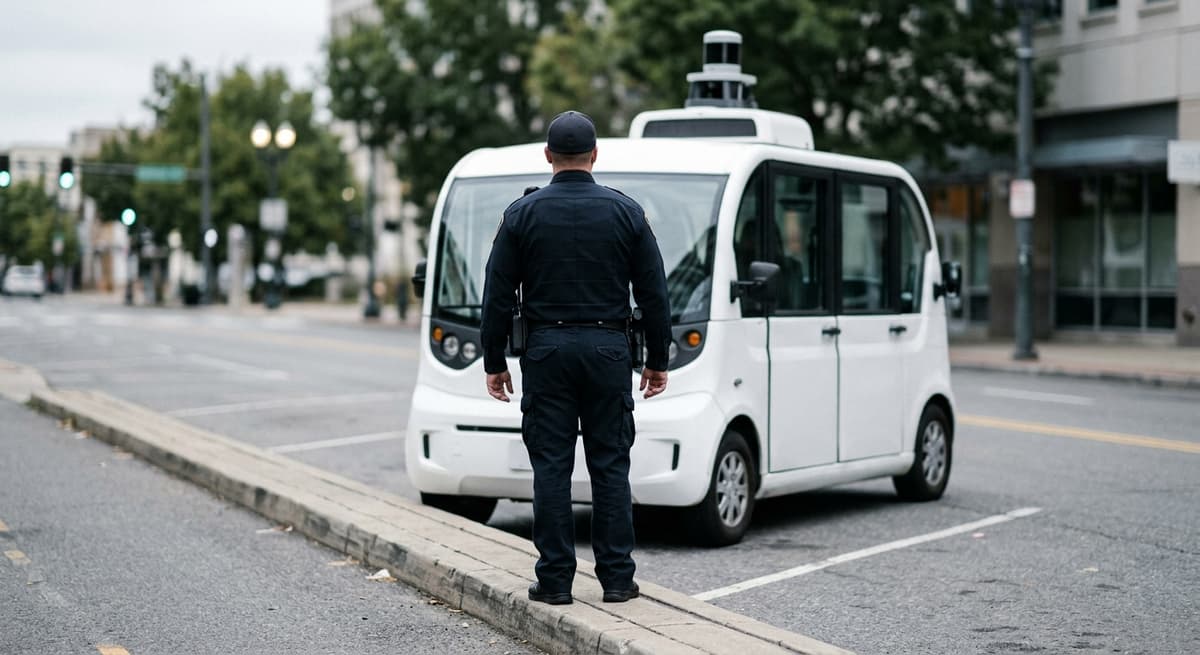
The requirements are:
- Traffic-law capability. Unless an exception or exemption applies under state or federal law, the vehicle must be capable of being operated in compliance with Articles 3, 3A, 7, 11 and 13 of Chapter 20, the state's motor vehicle code.
- Federal compliance. Unless an exception or exemption applies, it must comply with applicable federal law and regulations and be certified under 49 C.F.R. Part 567 as meeting federal motor vehicle safety standards, bearing the required certification label.
- Crash-duty capability. It must be able to meet the post-crash conditions described below.
- Minimal risk condition. It must be able to reach a "minimal risk condition," which the statute defines as a reasonably safe state, bringing the vehicle to a complete stop, if the automated driving system fails.
- Insurance. It must be covered by a motor vehicle liability policy meeting G.S. 20-279.21.
- Registration. It must be registered under the state's registration Part, and a vehicle registered in North Carolina must be identified on its registration and registration card as a fully autonomous vehicle.
North Carolina does not require a company to apply for a state testing or deployment permit before putting a vehicle that meets these conditions on the road. Article 18 contains no permit process at all. Registration runs through the ordinary vehicle registration system.
What counts as a "fully autonomous vehicle" in North Carolina?
G.S. 20-400 defines a fully autonomous vehicle as a motor vehicle with an automated driving system "that will not at any time require an occupant to perform any portion of the dynamic driving task" while the system is engaged. The dynamic driving task means real-time steering, braking and acceleration, watching the road, responding to objects and events, planning maneuvers and signaling.
If the car has a steering wheel, pedals or other controls, they must be "stowed or made unusable" so that an occupant cannot take control while the system is engaged. A vehicle with usable controls that a person could grab mid-trip does not fit this definition.
An automated driving system, under the same section, is hardware and software that can perform the entire dynamic driving task on a sustained basis, whether inside a limited operating area (an "operational design domain") or everywhere. In industry terms, fully autonomous vehicles correspond to SAE Levels 4 and 5. Our guide to the levels of driving automation explains those categories.
Do you need a driver's license to ride in a self-driving car in North Carolina?
No license is needed for the operator of a fully autonomous vehicle with the automated driving system engaged. G.S. 20-401 says that, notwithstanding the licensing statute, that operator "is not required to be licensed to operate a motor vehicle."
The statute also narrows who counts as an "operator." An occupant who performs only "strategic driving functions," such as scheduling the trip or choosing destinations and waypoints, is not an operator under G.S. 20-400. A robotaxi passenger who taps in an address is doing exactly that.
This rule applies only while the automated driving system is engaged. A vehicle that expects a human to take over on request is a different category, covered next.
What about cars that ask a human to take over?
G.S. 20-402 covers vehicles with an automated driving system that can perform the entire driving task "with the expectation that a human operator will respond appropriately to a request to intervene." Operation of those vehicles "is lawful under this Chapter and subject to the provisions of this Chapter."
In practice, that means these vehicles are governed by the ordinary motor vehicle code. The special rules in G.S. 20-401 (no license, owner responsibility for moving violations, the crash-duty safe harbor) are written for fully autonomous vehicles, so they do not by their terms reach a car that may hand control back to a human.
Driver-assistance features that need a person watching the road at all times are a further step removed. Because they do not perform the entire driving task, they do not appear to fit the statute's definition of an automated driving system at all. The person behind the wheel is simply the driver. For how that has played out in court, see our page on Tesla Autopilot and FSD lawsuits.
Can a child ride alone in a driverless car in North Carolina?
Not a child under 12. G.S. 20-401 makes it unlawful for a parent or legal guardian of a person under 12 to knowingly let that child occupy a fully autonomous vehicle that is in motion or has the engine running, unless the child is supervised by someone 18 or older.
Parents also stay on the hook for two child-safety laws when no one is driving. The parent or legal guardian of a minor is responsible for a violation of the open-bed pickup rule (G.S. 20-135.2B) or the child restraint law (G.S. 20-137.1) if the violation happens in a fully autonomous vehicle.
Who gets the ticket when a self-driving car breaks a traffic law?
The registered owner. Under G.S. 20-401, the person in whose name a fully autonomous vehicle is registered "is responsible for a violation of this Chapter that is considered a moving violation, if the violation involves a fully autonomous vehicle." For a company-run robotaxi fleet, that points to the company that registered the vehicle, not the rider.
This rule assigns responsibility for moving violations under the motor vehicle code. It does not say who pays for injuries or property damage in a civil lawsuit. Our national guide to whether a self-driving car can get a ticket compares how other states handle it.
Two practical provisions round this out:
- Registration card. For a fully autonomous vehicle, the rules on carrying the registration card are satisfied if the card is in the vehicle, physically or electronically, and readily available for an officer or inspector.
- Not "unattended." A vehicle is not considered unattended under G.S. 20-163 or any other part of Chapter 20 merely because it is a fully autonomous vehicle with the automated driving system engaged.
What happens after a crash involving a self-driving car?
North Carolina's hit-and-run statute (G.S. 20-166) and crash-reporting statute (G.S. 20-166.1) are written with a human driver in mind. G.S. 20-401 adapts them. If a fully autonomous vehicle is in a crash, the listed parts of those statutes "shall be considered satisfied, and no violation of those provisions shall be charged" when all of these conditions are met:
- The vehicle or its operator promptly contacts the appropriate law enforcement agency to report the crash.
- The vehicle or its operator promptly calls for medical assistance, if appropriate.
- For a reportable crash, the vehicle stays at the scene until registration and insurance information is given to the affected parties and a law enforcement officer authorizes removal.
- For a nonreportable crash, the vehicle stays at the scene or in the immediate vicinity until registration and insurance information is given to the affected parties.
A vehicle must be capable of doing all this to be operated legally in the first place. If the conditions are not met, the safe harbor does not apply.
What insurance does a self-driving car need in North Carolina?
The same kind of liability coverage as any other car. G.S. 20-401 requires that a fully autonomous vehicle be "covered by a motor vehicle liability policy meeting the applicable requirements of G.S. 20-279.21." Article 18 sets no special or higher amount for autonomous vehicles.
According to the North Carolina Department of Insurance, for policies issued or renewed on or after July 1, 2025, the minimum limits are $50,000 per person and $100,000 per accident for bodily injury, and $50,000 for property damage. The department also says underinsured motorist coverage is included in all new or renewed policies from that date. The change came from S.L. 2023-133, as amended by S.L. 2024-29.
Article 18 does not say who is civilly liable for a crash. It assigns moving violations to the registered owner, but questions of fault, negligence and product defects are left to ordinary North Carolina law. Our guides to who is liable in a self-driving car accident and self-driving car insurance go deeper.
Can Charlotte, Raleigh or other cities regulate self-driving cars?
Not with ordinances aimed at them. G.S. 20-401 says: "No local government shall enact any local law or ordinance related to the regulation or operation of fully autonomous vehicles or vehicles equipped with an automated driving system." The only exception is regulation already authorized under Chapters 153A (counties) and 160A (cities) that is not specifically related to those vehicles.

So a city can keep enforcing general traffic and parking rules that apply to every car. It cannot adopt its own permit, ban or operating rules just for autonomous vehicles.
Are there robotaxis in North Carolina?
Not in public service, based on the operator's own listing as of September 2026. On February 25, 2026, Waymo announced its intention to bring fully autonomous ride-hailing to Charlotte, and its announcement quoted Governor Josh Stein welcoming the expansion. As of September 2026, Waymo's website lists Charlotte under "Up Next," separately from the cities where it is serving riders.
Article 18 has no ride-hailing or trucking rules, but a separate 2021 law (S.L. 2021-179, G.S. 20-121.2) lets a "neighborhood occupantless vehicle" (a driverless low-speed cargo vehicle, defined in G.S. 20-4.01(23a)) run on roads posted 45 mph or less, and exempts fully autonomous vehicles designed to be operated only by an automated driving system from state equipment rules that exist only to support a human driver. For how robotaxi crashes are handled in states where service is live, see Waymo robotaxi accidents, and for trucks see autonomous truck laws.
What is North Carolina's Fully Autonomous Vehicle Committee?
G.S. 20-403, enacted in 2017, created a Fully Autonomous Vehicle Committee within the Department of Transportation. Its members, as enacted, include the Secretary of Transportation, the Secretary of Commerce, the Commissioner of Insurance, the Highway Patrol, police chiefs' and sheriffs' associations, the UNC Highway Safety Research Center, autonomous vehicle and trucking industry representatives, urban and rural planners, and two members each from the state Senate and House.
The committee is directed to meet at least four times a year, review state motor vehicle law as it relates to deploying fully autonomous vehicles, make recommendations on testing, and recommend changes to state law to the General Assembly. It is advisory: it does not issue permits or approve operators.
Can you be charged with DWI in a self-driving car in North Carolina?
Article 18 does not address impaired driving or riding. It removes the license requirement for the operator of a fully autonomous vehicle with the system engaged, but it says nothing about the impaired driving statutes. Article 18 itself does not answer how those laws apply to a person riding in an autonomous vehicle.
Our national explainer on DUI in a self-driving car covers the general principles, and North Carolina DUI laws covers the state's impaired driving rules for ordinary vehicles.
What to do after a crash with a self-driving car in North Carolina
A crash with an autonomous vehicle starts the same way as any other crash, with a few extra steps:
- Get safe and call 911 if anyone is hurt. Report the crash to police.
- Collect the vehicle's details. Photograph the vehicle, its license plate, any fleet number or company markings, and the scene. North Carolina's crash safe harbor for driverless vehicles depends on the vehicle staying at or near the scene until registration and insurance information is provided to the people affected, so ask for it.
- Identify the registered owner and insurer. For a fleet vehicle, that is usually the operating company.
- Preserve evidence. Autonomous vehicles record camera and sensor data. A lawyer can send a preservation request before that data is overwritten. See do robotaxis record you for what these vehicles capture.
- Watch the deadlines. Injury and property damage claims have filing deadlines. See North Carolina's statute of limitations.
North Carolina's ordinary crash, fault and insurance rules still govern the claim. Our guide to North Carolina car accident laws explains them.
How North Carolina compares
North Carolina's 2017 law authorized driverless operation without a state permit, preempted local rules and assigned moving violations to the registered owner. Other states range from permit-based systems to laws that name the automated system itself as the driver. See the self-driving car laws by state hub, our overview of federal self-driving car laws, and neighboring approaches in Georgia and Tennessee.
Frequently Asked Questions
Are self-driving cars legal in North Carolina?
Yes, if the vehicle is a fully autonomous vehicle that meets every requirement in G.S. 20-401: it can obey the listed traffic laws, meets federal safety certification, can handle its crash duties, can reach a minimal risk condition, is insured under G.S. 20-279.21 and is registered as a fully autonomous vehicle.
Does North Carolina require a permit to test or run driverless cars?
Not a separate permit. Article 18 of Chapter 20 creates no state testing or deployment permit, but the vehicle must meet every G.S. 20-401 requirement and be registered, and a North Carolina registration must identify it as a fully autonomous vehicle. A qualifying vehicle must be registered, and a North Carolina registration must identify it as a fully autonomous vehicle.
Do I need a driver's license to ride in a fully autonomous vehicle in North Carolina?
The operator of a fully autonomous vehicle with the automated driving system engaged is not required to be licensed. A passenger who only chooses the destination or schedules the trip is not an operator under G.S. 20-400.
Who gets a ticket if a driverless car runs a red light in North Carolina?
The person in whose name the fully autonomous vehicle is registered is responsible for a moving violation involving the vehicle under G.S. 20-401. For a fleet vehicle, that is usually the operating company.
Can my child ride alone in a robotaxi in North Carolina?
Not if the child is under 12. It is unlawful for a parent or legal guardian to knowingly let a child under 12 ride in a fully autonomous vehicle that is moving or has the engine running unless someone 18 or older is supervising.
How much insurance does a self-driving car need in North Carolina?
The same liability coverage as other vehicles under G.S. 20-279.21. The Department of Insurance says policies issued or renewed on or after July 1, 2025 carry minimums of $50,000 per person, $100,000 per accident and $50,000 for property damage.
Can Charlotte ban Waymo or other robotaxis?
No local ordinance aimed at them is allowed. G.S. 20-401 bars local governments from enacting laws or ordinances related to regulating or operating fully autonomous vehicles or vehicles with an automated driving system, other than general Chapter 153A and 160A powers not specific to those vehicles.
Is Waymo operating in Charlotte?
Waymo announced in February 2026 that it intends to bring fully autonomous ride-hailing to Charlotte. As of September 2026, its website lists Charlotte as an upcoming city, not one where it is serving riders.
Updates
Independently fact-checked against the cited primary sources
Sources and References
- N.C. Session Law 2017-166 (House Bill 469), chaptered text enacting G.S. 20-400 to 20-403 (Article 18, Regulation of Fully Autonomous Vehicles), effective December 1, 2017(legiscan.com)
- N.C. Gen. Stat. 20-400: definitions (automated driving system, fully autonomous vehicle, minimal risk condition, operator, strategic driving functions)(law.justia.com)
- N.C. Gen. Stat. 20-401: regulation of fully autonomous vehicles (license, minors, owner responsibility, crash duties, operating requirements, local preemption)(law.justia.com)
- N.C. Gen. Stat. 20-402: vehicles expecting a human to respond to a request to intervene(law.justia.com)
- N.C. Gen. Stat. 20-403: Fully Autonomous Vehicle Committee within the Department of Transportation(ncleg.gov).gov
- North Carolina Department of Insurance: changes effective July 1, 2025, including new 50/100/50 minimum liability limits and underinsured motorist coverage (S.L. 2023-133, as amended by S.L. 2024-29)(ncdoi.gov).gov
- UNC School of Government, North Carolina Criminal Law Blog: NC Regulates Fully Autonomous Vehicles (2017 analysis of S.L. 2017-166)(nccriminallaw.sog.unc.edu)
- Waymo announcement, February 25, 2026: intention to bring fully autonomous ride-hailing to Charlotte (company statement)(waymo.com)
- Waymo rides page: cities served and upcoming cities, listing Charlotte under Up Next (company statement, September 2026)(waymo.com)
- N.C.G.S. 20-121.2 and 20-4.01(23a) (S.L. 2021-179): neighborhood occupantless vehicles and equipment rules for fully autonomous vehicles (published NC code text)(unicourt.github.io)