
Maryland
Leyes de Montaje en el Parabrisas de Maryland (Guía 2026)
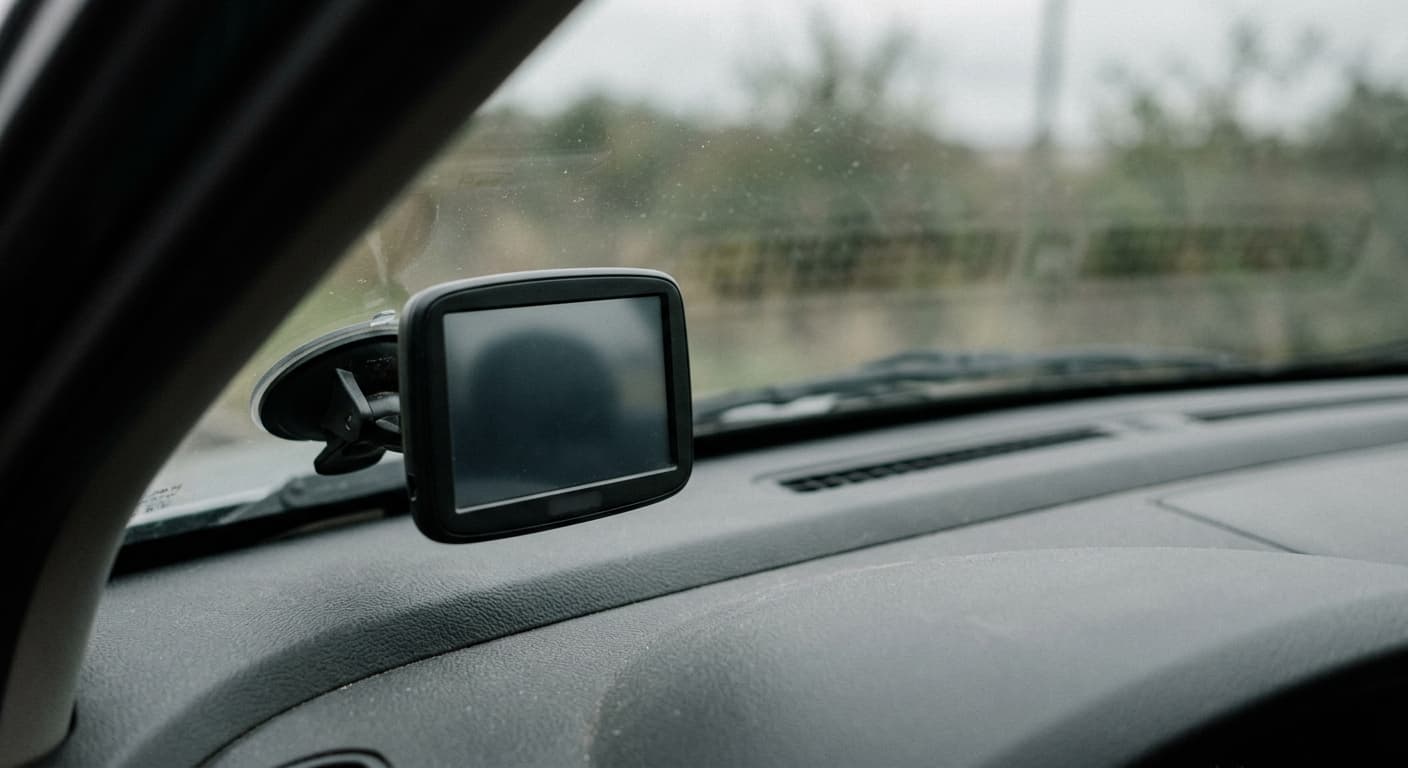
Las reglas de zona del parabrisas de Maryland fueron escritas para materiales planos no transparentes como calcomanías y tarjetas, no para dispositivos electrónicos. El Md. Transp. Code 22-404 permite que material no transparente se coloque por encima de la línea AS-1 (o las 5 pulgadas superiores) o dentro de un área cuadrada de 7 pulgadas en las esquinas inferiores, pero una unidad GPS, teléfono o cámara de tablero montada es alcanzable por separado bajo el Md. Transp. Code 21-1104(c), que prohíbe cualquier objeto que interfiera con la vista despejada del conductor y no ofrece refugio legal por zona para los dispositivos.
La ley de Maryland restringe lo que los conductores pueden fijar en sus parabrisas bajo dos estatutos superpuestos. El Código de Transporte de Maryland 22-404 prohíbe los materiales no transparentes en el parabrisas a menos que se ubiquen dentro de zonas de exención específicas. El Código de Transporte de Maryland 21-1104 es más amplio: el inciso (c) prohíbe cualquier objeto o material en o sobre el vehículo que interfiera con la vista despejada del conductor a través del parabrisas, y el inciso (d) repite la prohibición de materiales no transparentes y sus zonas de excepción en un lenguaje casi idéntico al del 22-404.
La superposición importa a la hora de leer una citación. Las zonas de la Sección 22-404 y las zonas idénticas del 21-1104(d) se aplican a materiales no transparentes como calcomanías y tarjetas, no a dispositivos electrónicos. La Sección 21-1104(c) es la disposición que realmente alcanza una unidad GPS, cámara de tablero o soporte para teléfono montado en el parabrisas, y no ofrece refugio legal basado en zonas para los dispositivos, solo excepciones para el equipo del vehículo y las viseras solares no fijadas al vidrio. Una citación por calcomanía o etiqueta en Maryland suele redactarse bajo el 21-1104(d) en lugar del 22-404, así que no asuma que el 21-1104 es un estatuto exclusivo para dispositivos.
Ley de obstrucción del parabrisas de Maryland (Transp. 22-404)
La Sección 22-404 del Código de Transporte de Maryland establece que una persona no puede conducir ningún vehículo motorizado con ningún letrero, cartel, tarjeta, calcomanía u otro material no transparente en el parabrisas delantero, las aletas laterales, o las ventanas laterales o traseras del vehículo. La única excepción general es un certificado u otro documento exigido por ley o autorizado por el Administrador.
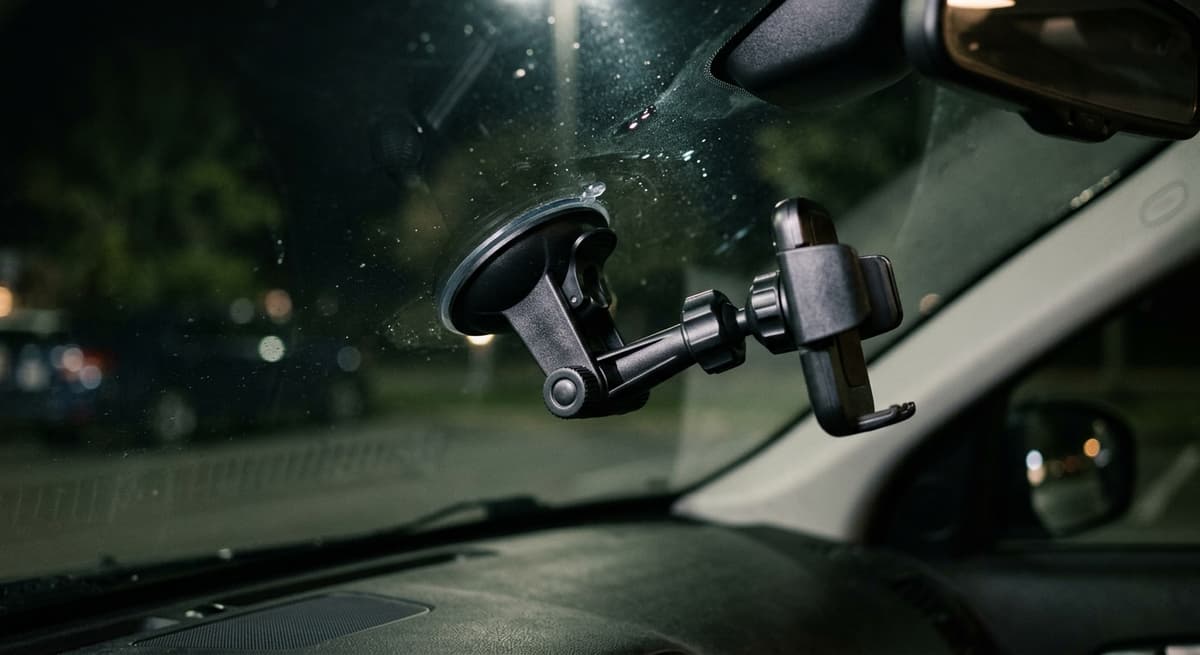
El estatuto luego establece zonas específicas donde se permiten los materiales no transparentes.
La regla de la línea AS-1
Se puede colocar material no transparente en el parabrisas por encima de la línea AS-1 o no más abajo de 5 pulgadas desde la parte superior del parabrisas, lo que sea menor. El material debe colocarse de manera que no interfiera con la vista despejada del conductor sobre el tránsito.
La línea AS-1 es una marca grabada en el vidrio por el fabricante. Normalmente cruza el parabrisas entre 5 y 6 pulgadas debajo del borde superior. Busque una pequeña etiqueta "AS-1" cerca del borde del vidrio. Cualquier material no transparente, como una calcomanía, un permiso de estacionamiento o una tarjeta de transpondedor de peaje, colocado por encima de esta línea está permitido bajo el 22-404 siempre que no bloquee la vista frontal del conductor. Esta zona se aplica a material plano, no a dispositivos electrónicos montados, que se abordan por separado más abajo.
La zona cuadrada de 7 pulgadas en la esquina inferior
También se puede colocar material no transparente en el parabrisas o la ventana trasera dentro de un área cuadrada de 7 pulgadas en la esquina inferior. El material debe colocarse de manera que no interfiera con la vista despejada del conductor sobre el tránsito.
Esta zona está escrita para material no transparente plano, como permisos de estacionamiento, tarjetas de transpondedor de peaje y calcomanías, no para dispositivos electrónicos tridimensionales. Una unidad GPS, soporte para teléfono o cámara de tablero colocada en esta esquina no obtiene el refugio legal del 22-404 de la forma en que lo obtiene una calcomanía, y sigue expuesta por separado a una citación bajo el estándar más amplio de vista despejada del 21-1104(c), que no tiene excepción de zona para dispositivos. El estatuto no especifica si la zona de la esquina debe ser del lado del conductor o del pasajero, por lo que cualquiera de las esquinas está permitida para los materiales que realmente cubre.
Para mantenerse dentro del límite legal en el caso de una tarjeta, calcomanía o artículo plano similar, mida 7 pulgadas desde el borde inferior del parabrisas y 7 pulgadas desde el borde lateral y mantenga el material completamente dentro de ese cuadrado.
Ley de obstrucción de la vista del conductor (Transp. 21-1104)
La Sección 21-1104 del Código de Transporte de Maryland aborda de manera más amplia las obstrucciones a la vista del conductor o al mecanismo de conducción. Este estatuto se aplica a objetos dentro del vehículo, no solo a artículos pegados al vidrio.
Qué prohíbe la ley
Bajo el 21-1104(a), una persona no puede conducir un vehículo si está cargado, o si lleva tantos pasajeros en el asiento delantero, que obstruya la vista del conductor hacia el frente o los lados, o interfiera con el control del conductor sobre el mecanismo de conducción. El inciso (a) no contiene un elemento de "en una carretera", por lo que no está limitado a las vías públicas de la forma en que sí lo está la disposición sobre el parabrisas.
Bajo el 21-1104(c), un conductor no puede operar un vehículo en una carretera con ningún objeto, material u obstrucción en o sobre el vehículo que interfiera con una vista despejada del conductor a través del parabrisas. Esta disposición excluye específicamente el equipo estándar del vehículo y las viseras solares no transparentes que no estén fijadas al vidrio. A diferencia de las zonas de material no transparente, el 21-1104(c) no tiene excepción de línea AS-1 ni de cuadrado de 7 pulgadas, por lo que es la disposición que realmente alcanza una unidad GPS, soporte para teléfono o cámara de tablero montada en el parabrisas sin importar en qué parte del vidrio se encuentre.
Calcomanías y etiquetas bajo el 21-1104(d)
El 21-1104 no es exclusivo para dispositivos. El inciso (d)(1) contiene su propia prohibición de conducir con cualquier letrero, cartel, tarjeta, calcomanía u otro material no transparente en el parabrisas, las aletas laterales, o las ventanas laterales o traseras, en un lenguaje muy similar al del 22-404.
El inciso (d)(2) reproduce entonces las mismas excepciones: material por encima de la línea AS-1 o no más abajo de 5 pulgadas desde la parte superior (d)(2)(i); material dentro de un área cuadrada de 7 pulgadas en la esquina inferior del parabrisas o la ventana trasera (d)(2)(ii); material en las ventanas laterales detrás del conductor en vehículos de pasajeros (d)(2)(iii); material en las ventanas laterales o traseras de vehículos multipropósito o camiones equipados con espejos exteriores dobles (d)(2)(iv); material exigido por una agencia federal o estatal con fines de seguridad (d)(2)(v); letreros de dirección, destino o ruta en transportistas comunes de pasajeros (d)(2)(vi); y dispositivos de cobro electrónico de peaje instalados conforme a las pautas de la Autoridad de Transporte de Maryland (d)(2)(vii).
El punto práctico para los conductores: una citación por calcomanía o etiqueta en Maryland puede redactarse bajo cualquiera de los dos estatutos, y las zonas permitidas son las mismas en ambos casos.
Objetos en el espejo retrovisor
El 21-1104(c)(3)(i) prohíbe por separado conducir en una carretera con cualquier objeto, material u obstrucción que cuelgue del espejo retrovisor y que interfiera con la vista despejada del conductor a través del parabrisas. Esto incluye ambientadores, permisos de estacionamiento, dados de peluche y artículos similares si bloquean la línea de visión del conductor.
La aplicación de ese inciso está limitada por el propio estatuto, no solo por la práctica policial. Bajo el 21-1104(c)(3)(ii), un oficial de policía puede hacer cumplir el inciso sobre el espejo retrovisor únicamente como una acción secundaria, cuando ya ha detenido al conductor por la sospecha de otra infracción del Código. Un ambientador colgante, por sí solo, no es una base legal para una parada de tránsito en Maryland.
Colocación de soportes de GPS y teléfono
La ley de Maryland no menciona específicamente los dispositivos GPS ni los soportes para teléfono, y el texto sobre materiales no transparentes tanto del 22-404 como del 21-1104(d) está escrito para cubiertas planas (letrero, cartel, tarjeta, calcomanía), una categoría que no describe un dispositivo electrónico montado. Colocar una unidad GPS o un soporte para teléfono dentro de esas dos zonas no crea el mismo refugio legal que crea para una calcomanía o un permiso de estacionamiento.
En cambio, un dispositivo montado en el parabrisas está regido por el estándar más amplio de vista despejada del 21-1104(c): un conductor no puede operar un vehículo con ningún objeto que interfiera con la vista despejada del conductor a través del parabrisas, y las únicas excepciones son para el equipo del vehículo y las viseras solares no fijadas al vidrio. No existe una zona estatutaria, ya sea la esquina inferior u otra, que proteja a un dispositivo de una citación si un oficial decide que interfiere con la vista del conductor.
En la práctica, los conductores comúnmente montan dispositivos cerca de la esquina inferior o detrás del espejo retrovisor porque esas posiciones son las menos propensas a obstruir realmente la visión frontal, que es el estándar que aplicará un oficial. Esa es una elección práctica de seguridad, no un refugio legal codificado como sí lo es para los materiales bajo el 22-404 y el 21-1104(d).
Los conductores también deben tener en cuenta que la ley de manos libres de Maryland (Transp. 21-1124.2) prohíbe usar las manos para operar un teléfono de mano mientras se conduce. Montar un teléfono en el parabrisas y usarlo en modo manos libres es el enfoque legalmente conforme.
Reglas de cámaras de tablero en Maryland
Maryland no tiene un estatuto específico sobre cámaras de tablero. Una cámara de tablero está regida por el estándar de vista despejada del 21-1104(c) que se aplica a cualquier otro dispositivo montado en el parabrisas, no por las zonas de material no transparente del 22-404 y el 21-1104(d), ya que una cámara de tablero no es material no transparente en el sentido de esas disposiciones.
La ubicación más común para una cámara de tablero es detrás del espejo retrovisor, donde generalmente no interfiere con la vista despejada del conductor sobre el tránsito. Los agentes del orden normalmente no citan las cámaras de tablero montadas detrás del espejo. No existe una zona codificada que garantice que una cámara de tablero esté exenta de citación, por lo que el enfoque más seguro es un soporte pequeño y discreto que un oficial razonable no consideraría que bloquea la visión frontal del conductor.
Grabación de audio con cámara de tablero y consentimiento
Aquí es donde la ley de Maryland crea un requisito de cumplimiento importante para los usuarios de cámaras de tablero. Maryland es un estado de consentimiento de todas las partes bajo el Código de Tribunales y Procedimientos Judiciales 10-402.
Grabar video con una cámara de tablero es legal en Maryland sin necesidad de obtener el consentimiento de los pasajeros u otras personas. La grabación de video por sí sola no está comprendida en el estatuto de intervención de comunicaciones.
Grabar audio es un asunto diferente. Bajo el 10-402, es ilegal interceptar cualquier comunicación oral a menos que todas las partes de la comunicación hayan dado su consentimiento previo. Una cámara de tablero que capta audio dentro del vehículo graba las conversaciones de todas las personas presentes. Sin el consentimiento de cada persona en el vehículo, la grabación de audio viola la ley de Maryland.
Las sanciones por grabación de audio ilegal en Maryland son severas:
- Sanción penal: Condena por delito grave con hasta 5 años de prisión y multas de hasta $10,000
- Responsabilidad civil: Las víctimas pueden demandar por daños reales, daños punitivos y honorarios de abogados
Para cumplir con la ley de Maryland, los usuarios de cámaras de tablero deben desactivar la función de grabación de audio u obtener el consentimiento explícito de cada persona en el vehículo antes de grabar. Colocar un aviso en el vehículo no sustituye el consentimiento real bajo el estricto estándar de consentimiento de todas las partes de Maryland.
Leyes de polarizado del parabrisas
El Código de Transporte de Maryland 22-406 regula el polarizado de ventanas y los dispositivos de protección solar.
Restricciones de polarizado del parabrisas
Los materiales de polarizado solo pueden aplicarse al parabrisas por encima de la línea AS-1 o dentro de las 5 pulgadas desde la parte superior del parabrisas. No se permite polarizado adicional en el área principal de visión del parabrisas.
Estándares para ventanas laterales y traseras
El estándar del 35% no es igual para todos los vehículos; la diferencia depende de la clase de registro del vehículo.
Bajo el 22-406(i)(1)(i), un vehículo registrado como Clase A de pasajeros (Transp. 13-912) no puede tener material de polarizado agregado después de su fabricación en ninguna ventana si permite menos del 35% de transmisión de luz visible (VLT).
Bajo el 22-406(i)(1)(ii), un vehículo registrado como Clase B para alquiler (13-913), Clase E de camión (13-917), o Clase M multipropósito (13-937) está sujeto al mínimo de 35% solo en las ventanas inmediatamente a la derecha o izquierda del conductor. El polarizado adicional en el vidrio trasero o en las ventanas laterales traseras de esos vehículos no está limitado al 35% por este inciso.
Un polarizado más oscuro que el estándar que aplica a su vehículo está prohibido sin una exención médica.
Exención médica para polarizado más oscuro
Maryland permite una exención médica para conductores que necesitan protección solar mejorada. Bajo el 22-406, el propietario de un vehículo puede obtener una certificación escrita de un médico con licencia en Maryland que indique la necesidad médica de polarizado por debajo del estándar de 35% VLT.
La certificación debe seguir el formato exigido por la División de Aplicación de Seguridad Automotriz y debe llevarse en el vehículo en todo momento. Las certificaciones son válidas por hasta 2 años, o indefinidamente si el médico determina que la condición es permanente.
Cambio reciente: El House Bill 436, firmado por el gobernador Wes Moore el 13 de mayo de 2025 y vigente desde el 1 de octubre de 2025, eliminó el requisito de renovación cada 2 años para condiciones médicas permanentes. Los conductores con condiciones permanentes certificadas por su médico ahora tienen exenciones indefinidas.
Legislación pendiente: El Senate Bill 913 de la sesión 2026 propone permitir que médicos de fuera del estado emitan certificaciones de exención médica. El proyecto de ley tuvo una audiencia el 10 de marzo de 2026 y aún no ha sido promulgado.
Excepción de protección solar para niños
Se pueden aplicar materiales de polarizado removibles para proteger a niños menores de 10 años de la exposición al sol sin necesidad de una certificación médica. El material debe ser fácilmente removible y no puede extenderse por debajo de la línea AS-1 del parabrisas.
Ley de manos libres de Maryland
La ley de manos libres de Maryland (Transp. 21-1124.2) afecta directamente cómo los conductores usan los dispositivos montados en el parabrisas. Bajo este estatuto, un conductor de un vehículo motorizado en movimiento no puede usar las manos para operar un teléfono de mano, excepto para iniciar o terminar una llamada o para encender o apagar el teléfono.
Esta es una ley de aplicación primaria, lo que significa que la policía puede detenerlo únicamente por sostener un teléfono mientras conduce. La ley ha sido una infracción primaria desde el 1 de octubre de 2013.
Sanciones por infracciones de manos libres
| Infracción | Multa máxima | Puntos |
|---|---|---|
| Primera infracción | $75 | Ninguno (a menos que haya accidente) |
| Segunda infracción | $125 | Ninguno (a menos que haya accidente) |
| Tercera infracción o posteriores | $175 | Ninguno (a menos que haya accidente) |
| Infracción que contribuye a un accidente | $175 | 1 a 3 puntos |
Un infractor por primera vez puede tener la multa exonerada por el tribunal si presenta prueba de haber comprado un accesorio de manos libres.
Quién tiene prohibido completamente el uso del teléfono
- Conductores de autobuses escolares (vehículos Clase H) que transporten pasajeros
- Titulares de permisos de aprendizaje
- Titulares de licencias provisionales menores de 18 años
Estos conductores no pueden usar un teléfono de mano en absoluto mientras conducen, incluso con un accesorio de manos libres para el teléfono mismo.
Exenciones
La ley de manos libres no se aplica a llamadas de emergencia al 911, hospitales, departamentos de bomberos, fuerzas del orden o servicios de ambulancia. Las fuerzas del orden y el personal de emergencia que actúan en sus funciones oficiales también están exentos.
Exenciones a las restricciones de montaje en el parabrisas
| Exención | Estatuto |
|---|---|
| Materiales por encima de la línea AS-1 o dentro de 5 pulgadas de la parte superior | Transp. 22-404(b)(1); 21-1104(d)(2)(i) |
| Materiales en un cuadrado de 7 pulgadas en la esquina inferior | Transp. 22-404(b)(2); 21-1104(d)(2)(ii) |
| Ventanas laterales detrás del conductor en vehículos de pasajeros | Transp. 22-404(b)(3); 21-1104(d)(2)(iii) |
| Ventanas laterales/traseras en vehículos multipropósito o camiones con espejos dobles | Transp. 22-404(b)(4); 21-1104(d)(2)(iv) |
| Calcomanías de seguridad federales o estatales según las pautas de la agencia | Transp. 22-404(b)(5); 21-1104(d)(2)(v) |
| Letreros de dirección y destino en transportistas comunes | Transp. 22-404(b)(6); 21-1104(d)(2)(vi) |
| Dispositivos de cobro electrónico de peaje según las pautas de MdTA | Transp. 22-404(b)(7); 21-1104(d)(2)(vii) |
| Equipo estándar o permitido del vehículo | Transp. 21-1104(c)(2)(i) |
| Viseras solares no transparentes no fijadas al vidrio | Transp. 21-1104(c)(2)(ii) |
| Objetos colgados del espejo retrovisor solo son exigibles como acción secundaria | Transp. 21-1104(c)(3)(ii) |
| Exención médica de polarizado (certificación médica) | Transp. 22-406 |
Multas por infracciones de parabrisas
Maryland trata las infracciones de obstrucción del parabrisas como infracciones de equipo bajo el Código de Transporte.
| Infracción | Multa | Puntos |
|---|---|---|
| Obstrucción del parabrisas (sin accidente) | $70 | 1 punto |
| Obstrucción del parabrisas (que contribuye a un accidente) | $110 | 3 puntos |
| Infracción de equipo (general, Transp. 27-101) | Hasta $500 | Varía |
| Polarizado de ventanas ilegal | Orden de reparación de equipo de seguridad | 0 puntos |
La multa preestablecida de $70 por obstrucción del parabrisas es una multa pagable, lo que significa que los conductores pueden pagarla sin comparecer ante el tribunal si eligen no impugnar la citación. Si la infracción contribuye a un accidente, las sanciones aumentan significativamente.
Bajo la Ley de Jake, la conducción distraída que causa lesiones corporales graves conlleva una multa de hasta $5,000 y hasta un año de cárcel. La conducción distraída que causa la muerte conlleva una multa de hasta $5,000 y hasta tres años de prisión. Aunque la Ley de Jake se enfoca principalmente en el uso del teléfono celular, una obstrucción del parabrisas que contribuya a un accidente fatal podría resultar en cargos agravados.
Requisitos de limpiaparabrisas y lavaparabrisas
La Sección 22-404 también establece requisitos de equipo para la visibilidad del parabrisas:
- Todo vehículo motorizado (excepto motocicletas) debe tener un dispositivo para limpiar la lluvia, la nieve u otra humedad del parabrisas
- El dispositivo de limpieza debe ser controlado por el conductor
- Todos los limpiaparabrisas deben mantenerse en buen estado de funcionamiento
- Los lavaparabrisas, si el vehículo los tiene instalados de fábrica, deben estar operativos y ser capaces de distribuir líquido limpiador
Un limpiaparabrisas o lavaparabrisas defectuoso puede resultar en la misma multa por infracción de equipo que una infracción de montaje.
Cambios legislativos recientes
2025: HB 436 (Capítulo 452) - Firmado el 13 de mayo de 2025, vigente desde el 1 de octubre de 2025. Eliminó el requisito de renovación cada 2 años para las exenciones médicas de polarizado de ventanas cuando un médico certifica que la condición es permanente.
2026: SB 913 (Pendiente) - Presentado en la sesión de 2026. Permitiría que médicos de fuera del estado emitan certificaciones de exención médica de polarizado. Se celebró una audiencia el 10 de marzo de 2026 en el Comité de Procedimientos Judiciales del Senado. Aún no ha sido promulgado.
No se han promulgado cambios a los estatutos principales de obstrucción del parabrisas (22-404 y 21-1104) en las sesiones legislativas de 2025 o 2026.
Más leyes de Maryland
- Leyes de grabación de Maryland
- Ley del limón de Maryland
- Leyes de choque y fuga de Maryland
- Leyes de asientos de auto de Maryland
- Leyes de mordeduras de perro de Maryland
- Plazo de prescripción de Maryland
Preguntas frecuentes
¿Puedo poner el GPS o el teléfono en el parabrisas en Maryland?
Sí, generalmente, si no bloquea su vista. Las zonas de la línea AS-1 y del cuadrado de 7 pulgadas del Código de Transporte de Maryland 22-404 y el 21-1104(d) se aplican a material no transparente como calcomanías y tarjetas, no a dispositivos electrónicos. Una unidad GPS o soporte para teléfono está regido en cambio por el Transp. Code 21-1104(c), que prohíbe cualquier objeto que interfiera con la vista despejada del conductor a través del parabrisas y no ofrece refugio legal por zona. Montar cerca de la esquina inferior o detrás del espejo retrovisor es la forma más práctica de evitar obstruir su propia vista, pero no es una garantía estatutaria contra una citación.
¿Es legal usar una cámara de tablero (dashcam) en Maryland?
Sí. La grabación de video con cámara de tablero es legal en Maryland. El montaje está regido por el estándar de vista despejada del Transp. Code 21-1104(c) en lugar de las zonas exclusivas de material no transparente del 22-404 y el 21-1104(d), así que elija una ubicación, como detrás del espejo retrovisor, que no bloquee su vista frontal. Maryland también es un estado de consentimiento de todas las partes bajo el Código de Tribunales y Procedimientos Judiciales 10-402. Grabar audio dentro del vehículo sin consentimiento de cada persona presente es un delito grave castigado con hasta 5 años de prisión y multas de hasta $10,000. Desactive la función de audio u obtenga el consentimiento explícito de todos los pasajeros.
¿Cuál es la multa por una infracción de obstrucción del parabrisas en Maryland?
La multa preestablecida por una infracción de obstrucción del parabrisas en Maryland es de $70 con 1 punto asignado a su historial de conducción. Si la obstrucción contribuye a un accidente, la multa aumenta a $110 con 3 puntos. Bajo el estatuto general de sanciones de vehículos (Transp. 27-101), las infracciones de equipo pueden conllevar multas de hasta $500.
¿Puedo polarizar mis ventanas más oscuras que el 35% en Maryland?
Depende de la clase de registro de su vehículo, y en caso contrario solo con una exención médica. Bajo el Código de Transporte 22-406(i)(1)(i), un vehículo Clase A de pasajeros no puede tener polarizado adicional en ninguna ventana que permita menos del 35% de transmisión de luz visible. Bajo el 22-406(i)(1)(ii), un vehículo Clase B para alquiler, Clase E de camión o Clase M multipropósito está sujeto al mínimo de 35% solo en las ventanas inmediatamente a la derecha o izquierda del conductor, por lo que el vidrio trasero más oscuro en esos vehículos no está limitado por ese inciso. Donde sí aplica el estándar del 35%, un médico con licencia en Maryland puede certificar una necesidad médica de polarizado más oscuro, y desde el 1 de octubre de 2025, las condiciones médicas permanentes califican para una exención indefinida (HB 436, Capítulo 452).
¿Puedo colgar objetos de mi espejo retrovisor en Maryland?
No, no si el objeto interfiere con su vista despejada. El Código de Transporte 21-1104(c)(3)(i) prohíbe conducir en una carretera con cualquier objeto que cuelgue del espejo retrovisor y que interfiera con la vista despejada del conductor a través del parabrisas, lo cual incluye ambientadores, permisos de estacionamiento y artículos decorativos. Pero el 21-1104(c)(3)(ii) limita cómo se puede hacer cumplir ese inciso: un oficial de policía puede hacerlo cumplir únicamente como una acción secundaria, después de detener al conductor por sospecha de otra infracción del Código. En otras palabras, un ambientador colgante por sí solo no es una razón legal para que un oficial lo detenga en Maryland.
Actualizaciones
Se corrigió la página de montaje en el parabrisas de Maryland para indicar que los objetos colgados del espejo retrovisor solo son exigibles como acción secundaria bajo el 21-1104(c)(3)(ii), se agregó la prohibición de materiales no transparentes del 21-1104(d), se limitó el mínimo de 35% de polarizado a las clases de vehículo que realmente cubre el 22-406(i)(1), y se eliminó un elemento de "en una carretera" que el 21-1104(a) no contiene.
La ley detrás de este artículo
Este artículo se apoya en las disposiciones legales a continuación, conservadas en nuestro propio registro jurídico y obtenidas de la fuente oficial. Toque una sección para leer el texto vigente.
Maryland Code, Transportation Article
§ 21-1104Vigente
§21–1104. (a) A person may not drive a vehicle if it is so loaded or there is in the front seat so many passengers as to: (1) Obstruct the view of the driver to the front or sides of the vehicle; or (2) Interfere with the control of the driver over the driving mechanism of the vehicle. (b) A passenger in a vehicle may not ride in any position where he: (1) Interferes with the view of the driver to the front or sides of the vehicle; or (2) Interferes with the control of the driver over the driving mechanism of the vehicle. (c) (1) Except as provided in paragraph (2) of this subsection and subject to paragraph (3) of this subsection, a person may not drive a vehicle on a highway with any object, material, or obstruction so located in or on the vehicle as to interfere with the clear view of the driver through the windshield. (2) This subsection does not apply to: (i) Required or permitted equipment of the vehicle; (ii) Adjustable, nontransparent sun visors that are not attached to glass; or (iii) Direction, destination, or termini signs on any passenger common carrier motor vehicle.
Texto oficial (extracto) · verificado el 2026-09-07 · Lea el texto completo en nuestra biblioteca legal · Verifique en mgaleg.maryland.gov
§ 22-404Vigentecitada en 2 de nuestros artículos
§22–404. (a) (1) Except as provided in subsection (b) of this section, a person may not drive any motor vehicle with any sign, poster, card, sticker, or other nontransparent material on the front windshield, sidewings, or side or rear windows of the vehicle other than a certificate or other paper either required to be so displayed by law or authorized by the Administrator. (b) This section does not apply to: (1) Nontransparent material placed on the windshield of a motor vehicle above the AS1 line or not lower than 5 inches from the top of the windshield, whichever is less, if the materials are placed so as not to interfere with the driver’s clear view of traffic; (2) Materials placed on the windshield or rear window, within a 7 inch square area in the lower corner, if the materials are placed so as not to interfere with the driver’s clear view of traffic; (3) Materials placed on the side windows of a Class A (passenger) vehicle to the rear of the driver, if the materials are placed so as not to interfere with the driver’s clear view of traffic; (4) Materials placed on the side or rear windows of a Class M (multipurpose) vehicle or Class E (truck) vehicle provided that the…
Texto oficial (extracto) · verificado el 2026-07-29 · Lea el texto completo en nuestra biblioteca legal · Verifique en mgaleg.maryland.gov
§ 22-406Vigentecitada en 3 de nuestros artículos
§22–406. (a) (1) In this section the following words have the meanings indicated. (2) “Aftermarket safety glass replacement” means motor vehicle safety glass replacement services that occur after the original installation by a vehicle manufacturer. (3) “Safety glass” means: (i) Any glass product that is so made or treated as substantially to prevent the glass from shattering and flying when struck or broken; or (ii) Any similar or other product that the Administration approves. (b) A person may not drive on any highway in this State any motor vehicle manufactured or assembled after June 1, 1937, and registered in this State, unless the vehicle is equipped with safety glass wherever glass is used in the motor vehicle in doors, windows, windshields, and wings. (c) A person may not sell any motor vehicle manufactured or assembled after June 1, 1937, registered or intended to be registered in this State and driven or intended to be driven on any highway in this State, unless the vehicle is equipped with safety glass wherever glass is used in the motor vehicle in doors, windows, windshields, and wings. Each sale in violation of this provision is a separate offense.
Texto oficial (extracto) · verificado el 2026-09-01 · Lea el texto completo en nuestra biblioteca legal · Verifique en mgaleg.maryland.gov
Citada en 3 resoluciones judiciales de nuestra colecciónResolución más reciente que la cita en nuestra colección: 2026
Resoluciones que citan esta sección en nuestra colección:
- United States v. Antonio Walker-Bey, Jr. (Court of Appeals for the Fourth Circuit 2020)“…a light transmittance through the window of at least 35%.” Md. Code Ann., Transp. § 22-406(i)(1)(i) (LexisNexis 2009). A law enfor…”
- United States v. Michael Brandon (Court of Appeals for the Fourth Circuit 2026)“…believed violated Maryland’s window tint statute, Md. Code Ann., Transp. § 22-406(i). Stewart pulled behind the…”
- United States v. Daniel Taylor (Court of Appeals for the Fourth Circuit 2015, 601 F. App'x 212)“…and issue a safety equipment repair order. Md. Code Ann., Transp. § 22-406(i)(2) (2014). Taylor…”
Identificado automáticamente a partir de las opiniones judiciales que citan esta sección; no es un ranking de qué caso prevalece.
§ 21-1124.2Vigente
§21–1124.2. (a) (1) In this section the following words have the meanings indicated. (2) “Handheld telephone” means a handheld device used to access wireless telephone service. (3) “9–1–1 system” has the meaning stated in § 1–301 of the Public Safety Article. (b) This section does not apply to: (1) Emergency use of a handheld telephone, including calls to: (i) A 9–1–1 system; (ii) A hospital; (iii) An ambulance service provider; (iv) A fire department; (v) A law enforcement agency; or (vi) A first aid squad; (2) Use of a handheld telephone by the following individuals when acting within the scope of official duty: (i) Law enforcement personnel; and (ii) Emergency personnel; (3) Use of a handheld telephone as a text messaging device as defined in § 21–1124.1 of this subtitle; and (4) Use of a handheld telephone as a communication device utilizing push–to–talk technology by an individual operating a commercial motor vehicle, as defined in 49 C.F.R. Part 390.5 of the Federal Motor Carrier Safety Regulations.
Texto oficial (extracto) · verificado el 2026-07-29 · Lea el texto completo en nuestra biblioteca legal · Verifique en mgaleg.maryland.gov
Citada en 1 resoluciones judiciales de nuestra colecciónResolución más reciente que la cita en nuestra colección: 2020
Resoluciones que citan esta sección en nuestra colección:
- Nathaniel Hicks v. Gerald Ferreyra (Court of Appeals for the Fourth Circuit 2020, 965 F.3d 302)“…to use their cellphones while driving. Id. at 580 (citing Md. Code Ann., Transp. § 21-1124.2(b)(2)(i))). Although Phillips concedes…”
Identificado automáticamente a partir de las opiniones judiciales que citan esta sección; no es un ranking de qué caso prevalece.
§ 27-101Vigentecitada en 2 de nuestros artículos
§27–101. (a) A person who violates a provision of the Maryland Vehicle Law is guilty of a misdemeanor unless the violation: (1) Is a felony under the Maryland Vehicle Law; or (2) Is punishable by a civil penalty under the applicable provision of the Maryland Vehicle Law. (b) Except as otherwise provided in the Maryland Vehicle Law, a person convicted of a misdemeanor for a violation of a provision of the Maryland Vehicle Law is subject to a fine not exceeding $500.
Texto oficial (extracto) · verificado el 2026-07-29 · Lea el texto completo en nuestra biblioteca legal · Verifique en mgaleg.maryland.gov
Citada en 2 resoluciones judiciales de nuestra colecciónResolución más reciente que la cita en nuestra colección: 2021
Resoluciones que citan esta sección en nuestra colección:
- Stutzman v. Krenik (District Court, D. Maryland 2018, 350 F. Supp. 3d 366)“…s otherwise or a civil penalty is assessed as punishment. Md. Code Ann., Transp. § 27-101 . Since the provision prohibiting flee…”
- Adeyemi v. Office of General Counsel for Booth Police Officers, National Security Agency (District Court, D. Maryland 2021)“…law, driving without valid registration is a misdemeanor. Md. Code, Transp. § 27-101(a) (“It is a misdemeanor for any perso…”
Identificado automáticamente a partir de las opiniones judiciales que citan esta sección; no es un ranking de qué caso prevalece.
Maryland Code, Courts and Judicial Proceedings Article
§ 10-402Vigentecitada en 26 de nuestros artículos
§10–402. (a) Except as otherwise specifically provided in this subtitle it is unlawful for any person to: (1) Willfully intercept, endeavor to intercept, or procure any other person to intercept or endeavor to intercept, any wire, oral, or electronic communication; (2) Willfully disclose, or endeavor to disclose, to any other person the contents of any wire, oral, or electronic communication, knowing or having reason to know that the information was obtained through the interception of a wire, oral, or electronic communication in violation of this subtitle; or (3) Willfully use, or endeavor to use, the contents of any wire, oral, or electronic communication, knowing or having reason to know that the information was obtained through the interception of a wire, oral, or electronic communication in violation of this subtitle. (b) Any person who violates subsection (a) of this section is guilty of a felony and is subject to imprisonment for not more than 5 years or a fine of not more than $10,000, or both.
Texto oficial (extracto) · verificado el 2026-09-23 · Lea el texto completo en nuestra biblioteca legal · Verifique en mgaleg.maryland.gov
Citada en 12 resoluciones judiciales de nuestra colecciónResolución más reciente que la cita en nuestra colección: 2026
En los tribunales (resumen editorial, verificado de forma independiente):Al aplicar la sección 10-402, Fearnow v. Chesapeake & Potomac Telephone Co. (1995) sostuvo que la responsabilidad bajo la Maryland Wiretap Act exige probar que el demandado actuó con dolo, es decir, una violación intencional o el desprecio temerario de un deber legal conocido; que un empleado no verificara si existía una orden judicial fue solo un factor para el jurado sobre ese punto.
Resoluciones que citan esta sección en nuestra colección:
- Fearnow v. Chesapeake & Potomac Telephone Co. (Court of Special Appeals of Maryland 1995, 104 Md. App. 1)✓La policía ocultó una grabadora en la línea telefónica de un oficial en la jefatura, con ayuda de un empleado telefónico y sin orden judicial; el tribunal sostuvo que un reclamo bajo la sección 10-402(a) exige probar una intercepción intencional, y no preguntar por una orden solo pesaba sobre esa intención.
- Maryland Attorney General Opinion 110OAG60 (Maryland Attorney General Reports 2025)“…or wire communications without the consent of all parties. Md. Code Ann., Cts. & Jud. Proc. § 10-402(a). However, the Wiretap Act contains e…”
- Boehner, John A. v. McDermott, James A. (Court of Appeals for the D.C. Circuit 1999, 191 F.3d 463)“…1992); Me.Rev.Stat. Ann. tit. 15, §§ 710, 711 (West 1998); Md.Code Ann., Cts & Jud. Proc. § 10-402 (1998); Mass. Gen. Laws Ann. ch. 272,…”
Identificado automáticamente a partir de las opiniones judiciales que citan esta sección; no es un ranking de qué caso prevalece.
Fuentes y referencias
- Md. Transp. Code 22-404 - Los parabrisas deben estar sin obstrucciones y equipados con limpiaparabrisas(mgaleg.maryland.gov).gov
- Md. Transp. Code 21-1104 - Obstrucción a la vista del conductor o al mecanismo de conducción(mgaleg.maryland.gov).gov
- Md. Transp. Code 22-406 - Vidrio de seguridad; protección solar y polarizado de ventanas(mgaleg.maryland.gov).gov
- Md. Transp. Code 21-1124.2 - Uso de teléfono de mano mientras se conduce(mgaleg.maryland.gov).gov
- Md. Cts. & Jud. Proc. Code 10-402 - Intervención de comunicaciones(mgaleg.maryland.gov).gov
- Md. Transp. Code 27-101 - Sanciones por delitos menores(mgaleg.maryland.gov).gov
- HB 436 (Capítulo 452, 2025) - Exención médica para ventanas polarizadas mejoradas(mgaleg.maryland.gov).gov
- SB 913 (2026) - Certificación de polarizado de ventanas por médicos de fuera del estado(mgaleg.maryland.gov).gov