
Australia
Window Tint Laws in South Australia (2026): VLT Limits, Rule 44 and the $533 Expiation Fee
Independently fact-checked against primary sources (last audited August 18, 2026). · 5 primary sources cited on this page. How we verify our legal content

South Australia sets its window tint limits in rule 44 of the Road Traffic (Light Vehicle Standards) Rules 2018, requiring at least 35 percent luminous transmittance on front windows and at least 20 percent on rear-of-driver glazing, and non-compliant tint carries a $533 expiation fee, though SA Police commonly handles it through a defect notice instead.
For the national comparison across all eight states and territories, see window tint laws in Australia. This page covers SA's own machinery in depth, including the defect-notice enforcement path and the documented absence of a medical exemption.
The governing rule: rule 44
South Australia's window tint standard is rule 44 ("Windows") of the Road Traffic (Light Vehicle Standards) Rules 2018 (SA), made under section 111 of the Road Traffic Act 1961, in the current authorised version. SA's own government consumer guidance on window tinting independently states the same figures as the rule text, which is a useful cross-check given how often tint-industry blog posts repeat unsourced numbers for this state.
VLT limits by glazing position
| Glazing | Minimum luminous transmittance | Condition |
|---|---|---|
| Windscreen | 75 percent (vehicle built after 1971) or 70 percent (any other vehicle) | May not be coated to reduce transmittance below that floor, rule 44(2)-(3) |
| Windscreen tinted band | No minimum | Top strip above the wiper sweep only, rule 44(4) |
| Window and partition glazing generally | 70 percent as manufactured | rule 44(5) |
| Front-of-driver windows | 35 percent | rule 44(6) |
| Rear-of-driver glazing (rear side windows and rear windscreen) | 20 percent | Requires a rear-vision mirror fixed to each side, rule 44(6A) |
| Rear-of-driver glazing, goods vehicles | 0 percent (no minimum) | rule 44(6B), see below |

The windscreen build-date split, 75 percent after 1971 versus 70 percent otherwise, comes from SA's own consumer-facing guidance rather than from the extracted rule 44 text directly, but it does not contradict rule 44(2)'s 70 percent floor; it appears to reflect a stricter vehicle-standards requirement that coexists with it for newer vehicles. The 35, 20 and 0 percent side-window and rear-glazing figures are confirmed directly against the rule text itself.
Reflectance
Rule 44(8) caps reflectance at 10 percent for any glazing that has been coated to reduce luminous transmittance, front or rear. SA's own guidance states the same figure independently.
Factory tint and goods vehicles
Factory-fitted privacy glass below 20 percent VLT is permitted where it was fitted as part of the vehicle when supplied by the manufacturer, distinct from aftermarket film added later; glass etched "Antisun" or "Antiglare" typically indicates this kind of manufacturer body-tinted glass. The exact rule 44 subsection covering this point was not identified precisely and should be treated as sourced to SA's consumer guidance rather than pinpointed in the rule text.
Rule 44(6B) allows rear-of-driver glazing on a goods vehicle down to 0 percent, meaning no minimum, where the vehicle is designed and primarily used for carrying goods, has a mirror fixed to each side, and has at least 4 wheels, or at least 3 wheels with a gross vehicle mass over 1 tonne. Front windows and the windscreen are not relaxed for goods vehicles; only the rear-of-driver glazing gets the concession.
Grandfathering: no provision found
No SA-specific grandfathering or transitional carve-out for tint fitted to an older vehicle was found in rule 44 or in SA's consumer guidance. The only build-date-conditional rule identified is the windscreen split above, and that is a stricter standard for newer vehicles, not a leniency for older ones. Whether the 2018 Rules contain a broader transitional or savings clause elsewhere was not confirmed either way, so this should be read as an absence found on the material examined, not a certainty that no such clause exists anywhere in the instrument.
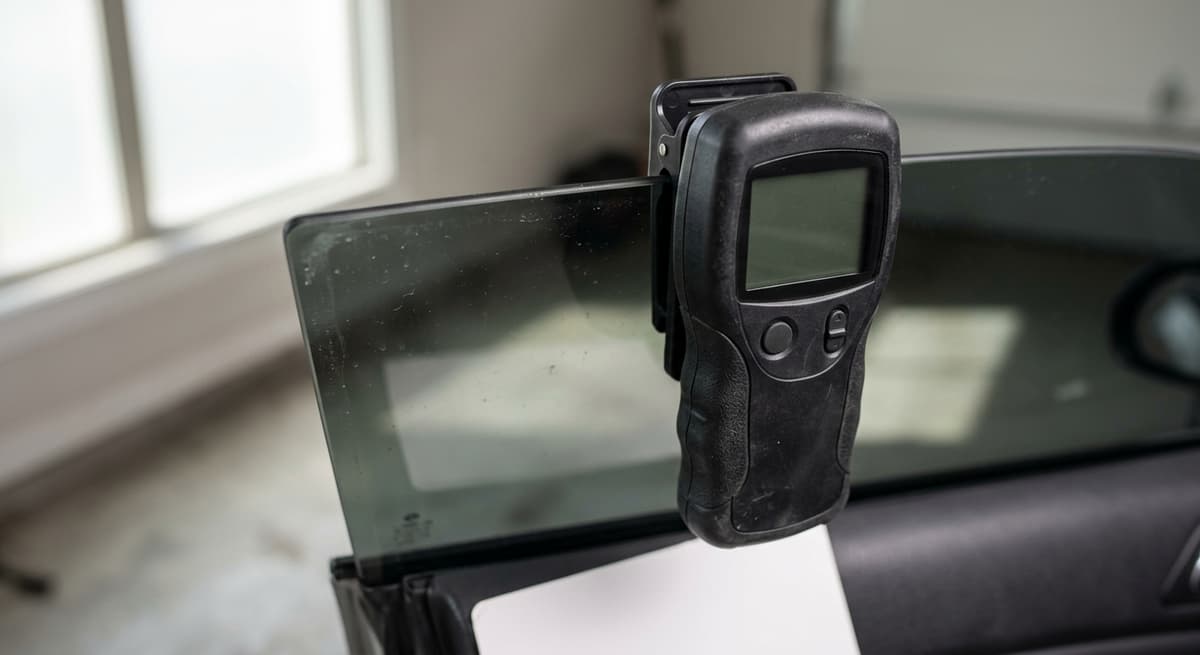
Enforcement: a $533 expiation fee, and the defect notice route
Non-compliant tint is a breach of a light vehicle standards requirement under Division 3A of the Road Traffic Act 1961, sections 117 and 118, which set out driver and operator liability for that kind of breach. Schedule 4 (Expiation of offences) of the Road Traffic (Miscellaneous) Regulations 2014 prices that breach at a fixed $533 expiation fee: item 117(1) for the driver ("light vehicle in breach of light vehicle standards or maintenance requirement driven on road") and item 118(1) for the operator, both at $533. Because rule 44 is part of the light vehicle standards, non-compliant tint is squarely covered by this line.
In practice, SA Police also has the option of the state's general defect notice process under section 145: an authorised officer who forms the opinion a vehicle has a deficiency, including out-of-spec tint, can issue a written defect notice, major if continued use poses an imminent safety risk, otherwise minor. The notice is affixed to the vehicle and a copy goes to the Registrar of Motor Vehicles; the owner must have the tint brought into compliance and the vehicle re-inspected before a clearance certificate is issued.
A South Australian legal adviser at the state's motoring association was quoted in 2016 stating there is no fine for driving with illegal tint and that the vehicle is instead defected. That statement is not a primary government source and is now some years old; it should be read as a description of how SA Police may choose to exercise its enforcement discretion in practice, not as proof that no monetary penalty exists in law. A fixed $533 expiation fee for a light-vehicle-standards breach does exist under Schedule 4 of the Road Traffic (Miscellaneous) Regulations 2014 and legally applies to non-compliant tint. Do not assume window tint carries no monetary penalty in South Australia.
No demerit points are known to attach to a rule 44 breach; it sits with vehicle-standards and equipment offences rather than the driving-offence schedule that carries demerit points in SA, though no source was found affirmatively stating "zero" either.
Medical exemption: none described
SA's own official window tinting guidance makes no mention of a medical or therapeutic exemption process, an application form, or a granting authority anywhere in its description of the VLT rules. This should be read as SA's official guidance describing no medical exemption process, not as a flat legal prohibition stated by any primary source, since no government page was found that affirmatively rules one out either.

SA drivers should also check the SA demerit points system, or return to the Australia driving laws hub.
This article provides general legal information about window tint law in South Australia. It is not legal advice and does not account for an individual vehicle's circumstances. Information was verified against South Australian legislation and government sources on 18 August 2026. For advice on a specific situation, contact the Department for Infrastructure and Transport directly or consult a legal practitioner admitted in South Australia.
Frequently Asked Questions
What is the legal window tint limit in South Australia?
At least 35 percent for front side windows and at least 20 percent for rear-of-driver glazing (rear side windows and rear windscreen), provided the vehicle has a mirror fixed to each side. The windscreen must stay at 75 percent for vehicles built after 1971, or 70 percent for older vehicles. Goods vehicles may go to 0 percent on rear-of-driver glazing. These figures come from rule 44 of the Road Traffic (Light Vehicle Standards) Rules 2018.
Will I get fined for illegal window tint in SA?
Yes. Non-compliant tint carries a fixed $533 expiation fee under Schedule 4 of the Road Traffic (Miscellaneous) Regulations 2014 (item 117(1) for the driver, item 118(1) for the operator). In practice, SA Police also has the option of issuing a defect notice instead, per a 2016 statement from an RAA legal adviser, but a monetary penalty does legally exist.
Is there a medical exemption for window tint in SA?
No medical exemption process is described anywhere in SA's official window tinting guidance. That is the state's own guidance describing no such process, not a primary source that explicitly rules one out.
Does old tint get grandfathered in SA?
No specific grandfathering provision for older tint jobs was found in rule 44 or in SA's consumer guidance.
Can goods vehicles have blacked-out rear windows in SA?
Yes, under rule 44(6B), if the vehicle is designed and primarily used to carry goods, has a mirror fixed to each side, and has at least 4 wheels, or at least 3 wheels with a gross vehicle mass over 1 tonne. Front windows and the windscreen are not relaxed for goods vehicles.
What happens if SA Police find my tint is too dark?
An authorised officer can issue a defect notice under section 145 of the Road Traffic Act 1961. The tint must be brought into compliance and the vehicle re-inspected before a clearance certificate is issued, and continued driving may or may not be restricted depending on whether the notice is major or minor.
Updates
Independently fact-checked against the cited primary sources
The Law Behind This Article
This article rests on the statutory provisions below, held in our own legal record and retrieved from the official source. Tap a section to read the operative text.
Road Traffic Act 1961 (SA)
s 145Defect noticesIn force
(1) In this section— defect notice means a notice issued under subsection (5); repairs means repairs, replacements, reconditioning, additions, adjustments or work of any kind for remedying deficiencies or defects; safety risk means a risk— (a) to public safety; or (b) of harm to the environment; vehicle means a light vehicle; vehicle registration authority means the Registrar of Motor Vehicles or the corresponding authority of another State or a Territory of the Commonwealth. (1aa) For the purposes of this section, a vehicle has deficiencies if the vehicle is in a condition such that there would be a breach of a light vehicle standards or maintenance requirement if the vehicle were driven on a road. (1a) An authorised officer may direct the driver of a vehicle to stop the vehicle and may examine the vehicle if the vehicle has deficiencies or the officer suspects on reasonable grounds that the vehicle has deficiencies.
Official text (excerpt) · last checked 2026-09-28 · Read the full text in our law library · Verify at legislation.sa.gov.au
Search our full record of US law — 2.1 million sections, every state + federal →
Sources and References
- Road Traffic (Light Vehicle Standards) Rules 2018 (SA), rule 44(2)-(4), windscreen luminous transmittance and permitted tinted band(legislation.sa.gov.au).gov
- Road Traffic (Light Vehicle Standards) Rules 2018 (SA), rule 44(6)/(6A)/(6B)/(8), front, rear and goods-vehicle VLT limits and the 10 percent reflectance cap(legislation.sa.gov.au).gov
- SA Government, Window tinting (driving and transport, vehicle standards and modifications), windscreen build-date split, factory privacy glass and reflectance figure(sa.gov.au).gov
- Road Traffic Act 1961 (SA), section 145, defect notice power for a vehicle standards deficiency(legislation.sa.gov.au).gov
- ABC News, 'Five everyday things that can get you fined driving in SA', RAA legal adviser statement that illegal tint is a defect notice matter, not a fine(abc.net.au)
- Road Traffic (Miscellaneous) Regulations 2014 (SA), Schedule 4 (Expiation of offences), items 117(1) and 118(1), $533 expiation fee for a light vehicle standards breach(legislation.sa.gov.au).gov